European Commission Report. How do partners assess Ukraine’s progress in environmental protection on the path toward European integration?

On November 4, the European Commission published its annual report on Ukraine’s progress toward European integration. International partners critically assess the parliament’s attempt to abolish environmental impact assessment, noting that over the past year the situation in Ukraine has not improved – journalists and activists continue to face pressure. In addition, the report criticizes the controversial so-called “Ihor Mazepa law.”
The public initiative Holka examined what risks European partners see in the decisions of the Verkhovna Rada related to environmental protection and corruption in this sector.

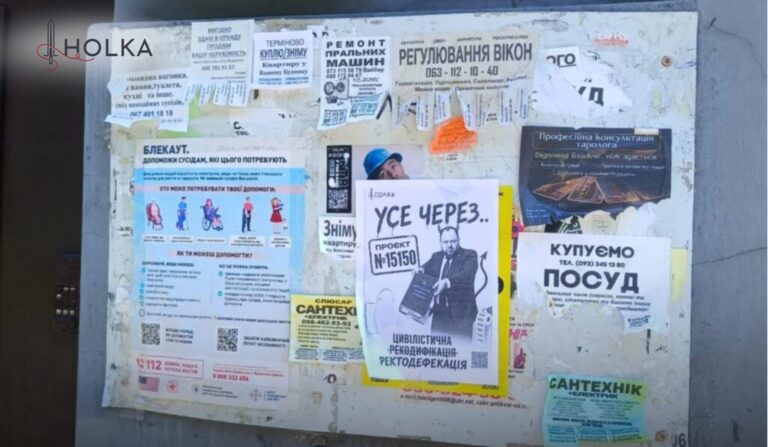
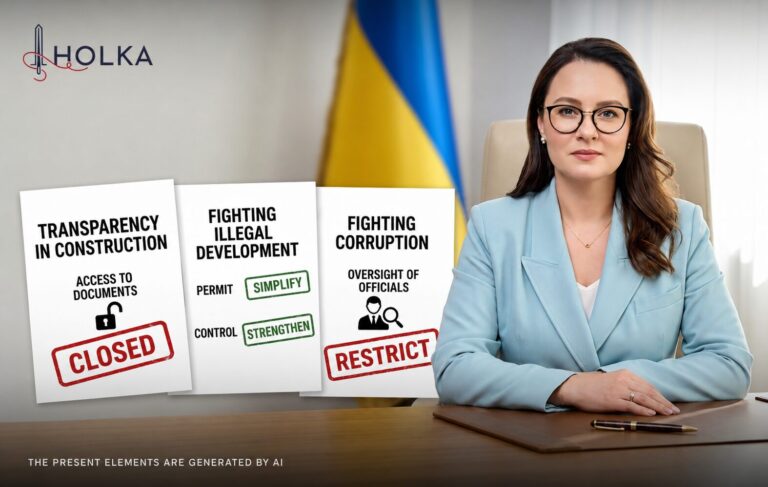
The European Commission, like the European Parliament in one of its resolutions, draws attention to the fact that the Verkhovna Rada adopted the scandalous so-called “Ihor Mazepa law,” which was lobbied in parliament by the “Kolomoisky group” in order to legalize property stolen from the state or local communities. If forests or coastlines were seized during the Yanukovych era or earlier, it is futile to challenge this in court, and if less than 10 years have passed since the illegal appropriation, the state or community must deposit the market (!) value of such property with the court.
In its report, the European Commission therefore expresses “serious concerns.” Moreover, the “Ihor Mazepa law” became a negative marker for Ukraine in two sections of the report at once: environmental governance and the fight against corruption.
 Excerpt from the European Commission’s 2025 report concerning the “Ihor Mazepa law.”
It is worth noting that neither the appeals of Ada Rohovtseva, Taras Topolia, Valerii Pekar, and other well-known Ukrainians, nor a petition to the President calling for a veto – which gathered over 25,000 signatures in the spring – managed to block the signing of this document (bill No. 12089 became a landmark case, and the results of the roll-call vote are reflected in the “REchargeUA is in your power” tool).
The first victim of the so-called “Ihor Mazepa law” was Protasiv Yar in Kyiv: the court refused to consider the prosecutor’s claim on the grounds that the market value of Protasiv Yar had not been deposited with the court from the budget.
At the same time, credit should be given to the government, which acted proactively in this situation and took appropriate measures even before the European Commission’s report was published. In the draft state budget for 2026, the Cabinet of Ministers decided to correct what the parliamentary majority had done: given the lack of funds in the state budget during wartime, the government in effect provided for a postponement of the implementation of this law’s provisions.
However, MPs from the Kolomoisky group submitted three amendments aimed at neutralizing the government’s efforts. One of them was defeated during the first reading, while the other two will still be considered when parliament adopts the budget for the next year as a whole. Civil society will closely monitor the consideration of these amendments.
In a comment to the public initiative Holka, Yaroslav Teleshun, Head of Policy and Advocacy at WWF-Ukraine, notes that any assessments and recommendations contained in the European Commission’s Report are important, as it serves as a roadmap on Ukraine’s path toward EU membership:


For the second year in a row, the EU has urged Ukraine to avoid new exemptions from the environmental impact assessment procedure. However, this has not stopped attempts to abolish the procedure for logging.

Excerpt from the 2025 European Commission report mentioning attempts to exclude the environmental impact assessment.
Last year, a draft law aimed at abolishing the environmental impact assessment did not gain the support of the parliamentary majority, although the results of the roll-call vote were documented by civic initiatives (Bill 9516). Currently, foresters have tried a different approach through the Economic Committee, incorporating ideas to eliminate the environmental impact assessment into the “Wood Market” draft law (No. 13227-d). These actions provoked outrage even within the Ministry of Economy, as reported by the “Ukrainian Environmental Group.” The government emphasized that the proposed provisions contradict Ukraine’s EU integration commitments.
Member of Parliament Yuliia Ovchynnikova (“Servant of the People”), who serves on the Environmental Committee, stresses that it is unacceptable to violate any of Ukraine’s obligations on its path toward European integration.

It is also unfortunate that the EU continues to mention illegal logging year after year. I can see reactions from law enforcement, including to my own reports of detected violations, but systemic changes are needed to truly solve the problem.
That is why, at the end of the summer, we held a broad discussion under the subcommittee I chair, involving law enforcement and civil society. We developed a shared vision. Now I am awaiting its implementation by the Ministry of Economy – so that by next year we can demonstrate significant progress in this area.

In addition to the environmental impact assessment, the European Commission is also concerned about construction on protected natural areas.

Excerpt from the 2025 European Commission report regarding the impact on protected natural areas.
Specific projects are not mentioned in the report, but currently there are ongoing attempts to develop Protasiv Yar and Chernechyi Lis, whose defenders are part of the Active Citizens Network. Additionally, in the Carpathians, there are attempts to build a massive resort on the Svidovets ridge, which is also linked to the “Kolomoisky group.”
However, the European Commission’s concerns are not limited to the “Ihor Mazepa Law” or the attempts to remove environmental impact assessment as a safeguard. The report also notes that the moratorium on environmental inspections prevents proper ecological control. While the EU recognizes some existing effective anti-corruption mechanisms, such as the work of the specialized environmental prosecutor’s office and the ProZorro auction system, the risks of illegal logging, as well as illegal mining and land use, remain high according to the European Commission.

Excerpt from the 2025 European Commission report regarding corruption risks
Analyst Petro Testov from the “Ukrainian Environmental Protection Group” emphasizes:


It is important to note that international partners have identified pressure on journalists and activists as a challenge that has remained unchanged over the past year.


Excerpts from the European Commission’s 2025 report regarding pressure on journalists and human rights defenders:
Recently, a publication on Detector.Media demonstrated that these warnings from Ukraine’s international partners are well-founded. The article reported that a deputy elected from OPZZh and a representative of the ruling party called environmental defenders “enemies,” while the Deputy Head of the President’s Office, Oleg Tatarov, stated before the adoption of the so-called “Ihor Mazepa Law” that the law would make life more difficult for activists who “earn big money.”
Journalist Olena Mudra noted that she and other environmental defenders, who are protecting the Carpathians from the construction of wind farms on mountain ridges, were subjected to disinformation campaigns and intimidation:

In addition to the texts, a number of videos targeting the women were published using artificial intelligence and deepfakes. These videos distorted their professional work and personal lives. The content was promoted through social media ads and on YouTube.
However, the pressure did not stop at disinformation. Eco-activist Natalia Vyshnevska experienced an attack on her home by unknown individuals, who, according to her, poured animal blood on the floor and walls around her apartment during the summer, and wrote on the doors, among other things, “Vyshnevska – Kremlin agent” – a narrative that mirrors what was spread in the fake content. Journalist Olena Mudra faced two SLAPP lawsuits from businesses totaling 100,000 UAH.
Aside from the negative warnings, the European Commission report also contains positive feedback regarding parliamentary lawmaking. For example, international partners highlighted the “climate” law on industrial pollution control (Bill 11310, roll-call results are reflected in the “REchargeUA” tool). It was adopted in summer 2024, with only the “Batkivshchyna” faction abstaining from the vote. The bill was submitted by the Cabinet of Ministers.
The European Commission’s report clearly states that Ukraine’s path to the EU is impossible without genuine anti-corruption efforts, the preservation of natural resources, and respect for the rights of citizens and journalists. These criteria will determine whether Ukraine becomes part of Europe not only geographically but also in terms of shared values.
Specially for Zaxid.NET