
Whose rules is the government playing by, and why has an analogue of the “Ihor Mazepa law” emerged within the Cabinet of Ministers?

The authorities are preparing an analogue of the “Mazepa law” to limit the timeframes for challenging illegal decisions in the construction sector. In April, First Deputy Prime Minister Yulia Svyrydenko announced the preparation of a draft bill aimed at establishing deadlines for appealing construction-related decisions. A report from a May meeting between developers and the leadership of the Ministry for Development and the State Inspectorate for Architecture and Urban Planning (DIAM) sheds light on how its authors envision this mechanism.
DIAM Head Oleksandr Novytskyi presented the developed framework for a mechanism that introduces a strictly defined timeframe for appealing permit documents after construction begins. It is proposed that this period will be calculated from the moment the data is published in the Unified State Electronic System in the Construction Sector (EDESSB).
According to Novytskyi, the mechanism will not limit the powers of the State Architectural and Construction Control bodies, and in the event of inspections and documented violations, the appeal period will be suspended. It is also planned to record the actual start of construction work through a declarative notification in the system.
However, the “Holka” civic initiative looked into whether this is actually the case.
Why is this a problem, and what will the consequences be?
Construction that violates the requirements of urban planning documentation, heritage protection, environmental regulations, other land-use restrictions, and building codes is an ongoing violation. However, as a result of 15 years of deregulation reforms, the procedure for stopping such a violation is far from simple.
There are two documents that grant the right to carry out construction work. A notification on the commencement of construction work is required for objects with minor consequences (CC1), which account for approximately 90% of all construction projects. The remaining 10% of objects fall under medium (CC2) and significant (CC3) consequences and require a construction permit.
The existence of a permit or notification obtained through corruption or fraud that exploits deregulation does not make construction involving violations lawful. However, as long as these documents remain valid, the developer retains the right to carry out construction work in accordance with the Law “On Regulation of Urban Planning Activity.” Therefore, the only way to halt illegal construction in such a scenario is to cancel the validity of the notification or permit.
The Government’s intention to strictly limit the timeframe for challenging unlawfully obtained permit documents is not merely an amnesty for past violations; it transforms notifications and permits into an indulgence for further breaches of legislation. Developers will continue to carry out illegal construction using these documents, while both local communities as a whole and individual citizens will be stripped of the opportunity to defend their rights through peaceful means.
In other words, we are being offered a forceful confrontation with illegal construction. Following four years of full-scale war, many citizens will be prepared to defend their rights by force. It is worth remembering here: should the Cabinet of Ministers’ intentions be realized, the state authorities will be deprived of the ability to stop illegal construction and resolve the conflict.
The second consequence will be a significant increase in corruption risks and fraud on the part of developers when obtaining permits and submitting notifications. As previously noted, the presence of these documents currently does not legalize violations within a construction project. To prevent documents from being canceled and construction with violations from being halted, developers must utilize corrupt schemes to secure protection from state architectural and construction control bodies and the courts until the project is commissioned. Given the long-term risks, some developers hesitate to commit violations.
The limitation on the timeframe for appealing construction documents planned by the Cabinet of Ministers makes obtaining them through illegal schemes highly attractive. After all, it will be enough to hold out for a certain period, after which the notification or permit becomes that very indulgence for breaking the law.
Legislation in construction is not violated out of sporting interest, but to reduce prime costs or create an exclusive offer—in other words, for a competitive advantage.
Therefore, the third consequence will be a deterioration of competitive conditions: developers with corrupt connections will gain an even greater advantage over compliant ones thanks to “immortal,” unlawfully granted permits. Honest construction businesses will either go bankrupt or be forced to resort to corrupt schemes themselves. Consequently, Ukraine will become even less attractive to foreign investors.
When would the implementation of the government’s intentions not carry negative consequences?
Limiting appeal timeframes can only work under one condition: if the state reliably detects violations prior to commencement or at the early stages of construction. This is precisely why the key issue becomes the effectiveness of the control system, rather than the speed of issuing documents.
The only way to strictly limit the timeframes for appealing construction decisions without causing a catastrophic increase in the share of illegal construction is to provide a 100% guarantee either that the right to build can be obtained exclusively in the absence of violations, or that existing control systems will ensure the detection and elimination of violations within the specified timeframe.
In civilized Europe, they follow the first path—errors and violations are detected at the earliest possible stage to avoid major losses. However, Yulia Svyrydenko explicitly states that the goal of the reforms is “simplifying construction regulation and accelerating reconstruction.”
As a result of complete deregulation, a notification is not even a document of a permissive nature—the developer simply submits it, and the state architectural and construction control body is obliged to register it in the EDESSB without any verifications. In practice, the unlawful return of notifications for revision is quite widespread, yet officials of state architectural and construction control bodies bear no responsibility for registering a notification for construction that involves violations.
The procedure for obtaining a permit has also fallen victim to deregulation. When granting it, officials from state architectural and construction control bodies verify only isolated requirements specified in the urban planning conditions and restrictions (MUBs). Meanwhile, almost all key issues must be verified by an expert organization chosen by the developer themselves. Furthermore, neither compliance with legislation when granting MUBs nor compliance during the expert assessment is verified when the permit is issued.
A separate case involves the adjustment of project documentation and the introduction of changes to a previously obtained permit. This procedure entails complete deregulation—the developer simply has to notify of the changes, and officials from state architectural and construction control bodies are not required to verify anything. As a consequence, a fraudulent scheme has emerged: a lawful permit is obtained initially, and then, through a project adjustment notification, it is transformed into a permit for construction with violations.
The regulation is structured around the principle that documents granting the right to build are issued virtually without verifications, and violations are supposed to be detected and eliminated during construction. Even if the authorities decide to reverse this approach entirely, the problem of tens of thousands of still-valid notifications and permits will remain, during the issuance of which compliance with all legal requirements was never verified.
Thus, only the second option remains—to promptly detect and eliminate violations, it is necessary to create a perfectly functioning control system during construction. Under conditions of deregulation, the main role in control always belongs to the public. In addition, legislation currently provides for two special control mechanisms—state architectural and construction control, and state architectural and construction oversight. But are these mechanisms capable of fulfilling their task?
Instead of the promised openness—closure of access to information
The primary condition for the effective exercise of public control is access to information. Since 2020, a true revolution in ensuring construction transparency was supposed to take place—the Unified State Electronic System in the Construction Sector (EDESSB) began operating. All documents were to become public and universally accessible online via the system’s public portal. But is everything truly as top officials describe regarding the success of the digitalization reform?
As noted in the report by the Head of DIAM, the Inspectorate reviewed nearly 123,000 documents in 2025. However, the public portal of the EDESSB finds information on only 116,000—7,000 documents (about 5.6%) are hidden. It is even worse with permits: the portal finds only 1,114 active and canceled permits, although according to the DIAM report, there should have been over 1,700. In other words, about 35% of issued permits and approximately 3.5,000 registered notifications are concealed from the public.
At the same time, the absence of a permit in a search does not mean it does not exist—only the content is hidden, not the record itself. It can only be found if you know the document number, the cadastral number of the land plot, or the USREOU (ЄДРПОУ) code of the developer. Below is a screenshot of what “public and universally accessible” information looks like in such documents: even the name of the asset is missing.
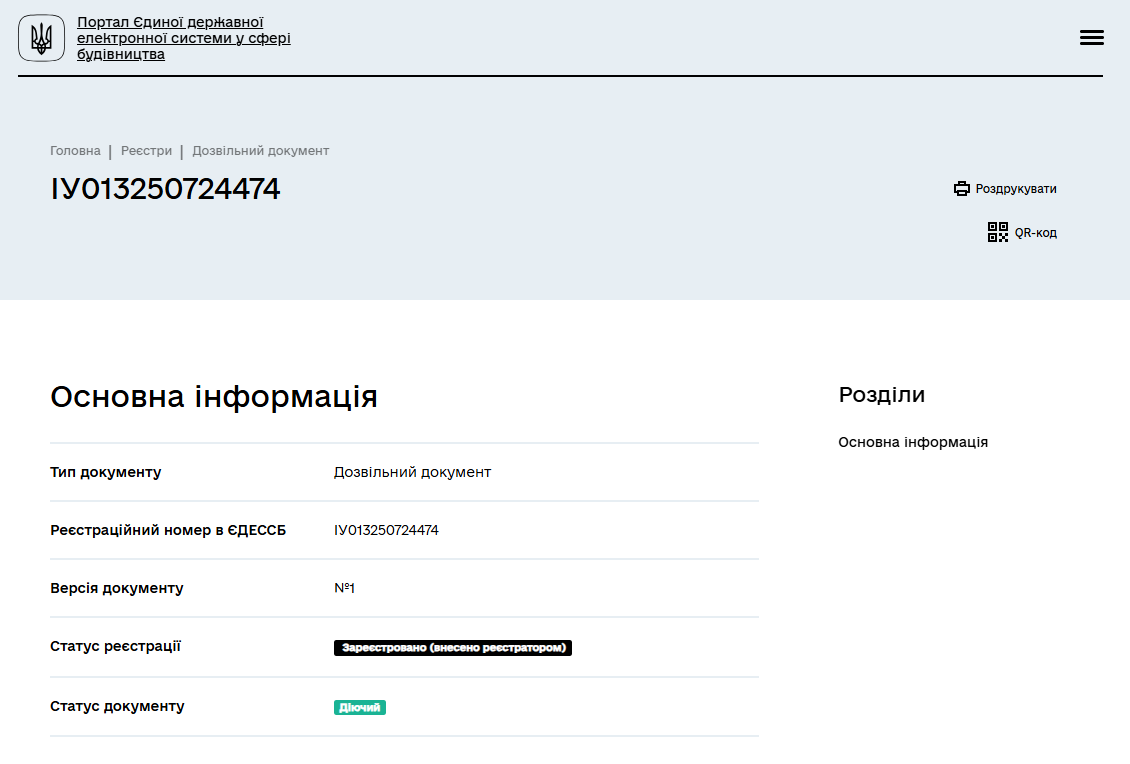 Example of a permit with content hidden from the public on the EDESSB public portal
The functionality of the EDESSB allows officials to hide the content of any issued document—and this capability is being used very actively. Concealment is practiced not only by DIAM but also by local government architectural and construction control bodies, involving building certificates, urban planning conditions and restrictions, expert assessments, and more.
You may regularly and meticulously review all issued notifications and permits to try to notice and stop illegal construction in time, but at the request of the developer, the documents can be hidden, and you will only learn of their existence after the appeal period has expired.
If you are fortunate enough to find a permit for a dubious construction project in the EDESSB in time, you still need to be able to detect the violations. There are specific, flagrant violations that can be spotted even by the name of the asset or the very fact of construction on certain territories. However, the majority of violations cannot be detected at the initial stage of construction without having access to the project documentation.
Part ten of Article 22-1 of the Law “On Regulation of Urban Planning Activity” defines that access to project documentation is provided in read-only mode without the possibility of copying, with a caveat that such project documentation is a subject of copyright. Yet, the public has no access to a single project within the EDESSB.
This is all because the Cabinet of Ministers established in paragraph 182 of the Procedure for Maintaining the EDESSB (Resolution No. 681 of June 23, 2021) that access to a project is granted exclusively when the copyright holder has given permission for the public use of their work. And who is going to allow people to look for violations in their project if there is an option simply not to permit its publication?
Prior to the creation of the EDESSB, access to CC2 and CC3 projects did exist—albeit limited: one had to arrive in person, as the GABI (ДАБІ) lacked the equipment to scan large blueprints. Now, there is no access at all—not even upon request.
The situation with the expert assessment of the project is no less revealing. According to paragraph 15 of CMU Resolution No. 560, the report on the results of the expert assessment and the automated verification logs are public and must be published in the system. In the best-case scenario, however, only general information and a free-form annex are available—the expert assessment itself and the log are absent from the public domain. The Ministry for Development, as the holder of the EDESSB, has failed to ensure the system’s compliance with legislative requirements.
Even obtaining an excerpt of an expert assessment upon request is a problem: DIAM refuses, claiming it is not the administrator of this information—even though it grants permits and registers modifications to them based on these very expert assessments.
State architectural and construction control—more dead than alive
Full-scale verifications of compliance with legislative requirements are currently supposed to be carried out not when construction documents are granted, but rather through state architectural and construction control (hereinafter simply referred to as control) during the construction process.
There is an obvious way to simultaneously ensure both the rapid issuance of construction documents to accelerate reconstruction and the effective detection of potential abuses of simplified permit procedures—it would suffice to introduce a mandatory desk review of the legality of the planned construction within a month or two following the registration of a notification or the issuance of a permit. (A desk review is a verification of documents without an on-site visit, based exclusively on the data within the system). For architectural and construction control bodies, this poses no problem at all—all necessary documents in the EDESSB are fully open and accessible to them.
However, the legislation provides exclusively for on-site scheduled and unscheduled inspections, and neither the Cabinet of Ministers nor the Ministry for Development is proposing the introduction of mandatory desk reviews.
Statistics on the activities of local government architectural and construction control bodies are non-existent, so let us analyze and compare the activities of the old GABI and DIAM, which was launched on September 15, 2021, to replace it, and which account for the issuance of documents for approximately 60% of all construction objects.
The Cabinet of Ministers began reforming the state architectural and construction control system in March 2020. In the more than 6 years that have passed since then, fewer than 350 inspections have been carried out, while approximately 250,000 notifications and permits were granted during the same period.
Initially, the Cabinet of Ministers banned GABI from conducting inspections, meaning that from March 2020 to September 2021, no inspections were carried out at all. The newly created DIAM conducted only 49 scheduled and 63 unscheduled inspections prior to the start of the full-scale invasion, after which the Cabinet of Ministers, by Resolution No. 303 of March 13, 2022, banned scheduled inspections and significantly restricted unscheduled ones. The conduct of unscheduled inspections resumed to a certain extent from mid-2023.
The report of the Head of DIAM notes that 106 inspections were carried out in 2025. For comparison, in 2019, prior to the start of the government reforms, GABI conducted 9,970 inspections, of which 9,105 were unscheduled. These figures speak for themselves—in recent years, the Cabinet of Ministers has decimated state architectural and construction control.
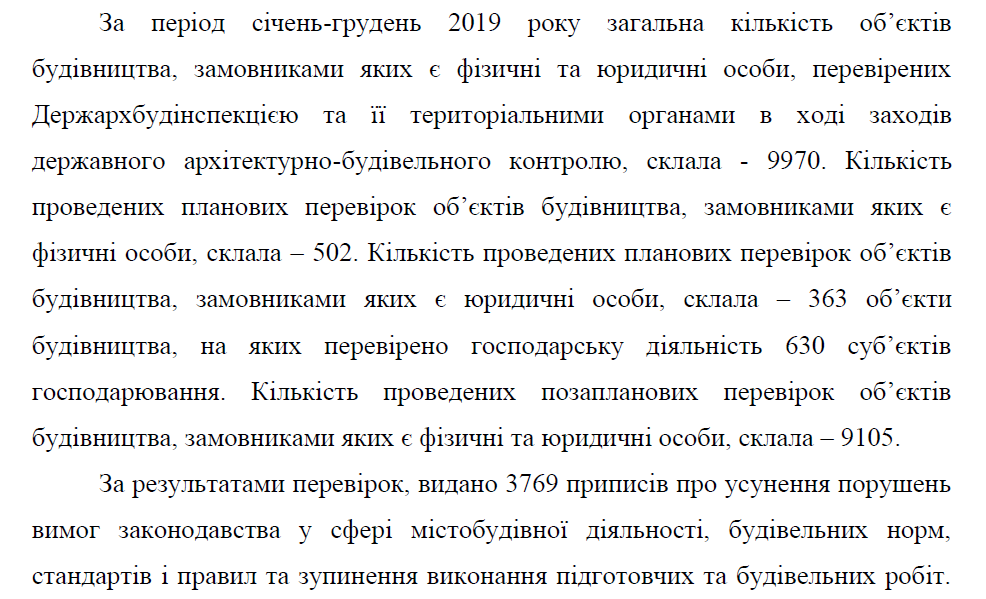 Fragment of the GABI (ДАБІ) report on performance results in 2019
The procedures established by the government for ordering unscheduled inspections have many flaws, but let us focus on only the two most critical ones.
Since 2021, the Procedure for Exercising State Architectural and Construction Control (CMU Resolution No. 553 of May 23, 2011) has dictated that a specially created commission must preliminary review and determine the validity of requests from individuals or legal entities regarding violations of urban planning legislation. However, no criteria for the validity or invalidity of a request have been established.
In other words, discretionary powers are created—a direct corruption-prone factor. Predictably, the commission under DIAM deems almost all requests invalid, claiming that applicants have failed to prove the fact of a legislative violation. Effectively, a scheme with signs of corruption has been built, whereby DIAM refuses to order inspections even upon receiving well-substantiated requests.
It is important to emphasize that it was the Cabinet of Ministers, as demonstrated above, that cut off public access to the information needed to detect violations. And it was the Cabinet of Ministers that established an inspection procedure which obliges the public, in the absence of access to the required information, to independently detect violations and prove their existence.
The second problem is the restriction on conducting unscheduled inspections during martial law. The Cabinet of Ministers permitted them exclusively “in the presence of a threat that has a negative impact on human life and health, the environment, state security, or for the fulfillment of Ukraine’s international obligations.” For instance, a violation of urban planning documentation requirements is the gravest possible breach of urban planning legislation. Yet, in most cases, it does not fall under the Cabinet of Ministers’ criteria, much like nearly all other potential violations.
Consequently, architectural and construction control bodies are stripped of the right to inspect the vast majority of violations—and therefore, the right to initiate the cancellation of unlawfully issued documents.
State architectural and construction oversight on indefinite leave
State architectural and construction oversight is a mechanism for monitoring the legality of officials’ actions when granting construction documents. In essence, it is a form of anti-corruption activity. It is supposed to be carried out by DIAM.
As a result of the deregulation of permit procedures, oversight over the legality of registering notifications or changes to permits in the event of project documentation adjustments has been rendered meaningless. And even oversight over the issuance of permits faces significant problems. For example, the vast number of permits unlawfully granted by GABI is widely known. However, GABI was liquidated by the Cabinet of Ministers, making it theoretically impossible to conduct an oversight inspection of an already non-existent government body and cancel the documents unlawfully issued by the old Inspectorate. The second problem is that over 70% of all permits are currently issued by DIAM itself. Yet, as Oleksandr Novytskyi stated in an interview with Ukrinform, DIAM refuses to inspect itself, citing a conflict of interest.
Nevertheless, oversight is the most effective mechanism for halting illegal construction where permits were obtained through corruption during the issuance of MUBs. If DIAM detects violations in the issuance of MUBs during an inspection, the validity of the construction permit is also suspended. The subsequent cancellation of the MUBs serves as grounds for canceling the permit.
The situation with oversight is almost identical to that of control. Since March 2020, the Cabinet of Ministers stripped GABI of its oversight powers, and DIAM has never fully commenced inspections due to prohibitions and restrictions during martial law.
Over the past six years, only about 50 inspections have been conducted. The record holder was last year—with 29 inspections. For comparison, in 2019, GABI conducted 1,224 inspections, 881 of which were unscheduled.
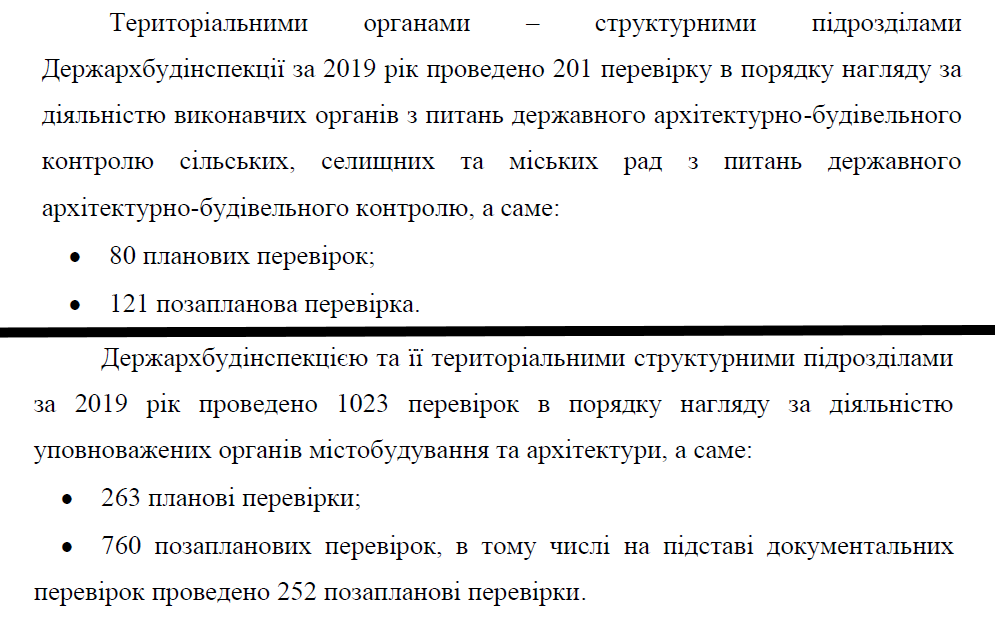 Fragment of the GABI report on performance results in 2019
DIAM constantly receives requests from citizens—yet inspections are refused, with authorities citing a lack of grounds or prohibitions from the Cabinet of Ministers. Isolated inspections are ordered primarily at the request of law enforcement agencies. The government has destroyed the oversight system just as it did the control system.
What does this imply?
The actions of the Cabinet of Ministers over the past 6 years can be described by a quote from George Orwell’s novel 1984: “War is peace, freedom is slavery, ignorance is strength.” Construction transparency means closing access to documents. The fight against illegal construction means simplifying permit procedures and banning control. The fight against corruption means banning oversight of the legality of officials’ actions.
Over the past six years, due to deregulation and corruption, permit documents for construction involving violations continued to be issued just as before. However, the Cabinet of Ministers has effectively decimated the entire control and oversight system, causing the volume of construction under such unlawfully obtained permits to grow continuously.
Strictly limiting the timeframe for appeals is a completely logical next stage of this anti-reform. The government is not interested in the consequences—it is interested in ensuring that the construction lobby can continue to profit from violations.
Specially for “Zaxid.NET“.