The “Fish Law” threatens drinking water safety and opens the door to shoreline overdevelopment

A reservoir from which a city gets its drinking water could be handed over for fish farming—and its shore could be enclosed by a fence. This is exactly what draft bill No. 12384, which the “Servant of the People” faction is bringing to a vote this week, provides for. Lawyers, environmentalists, and even a Member of Parliament from the relevant committee state that the document is dangerous. The Chief Legal Department of the Verkhovna Rada notes that it duplicates a law the President has already rejected as unconstitutional.
While the draft bill is labeled as investment-oriented, it will in reality impact who has access to Ukrainian water bodies and how this will affect the quality of drinking water.
If passed, draft bill No. 12384 will allow restrictions on access to coastal zones and permit reservoirs currently used for water supply and recreation to be handed over for fish farming.
The authors of the project, including the head of the “Servant of the People” faction, Davyd Arakhamia, and his deputy, Andrii Motovylovets, propose a new mechanism for attracting investments into the fisheries industry through special investment agreements and auctions. The explanatory note to the document states that this is intended to help reduce Ukraine’s dependence on fish imports, attract investors, and create new jobs.
To achieve this, the People’s Deputies propose transferring designated offshore areas of water bodies to investors for use, as well as providing access, in certain cases, to small plots of coastal protective zones to set up the necessary infrastructure.
The coastline will be allowed to be enclosed by a fence. This is pointed out by Svitlana Tabolina from the non-governmental organization “Teren”. Although the plots mentioned are small—0.1 hectares—several investors side by side could fence off an unlimited number of sections. The President vetoed a similar initiative two years ago, in part because it violated the Constitution. Therefore, this is already the second attempt by lobbyists to push the required changes through the session hall of the Verkhovna Rada.
This is not only about blocking access to the water with a fence. When fish are farmed in a water body, the amount of organic matter (feed and feces) increases, which can lead to a severe decline in water quality.

Filiuta emphasizes that aquatic plants die, creating zones with low oxygen levels in the water.
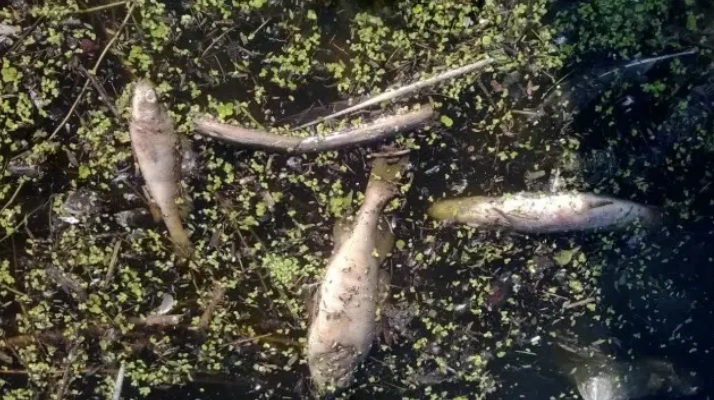
Dead fish on the shore of the Sula River near the village of Matskivtsi, Poltava Oblast. Photo source: BBC

Tabolina emphasizes that the draft bill to be considered by the Verkhovna Rada duplicates a number of provisions, in particular “the exclusion from investment activities of only water bodies within the first sanitary protection zone, rather than all water bodies used for drinking purposes, and non-compliance with the Aarhus Convention (on public participation in decision-making, — Ed.)”:
Warnings regarding this draft bill are also present in the conclusion of the Chief Legal Department of the Verkhovna Rada Secretariat: “…we repeatedly note that the draft bill, in terms of its legal scope and content, duplicates most provisions of the Law of Ukraine “On Attracting Investment in the Development of the Fisheries Industry” (draft bill registration No. 8119) passed by the Verkhovna Rada of Ukraine on November 20, 2024. According to the President of Ukraine’s Proposals to this Law dated December 18, 2024, it is proposed to be rejected because the passed Law “introduces specific legal regulations for investment activities in the fisheries sector that do not comply with the Constitution and laws of Ukraine, disrupt the consistency of legislation in the relevant field, and create corruption risks as well as risks of violating the rights and legitimate interests of individuals, legal entities, and the state,” etc.”. The vetoed draft bill No. 8119 was submitted in 2022 by the head of the agrarian committee, Oleksandr Haidu from the Servant of the People faction, and his colleagues.
Due to a moratorium on inspections, environmental inspectors will not be able to check entrepreneurs who farm fish. If access to a water body is cut off, citizens will also be unable to monitor its condition.
Environmentalist Petro Tiestov, who also works at the organization “Teren”, explains that the Water Code prohibits leasing certain reservoirs for commercial fish farming, but there are cases where this ban is bypassed.

According to Petro Tiestov, if the law is passed, such treatment of water resources will become the norm, and the justice system will not help communities defend their rights.
This initiative by the “Servant of the People” is allegedly aimed at improving the investment climate, but it fails to consider a number of factors important for European integration and violates citizens’ rights. The authors of the draft bill propose the following algorithm: an investor selects a water body and, if it meets the requirements, submits a proposal. Then, the State Fisheries Agency must make a decision and publish a list of water objects for investment attraction. Extremely little time is allocated for this procedure. Moreover, the authors of the project forgot to mention… public consultations. Similarly, there is not a single word about the procedure for appealing decisions. This already violates the requirements of the law “On Environmental Protection” and the Aarhus Convention.
The law will allow investors to obtain not only 14% of a water body for fish farming, but also 0.1 hectares of land near the water. There are no restrictions on the configuration of the plot: it could be 10 by 10 meters or 1 meter by 100 meters. This means that five investors could set up a fence along 500 meters of the coastline.
In addition, as was the case with the Klekotyna reservoir, temporary structures will emerge near the water bodies where fish are farmed. The documents will describe them as feed warehouses or utility rooms, but over time, they may turn into someone’s housing.
In the explanatory note, the authors of the draft bill do not see a problem with this, emphasizing instead the advantages for investors, the fact that the structures on the coastlines will be temporary, and that the lease will bring money into the budget.
People’s Deputy Yuliia Ovchynnykova from the “Servant of the People”, who is a member of the environmental committee, submitted amendments to the legislative initiative to minimize the risks.

According to the People’s Deputy, the project “does not ensure a proper balance between economic goals and environmental protection requirements, which is one of Ukraine’s key obligations on its path to European Union membership”.
In its current form, the draft bill cannot be passed: it requires substantial amendments and the inclusion of environmental safeguards.
Specially for “Livyi Bereh”