Environmental Experts and MPs Say Weakening Environmental Impact Assessment Threatens Ukraine’s EU Accession


Ukraine’s reconstruction cannot come at the cost of restricting citizens’ constitutional right to a safe and healthy environment. This was the key conclusion voiced by policymakers and experts following the Ukraine Recovery Conference during the presentation of a White Paper on improving Environmental Impact Assessment (EIA) and Strategic Environmental Assessment (SEA) procedures, prepared by Ukrainian civil society organizations.
Member of Parliament Yuliia Ovchynnikova (Servant of the People), who serves on the Verkhovna Rada Committee on Environmental Policy and Nature Management and leads the European integration agenda within the committee, emphasized that Ukraine opened the first cluster of EU accession negotiations – “Fundamentals” – at the beginning of the summer. The next stages, she noted, will also include the EU’s Green Agenda, which focuses on environmental protection.
“When we speak about the ‘Fundamentals’ cluster, we are also talking about the effective implementation of Environmental Impact Assessment and Strategic Environmental Assessment in practice. However, there are vested interests pushing to weaken or abolish EIA and SEA requirements. They seek this in order to facilitate activities such as logging or constructing wind farms in the Carpathians without proper environmental scrutiny. Ukraine must take a clear state-oriented position: there can be no weakening or undermining of Environmental Impact Assessment or Strategic Environmental Assessment. Otherwise, the doors to the European Union will remain closed.”
Environmental Impact Assessment procedures can indeed be manipulated, particularly in the context of construction projects. Petro Tiestov, representative of the NGO Teren, noted that both local communities and central government authorities often treat these procedures as a mere formality, and that this approach must change.
“The problem is that Environmental Impact Assessments are often conducted far too late – after the project parameters have already been determined, and in some cases even after financial decisions have been made. They need to take place much earlier. This concerns not only forests or coastal areas, but also mineral resources. For example, the State Service of Geology and Subsoil recently auctioned off the riverbed of the Cheremosh River for gravel extraction, despite this being explicitly prohibited by law. The Supreme Court essentially responded by saying: ‘It’s fine, the Environmental Impact Assessment will reveal any issues.’ But that is absurd – assessing environmental damage only after the decision has already been made.”
Yaroslav Teleshun, Head of Policy and Advocacy at WWF-Ukraine, stressed that Strategic Environmental Assessment and Environmental Impact Assessment not only help protect public health but also reduce risks for businesses.
“Reconstruction should not be measured solely by the billions of euros invested, but also by the quality of the rules governing investment. No investor wants to finance a project that could become entangled in years of litigation due to violations of environmental procedures. That is why Environmental Impact Assessment and Strategic Environmental Assessment are not merely bureaucratic requirements imposed by Brussels, as some businesses and politicians claim. They are an essential component of a predictable investment environment expected by international partners and financial institutions. If construction projects encounter problems, the environmental assessment is not to blame.”
He added that the White Paper prepared by the expert community should serve as the starting point for a broader policy discussion, a direction that is also supported by European partners.
Marcella McAndrew, representative of the European Commission’s Directorate-General for Environment, underlined that robust Environmental Impact Assessment and Strategic Environmental Assessment are essential prerequisites for rebuilding Ukraine in line with EU standards. According to her, this requires effective institutions, clear procedures, and sufficient administrative capacity.
During the Ukraine Recovery Conference, Deputy Minister Oleksandr Krasnolutskyi acknowledged that the ministry currently lacks sufficient specialists to effectively implement Ukraine’s state environmental policy.
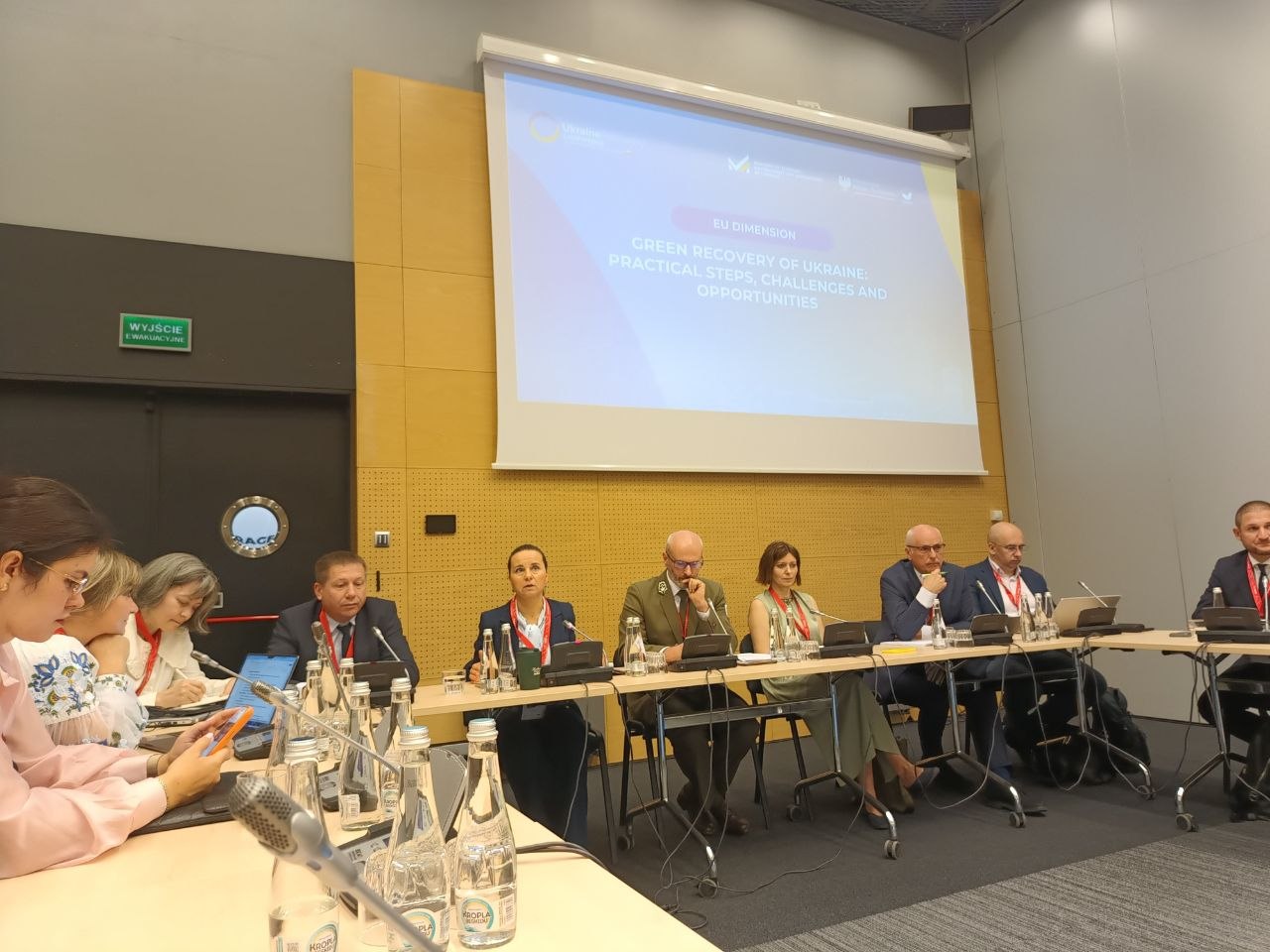
Ukraine Recovery Conference 2025 – discussion on green reconstruction with the participation of Deputy Minister of Economy and Environment Oleksandr Krasnolutskyi.
Olha Melen-Zabramna, Head of the Legal Department at Environment–People–Law (EPL), who also attended the conference in Gdańsk, noted that more than 130 organizations had appealed to Parliament to restore the full functioning of the Ministry of Environmental Protection and Natural Resources.
“We are also witnessing attempts to weaken Environmental Impact Assessment and Strategic Environmental Assessment instruments, which directly contradict Ukraine’s European integration path. This is precisely why the White Paper should become the starting point for a discussion on strengthening – rather than weakening – these crucial environmental procedures.”