Eka Tkeshelashvili: “Political Will Does Not Arise on Its Own — It Is Shaped”

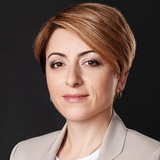
Eka Tkeshelashvili was one of the key figures behind Georgia’s post-Rose Revolution reforms. Over the years, she served as Minister of Justice, Minister of Foreign Affairs, Secretary of the National Security Council, and Deputy Prime Minister during a period when Georgia pursued radical transformation of its state institutions, law enforcement system, and judiciary.
After 2014, Tkeshelashvili moved to Ukraine and led the EU Anti-Corruption Initiative (EUACI), one of the country’s key international anti-corruption programmes supporting the development of Ukraine’s anti-corruption infrastructure, including the High Anti-Corruption Court.
Following Russia’s full-scale invasion, she became involved in international efforts to advance the creation of a Special Tribunal for the crime of aggression against Ukraine, working together with foreign politicians, diplomats, and experts to push the initiative forward internationally.
We spoke with Eka Tkeshelashvili about how political will is actually shaped, why international experts still matter for Ukraine, what went wrong with Georgia’s reforms, whether universal models of judicial reform can work in transitional democracies, and why accountability for Russia’s aggression matters far beyond Ukraine itself.
This interview is published as part of the “Reasonable Doubt” project in collaboration with Holka NGO.

What pulled me toward Ukraine was what happened after 2014. Crimea, and then everything that followed, felt like a very bad déjà vu – but magnified. Our war in 2008, replayed at a completely different scale. Ukraine, which was always close to us Georgians and to me personally, had become a new frontier.
Maintaining Ukraine’s independence and its claim to being a successful European country became the fight we could actually contribute to. And by helping Ukraine, we were also helping Georgia – because Ukraine’s success is what keeps hope for Georgia’s success alive. If Ukraine fails, it’s our failure too.
And I never questioned why anti-corruption specifically – I knew from Georgia how much that transformation meant for economic development, for resilience when facing external threats.
Even in anti-corruption – a difficult field for those in the power centers – you always find actors who want change and can be champions of it. The mindset was to understand what was needed at that particular moment, in a prioritized way, and what would deliver in the short term combined with the long term. If you don't deliver something tangible in the short term, you lose momentum – and with it, the window to do something bigger and more complicated.
There were always actors who sincerely wanted change. Others were not ideologically committed but understood that supporting reform was pragmatically a win for them – it kept them relevant, gave them political capital. And yes, there were retrograde forces too, working against. The task is to understand the whole spectrum: identify the champions, understand how they can be part of a collaborative effort where good results are a win-win for everyone, and then build a coalition broad enough to push through what no single actor could do alone.
That’s exactly what happened with the High Anti-Corruption Court – back and forth, back and forth, but ultimately it came through.
Ukraine has never been, and will never be, a country where you cannot find actors willing to fight for the right cause.
What I don’t like is when people use political will as a mythical category – either to justify all failures (“there was no political will”) or to explain all success (“there was political will”). The right question is always: why did this will emerge, or fail to emerge? What shaped it? If you reflect on that, you understand better how to shape it in the future.
Civil society and media are important tools for shaping political will, but not the only ones. If you only push from outside, you can create a defensive posture in the political class. You need to work on both sides simultaneously – showing those inside government what they gain, not just what they lose.
The High Anti-Corruption Court is the clearest example. When the process kept stalling – back and forth on how judges would be selected, whether the court would be genuinely independent – it was a web of pressure points at that critical moment, including making the court's creation a conditionality of the IMF, that proved decisive. Without that pressure at that particular moment, I don’t believe the court would have been established as it was.
But the court was not created because of that pressure alone. A lot had been done before – raising awareness, civil society engagement, actors from parliament and different ministries being part of the process, NABU and SAPO already having credibility. If there had been no credible investigations and prosecutions, nobody would have fought as hard for the court.
And there’s also the other side of this. It's wrong to assume that something can only be achieved through international pressure – because that gives local actors an excuse: you only need to lobby international organizations to pressure your own government. That's a very partial role for civil society. The biggest value any civil society has is its connection to actual voters – the communities that ultimately make political decisions. Without that link, you become a loud actor whose existence depends entirely on external funding.
When the country goes through a war of this magnitude and then, hopefully soon, returns to a peaceful situation with elections and reconstruction, there will be enormous political activity. Maintaining 100% independence of anti-corruption bodies – NABU, SAPO, HACC – so that none of them becomes a tool for selective justice or political cases, will be extremely important. Having international experts as part of the upcoming selections diffuses tension and opens space for constructive and independent process,
Even if Ukrainian commission members act independently, disappointed actors can always claim bias or political connections. International experts reduce that risk because they stand outside the Ukrainian political context – and at moments of high political tension, that matters.
What also made the HACC work was what happened after the selection. From day one, the court received coordinated institutional and donor. One common mistake is to think that selecting good judges is enough. In reality, a strong selection can fail without equally strong institutional support afterward.
What we worked hard to achieve – and it was a genuine breakthrough – was shifting the standard for integrity assessment from ‘beyond reasonable doubt’ to ‘reasonable doubt.’ The logic is different: in a criminal case you must prove guilt, while in an integrity assessment, substantiated doubt may be enough to disqualify a candidate. We had to argue this case with donors, with embassies, with the Venice Commission. It took time. But it was accepted and settled as a rule applied in other countries as well.
International expertise gives you the reassurance that when a genuinely contested candidate comes up – someone with real integrity problems or political connectivity – you have unbiased and highly professional people with no stake in Ukrainian politics who can call it clearly. That’s the value worth preserving for a while.
A mixed commission – Georgian and non-Georgian experts – would contain those biases better while still preserving deep understanding of the local context.
That said, I don’t see this as a permanent requirement. At some point, when Ukrainian politics normalizes – after the war, after at least one, ideally two rounds of elections, when the political landscape is no longer in a post-war state – the case for international involvement becomes much weaker. The key is not to exit prematurely for reasons of budget convenience, and not to maintain it forever as a condition imposed from outside rather than a shared understanding with Ukrainian actors.
It is important to mention that, in Ukraine, civil society actively wanted international involvement – it was not something imposed from the international side. If Ukraine’s actors – civil society, anti-corruption bodies, the state – come to a clear consensus that they no longer need it, there is no basis for the international community to insist
So now we have a judicial system that is, for good reasons, completely distrusted – and not just the judiciary, but law enforcement and security forces as well. When change comes – through elections or however it comes – a complete systemic overhaul of public administration will be unavoidable. Not firing everyone, but a genuinely systemic transformation. The challenge is doing it without disrupting the delivery of public services. When functioning institutions have become instruments of a captured regime – which is often harder to reform than building institutions from scratch.
I’m watching Hungary closely. How an EU member state attempts to reform politically captured institutions while remaining within European legal constraints will be extremely important for countries like Georgia.
And yes, international involvement in Georgia's transformation would help consolidate support rather than fragment it. Without it, every decision can be framed as revenge by the new government against the old. With international involvement this narrative becomes much harder to sustain.
For implementing project staff, accountability is very direct: if something goes seriously wrong, it can affect your position or employment. For donors, accountability works differently. Even when reforms do not deliver the expected results, donors can usually point to the fact that they provided funding, technical expertise, political backing, and support throughout the process. Because institutional reform depends on many local political and institutional factors, it is often difficult to clearly attribute failure to any single actor. As a result, donors generally face less direct accountability for outcomes than the local institutions or project teams implementing the reforms. In practice, however, the primary responsibility still rests with local actors, because they are expected to lead the process, define priorities, and ensure that external assistance is properly focused, coordinated, and effectively used.
One principle I feel strongly about is that the selection process should never be separated from the institutional support that follows it. If you invest heavily in creating a strong and credible selection process, but then fail to provide the new institution with adequate infrastructure, staffing, operational support, and sustained follow-through, much of that investment is wasted.
You have to be radical about the right things – the centers of gravity. Ukraine's mistake, in my view, was starting with the Supreme Court without a parallel process of reforming at least selected first instance and appellate courts as well. Until a case reaches it, everything happens in the lower courts. If the system doesn't change from below, you cannot count on the Supreme Court to change system miracolousely through its decisions. Judicial reform shall be a web of parallel processes. And the judicial governing bodies are the most important centers of gravity – they set the tone for the whole system.
In Georgia, we did not simply dismiss judges en masse. We redesigned the judicial architecture itself. We replaced the post-Soviet court structure with a more specialized system aligned with European standards, introduced clearer institutional and procedural frameworks, and reformed the judicial governing bodies. Judges had to apply to the new courts through a rehiring process in which integrity was a central criterion, alongside professional qualifications and the ability to function within the reformed system.
Unlike police reform, judicial reform moves at a different pace. Legal expertise, judicial culture, and professional capacity take years to develop, which creates natural limits on how quickly change can occur. But that makes structural redesign even more important, particularly at the level of appeals courts and judicial governing bodies, because these institutions shape how the entire system functions and set the standards that influence the judiciary as a whole.
What went wrong in Georgia over time — and this is important to acknowledge — was that the prosecution became institutionally much stronger while the defense side lagged behind. Both the state and donors invested heavily in strengthening the prosecution: resources, training, institutional capacity, investigative tools, and professional development. There was no comparable investment in strengthening the bar association or improving the quality and capacity of defense attorneys.
If I could go back, I would place far greater emphasis on strengthening the defense side of the system, including the bar association and the overall quality of legal defense.And I would push for more forceful reform of legal education – double down on ethics from the first day. In the US, when you study law, the understanding that a single ethical violation can end your entire career is imprinted in you from day one. It becomes part of your professional DNA. Legal education and professional ethics matter enormously. Institutional reform alone is not enough without an independent and ethical legal profession. I strongly believe in that.
In periods of deep institutional transformation, I am cautious about immediate lifetime appointments for judges. At that stage, institutional culture is still evolving, and it is impossible to fully know how individuals or institutions will function under the new framework. If irrevocable guarantees are introduced too early, countries may lock in structural problems for decades.
A more prudent approach is to begin with tenure-based appointments and move gradually toward stronger guarantees as the system matures. What matters is not copying a ready-made model, but building safeguards that actually work in the political and institutional reality of a given country.
During transition periods, strong protections for judicial independence still remain essential: credible judicial governance, fair oversight mechanisms, transparent procedures, institutional security, and, where necessary, international participation. There is nothing illegitimate about designing transitional systems differently from long-established democracies.
Countries undergoing profound transformation do not have the luxury of relying on off-the-shelf institutional models. Effective reform has to reflect political realities, institutional weaknesses, and reform objectives specific to that society.
In times of deep transformation, I don't think we have the luxury of off-the-shelf solutions. Tailor-made is always better – because it's made for your specific construction.
But projects like this always begin with a small group of people willing to push an idea others consider impossible. And where we are today — with institutional structures, evidence-gathering mechanisms, and growing international participation — is already far beyond what most expected at the beginning.
There has always been a clear jurisdictional gap regarding the crime of aggression. Without a Special Tribunal, Russia would likely avoid accountability for that crime entirely. Even if Putin himself is never physically brought before a court, establishing legal responsibility still matters. It strengthens the basis for reparations, the use of frozen Russian assets, and creates a historical and legal record that cannot easily be erased.
The question of genocide belongs within the ICC framework, and Ukraine together with partner states continues to work in that direction.
I strongly believe that accountability matters not only for Ukraine, but for the future of the international legal order itself. The principles established after Nuremberg helped sustain a degree of global stability for decades. Today, that order is clearly under strain, and reaffirming accountability for crimes of this magnitude matters far beyond this war alone.
And I think it is important to remain driven by optimism, because optimism is what mobilizes action. The tribunal itself began with only a handful of people who believed the idea was possible. Few believed the Soviet Union would collapse. Many still doubt that Russia can lose this war. I believe Russia will lose this war. The real question is not whether that outcome is possible, but what work is being done to help bring it about.
Specially for ZN.UA (Dzerkalo Tyzhnia).