Getting to the forests and coasts under the guise of reconstruction. How can the system of protection of state and community property be destroyed?

Lobbyists for big business interests are constantly trying to complicate the protection of forests and coasts. During the war, the Verkhovna Rada works not just in turbo mode but in its most isolated manifestation. Moreover, MPs have been working for years in the absence of journalists on the sidelines. As a result, initiatives with corruption risks appear on the Parliament’s agenda one after another and are voted on without discussion.
For example, on November 20, MPs supported, in the first reading, a draft law that the Anti-Corruption Action Center called “legalization of stolen land” (12089). The Holka civil initiative also analyzed the risks of this initiative in detail.
What can happen? There are developers who have managed to get plots on the coast or in the forest for nothing. So, if the community or the state decides to return them, it must deposit the market (!) value of this property with the court. The term for returning such valuable property is proposed to be limited to… 10 years.
Moreover, this legislative initiative significantly reduces the list of property and land that cannot be alienated. This means that the window for the carve-up of state and community property is opening extremely wide.
Only 246 MPs voted in favor of this, with only the Voice party and the EU not giving a single vote in the first reading. And now the draft law is being prepared for the second reading.
But there is another initiative. It was submitted by the “servants” – the chairman of the Committee on Law Enforcement, Serhiy Ionushas and Vladlen Neklyudov (7659). This project was supposed to be considered last week, but it was postponed.
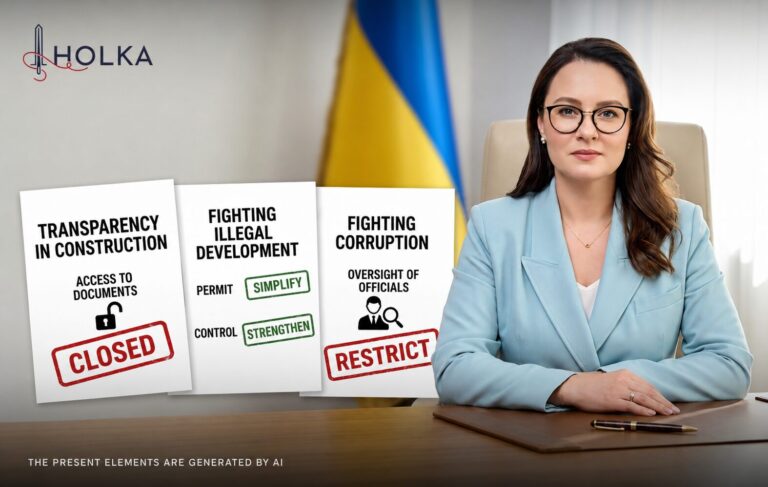
In this legislative initiative, MPs are trying to amend Article 23 of the Law on the Prosecutor’s Office, and in combination with what MPs propose in draft law 12089, this can maximize the destruction of the system of protection of state property and community property.

Currently, the prosecutor’s office can sue to protect such property when other authorities are inactive. For example, when local authorities do not sue to return the coast or the forest or protect cultural heritage, the court decides whether the prosecutor really has grounds to sue.
Natalia Vasylenko, Deputy Head of the Department for Representation of the State’s Interests of the Prosecutor General’s Office, notes:

.
Judge of the Grand Chamber of the Supreme Court Oleh Tkachuk says that in one of the cases considered by the Grand Chamber of the Supreme Court, there is a conclusion that the prosecutor has the authority, acting in the interests of the state or community, to go to court if state authorities, local governments, their officials are unwilling or unable to go to court, or are themselves a source of violation of the rights and legitimate interests of the territorial community or public interests:

This mechanism, which is currently in place, allows the prosecutor’s office to win more than a dozen significant cases: the Tereshchenko estate and Protasiv Yar were returned to Kyiv, the Palace of Kino was returned to the residents of Ternopil, and Peremohy Park was returned to Poltava. We also managed to save the Tuzly Estuary.

Tereshchenko’s estate, photo by “Evening Kyiv”
Now, lawmakers are proposing to make sure that it does not go to court.
Amendments to the article require the prosecutor’s office to prove the need for intervention at the stage of collecting evidence. This seems absurd because it is impossible to prove that there are grounds for intervention without the evidence base.
The Constitution enshrined the prosecutor’s office’s function to protect state property ( Article 131). This is how the prosecutor’s office is supposed to ensure the rights and freedoms guaranteed to citizens. However, by amending the law “On the Prosecutor’s Office,” MPs can undermine the protection of state interests.


Local authorities usually have representatives of large developers. For example, in Kyiv, the fight for the preservation of the Osokorky Ecopark and the Prolisok green zone continues, and in Irpin, the Irpin River floodplain and green areas are being protected.

Photo of Osokorky Ecopark: from Serhiy Lyubchenko’s Facebook
In Kyiv, the traces of developers often lead to Batkivshchyna, and in Irpin, one of the largest developers is former mayor Volodymyr Karpliuk. He once declared 67 apartments, and his fellow New Faces party member, developer Ihor Overko, who was elected to the Irpin City Council, had 586 apartments. And this happens in every community where land is expensive.
Of course, when the majority of deputies in the council vote in favor of developers, there is no hope that the local authorities will represent the interests of the community in court.
Yevhen Krapyvin, an expert at the Center of Policy and Legal Reform, notes:

The prosecutor requests relevant documents to establish whether the state’s interests are being violated and how the authorized state body (e.g., a local council) responds to these violations. This helps prosecutors understand the situation and whether the prosecutor’s office should defend the interests of the state or the community.
If MPs support the amendments to Article 23 as proposed, before going to court, the prosecutor’s office will have to write letters at the stage of collecting evidence and argue, for example, to local authorities why they need information about the sold-off plots in the forest or on the coast.
If the local authorities do not consider it appropriate for the prosecutor’s office to intervene, they may not provide any information and claim that they have not been shown the expediency of collecting such evidence. Accordingly, the case may never go to court with this approach. And if the case does go to court, the issue will be the evidence base that could not be collected. And developers will only benefit from this.


Yevhen Krapyvin emphasizes that the court should remain the centerpiece of the case.
The head of the Specialized Environmental Prosecutor’s Office of the Prosecutor General’s Office, Borys Indychenko, agrees with this position. He notes that the prosecutor represents the interests of the state in court, not in central or local authorities. The prosecutor comments on this legislative initiative to the Holka civic initiative regarding the amendment of Article 23, which concerns representation:

MP Maksym Pavliuk (Servant of the People), who is a co-author of the draft law, argues that these risks should be removed before the second reading:

It is worth adding here that Article 23 of the Law “On the Prosecutor’s Office” has been under attack from developers for a long time. And they can act not only through the Parliament.

Reinir Business Group LLC filed a complaint with the Constitutional Court. At the end of April, the Second Senate (judges: Serhiy Holovaty, Viktor Horodovenko, Vasyl Lemak, Volodymyr Moisyk, Oleh Pervomaiskyi, Halyna Yurovska). The Holka civic initiative wrote about this when it analyzed another legislative initiative of the “servants” submitted in developers’ interests (11185). It was this project that later became the basis for the new legislative initiative mentioned above, which was supported by the Parliament in the first reading last week (12089).
In the Constitutional Court, developers are challenging the right of prosecutors to act in the interests of the state in cases involving the protection of the interests of the state and communities. And this is Article 23 of the Law of Ukraine, “On the Prosecutor’s Office,” which they are now trying to change through the Parliament.

Screenshot from the Constitutional Court’s website regarding the challenge to Article 23 of the Law “On the Prosecutor’s Office”
The prosecutor’s office filed a lawsuit against the complainant company to protect the water fund lands distributed by the Kozyn village council (Kozyn, like Koncha Zaspa, has some of the most expensive plots near the capital).
The developers tried to prove their right to the 17-hectare water fund plots, which cannot be privately owned. The Supreme Court upheld the prosecutor’s claim and returned the land to the community.
Thus, developers are lobbying for their interests not only in the Verkhovna Rada, but they are also trying to undermine the protection of state and community property even in the Constitutional Court.
It is also worth recalling that the Grand Chamber of the Constitutional Court removed itself from the issue of national security and closed the proceedings in a high-profile case in which fifty MPs had been arguing for 5 years that the Verkhovna Rada had violated the Constitution by abolishing the list of objects that cannot be privatized. The existence of such a list is a direct requirement of the Basic Law, and it is the responsibility of the Parliament.
However, the Constitutional Court failed to do its job here, and the Parliament continues to create bills that pose significant risks to the loss of state and community property.
Specially for LB.ua