How are officials of the Verkhovna Rada Secretariat provided with official housing during the war and why have they forgotten about the military?

The government has authorized the provision of service housing to employees of the Verkhovna Rada and its subordinate state-owned enterprises. Most Ukrainians hear about official housing only from journalistic investigations into its illegal privatization by government officials or security forces.
But currently, there is almost nothing to privatize in the Parliament’s Secretariat – “everything was stolen before us.” Out of the nearly 1,500 apartments built for MPs over the past 35 years, there are about 20 vacant apartments left on the balance sheet. But this number may increase.
The Golka civic initiative has analyzed the possibilities of replenishing the official housing stock of the Verkhovna Rada. The prospects turned out to be good: hundreds of new apartments could be built for officials in the coming years. No one waited for the government’s permission and the process is already underway, but the law is resting.
They already have an illegal skyscraper on Hlybochytska Street in partnership with companies allegedly linked to MP from the Servant of the People party Strykharskyi, a criminal case opened by the NABU against the secretary of the Verkhovna Rada’s urban planning committee, Dmytro Isayenko (Restoration of Ukraine group, former OPFL), and a lawsuit demanding to cancel the status of the park granted by the Kyiv City Council under public pressure back in 2015.

By the mid-2000s, 11 buildings with almost 1,500 apartments were built for MPs and their staff. The housing privatization scandals were not without their share of controversy. A week after Yanukovych’s escape, the parliament blocked the possibility of providing official housing to MPs. However, there were still more than 20 unprivatized “remnants” of apartments, as well as plots of land where official housing was supposed to be built, including in the Shevchenkivskyi district of the capital. A classic suitcase without a handle – they could not be used for their intended purpose, they spent money on maintenance, and they did not give them to anyone.
The property was not abandoned, as they did not give up hope of obtaining the right to use it to provide housing for the staff of the Office. As stated in the Accounting Chamber’s report, in 2021-2024, the Government repeatedly made relevant appeals to the Government. The recommendations of the Accounting Chamber in this report were decisive, although it would be more logical to transfer the apartments and land for construction to the management of, for example, the Ministry of Defense to provide housing for military personnel and their families.
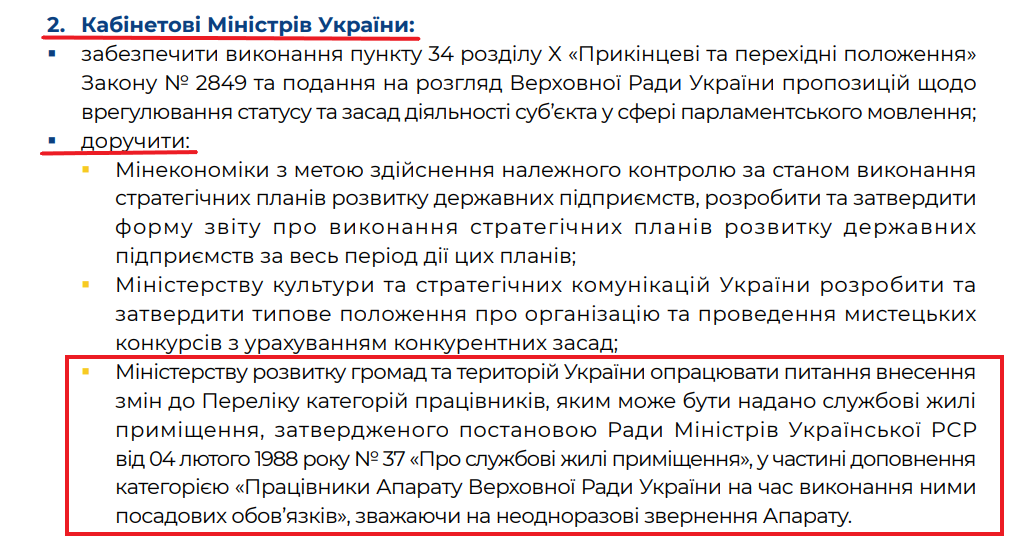
Recommendations of the Accounting Chamber based on the results of the audit in 2024
It is important to note that two dozen former MPs’ apartments are only the locomotive that should ensure the right of the Verkhovna Rada to provide official housing. And they need this right to actively launch partnership projects for housing development on the land plots used by the Secretariat and its subordinate state-owned enterprises.
Today, there are 20 service apartments out of the deputies’ apartments. Part of the construction of new apartments began long before the Cabinet of Ministers resolved the issue. The aforementioned report of the Accounting Chamber contains information about 30 apartments that are currently under construction on Hlybochytska Street. So next year there should be 50 apartments.
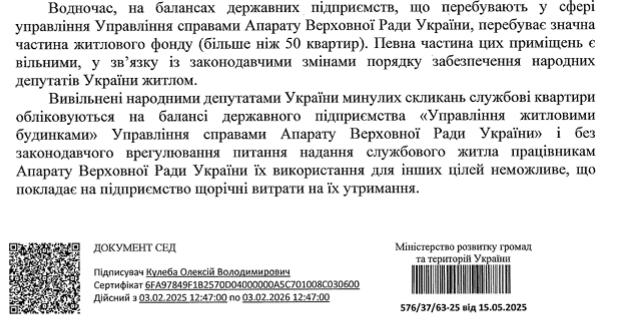
Excerpt from the explanatory note to the relevant draft government resolution
And if we analyze the activity in other areas of BP, then in five years they may already have several hundred service apartments. Even the joint development of state-owned land by the Office with private firms in exchange for a certain share of future apartments carries no less corruption risks and potential losses than the possibility of privatizing service apartments in the future.
The excessive number of service apartments, as well as the construction of housing for departmental waiting lists, is a hidden benefit for civil servants that is very expensive. State property is exchanged for apartments, which are then provided for free use by officials. But this state property could continue to be used for profit or privatized at market value, filling the budget.
New housing requires social and engineering infrastructure. If the development is densified with single houses, the existing infrastructure can cover the need. But when it comes to building large plots in new neighborhoods, the entire financial burden falls on the local budget. And the local budget should be used to build infrastructure not only for service apartments, but for everyone.
It’s hard to estimate current prices, but before the full-scale invasion in Kyiv, it was necessary to spend 10-20% of the cost of building the housing itself. In other words, it is cheaper for Kyiv’s budget to build housing for officials alone than to build the infrastructure to support all of them together.
To complete the picture, add to this that the cost of the resulting apartments is usually significantly less than the market value of the state land and the buildings previously located on it, and the private partner is selected through a corrupt scheme.
And you should always remember about violations of urban planning legislation during construction. The fact that the customer is an influential government agency only increases the risk of violations.
The Authority has already started the construction of certain plots, so there is every opportunity to see whether the above risks are realized.

In December 2018, the Parliamentary Committee on Regulations approved the conclusion of an agreement between the Office of the Presidential Administration and Status Bud-Prime for the construction of a residential building on a land plot at 79-97 Hlybochytska Street. The Office was to receive 8% of the total area of the facility, but no less than 30 apartments. According to media reports, this company is associated with Andriy Strykharsky, a current MP of the “servants”.
The market conditions for joint construction are 12% of the building’s area for the user of the site on the outskirts of Kyiv, while the parliament should have received 20-25% on Hlybochytska. But the main thing in the agreement was not the meager percentage of the area, but the number of apartments, because the 0.5-hectare plot is supposed to have at least 30 apartments, subject to market conditions.
According to Kyiv’s General Plan, the construction site is located in a zone of low- and medium-rise buildings, where it is forbidden to build above 8 floors. It is also located within the Historic Landscape of the Kyiv Mountains and the Dnipro River Valley, where it is forbidden to build above 25 meters. But in 2020, the SACI issued a permit for a 9-10-story building with a percentage of the site development twice as high as the standard.
As of now, the thirteenth floor of these 9-10 floors is already under construction. And the developer is not going to stop there – according to LUN, apartments in the 15-storey building were sold. The State Inspectorate of Urban Planning and Architecture, created in 2021 from “professionals with zero tolerance for corruption,” does not notice these violations.

The residential complex on Hlybochytska Street as of today. FB by Volodymyr Gerasymovphoto
As a result of the violations, the building’s area will exceed the maximum allowed by the standards by more than three times, and the market share of the VR Secretariat of 30 apartments for legal construction will turn into the same scanty 8% of the usable area.

The intention to build up 8 hectares of the territory of the State Construction Plant of the Verkhovna Rada Secretariat in Berezniaky is not new. The minutes of the consideration of proposals to the draft Kyiv General Plan in 2011 show that a letter with a corresponding request was sent by the then First Deputy Speaker of the Parliament Adam Martyniuk. But he was denied.

Minutes of consideration of proposals to the draft Kyiv General Plan in 2011
However, already in 2017, the Kyiv City Council approved a deliberately illegal detailed plan of the territory, which, contrary to the provisions of the city’s General Plan, provided for the creation of a new residential neighborhood for tens of thousands of residents on the site of the industrial zone. After that, it was only a matter of time before the Verkhovna Rada’s Secretariat began to realize its long-held wish.
At the end of December 2020, an investment auction was held “for their own”, which was won by a company from the structure of the developer Perfect Group, associated with MP Dmytro Isaienko from the OPFL.
In June 2021, Vitali Klitschko, as the head of the Kyiv City State Administration, issued a decree to change the purpose of the land plot, and in July approved the corresponding land management project for residential construction. And in September of that year, a week before its liquidation, the notorious SACI issued a building permit.
However, construction has not yet begun. The process of writing off the buildings located on the site is a long process, and it has attracted the interest of law enforcement. And in March 2023, the NABU and the SAPO served a notice of suspicion to Dmytro Isaienko, former First Deputy Head of the Verkhovna Rada’s Office and director of the state-owned enterprise, for attempting to illegally seize land and property of the state-owned enterprise.
The site was to be used to build 3,600 apartments with a total area of 175,000 square meters, a retail and office complex, underground and multi-story surface parking lots with a total of more than 2,000 parking spaces. Out of all this, the Verkhovna Rada Office was to receive only 270 apartments with a total area of less than 13 thousand square meters.
However, according to law enforcement calculations, only to fully compensate for the value of the state land and the company’s existing buildings on it, the share of apartments should have been significantly higher. If we translate the hryvnia calculations of the experts in the HACC ruling into apartments, it should have been 710 apartments with a total area of more than 34 thousand square meters.
There was also a violation of urban planning legislation. As stated in the verdict of the High Anti-Corruption Court against the director of the SE, the strategic development plan of the SE stated that the provisions of the detailed plan of the territory within the site envisaged the construction of a recreation park and social infrastructure facilities for the needs of residents of neighboring residential complexes, so it is necessary to implement the plan for its development by the enterprise as soon as possible, before the site is seized for the needs of the city. In other words, when justifying the development intentions, it was not even concealed that in order to maximize profits, they planned to act against the interests of the city community.

Fragment of the DPT with the development plan of the plot of the State Enterprise “State Construction Plant USA Vru”
In fact, the city authorities were not going to (and had no right to) forcibly seize the land. But parts of it were to be used to build a stadium with sports fields for a new school, a separate kindergarten for 240 children, and a public garden. However, the development project did not take into account the needs of the territory for these facilities, which allowed the construction of about 40 thousand square meters of apartments. The SACI surprisingly did not see these violations when granting the permit. As a result, someone may receive millions of dollars in additional profit, while Kyiv will be forced to look for additional space and considerable money to build social infrastructure for residents not foreseen in the detailed plan.
A comparison of the state and Kyiv’s expenditures on housing for the staff of the apparatus is very revealing. According to NABU calculations, the state’s investment in construction with its property in 2020 prices amounted to UAH 525 million (of which 330 million were stolen). And only for the construction of a school to provide for children in a residential complex with 6630 planned residents, about 340 million would have to be spent from the city budget (the cost of construction is based on the example of a real school project).
But a school is only part of the necessary infrastructure. Even if the kindergartens are built by the developer, the city budget will have to pay for a hospital with a clinic, roads, green space, etc. However, the state does not care about additional related costs from the Kyiv budget to improve the living conditions of civil servants.
Currently, the investment agreement for the development of the Klemanska Street site has been declared invalid by the court. However, this, as well as the criminal case of the NABU and the SAPO, do not prevent the implementation of plans for its development. The land plot already has the required designated purpose, and no one has canceled the construction permit obtained in 2021. It is enough to hold a new investment auction, taking into account previous mistakes. And the right of employees of the Verkhovna Rada to service apartments will be a serious argument for the need for this construction.

In the spring of 2013, on Tropinina Street, 3-5 (now Yakubenkivska Street), an attempt was made to start construction of a 16-story building with 195 apartments on a plot of only 18 acres. The developer of the project was one of the companies of the scandalous Anatoliy Voitsekhivskyi. Unlike his other projects, the construction was permitted, although the building was twice as tall as allowed in this location and required a plot three times as large as the standard.
The secret of the permit for the obviously illegal construction is simple: the customer was the Verkhovna Rada Office, which was to receive 10% of the future apartments for transferring its land plot to the investor.
Thanks to protests near the parliament, the construction was stopped at the stage of installing the fence – the SACI canceled the permit for the illegal high-rise in a matter of months.

Protests against the illegal construction of a residential complex on Tropinina Street in the summer of 2013. Source.
Realizing that the construction could resume, Kyiv residents pressured the Kyiv City Council to terminate the right to permanent use of the site in October 2015 and grant it the status of a public garden. It was a pre-election PR stunt. The decision contained many mistakes that should have made it easier for the land user to get the land back through the courts.
For years, it seemed that this story would be one of the rare examples of community success in confronting developers. But in 2021, they decided to resurrect the construction idea.
The Office of the Verkhovna Rada’s Administration filed lawsuits against the investor to terminate the joint construction agreement and against the Kyiv City Council to cancel the decision on the park. The lawsuit explicitly stated that the Secretariat “plans to use the land plot for its intended purpose (for the construction of a residential building with underground parking)” and that the status of a public garden granted by the Kyiv City Council prevents it from doing so.
The investor did not resist – he filed neither a review nor an appeal against the decision, thereby admitting his guilt that the building had not been built for many years. The dispute over the park, however, was a mixed bag, going through all the administrative courts and being redirected to the commercial courts.
In April of this year, the Commercial Court of Appeal upheld the claim and revoked the status of the park granted in 2015. The Commercial Court of Cassation may put the final tie in the coming days – a hearing is scheduled for June 3.
It is not worth expecting that if the Agency wins in court, it will simply forget about the land plot – the Accounting Chamber in its report accused it of ineffective management decisions and noted that the long term non-use of the land plot for development led to the risk of losing the right to use it.
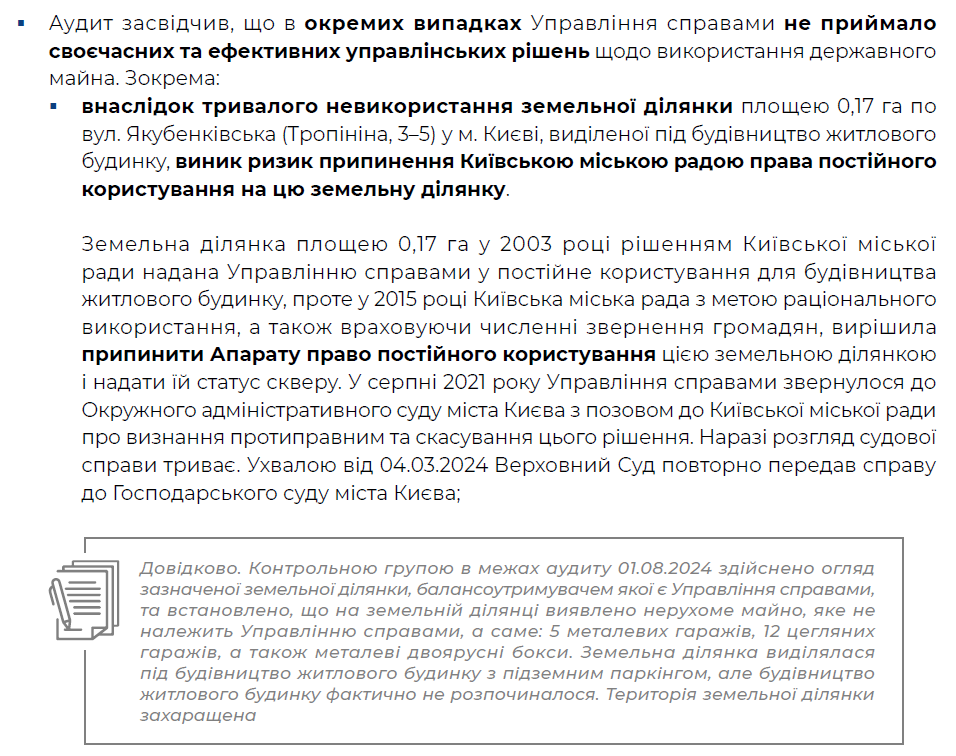
The Accounting Chamber’s conclusions on the use of the Yakubenkivska (Tropinina) land plot
In addition to the plot on Yakubenkivska Street, there are two more plots almost in the center of Kyiv, where the Verkhovna Rada apparatus does not give up hope of building residential buildings. The first plot is at 11 Observatorna Street (0.45 hectares). The second one is at 11 Nestorivskyi lane, 0.19 hectares. Both have a designated purpose for the construction of housing “for MPs and staff members“.

Even though it does not have the right to provide official housing for its employees, the Parliamentary Secretariat is developing its land plots and preparing new projects for implementation. In all cases known over the past 12 years, the share of apartments was significantly lower than the market price, which indicates corruption in the selection of a private developer partner. In all cases, there are gross violations of urban planning legislation aimed at increasing the profits of private companies.
Under such circumstances, the permission of the Verkhovna Rada to provide service apartments to employees will only worsen the situation, as it will serve as an additional reason for new residential development to replenish the service housing stock.
Unfortunately, this situation is not unique – fraudulent joint development of land plots by government agencies has long been commonplace. And until the requirements for such business are strictly regulated at the legislative level and corruption in the issuance of permits and subsequent control over construction is overcome, the situation will not change.
Specially for “LB.ua“