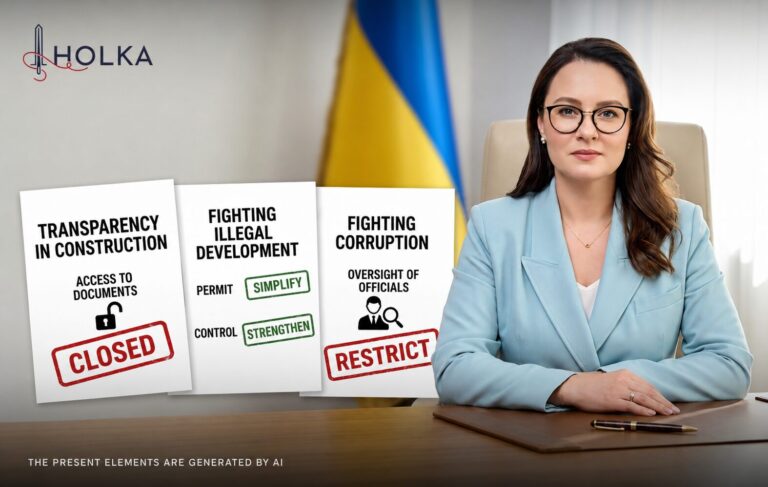
NACP Anti-Corruption Strategy: Who Prepared the “Construction” Section?

The Anti-Corruption Strategy for 2026–2030 is one of the most vital strategic documents that will influence the state’s development over the next five years. As emphasized by Taras Kachka, Ukraine’s Deputy Prime Minister for European and Euro-Atlantic Integration, its adoption is one of the Government’s key priorities for 2026. This is hardly surprising, as the approval of the Anti-Corruption Strategy is a fundamental requirement from Western partners for receiving continued funding.
The draft prepared by the NACP (National Agency on Corruption Prevention) is a massive document exceeding 100 pages. It was developed over nearly two years and includes anti-corruption reform tracks both for general governance and within 17 priority sectors. However, we will focus specifically on the section “Construction and Infrastructure,” a chapter that the “Holka” NGO joined at the final drafting stage.
Before the full-scale invasion, construction accounted for 17–18% of Ukraine’s GDP. Given the immense destruction caused by Russian aggression, these figures will rise significantly during the reconstruction period.
But we are not just talking about the regulation of a significant part of the economy; we are talking about the sources of recovery funding. Reparations from the Russian Federation may be a long time coming, so the plan relies on international aid funds. Any discredit regarding the use of these funds—whether through corruption or illegal construction—will strike at Ukraine’s reputation and could lead to a cessation of funding.
A no less serious problem may arise with private foreign investment, which is also heavily counted upon. A private investor will not put money into projects where they cannot generate a profit. Both corruption and the prevalence of illegal construction make foreign investors uncompetitive.
Spatial planning and territorial development are highly specific fields. Therefore, tackling corruption in this sphere has certain peculiarities that must be taken into account when preparing an anti-corruption strategy.
The goal that urban planning legislation aims to achieve is the creation and maintenance of a high-quality living environment to ensure the sustainable development of territories while ensuring compliance with environmental and heritage protection requirements.
In turn, corruption offenses during urban planning activities are just one of the negative factors hindering the effective achievement of the goal of urban planning legislation. An equally negative factor is construction carried out in violation of legislative requirements.
Therefore, reducing the level of corruption in the field of urban planning cannot be an end in itself for the reform; it must be viewed exclusively as one of the tasks whose solution should improve the effectiveness of urban planning legislation in achieving its set goal. Thus, from all possible methods of reducing corruption in the construction sector, one should choose exclusively those that, at a minimum, do not impair the ability of urban planning legislation to solve its assigned tasks.
Corruption offenses in the field of urban planning fall into two main types: the extortion of an illegal benefit for the proper performance of official duties by an official, and the receipt of an illegal benefit for making decisions in violation of the law in the interests of a developer.
To reduce the level of corruption, it is essential to consider the impact of proposed measures on both types of corruption and remember that the second type of corruption is significantly more dangerous than the first. Beyond its general negative impact on the economy, it leads to chaotic development, creates opportunities for the embezzlement or misuse of public funds, and can pose a threat to human life and health, the environment, and cultural heritage.
Territorial planning and subsequent development is an integrated process with a significant number of stages. A single goal—the implementation of a development project in violation of urban planning law—can be achieved through corruption offenses at different stages:
-
A project with violations can be embedded during the development and approval of urban planning documentation;
-
It is possible to grant Urban Planning Conditions and Restrictions (MUO) with violations;
-
During the development of the construction project and its expert review, manipulations are possible due to legal uncertainties and contradictions in legislation and state building norms;
-
It is possible to obtain a document granting the right to perform construction work through violations;
-
Construction in violation of the project is possible by avoiding or improperly implementing state architectural and building control measures and through violations during the commissioning of the building.
Similarly, manifestations of corruption are possible at various stages when it comes to extorting illegal benefits from honest construction clients.
As a result, attempts to reduce the level of corruption through “point-based” changes at individual stages will not solve the problem as a whole—instead of reducing corruption, there will simply be a shift in the primary corruption schemes. Furthermore, if an anti-corruption measure is chosen for a specific stage of development without considering the specific risks of other stages, the level of corruption may even increase.
It is important to consider that deregulation—by transferring part of current powers from authorities to private entities—also does not necessarily lead to a decrease in corruption and, under certain circumstances, can even lead to its increase. With full digitalization in the construction sector, where everything is based on the formation of documents in the Unified State Electronic System in the Construction Sector, all architects, design engineers, and experts are considered “persons providing public services.” Therefore, they fall under the “Prevention of Corruption” law, and their illegal actions in the interests of third parties constitute corruption.
Although these “public service providers” fall under the law, the level of anti-corruption control over their actions is significantly lower compared to government officials—they do not submit electronic asset declarations and are not subject to the jurisdiction of specialized anti-corruption bodies (NABU, SAPO, HACC).
It is a mistake to believe that any digitalization and automation in urban planning is inherently an anti-corruption measure that will positively affect the situation.
For example, the creation of the Unified State Electronic System was pitched as a unique system that would ensure openness and publicity for all construction processes and reduce corruption to zero. But in over five years of existence, its functionality has still not been brought into compliance with the requirements defined by law.
If it is technologically impossible to ensure a proper level of automation, it is better not to undertake it at all. In cases where the automation of permit processes exists de jure but is absent de facto, the situation deteriorates catastrophically—the system is unable to detect violations, so construction documents that violate the law are issued without any problems, and no one is held responsible.
Due to article length constraints, we will not describe in detail the flaws of the first draft of the Anti-Corruption Strategy, which contained many “strategic results” that did not meet the requirements mentioned above or had no anti-corruption focus. However, it should be emphasized that the National Agency on Corruption Prevention (NACP) should not bear all the blame for these shortcomings.
The NACP, as a government body, is obliged to use official statistics. But for the last four years, routine inspections in the field of urban planning have been completely banned by the Cabinet of Ministers, and unscheduled inspections are allowed only in exceptional cases and only based on an order from the Ministry of Development. No inspections mean, officially, no violations.
Certain high-profile cases might even lead one to conclude that everything is wonderful compared to other sectors. For example, how can one talk about significant corruption in the granting of Urban Planning Conditions and Restrictions (MUO) if over 4,000 MUOs are issued per year and violations are officially detected a maximum of once during that period? And officially, we practically have no construction with violations—only a handful of confirmed violations per year out of 50,000 new construction objects.
In the absence of official data, the only way to develop a high-quality Anti-Corruption Strategy is to conduct a deep analysis of both the legislation for corruption risks and existing construction projects for manifestations of identified risks. But this is very difficult and painstaking work that requires the involvement of high-level, niche specialists. The Anti-Corruption Strategy isn’t just about construction; dozens of such specialists are needed in various fields, and the NACP simply does not have the capacity to hire such a number of professionals.
As a result, the analysis and development of the corresponding section of the draft Strategy were funded by the Eurasia Foundation and the UK government project UK DIGIT. As NACP Deputy Head Dmytro Kalmykov stated during public discussions, the experts were selected by the donors themselves.
In fact, the selection of experts played a cruel joke on the NACP. Two experts, including the head of the authorial group (Taisiia Barynholts and Andrii Bilenko), are assistants to the former head of the “Servant of the People” political party and chair of the relevant Verkhovna Rada committee, Olena Shuliak—who is known for the scandalous Bill 5655 and other dubious legislative initiatives in the interests of developers. Incidentally, Taisiia Barynholts’ role in developing Bill 5655 is well known to the NACP, as she herself communicated with the NACP on this issue in 2021 and 2022 as a representative of Olena Shuliak.
Two other experts are directly connected to the Confederation of Builders of Ukraine—Board Member Anzhelika Livitska and the head of the committee on regulatory and legislative activity, Olha Sydorchuk.
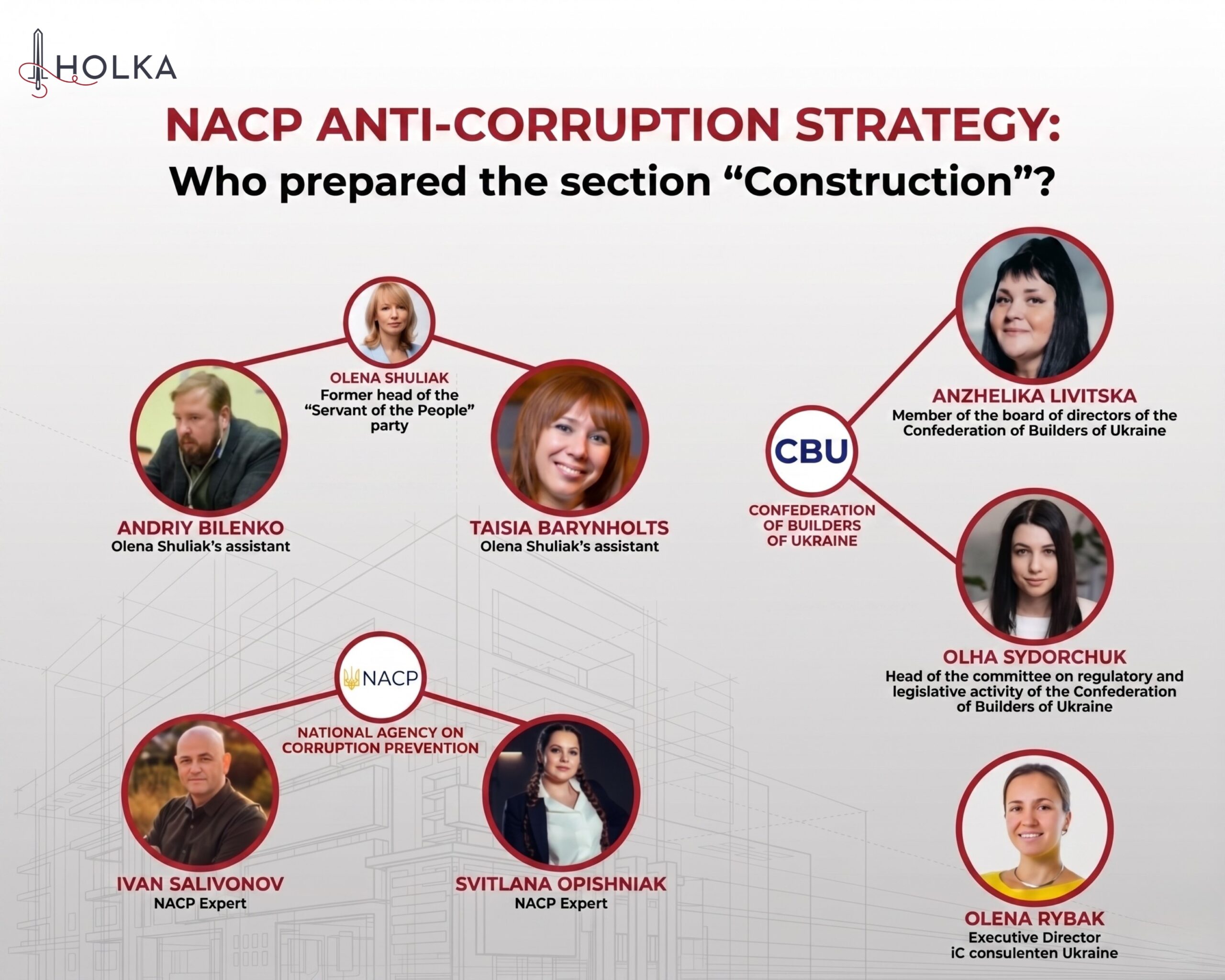
Team of experts responsible for drafting the “Construction” section of the Anti-Corruption Strategy.
If representatives of the construction lobby develop a reform plan, it will be a plan in the interests of only one stakeholder—the construction business. The main failure in the NACP’s work was not managing the conflict of interest regarding these experts and the non-public preparation of the situational analysis and the first draft.
Unfortunately, this only became known in late December during public discussions. And here, credit must be given to the NACP, which proved ready to acknowledge its mistakes and actively work to fix their consequences. This is a great rarity among current government bodies.
Using the opportunity provided by the NACP, the “Holka” NGO provided 71 comments and proposals. As a result of their processing and long meetings, 25 comments were fully accepted, and 18 were partially accepted.
Among other things, the draft Strategy was purged of norms that corresponded with the provisions of Bill 5655, provided for the implementation of “experimental projects,” or lacked a direct anti-corruption focus.
But the most significant additions and revisions concern the Expected Strategic Results (ESR), which we will examine below.

NACP summary report on the inclusion of proposals submitted by “Holka” NGO.
-
Prompt preparation and adoption of a codified legislative act that will regulate all urban planning legislation. For the last two decades, the development of an Urban Planning Code has begun repeatedly, but no attempt has succeeded. Meanwhile, mutual contradictions between a large number of laws are one of the causes of corruption in construction.
-
Creation of a state control system for compliance with legislation and building norms during the development, update, and approval of urban planning documentation at the local level. One of the main causes of corruption in planning is the complete absence of a state control system.
-
Introduction of a subvention to local budgets for the purpose of digitizing previously approved urban planning documentation to ensure transparency. If implemented, this will deprive local authorities of their main excuse for not converting old master plans into vector formats suitable for public disclosure and automated processing.
-
Restoration of inspections (state architectural and building control and oversight) which were suspended by the Cabinet for the period of martial law, and the establishment of clear deadlines for considering appeals and appointing inspections. This will prevent the state inspectorate (DIAM) from delaying investigations into the legality of permits for months.
-
Introduction of “desk audits” (cameral checks) to detect violations. Currently, violations can only be established during on-site inspections, which is often pointless as many violations can be identified by checking design documentation already uploaded electronically to the Unified System. This change also prevents developers from evading inspections for months.
-
Alignment of architectural control procedures with the laws “On Appeals by Citizens” and “On Administrative Procedure.” The current Cabinet-established procedure requires the applicant’s presence during the consideration of an appeal; if they do not show up, the complaint is ignored.
-
Introduction of extraterritoriality for administrative services related to construction permits based on a random distribution principle. Currently, the system is simple: local control bodies issue illegal permits to “their people” and deny “outsiders,” while developers with high-level connections deal with the state inspectorate (DIAM). Randomly distributing applications among all existing control bodies across the country should be an effective safeguard.
-
Bringing the functionality of the Unified State Electronic System into compliance with the law. Currently, the system only ensures openness in top officials’ reports. For example, a “corruption scheme” was built into its original code that allows “notices of start” for small projects (SS1 class) to be returned for revision, contrary to law. Also, access to project designs is closed, and officials can freely hide other documents.
-
Harmonization of the project adjustment procedure. Currently, a developer can get a legal permit and then “adjust” the project to include any violations (e.g., turning an office into a high-rise) simply by “notifying” of changes, with no responsibility or defined review process for officials. The adjustment process must be brought in line with the initial permit process.
-
Establishing a legal obligation to adjust project documentation if new heritage protection restrictions are established. Since construction permits are indefinite but heritage research is ongoing, building on old designs in new protection zones creates risks for both monuments and corruption.
Part of the proposals not included by the NACP could have significantly improved the Strategy. However, those legislative changes are possible through other means, such as the Urban Planning Code.
Far worse was the failure to address objections to certain measures in the first draft that could have a negative effect. While most were removed, a few remain:
-
Automatic granting of MUOs (Urban Planning Conditions) based on new planning documents. However, since specific requirements are often only in “detailed territory plans,” granting MUOs based on broader general plans leads to unbalanced development and “slums” without social infrastructure.
-
Vague regulations on how new planning documents affect old MUOs. Since MUOs have been indefinite since 2011, without clear rules that they must be adjusted when planning changes, new city development becomes impossible due to old, conflicting permits.
-
Review of administrative services in heritage preservation to “simplify” them. Since 2022, approvals for building in historical areas have already been largely abolished. This threatens cultural heritage and violates Ukraine’s international obligations under the Convention on the Protection of the Architectural Heritage of Europe.
In Conclusion: The draft Anti-Corruption Strategy submitted by the NACP for government approval is not perfect, but if it is approved and implemented, the situation in the sector should significantly improve.
However, we must remember that “if”—the draft could change at the request of the Cabinet or be completely rewritten in the Verkhovna Rada. And implementation is a separate, difficult task. For instance, the previous strategy for 2021–2025 was largely unfulfilled due to sabotage by the Ministry of Development and the Ministry of Culture.
Specially for “Dzerkalo Tyzhnia“