Electoral systems: how do local councils and parliament work without elections?

Local elections are to be held in a year under the condition of victory. If the war drags on, local councils, like the Parliament, can only rely on those elected by voters in the previous local elections in 2020. However, the situation at the national and regional levels is quite different. The elections to the Verkhovna Rada and local councils were held under different electoral systems.
In the Parliament, where there are representatives of specific constituencies — majority voters — almost a tenth of the councils are missing. On the ground, the situation is much better. The problem is like this because in 2020, the Electoral Code was already in effect, and the party system came down to all communities with more than ten thousand voters.
The party system demonstrated superior stability during the war, even with semi-open lists.
The Holka civic initiative discovered how regional and city councils of regional centers work in war.

After the Revolution of Dignity, the Parliament was re-elected twice. And twice, it worked without majoritarian members from the temporarily occupied territories. It would seem that conclusions could have been drawn, and the legislation could have been changed in advance. The 2019 parliamentary elections could have been held under a different political system so that the institution would be more secure and have maximum representation in times of war, especially since the public sector has been demanding for years that elections be held not according to Yanukovych’s law, but on open lists.

Freeze-frame from the TSN story. Action in support of Electoral Reform, 2018
But then the majority system was left in place because the political forces in the previous Parliament hoped that the majority districts would help balance the high rating of the Servant of the People. This bet did not work—in many majority districts, people voted not for a specific candidate from the future mono-majority but for a new brand, the Servant of the People, which elected President Volodymyr Zelenskyy.
In the last days of the previous Parliament’s work, MPs pulled themselves together and supported the Electoral Code with open lists before resigning their seats.
But because the parliamentary elections have already been held under the old majority system, there are currently no representatives of almost 40 constituencies (!) in the Verkhovna Rada.
Most are temporarily occupied territories, but there are also constituencies where MPs resigned their seats. In addition, the representative of one of the Chernihiv region’s constituencies died (Anton Polyakov, 206th district—Chernihiv region), and the elections that were supposed to be held in the spring of 2022 did not take place due to the full-scale invasion.
Oleh Rybachuk, head of the Center for Joint Action, notes that the electoral reform was not implemented on time because the leaders of political parties had the mentality of party leaders:


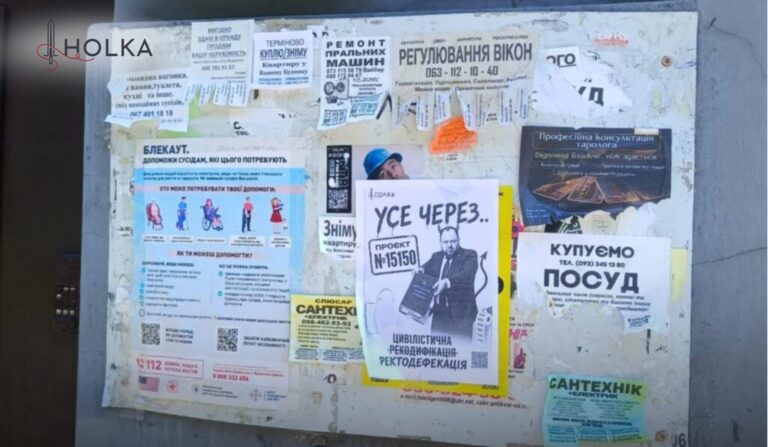
Poster about the event of MP Anton Yatsenko in the constituency in the election year
It is worth recalling that after the Electoral Code came into effect and the local elections were held, the majoritarian party tried to return to the majority system and registered a corresponding draft law (6444), which, fortunately, was never considered.
Now, even a few dozen votes can be decisive for the Parliament during the voting. For example, there is a critical lack of votes on such important issues as decolonization.
Oleh Rybachuk notes that there are results when a party system with semi-open lists is introduced at the local level. There is no such large-scale problem with the lack of deputies in councils as in the Parliament because there are no majority voters:

Photo by Dmytro Gurin, a member of the SN People’s Assembly. A leaflet distributed in parliament before the vote
By the way, when the Parliament was discussing the electoral quota, representatives of the OPFL played a decisive role, proposing to “improve” the Electoral Code by increasing the quota. Thus, the open lists became semi-open, and the OPFL, in particular, was able to get those they needed into local councils.
The head of the Servant of the People faction, David Arakhamia, has to solve a rather difficult task in the context of war: finding a sufficient number of parliamentarians to vote.

Moreover, Mykola Tyshchenko ( Kyiv, constituency 219), who is under house arrest, and Oleksandr Dubinsky ( Kyiv region, constituency 94), who is accused of treason, remain MPs because of the majority system. They were elected as representatives of the Servants of the People. If they had entered through the party list, the issue of their mandates could have been resolved. For example, after a scandalous trip abroad, list MP Yuriy Aristov resigned his mandate, and Tyshchenko was only expelled from the faction after a trip to Thailand.

Since the beginning of the full-scale war and until the end of September, 148 deputies resigned from the regional councils, while 90 deputies took office.
This discrepancy is because none of the 23 deputies who resigned from the Zaporizhzhia regional council took office. The last session of the regional council took place in March 2022. About ten more deputies of the regional councils who lost their seats represented now-banned parties. Since the parties have been banned, their representatives can no longer be elected to the council.
For the city councils in regional centers, 102 deputies lost their seats, and 58 gained them. The situation with deputies of banned parties is similar. For example, in Cherkasy City Council, none were elected, instead of 3 deputies representing the OPFL who lost their mandates.
In some councils, deputies of banned parties managed to disband their factions to avoid losing their mandates. For example, in Mykolaiv City Council, deputy Artem Iliuk, who voted for “dictatorial laws” in 2014 as an MP, announced the absence of the Opposition Platform—For Life political party faction. Representatives of the banned party became non-factional and remained with their mandates.
But here, the city council members showed a creative approach and managed to deprive one politician of the ex-Opposition Platform – For Life of his mandate. In February 2024, he was expelled from the council for non-payment of child support and “taking into account his open public anti-Ukrainian position and activities.”

Mykolaiv City Council’s response to the request of “Holka”
It is worth recalling here that the government submitted a draft law several years ago to purge local councils from deputies elected from banned parties (7476). However, the Parliament has not considered it. If such a legislative initiative were adopted, local authorities would not have to look for creative arguments to cleanse local councils, and the public sector would not block the appointment of such politicians to leadership positions in commissions, as was the case in the Kyiv City Council with Medvedchuk’s lawyer.
However, even with open party lists, a meeting of the territorial election commission is required to inaugurate deputies. As a rule, political parties can pay their commission members in cash, and no one is interested in working for free during the inter-election period. Moreover, some of the commission members may have gone abroad or changed their residence, which may raise the quorum issue.
In Chernihiv City Council, none of the four politicians who were supposed to take office received a mandate. The reason is the lack of a quorum.

City councils are generally less willing to report why deputies do not take office than regional councils.
In the Kyiv region, there are also problems with introducing new deputies. For example, in the Bucha district council, 21 deputies prematurely terminated their powers, but only four were appointed, as the Bucha district territorial election commission did not send any more decisions. The district council did not specify the reasons.
In the Kyiv region, the Holka civic initiative sent appeals to 25 village, city, and district councils, and in general, territorial election commissions are working even in those communities that have suffered the most from the temporary occupation, including Borodyanka.
However, in Kotsiubynske, an enclave of Kyiv that has never been occupied for a single day, the Kotsiubynske village council did not receive any decisions from the territorial election commission, although two deputies resigned, one in February 2023.
The secretary of the Kotsiubynske village council, Yulia Hlavatska (“New Faces”), did not provide any reasons why the territorial election commission did not send decisions.
This is the dialog that took place in the Kotsiubyn TEC chat room when the issue of the new deputy’s induction into office arose two years ago. The TEC member who raised the issue was not even recognized in the chat room, which has been out of service for years. Even the relevant documents did not help to find their way around.

A screenshot from the Kotsyubynske TEC chat
So far, the TEC has not yet vested the new deputies.
MP Alina Zahoruyko (Servant of the People), who chairs the subcommittee on elections, notes that violations by election commissions may occur, but the Central Election Commission responds to them:

Zahoruyko emphasizes that the Electoral Code will not be able to solve all the problems, such as the sale of quotas in TECs by parties, and the legislation concerning political parties should be updated:
The situation in Irpin City Council is rather strange. The civic initiative “Holka” was informed that they do not keep records of deputies who have ceased and assumed their powers. This answer was signed by Angela Makeieva (Servant of the People), the council secretary who is supposed to keep track of the quorum. Recently, a scandal erupted when the Ministry of Justice reported that the diploma attributed to Makeieva had not been officially issued.

An excerpt from the Irpin City Council’s response to the Holka
Speaking of representatives of banned parties, in the Kyiv region, Fastiv and Boryspil district councils did not recognize the five new deputies as elected because they would represent the OPFL, which no longer legally exists. But in the absence of several deputies, the councils here can work without problems.
MP Alina Zahoruyko notes that open lists do work. Still, in the first parliamentary elections after the victory, she believes that a proportional system of closed lists should be in place:
The war sharply revealed the majority system’s risks, significantly weakening the Parliament as an institution. What system will be used for post-war elections is currently unknown, as the situation may change significantly. However, this issue will definitely require discussion in society.
Specially for LB.ua