Advisors as Chimeras in President’s Office. Who Really Rules and What Needs to be Changed?

Elections in Ukraine cannot be held during times of war. It’s prohibited by the Constitution. That’s why Ukrainians and our partners all over the world recognize that Volodymyr Zelensky is the legitimate President now and we are not oblaged to have elections.
At the same time, everyone understands that power is concentrated in the hands of Bankova, and Russia will use any opportunity to launch an information campaign against Ukraine, accusing the states authorities in dictatorship. And Ukraine needs to keep aid and partners’ trust.
The fact that the President’s Office, with Andrii Yermak on it’s head, is concentrating more and more power in its hands is detrimental to parliamentarism, decentralization reform, and regional policy, which needs a separate ministry. Essentially, Yermak’s advisors are already replacing the government. This is nothing but a chimerical governance of the state.
The public initiative “Holka” (“The needle”) studied the documents regulating the activities of the President’s Office and found out what needs to be urgently changed so that the chimerical institution of Yermak’s advisors on Bankova street, where President’s Office is situated, stops harming the development of a democratic society.

The biggest source of power centralization on Bankova is the Head of the President’s Office – Andriy Yermak. As soon as he appeared on Bankova, he decided to congratulate Biden on his inauguration. Heads of state congratulate other heads of state on their election – this is a law of diplomacy. At that time, “Dzerkalo Tyzhnia” called Yermak the Vice President.
Before that, “Ukrainska Pravda” had also referred to him this way. This “title” has stuck.

Later, the BBC and other publications used this term, emphasizing the appointee’s real influence on state governance.
Now Yermak positions himself as a leader on the international stage. At least this was the case at the Peace Summit: “Tomorrow, we, the leaders, will discuss the principles of the future plan,” he said.
In reality, Yermak is merely an appointee who can be dismissed with a single stroke of Zelensky’s pen, just as it happened with the previous head of the President’s Office Andriy Bohdan. If there was the will to do so.
Yermak does not shape the country’s policy on his own. He has a significant number of advisors. All these “unofficial advisors,” who de jure do not exist, constitute a quasi-civil society with immense shadow influence. And, as long as there is no legislative regulation, the true civil society, which Bankova should be listening to, is excluded from the opportunity to engage in dialogue and genuinely influence qualitative changes in the state.
Moreover, there have been documented instances of censorship in the media, particularly in “Ukrinform.” When journalists write about this, they see the “shadow of Yermak’s advisors.” While access to the media is being blocked for the military and activists, the project of the advisor to the Head of the President’s Office, Serhiy Leshchenko, was given the green light, resulting in the program “Leshchenko Asks.”

The President’s powers are currently enshrined in the Constitution (Article 106). He is not entitled to delegate his powers to other persons or bodies. To exercise his powers, the President creates advisory and other auxiliary bodies and services within the funds provided in the state budget. The Constitution also states that officials must act only on the basis of, within the limits of, and in the manner prescribed by the Constitution and laws of Ukraine (Article 19). This applies to the President as well.
Currently, there are no advisors to the President or the Head of the President’s Office in the structure of the President’s Office. Thus, the positions of “Yermak’s advisors” are legally chimerical. However, when questions arose about the status of Oleksiy Arestovych in the President’s Office, Mykhailo Podolyak confidently stated: “Advisor to the President’s Office of Ukraine. Which he officially is according to the staffing schedule…”
Moreover, Podolyak himself is referred to as Yermak’s advisor on the website of the President’s Office. And when Arestovych wrote a resignation letter, he stated that he was requesting to be relieved from the position of “advisor to the Office (unofficial).”
The head of “Detector Media”, Natalia Lyhachova, notes that advisors to the President’s Office have a serious influence on the information field and, citing a source, adds that Podolyak was sidelined from shaping the policy of “one voice” in the information space when Arestovych left. Supposedly, it was Podolyak himself who brought Arestovych to Bankova.

And here it’s important to compare what the advisors to the President’s Office are doing with what the law prescribes. As soon as Zelensky took office, the structure on Bankova was not just renamed to the President’s Office; a separate provision was introduced. The main tasks of this document were to define the organizational, legal, advisory, informational, expert-analytical, and other support for the exercise of the President of Ukraine’s powers as defined by the Constitution of Ukraine.
And if we talk about the renamed President’s Office and its advisors, it specifically states that advisors and authorized advisors can only be for… Zelensky. There is not a word about advisors to the Head of the President’s Office.
So who are all these people we started seeing from the first day of the full-scale invasion and continue to see in the unified marathon, who are signed as advisors to the President’s Office?
Ukrainian legislation certainly cannot provide an answer to this question. Neither the process of their appointment, nor their functions, nor their powers are provided for in any regulatory act.
And this is unacceptable in a democratic country, which is still in a state of war. Because de jure, advisors do not exist, accordingly their powers are not defined, nor is their responsibility. Moreover, they may have access to sensitive and restricted information, give instructions to officials, who may then bear legal responsibility if following such instructions leads to negative consequences. These advisors, in addition to appearing on television, attend international events where they represent Ukraine, call or visit the heads of various state bodies, issuing instructions from the President’s Office to them.
It is quite obvious that the President’s Office has become a powerful separate force that influences absolutely all processes in the country. And the strangest fact is that its activities are almost entirely unregulated, and the media, which take their comments and sign them as “advisors to the President’s Office,” thus legitimize them.
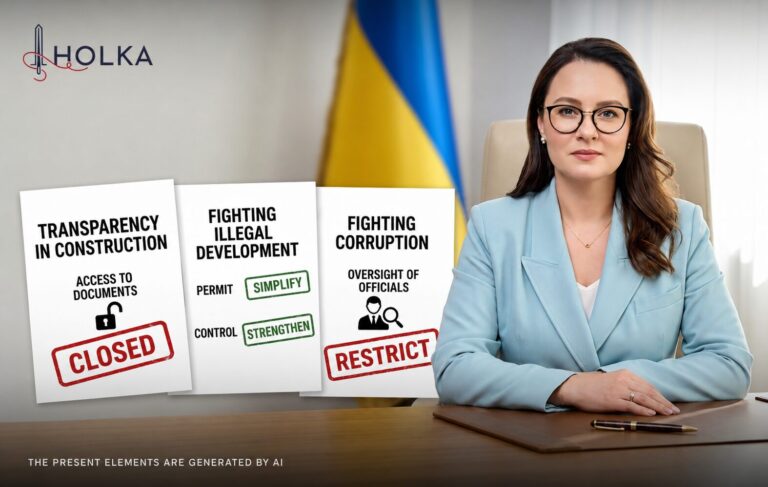
The Deputy Chair of the “Holos” faction in Ukrainian parliament, Yulia Klymenko, notes that advisors cannot govern the country:


But the question is not only about how the activities of the President’s advisors are regulated. There are also questions for the deputy heads of the President’s Office.

Of course, the personnel policy regarding Yermak’s deputies raises many questions among the public and journalists. For example, the dismissal of Andriy Smirnov was criticized, alleging that he influenced the judicial system, similar to Andriy Portnov during the presidency of Viktor Yanukovych. This was reported by the DEJURE Foundation. Another controversial deputy of Yermak, Kyrylo Tymoshenko, was sent to the Ministry of Defense as a staff advisor.
One of the most scandalous deputies of Yermak who still holds his position is Rostyslav Shurma. He ran for parliament from a banned pro-Russian party and seeks to influence the work of the Verkhovna Rada. Journalists have reported on this several times, particularly concerning the activities of the state enterprise “Forests of Ukraine,” where forest resources and an entire industry are brought under control. Furthermore, a monopoly on “Water of Ukraine” may soon emerge. Additionally, his brother was compensated millions for undelivered electricity. Media reports suggest that Shurma may have influenced the government in this matter.
Natalia Lyhachova emphasizes that our partners are surprised when they hear that Zelensky listens to only 5-6 managers. Diplomats cannot understand how such a small number of people can influence the country’s management.
And when it comes to democracy, advisors and deputies cannot replace the executive branch of government—the Cabinet of Ministers, which is essentially happening now.
As for Yermak’s deputies, according to the law, there can currently be an unlimited number of them. This issue also needs to be regulated. We cannot yet expect this to be an initiative from the President.
The government, which has long needed a reboot into a coalition format, is also not likely to initiate such a move at the moment.
In the conditions of a prolonged war, it is important for us to have one hundred percent trust from the world and faith that Ukraine will develop democratically. Therefore, society and international partners can only rely on the Verkhovna Rada in this matter.
Especially for “Espreso“