A loophole for developers. Who permits and who is allowed to build high-rises in green areas under the guise of hotel apartments?

Recently, the government appointed six ministers and the head of the State Property Fund at once. The position of the head of the Ministry of Infrastructure has been vacant since May. It was exactly when one of the main lobbyists of the scandalous urban planning “reform” (5655), Oleksandr Kubrakov, was fired.
Deputy Prime Minister Kubrakov was in charge of the State Inspectorate of Architecture and Urban Development (DABI – until 2021), responsible for approving state building codes. At the end of the Groysman government, the Ministry of Regional Development approved new state-building standards that made it possible to build housing on recreational land and not to build schools, kindergartens, or playgrounds. They are still in force today. It is quite clear that Kubrakov, who lobbied for legislative initiatives in the interests of large developers, found it unprofitable to change these norms.
As soon as the changes to the state building codes came into force, Nashi Hroshi journalists immediately saw who benefited from them. Construction of apartments began on the seashore in Odesa, which were sold as flats. The developer was associated with the current MP Dmytro Isaienko, who was elected to the parliament from the banned OPFL party and supported the scandalous urban planning “reform” of 5655 by the head of the Servant of the People party Olena Shuliak. It is Isayenko who is called an important player in the shadow management structure of the Ukrainian construction market. This MP, by the way, received a suspicion notice from the NABU for trying to seize the land and property of the State Construction Plant.
Along with Kubrakov, the Minister of Agrarian Policy Mykola Solskyi was also fired. NABU suspects him of land deals worth 500 million. Solsky had been the minister for almost two years, and previously, he was a member of parliament from the Servants of the People party. In parliament, he headed the Committee on Agrarian Policy and Land Relations. It was under his chairmanship that the committee recommended that the Verkhovna Rada support Solsky’s amendment to the Land Code, which allowed residential buildings to be built on recreational land.
Using the example of the Prolisok tourist complex in Kyiv, located next to the Holosiivskyi National Park, the Holka civic initiative found out how the new regulations prevent citizens from protecting green areas.

It is a Ternopil-based developer, Creator-Bud, that is trying to build up the green zone along Zhytomyr Highway in the Sviatoshynskyi capital district. They decided to build a “Gravity Park” here. The area of pine forest, prepared for 13 high-rise buildings, is almost 20 hectares.

Project visualization, photo from https://gravitypark.com.ua/
This land is in permanent use by the Prolisok Tourist Complex joint-stock company. More than half a century ago, a recreation area for foreign tourists was created here in a pine forest, with a three-story hotel, a post office, a Finnish bath, a cellar for tasting drinks, and a hut.
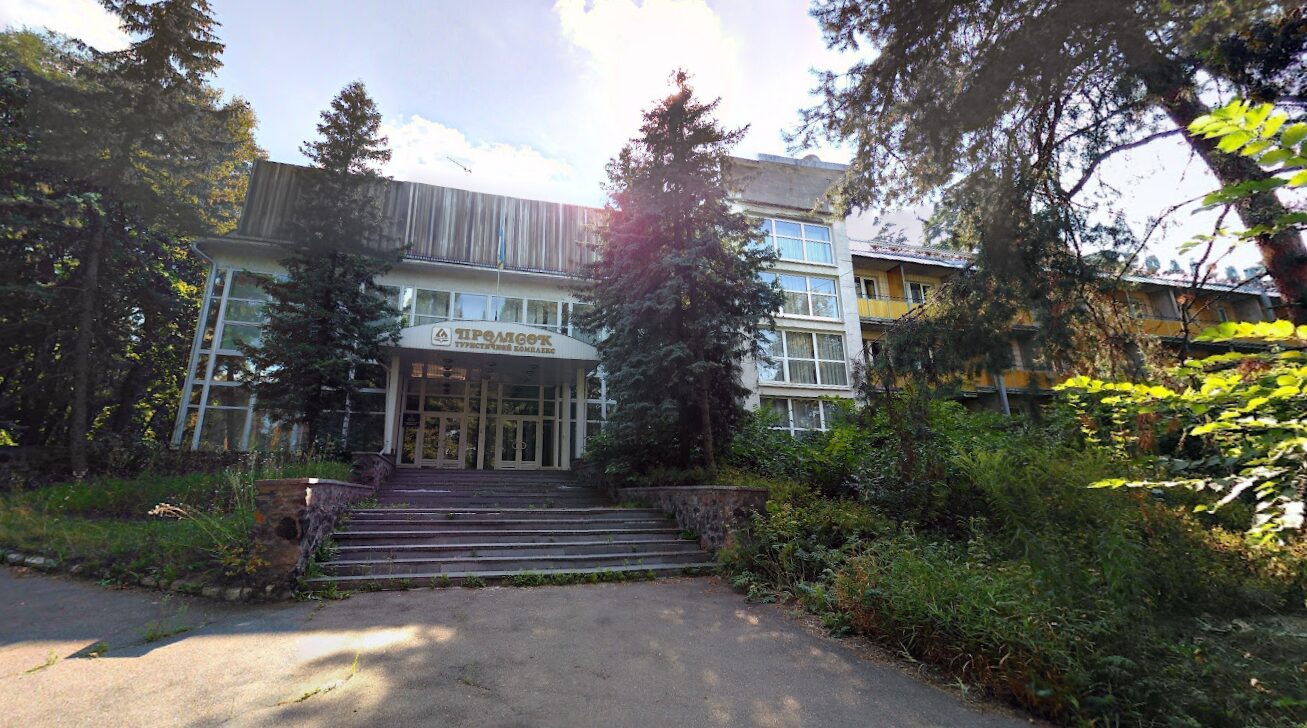
Hotel building, photo from Google Maps
A representative of the Holosiivskyi National Park, Oleksandr Sokolenko, notes that building up this green zone with high-rise buildings will have a significant harmful impact on the Bilychanskyi Forest, a part of the national park:


Photo: Anna Filatova, Moose hit in Kyiv. During the accident, the car was deformed and the windows flew out
The fact that there is a national park nearby should have made such construction impossible. This is a violation of environmental laws. According to the regulation “On the Protection Zones of the Holosiivskyi National Nature Park,” security boundaries are established around the Holosiivskyi National Nature Park, which cannot be less than 250 meters for capital construction of residential and public facilities.
Petro Tiestov, an analyst at the Ukrainian Nature Conservation Group, notes that a forest is not just trees, but an ecosystem that includes many components:


To begin with, the Kyiv City Council authorized the removal of almost 400 trees to make way for the skyscrapers.
On top of that, three years ago, the relevant department of the Kyiv City Council issued urban planning conditions and restrictions for the reconstruction of Prolisok. Although the type of construction work is defined as reconstruction, the project’s official website says that a residential complex is being built. It was the issuance of the reconstruction documents that also made it possible not to specify the maximum permissible percentage of development on the site.
The text in the documents was worded in such a way that it essentially allowed the designers to obtain a construction permit from the State Architectural and Construction Inspectorate, which was being disbanded at the time. Previously, it would have been impossible to obtain such a permit, but during the Groysman government, at the end of 2018, the state building codes “Hotels” were amended. They added the definition of “apartment” and a new type of building – “apart-hotel”.
Apartments are rooms that consist of several living rooms with a bed, a separate place for rest, and kitchen equipment. Incidentally, what was presented as an “apartment hotel” actually fits the description of an ordinary apartment building, because, unlike traditional hotels, they do not require appropriate office space and temporary accommodation services.
The following year, new regulations on “Planning and Development of Territories” were introduced, which added the concept of “recreational housing”. These are private residential buildings intended for permanent residence of homeowners together with temporary accommodation of a limited number of vacationers and located outside of public green areas.
In this case, such residential buildings can be of considerable size – up to 4 floors, and the number of people temporarily accommodated in one residential building should not exceed 30 people.

Image of recreational housing, DBN B.2.2-12:2019 “Planning and development of territories”
Since the current urban planning legislation explicitly prohibits the construction of residential real estate in recreational areas, the developer is now selling “apartments”.
MP Ivan Yunakov (“Servant of the People”) says that “apartments” solve the problem of building housing where it does not belong:

Architect Kyrylo Chuiko has this to say about the changes in state building codes:

And all this then falls on the existing infrastructure of the city. Given that the share contributions for developers have been canceled, the city faces additional problems, and people face inconveniences.
Reconstruction in the legislation is a very vague term. If the plot is not empty and there is at least some small architectural form on it, then new construction can be called reconstruction. Reconstruction also gives you more room for maneuver. Adding a small porch, adding 9 floors, demolishing, and building a new building – formally, all of this can be called reconstruction.
From a global perspective, the system is built in such a way that there are loopholes at every step that allow this to happen. The Land Code, state building codes, and the electronic permit system (EDESBB).
The electronic system operates only with quantitative indicators, not qualitative ones. So if it says that the land plot has a recreational function, everything is fine. If the project says that it is an apart-hotel, the computer agrees. The main thing is to tick the right boxes, not to understand the details. This is a system of blurring responsibility when everyone is not responsible, but the result for society is unsatisfactory.

Now all that remains for activists is to write on social media about the damage caused by the development of such green areas, but in fact, the government has taken away real levers of counteraction.
Three years ago, criminal proceedings were initiated against the developer for abuses during construction, and in February 2022, the site was arrested. However, this arrest was almost immediately lifted.

As a result, the activists have no access to the criminal proceedings, which have hardly progressed at all. Only a few years after the start of the pre-trial investigation, the activists were interviewed as witnesses in this criminal proceeding.
Currently, an expert examination has been ordered to help law enforcement officers better understand the status of the legality of this construction, but it is unknown how long we can expect its results. According to our information, there are about 200 such examinations in the expert’s queue.”
In the meantime, the initiative group of Sviatoshyn residents who oppose this construction continues to appeal to the prosecutor’s office, the State Environmental Inspectorate, and the State Inspectorate for Architecture and Urban Development. A lawsuit was also filed with the district court demanding that the issued urban planning conditions and construction permit be canceled.
Due to the government’s inaction and the amendment to the Land Code, Kyiv residents may lose another green area where they could relax on weekends without having to leave the city.
The story of Prolisok is not the only one. A similar problem, when a residential complex was built under the guise of apartments, occurred in Pushcha Vodytsia, where the court suspended the urban planning conditions for Kyivmiskbud. This was reported by Nashi Hroshi. Before that, Bihus.info investigated how 30 hectares of recreational land were decided to be built up by companies from the orbit of the then-head of the Presidential Office, Andrii Bohdan, and developer Andrii Vavrysh. There are, in fact, many more such cases that were not reported by investigative journalists.
However, it is quite obvious that such stories have gained the right to exist because of poor management decisions with very specific beneficiaries. And the situation needs to be corrected urgently.
 First of all, Article 52 of the Land Code should be amended to remove the possibility of building on the territory of recreational areas.
It is also necessary to change the approach to the wording of the term “apartments” in the State Building Standards, removing the identification with residential development. To do this, it is necessary to establish a mandatory business component in the right to own an apartment. That is, if you buy an apartment in a recreational area, you do so to rent it out and earn income.
Specially for “LB.UA”