Kremlin’s Octopus in the Legal Profession and Blockade of Legislation for Temporarily Occupied Territories

Volodymyr Zelensky has stated that Crimea and the Black Sea battle will become the focal points of the war. While the Armed Forces of Ukraine (ZSU) are doing everything to de-occupy territories, it is necessary to work on establishing a legislative framework in the rear that will allow for the effective restoration of the functioning of government bodies, including in Crimea, after the Victory.
Lawyers are one of the driving communities for proposals on creating such a legislative framework. The National Association of Lawyers of Ukraine (Association) could become the organization that propels these important processes. However, for more than 10 years, the monopoly on managing the legal profession has been held by Lidiia Izovitova, an associate of Putin’s crony Viktor Medvedchuk and another accomplice of the “Russian world” – Serhiy Kivalov.
Frontline lawyers report suppression from the Association, while this organization remains inactive regarding “lawyers” involved in torture on temporarily occupied territories. Additionally, for a long time, the Association has been sabotaging the election of two members of the High Council of Justice by the Congress of Lawyers of Ukraine.
Contacts of Izovitova with russian colleagues
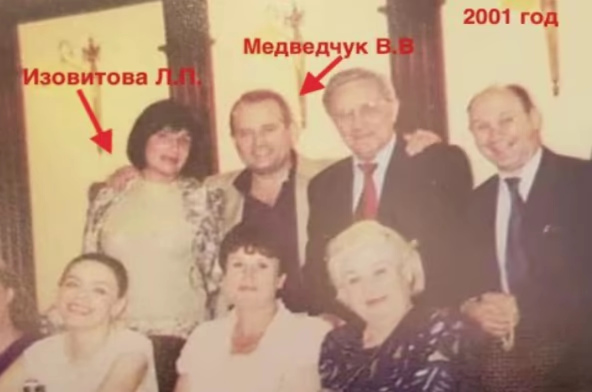
The head of the Association, Lidiia Izovitova, is a long-time associate of Viktor Medvedchuk. She has consistently headed this organization for more than 10 years, and membership and support of which are mandatory for all lawyers. Despite the fact that this position is elective, new elections are not held, citing the ongoing war. Izovitova cannot run again because she has served two terms of five years each.
Why is it impossible to change the leadership of the Association?
Olena Shcherban
Deputy Executive Director of the “Anti-Corruption Action Center”
“Parliament and president change more frequently in our country than the leadership of the legal self-governance, where a certain circle of individuals has simply monopolized power and influence. What then, as a society and as legal professionals, do we expect from the justice system and law enforcement when the self-governing legal profession is reluctant to ‘clean its own stables’ and in some cases even tolerates or cements cronyism.”
Lidiia Izovitova in the Association has a deputy – Valentyn Hvozdii. They attend events together, including a forum in Germany in 2019.
Importantly, at these events, they actively engaged with russian colleagues. As proof, here’s a photo of Izovitova and Yuriy Pilipenko from the Moscow region bar association.
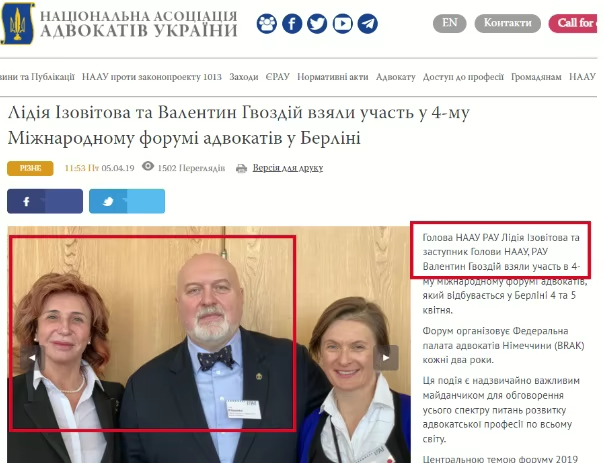
Screenshot from the website of the Lawyers’ Association.
This photo of Izovitova with her russian colleague was intentionally posted on the Association’s website.
So, who is this russian lawyer, Pilypenko? He appears in one of the lists of “Collaborators of the Occupying Authorities” created by the International Anti-Corruption Foundation (an organization supporting Navalny).
Pilypenko “actively supported russia’s aggression against Ukraine, providing assistance to the occupation administration in the Zaporizhia region for the integration of this territory into russia” – that’s the reason stated next to this lawyer’s name, with whom Izovitova so warmly posed for a photo.
Valentyn Hvozdii, who is second in command after Izovitova in the Association and also participates in such “comradeship,” is a member of the supervisory board of the Private Joint-Stock Company “Ukrhydroenergo.” Ukrhydroenergo includes a dozen stations on the Dnipro and Dniester rivers, providing coverage for peak loads, frequency and power regulation, and mobile emergency reserves in the unified energy system of Ukraine. Essentially, Hvozdii found himself in the supervisory board of a strategically important object for Ukraine’s energy security in the midst of a full-scale war.
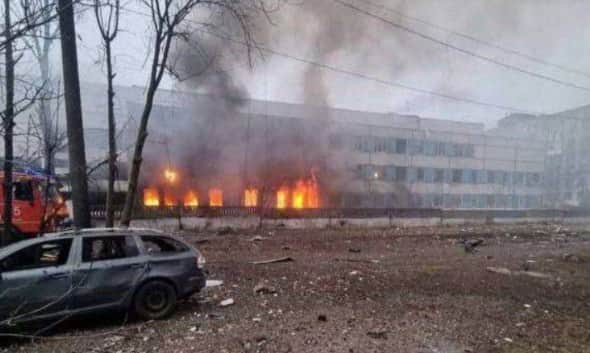
The russian federation’s military incursion into a maternity hospital in Dnipro before the new year in 2024.
It is worth reminding that in 2014, during the Revolution of Dignity, a group of lawyers signed the Act of No Confidence in the leadership of the Association because it failed to make appropriate statements after the adoption of the “dictatorial laws” on January 16. Among the leadership both then and now were Izovitova, Hvozdii, and the then-chairman of the Higher Qualification and Disciplinary Commission of Advocacy, Valentyn Zahariia.
Lawyer Oleg Polishchuk writes that regarding the “dictatorial” laws, Valentyn Zahariia mentioned that they are normal and pro-European. However, according to the information provided by the Association in response to Izovitova’s directive in spring 2014, during the temporary occupation of Crimea, the discussed issue was membership fees, which, due to an endless flow, transformed the Association into a bureaucratic structure.
And here we are, almost 10 years since the start of the Russian aggression, and the leadership of the Association still consists of the same people. Moreover, the leadership of this organization, which is supposed to implement the tasks of self-governance of lawyers, does not react to the actions of those “colleagues” participating in torture on temporarily occupied territories. However, it can help block the legal practice of those who joined the Armed Forces.
“Ours” and “others” for the Lawyers’ Association
Even in the territory under control, there are lawyers who de facto serve the interests of the pro-Russian authorities.
One of the judges of the Supreme Court, Viktor Prorok, recently disclosed an appeal from lawyer Rostyslav Kravets, who inquires about Judge Prorok and his colleague Judge Dmytro Hudyma. The head of the NGO “Legal State” Kravets is supposedly interested in the “absences” and “tardiness” of these two judges. This is despite the fact that the working day and week for judges are unregulated, something a person with a certificate for practicing law should know.
To an uninformed person, it might seem like public oversight of the work of the judicial branch of power. However, if a public organization monitors the work of a certain body, there should be a methodology for such monitoring that applies to all judges, MPs, or officials without exception. Here, however, we have a request about specific two judges. Therefore, it is important to understand who is requesting information, about whom, and why.
Rostyslav Kravets is a lawyer known for supporting the “judges of Maidan” and Oleg Grynkovsky, who is considered a traitor. Kravets was also mentioned in the “Vovk’s tapes.” His “services,” in particular, were used to file lawsuits in which the now liquidated OASK head Pavlo Vovk was interested. This same OASK canceled the new Ukrainian spelling that essentially provided for the de-Russification of our language. Kravets’ organization acted as the plaintiff.
And here, it is worth mentioning the Telegram channel “Under the Guise,” which mostly reposts Rostyslav Kravets.
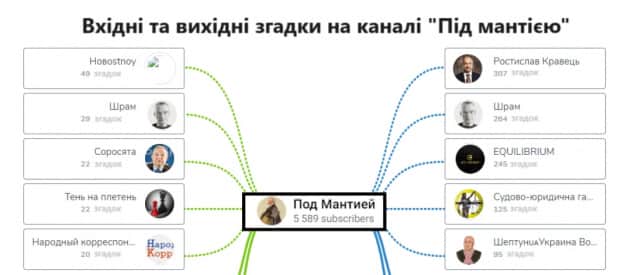
Left-hand TG channels that share posts from TG channel “Under the Mantle”, on the right TG channels that “Under the Mantle” disseminates.
So, the head of the Anti-Corruption Action Center, Vitaliy Shabunin, spoke a few years ago about whose channel this is:
Who is associated with the TG channel “Under the Mantle”?
Vitaliy Shabunin
head of the Anti-Corruption Action Center
Vovk (head of District Administrative Court of the City of Kyiv) offers his services to the “Opposition Platform — For Life” (a political party in Ukraine) for demolishing presidential sanctions against Medvedchuk’s media holding. The “anonymous” judicial Telegram channel “Under the Mantle” suggested a scheme to circumvent the Supreme Court on the issue of lifting sanctions (enacted by yesterday’s Presidential Decree against Medvedchuk’s wallet and his propaganda TV channels). Just in case someone doesn’t know: this channel is backed by Pavlo Vovk and the gang from District Administrative Court of the City of Kyiv/High Council of Justice, who are being pursued by NABU.
I will remind you that the same lawyer Kravets filed a request to recognize the Anti-Corruption Action Center as an extremist organization. Moreover, he often publicly tries to humiliate the member of the VRP Roman Maselko and several judges of the Supreme Court: Ivan Mishchenko, Viktor Prorok, Olena Kibenko, and Dmytro Hudyma. And all this under the slogans of supposed love for Ukraine.
Well, and the channel ‘Under the Mantle’ also reposts the channel ‘Sudovo-Yuridichna Gazeta,’ which often covers Vovk’s position, and Equilibrium. The latter promotes a favorable Russian discourse about representatives of Ukraine’s civil sector, claiming they are ‘SOROSiata’ It negatively portrays public figures advocating for a quality judicial reform, such as Mykhailo Zhernakov, Halyna Chyzhik, and Shabunin, reposting the same ‘Sudovo-Yuridichna Gazeta.’
Kravets’s active activities do not end there. To create confusion, he formed the organization ‘Public Council of Virtue,’ essentially making a ‘name clone’ of a legally defined structure that checks judges and judge candidates for compliance with criteria of virtue and professional ethics.
And Judge Viktor Prorok, one of the two individuals whom Kravets is interested in according to the request, has been very active. He exhibited a proactive stance when it was discovered that the head of one of the cassation courts within the Supreme Court, Bohdan Lvov, held Russian citizenship. Additionally, during the Plenum of the Supreme Court, when the contentious issue of the new staffing schedule was raised, Judge Prorok’s position was also measured and well-justified.
As for Judge Dmytro Gudyma, he received the ‘Honor of the Week’ award from the civil sector. During one of the recent Plenums, this judge emphasized that legislative initiatives by MPs related to the Grand Chamber of the Supreme Court are an attempt to encroach on the independence of the judiciary. This position is shared by the civil sector.
Kravets, an attorney, may have personal reasons to be interested in Judge Prorok. There is a court decision from November 29, 2023, where Prorok, along with other Supreme Court judges, satisfied the cassation complaint of ‘Automaidan.’ This organization sued for the protection of the honor and dignity of Judge Oleksandr Khrymli, who managed to resign. Kravets was the lawyer on the side of the judge in that case. We are yet to find out which cases Kravets has with the Supreme Court involving Judge Gudyma, or possibly the same Khrymli.
So, individuals like Kravets face no ethical consequences for their actions. None. However, lawyers who went to the front to defend Ukraine encounter problems. For instance, lawyer Artem Dontsya has to fight for the right to be a lawyer. He was disciplined and had his lawyer’s certificate suspended for six months. He argues that he criticized activities of the Higher School of Advocacy, which is under the control of the Bar Association.
Lawyer Ilya Kostin, serving in the Armed Forces of Ukraine and writing about the situation in the legal profession for years, emphasizes that the Verkhovna Rada should create a Temporary Investigative Commission to address issues related to Russian influence in the legal profession:
Why isn’t self-governance in the legal profession working properly?
A lawyer who joined the Armed Forces of Ukraine
“The legal profession, courts, and law enforcement agencies are part of the justice system. If one is missing, there is no justice system. Can the leadership of the National Police and the Supreme Court not dismiss individuals who switched sides? So that these individuals continue to perform their duties until a court verdict or the end of the state of war? No, they cannot. But this is the policy pursued by the leadership of the Bar Association: Izovitova, Gvozdiy, and the Association’s secretary Igor Kolesnik. The creation of a temporary investigative commission is the only way. The parliament should take on the function of the Association in legislating rules on ‘who is a collaborator’ and ways to restore the advocacy system in the occupied territories, including Crimea”.
The issue of creating a temporary investigative commission and the situation in the legal profession at the end of 2023 was raised by MP Kostiantyn Kasai (‘Servant of the People’). He already received a response from the head of the relevant committee, Denis Maslov (‘Servant of the People’).
‘… understanding your concern about the raised issues, we inform you that the content of your appeal… has been taken into account and brought to the attention of the people’s deputies of Ukraine – members of the committee on legal policy for possible use in legislative activity,’ the response said.
There is no word in the response regarding the creation of a Temporary Investigative Commission, which Kasai requested. Vladimir Vatras, the chairman of one of the subcommittees, stated that an MP could initiate such a matter himself. But Kasai claims that he already belongs to one investigative commission and advises finding another MP
How could lawyers assist the state?
Tamila Tasheva, the Permanent Representative of the President of Ukraine in the Autonomous Republic of Crimea, emphasizes that the legal component of key directions for the reintegration of Crimea after de-occupation is extremely important. This involves restoring the functioning of government institutions, holding accountable and lustrating individuals who collaborated with the enemy, and addressing the verification of documents.
How does the Association help address these issues?
Tamila Tasheva
the President’s Representative in the Autonomous Republic of Crimea
“The involvement of the legal community in the development of legislation for the effective process of Crimea’s reintegration would strengthen and expedite the preparation for future de-occupation. The Presidential Representative’s team is actively working on this. The primary issue here should be the restoration of our legal profession. For citizens affected by the consequences of the occupation and crimes of Russia, this is a crucial component of ensuring the right to fair justice and proper access to legal assistance. We have appealed to the Bar Association and the Association of Lawyers of Ukraine to form such a personnel reserve. However, the decision of the Bar Council of Ukraine to consider the appeal has been postponed until the end of the martial law”.
It is worth noting that ZMINA emphasized that the head of the Bar Association, Izovitova, and the Council of Lawyers of Ukraine, under her control, protect traitors who work on the side of the occupiers.
As for another organization, the Association of Lawyers of Ukraine, it, in collaboration with the President’s Representation in the Autonomous Republic of Crimea, is developing strategic proposals and recommendations to qualitatively restore the legal profession on the peninsula not only after the victory but also now. Tasheva notes that the proposals involve restoring self-governance of the legal profession and verifying the terms and forms of cooperation between lawyers and occupation administrations, providing training for those lawyers who have not upgraded their qualifications according to Ukrainian law, and more.
Artem Donets, who is currently defending his right to practice law in court, emphasizes that his colleagues could really help legislators not only in issues related to Crimea or temporarily occupied territories:
Who can help resolve the situation?
Artem Donets
a lawyer who joined the Armed Forces of Ukraine
“They could develop effective mechanisms for lustrating politicians from banned parties or block the activities of the FSB in robes. After the liberation of Crimea and other occupied territories, we should already have legislation in place to restore our government’s authority in these territories and address educational issues. Instead of developing these fundamentally important things, lawyers are currently fighting for the right to practice law and self-governance in their sector. It is very advantageous for our enemy for the legal community to be weakened. This is why the Association has been developing a Medvedchuk sprout for over 10 years. Therefore, the role of Members of Parliament, who must resolve problematic issues in the self-governance of lawyers, is crucial”.
Especially for “Ukrainska Pravda“.