What are the dangers of phosphates to us, and why is Shmyhal in favor of an environmental disaster?

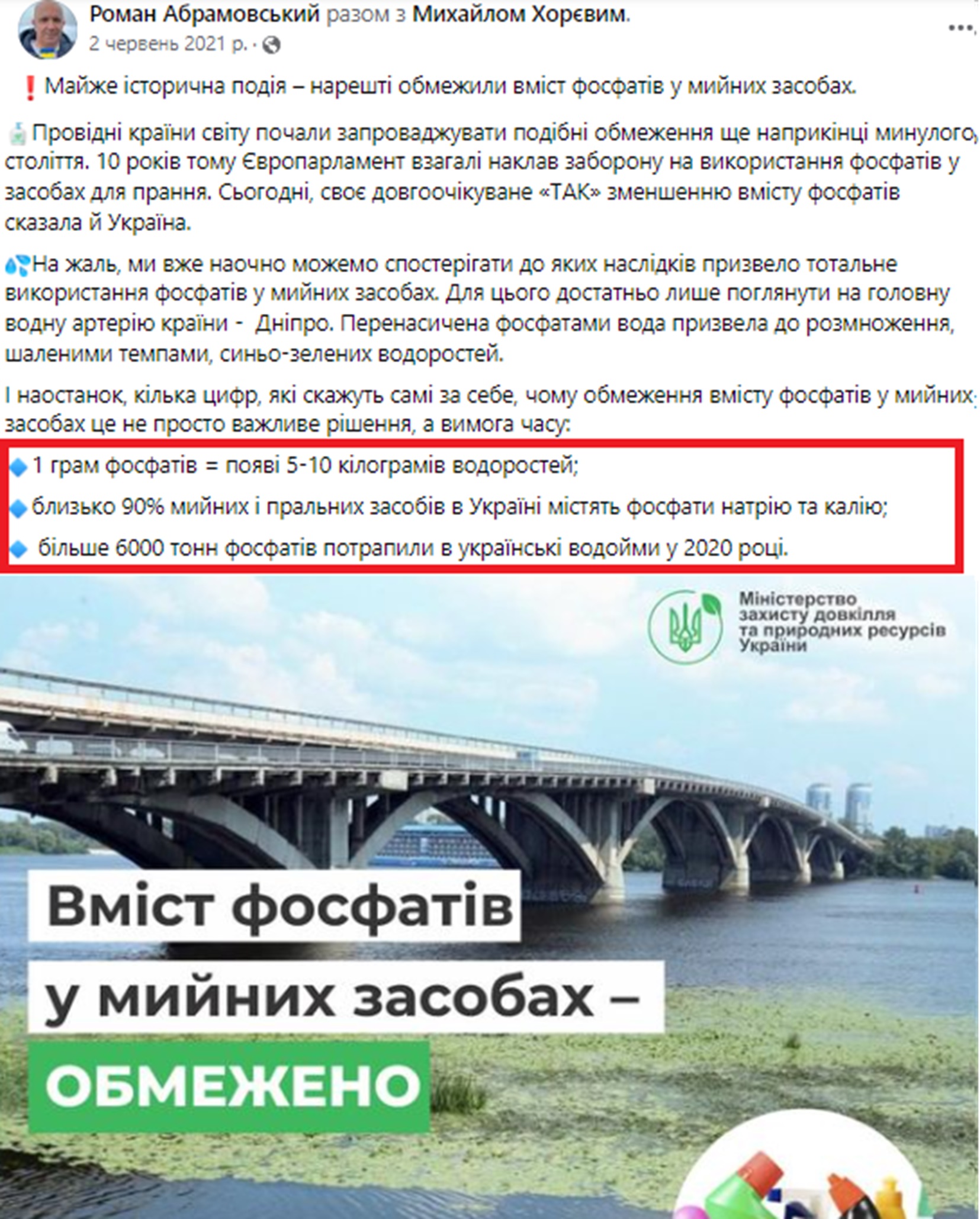
From January 1, 2024, a government-imposed phased ban on the use of phosphates in both household and industrial chemicals was supposed to come into effect. The Cabinet of Ministers supported the relevant document two years ago – before the start of the full-scale war. The then Minister of Ecology, Roman Abramovsky, emphasized that this was a historic decision. Essentially, from that moment, our technical regulations began to align with the requirements of the EU.
The European Parliament imposed a ban on the use of phosphates in laundry detergents more than 10 years ago. And some progressive countries began to do this even at the end of the last century.
However, on December 22 this year, the government postponed the implementation of this regulation. This happened after the European Council approved negotiations for EU membership. Now the environmentally important initiative will come into effect… after the victory. And even then, not immediately, but 90 days after the end of the martial law. But those who already produce detergents with phosphates – these restrictions will not apply to them even after the victory.
How do phosphates harm health?
Phosphates harm our water bodies and cause phenomena such as water blooming – the proliferation of blue-green algae. If there are too many of them, swimming bans may be imposed on beaches because they negatively affect people’s health: skin irritation, itching, swelling of the mucous membranes of the eyes and nose, elevated temperature, muscle and joint pain. They can even cause nausea or vomiting. Children and the elderly are particularly vulnerable to this.
All water bodies suffer from this. When the government made the decision, the Minister of Ecology emphasized that over 6,000 tons of phosphates entered water bodies each year. The Dnipro River, from which 70% of the population consumes water, also suffers.
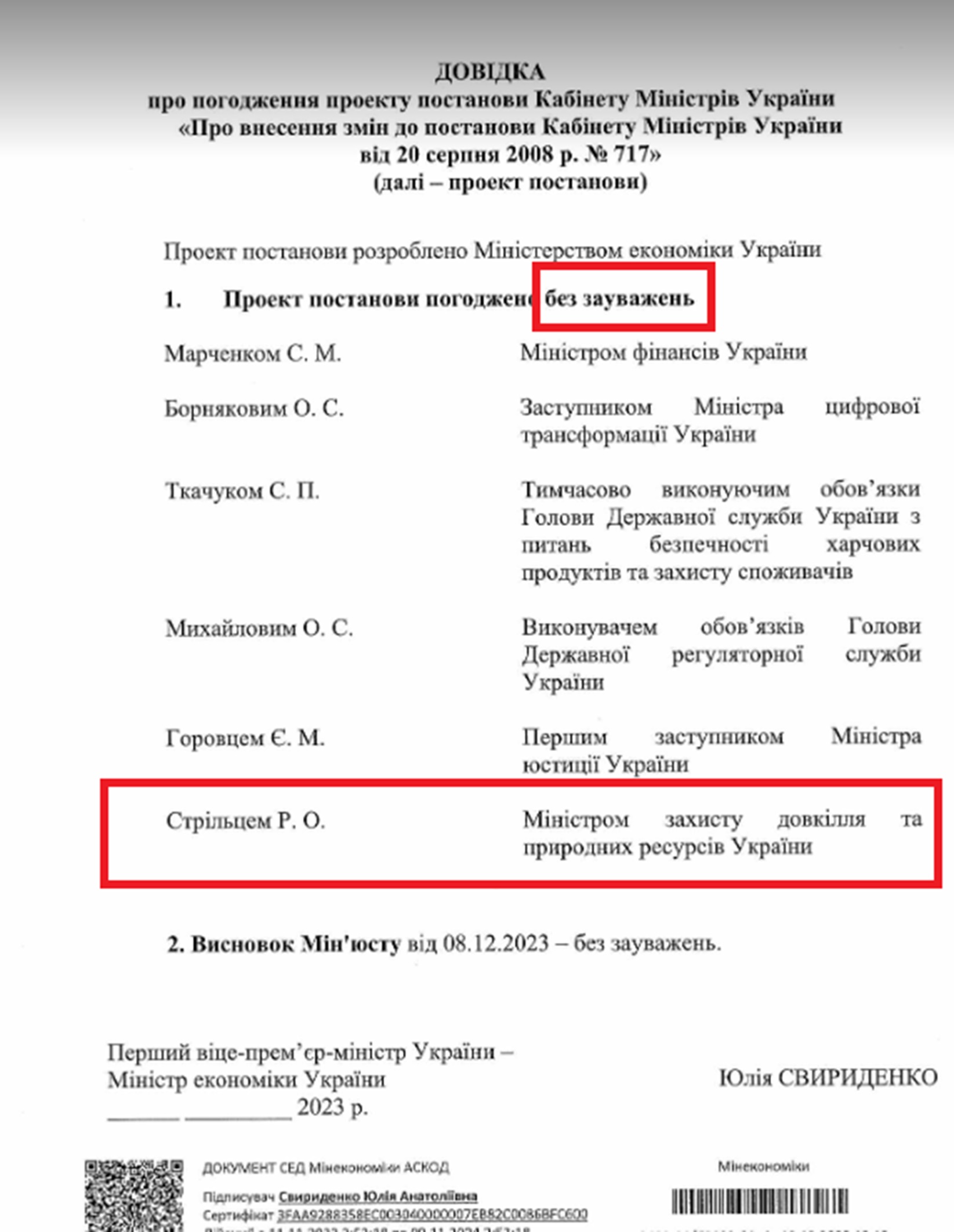
Approval certificate for the Cabinet of Ministers’ draft resolution on phosphates
“It was not the initiative of the Ministry of Ecology. As far as I know, the Ministry of Economy sees certain prerequisites for this. I would really like the Ministry of Ecology not to play the last fiddle in this orchestra,” says MP Oleg Bondarenko (“Servant of the People”), who heads the Environmental Committee of the Verkhovna Rada.
The Ministry of Economy explains that the postponement was necessary due to the conditions that arose during the war.
Why were the new environmentally important rules postponed?
Vitaliy Kondratyev
Deputy Minister of Economy
“There is a technical regulation that defines norms. Large enterprises were supposed to switch to new standards—change technologies. The war started, and associations, such as the American Chamber of Commerce, turned to us. Enterprises cannot make investments and asked to postpone this issue until the end of the state of war. The issue here is purely economic”.
The chemical industry informed a year ago that turnover had decreased by $5-6 billion due to the war. The share of the chemical industry in Ukraine’s GDP is about 3%. In the structure of industrial production, this industry, depending on the year, accounted for 9-10%. At the same time, the volume of the domestic market for chemical products in Ukraine at the end of 2020 was $10.6 billion, of which 74% was imports, and 26% was domestic production.
As of now, there are no answers to the questions of how enterprises will manage to modernize their facilities within 90 days after victory and what to do if the war continues for several more years.
However, it is essential to understand that now the government resolution refers to the following: “To establish that the provision on the market of detergents (providing products on the market—any paid or free supply of products for distribution, consumption in the Ukrainian market during economic activities—editor’s note) introduced into circulation before the date of application of restrictions on the content of phosphates and other phosphorus compounds in detergents, established in Appendix 1 to the Technical Regulation approved by this resolution, cannot be prohibited or restricted due to non-compliance of such detergents with the established limitation.”
Thus, those who have already entered the market will not be blamed or required to change anything.
The Ministry of Ecology says that when working on changes to the technical regulation, they expressed their reservations and plan to make changes to this resolution, specifically concerning the aforementioned paragraph.
What is the resolution about?
Oleksandr Krasnolutskyi
“Here, it is necessary to clarify that it is about goods that will be in circulation in our country at the end of the war. In addition, it will be necessary to work out jointly with the Ministry of Economy a solution to regulate the specified issue to preserve our water resources in accordance with the Projects of River Basin Management Plans, which include measures for environmental rehabilitation and post-war recovery of water bodies. Among them are the modernization of outdated treatment facilities and sewage networks, which will significantly improve the treatment of wastewater and, accordingly, protect water bodies from the entry of such a large amount of phosphates. The requirements of the Ukrainian Technical Regulation on environmental labeling, which will come into effect after the end of the state of war, are stricter than the norms set by EU directives. For example, the EU sets the phosphates limit in detergents at 0.5 grams, while in our case, it is 0.2 grams”.
What are the rules in Europe?
Mykhailo Khorev
Lecturer at Kyiv-Mohyla Academy, former Deputy Minister of Ecology
“In the EU, they have been using phosphate-free detergents based on zeolites and copolymers for a long time. But scientists have found that they also have a negative impact on the environment and human health. The EU governments have set the task of developing a new generation of safer detergents. The REACH program monitors the harmful effects and sets strict limits. Of course, the chemical industry is not thrilled. But they have come to the conclusion that the chemical industry must continue research to create safer household chemicals. The EU Commission warns the chemical business about the future introduction of stricter hygiene and environmental restrictions. Meanwhile, we extend the use of phosphates”.
It is worth noting that this is not the only government initiative criticized by environmentalists. By its resolution, the Cabinet of Ministers established “Forests of Ukraine,” which is expected to become a joint-stock company. Environmentalists see this as a serious threat to preserving the state forest fund. A significant part of the forests could also be protected if Ukraine fulfilled one of its European integration commitments and created an emerald network of particularly valuable territories to preserve rare plant and animal species. However, the Verkhovna Rada has been unable to consider the relevant draft law (4461) for several years.
Especially for “Glavkom”