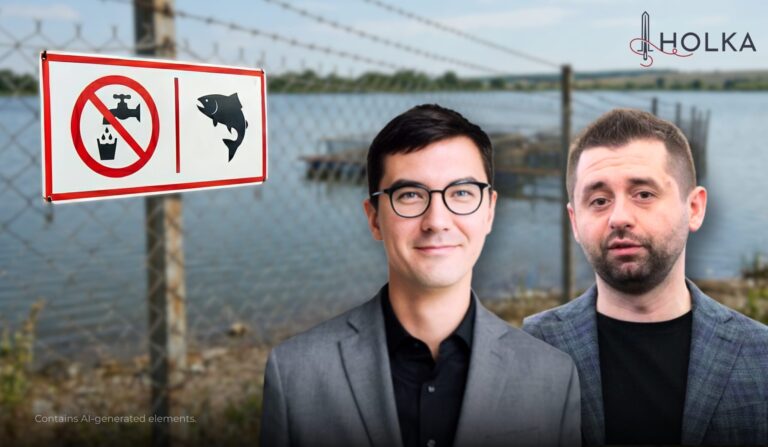
A welcome gift for developers. Member of Parliament Hryvko from the Servant of the People surprised with a bill

A draft law (11506) has appeared in the Verkhovna Rada that allows developers to get what they have been dreaming of for years: to take control of archaeological land.
Currently, according to the law, all archaeological sites are state property, and this is in line with the European Convention on the Protection of Archaeological Heritage, which has been ratified by Ukraine, and the Constitution of Ukraine (Article 54).
However, everything can change, and control over such valuable sites that store information about the statehood and history of Ukraine can be gained by local authorities, which will then be able to transfer these sites to developers.
To do this, it is enough to amend a single article of the Law on the Protection of Cultural Heritage (Article 17).

Excerpt from draft law 11506. Comparative table with proposed amendments to the law
This is the legislative initiative submitted by MP Serhiy Hryvko (Servant of the People). He is known for his earlier proposal to introduce a “childlessness tax” and to allow convicts to “pedal and generate electricity.” He considered this initiative “creative”.
Hryvko is a member of the Committee on Social Policy and Veterans’ Rights, and now he has decided to transfer his “creativity” to the archaeological heritage, and this is no accident.
He was elected to the Verkhovna Rada from one of the majority constituencies in the Chernihiv region. Coincidentally, the Grand Chamber of the Supreme Court recently ruled on the Chernihiv burial mounds, which were transferred to communal ownership by local authorities and then leased to a private company for plowing. The Grand Chamber ruled that the land where the mounds and other archaeological heritage sites are located should be owned by the state only. The court’s decision could have been different if what the MP proposed had become law.
Hryvko explains why he initiated such changes:

He cites as examples cases involving the communities of Semenivka and Sosnytsia in Chernihiv Oblast.
The National Academy of Sciences has already received Hryvko’s legislative initiative to prepare its conclusions for parliamentarians. Researcher Viacheslav Baranov explains to the civic initiative Holka what threats such legislation poses:


Photo: Didintseve Valley, Vasylkiv.info
The Kytayiv mentioned by Baranov is the land within the capital, where archaeologists have discovered the remains of fortifications, Trypillian ceramics, dwellings from the times of Kyivan Rus with clay ovens, and so on. This land was given away for construction for another 20 years during the time of Leonid Chernovetsky. This summer, the Kyiv City Council had a chance to terminate the lease agreements for all 5 plots, but the agreements were extended for three of them, and the prosecutor’s office is still in court over two of them, arguing that there is an archaeological heritage here, which means that the local authorities could not give them away for construction. The former first deputy head of the Kyiv City State Administration, Ihor Nikonov (KAN Development), wants to build here.
Vladyslav Maksymov, director of the International Institute “Actio-Expert” and lawyer representing the Institute of Archeology in the trial, notes that such a legislative initiative contradicts Ukraine’s international legal obligations:

Hryvko’s legislative initiative is to be considered by the Committee on Humanitarian and Information Policy, headed by Mykyta Poturaiev (Servant of the People). The head of the committee noted that, in his opinion, this draft law has no chance of getting either to the Verkhovna Rada session hall or passing the committee.
Member of the relevant committee, MP Volodymyr Viatrovych (EU), also emphasizes the risks of the draft law:
Special to “Glavkom”