Judicial reform. Imitation from Yanukovych to Poroshenko.

Control over the courts has always been important for the presidential hierarchy under Kuchma, Yanukovych, Poroshenko, and Zelenskyy. Recently, Andriy Smyrnov, the “ supervisor” of the courts, was fired on Bankova Street, but the Presidential Office has not given up trying to influence the courts.
Currently, the Parliament is considering a draft law that could help the Office control the Grand Chamber of the Supreme Court, which was created during the reform. It is this chamber that has the “decisive vote” in presidential and parliamentary elections and all-Ukrainian referendums.
Control of the courts gives the president absolute power, which can lead to authoritarianism or dictatorship. The courts are supposed to help maintain a balance between the president, parliament, and government. When disputes arise between them, the courts have the final say.
The role of courts in history is often decisive. Kuchma, whom Ukrainians demanded to be removed from office after the murder of Gongadze, could legally run for a third time. There was a corresponding decision of the Constitutional Court. When Yanukovych wanted to seize power in 2004, the Supreme Court ordered a second round. During the Revolution of Dignity, the Kyiv District Administrative Court, nicknamed the “wolf court,” banned gatherings on Khreshchatyk.
The judicial and law enforcement systems were quick to deal with the Maidan protesters. The first instance finally passed a verdict against the Berkut members last year. The reform of the courts has been going on for more than 10 years, and trust in the courts is still extremely low. Only parties have lower levels of trust. And this is not surprising, as the media reports that Supreme Court Chief Justice Vsevolod Kniazev was caught on bribes, or that a judge of the same court, Bohdan Lvov, was found to have a Russian passport. Without judicial reform, the path to the European Union is closed.
In addition to the influence of the President’s Office, the judges themselves are also blocking the reform and trust in the courts. For example, the Grand Chamber of the Supreme Court recently passed a scandalous ruling that allows the “Maidan judges” to remain in the system. This resolution was criticized by the public sector. It weakens the judicial system, which can be used by Bankova Street.
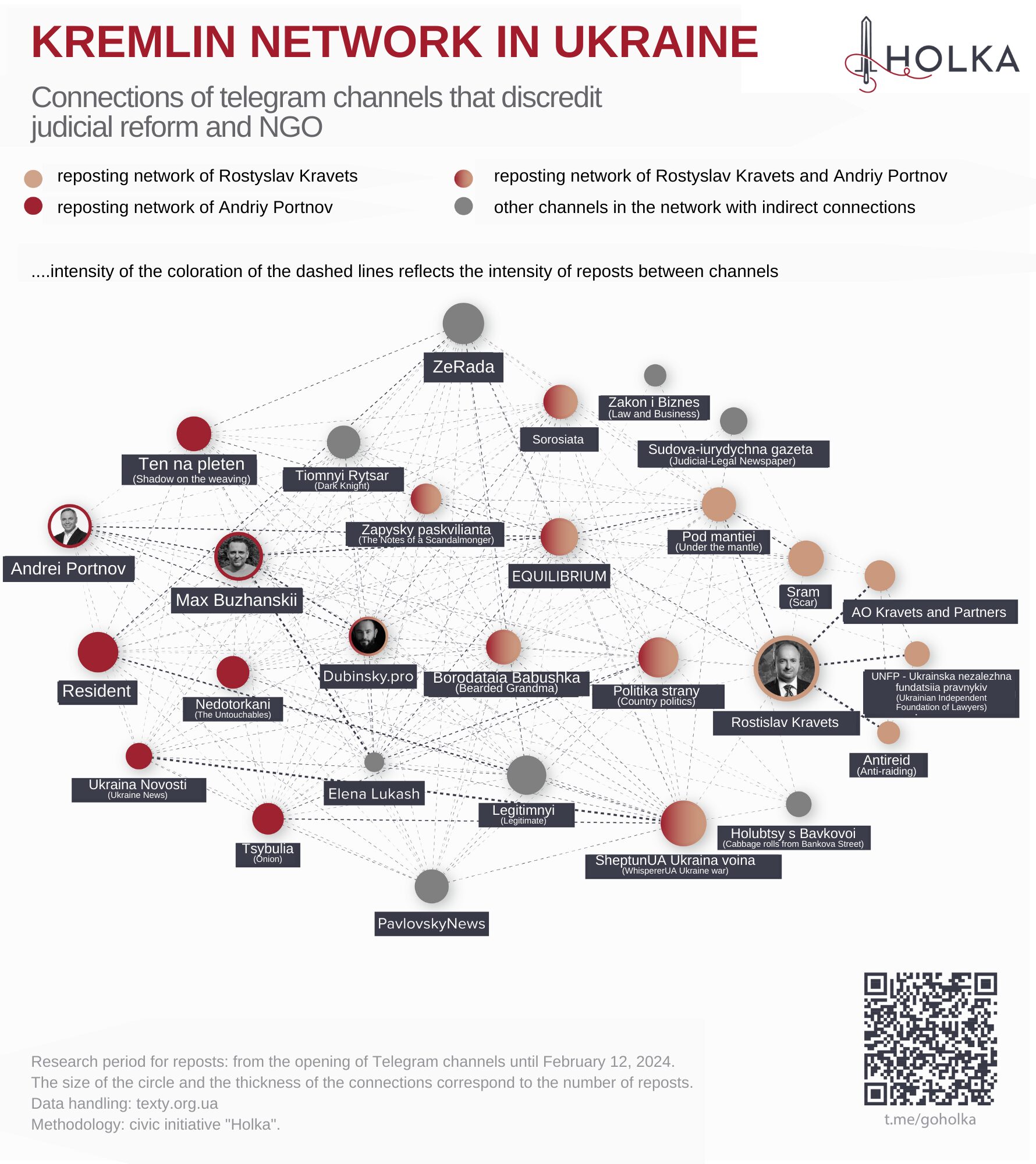
The Holka civic initiative (The Needle) has been investigating why the reform has not been properly implemented for so many years.

The state traitor Yanukovych, first with the help of Serhiy Kivalov and then Andriy Portnov, built his influence on the courts. Kivalov was the head of the CEC during the 2004 elections. The results in the second round were falsified in favor of Yanukovych, and later, as a member of the Party of Regions, he became the head of the Verkhovna Rada Committee on Justice and actively communicated the “success of judicial reform.”

Protest in Odesa demanding to deprive Kivalov of the title of honorary citizen
Photo: “Southern Watch”
Yanukovych realized that he would never gain full power without the control over the courts.
Natalia Sokolenko, a member of the first Public Integrity Council, and a journalist, describes how “effective managers” turned the courts into a business:

The Revolution of Dignity gave a key message – to reform the courts. Poroshenko called it the “number one” task. At that time, the trust in the courts was 5%. Volodymyr Butkevych, who was a judge at the European Court of Human Rights, noted in 2014 that the government “went to the offices of judges.”

However, a year after the Maidan events, they tried to launch the reform. First, the parliament passed the laws “On Ensuring the Right to a Fair Trial” and “On Restoring Confidence in the Judiciary,” and then, to implement the reform, it was necessary to amend the Constitution and adopt a new law “On the Judiciary and the Status of Judges” to replace the Kivalov law.
 As a result of the 2016 reform, anyone who wanted to become a judge had to pass a qualification assessment. For this purpose, the Public Integrity Council was created and the High Qualification Commission of Judges of Ukraine was relaunched. The same evaluation was expected for current judges who wanted to continue working in their court or move to another one.
Previously, judges were appointed by the president for the first five years, and then elected for life and dismissed by the parliament. Since 2016, this has been done by the High Council of Justice. The president retained the ceremonial function of issuing a decree to implement the decision of the High Council of Justice. Thus, this was a step towards independence of the courts from political influence (although Zelenskyy’s office has been trying to regain influence over the appointment of judges by not preparing relevant decrees for the president’s signature for years).
About 1,500 judges then resigned to avoid the qualification assessment. But the High Qualification Commission of Judges never took advantage of this historic moment. Nevertheless, the level of trust in the judiciary is growing (16% in 2018 and almost 25% in 2023).
After the Revolution of Dignity, it was decided to reform the system from the top and focus on the Supreme Court first. To launch the institution from scratch, a competition was launched and lawyers and scholars who were outside the system were involved in the process. However, the Public Integrity Council emphasized that almost one in four of those selected was dishonest.
Roman Maselko, who is currently a member of the High Council of Justice explained:

Vitaliy Tytych, co-coordinator of the first composition of the Public Integrity Council, notes: “Poroshenko had his own Portnovs and Kivalovs. These are Oleksandr Granovsky and Oleksiy Filatov. The reboot of the Supreme Court did not work because a part of active civil society had illusions about the “new” politicians due to the lack of understanding of how the system works. During the first meeting of the Public Integrity Council with members of the High Qualification Commission of Judges, the head of the commission, Serhii Koziakov, proposed to coordinate the lists of candidates for the Supreme Court. He said, “Tell us who you want from your people, and we will tell you ours. Then the partners put pressure on Hromrada (the public council), encouraging it to cooperate with the system. Even those organizations that delegated us to the Hromrada betrayed us. Some of them fought, while others simply preferred to play along with our international partners and show that reforms were underway. There were also information attacks on us.”
Information attacks on honest judges and the public sector are still ongoing.
 Natalia Sokolenko emphasizes that the Public Integrity Council demanded that Poroshenko would stop referring to the public when it comes to the selection of judges to the Supreme Court:
Yet our work was ignored even by the USAID judicial project managers, Natalia Petrova and Oleksandr Piskun, who played along with the head of the High Qualification Commission, Koziakov, in every way possible. After the scandalous list of future Supreme Court judges was made public, Petrova and Piskun continued to finance and organize events with the High Qualification Commission and the High Council of Justice as if nothing had happened. I asked Koziakov: What will you do if the people do not recognize the decision of the Supreme Court that you have formed? Why did you choose Lvov? He was telling the judges how to vote in a secret ballot! This is a competition. They could have chosen the best! And now we have the Grand Chamber's decision on the “Maidan judges.” How can we trust the courts? And this is the key.
USAID event in 2017. Discussing the reform
It is worth noting here that when Bohdan Lviv was found to have a Russian passport, several Supreme Court judges who joined the court during the reform emphasized that Russian citizens have no place in Ukrainian courts. In other words, the Supreme Court has managed to form a core of values, but not a critical mass.
As for Poroshenko and the reforms, he experienced firsthand that they had not been implemented when he left office. Several dozen criminal proceedings were opened against him. The partners warned against political persecution of the former president.
Lawyer Ilya Kostin, who joined the Armed Forces, emphasizes that during the reform, it is impossible to take on the courts “one at a time” and not look at the system as a whole:

It should be recalled here that Lidiya Izovitova, who still heads the Association, apologized to judges during Yanukovych’s time for the actions of lawyers who defended Maidan participants. The unreformed bar also slows down judicial reform.

After being elected President of Ukraine, Zelensky dismissed the High Qualification Commission of Judges. Amendments to the law created the Commission on Integrity and Ethics, which was supposed to check the members of the High Council of Justice and was authorized to dismiss Supreme Court judges for significant violations. However, the paradox is that this commission was supposed to be subordinate to the High Council of Justice and was supposed to check its members. These changes were criticized by international partners. They pointed out that such a change in the system would not work without a restart of the High Council of Justice itself, which was not mentioned in the adopted law.

Protest in Kyiv against the imitation of the reform, 2021
Photo by Radio Svoboda (Liberty Radio)
Zelenskyy’s “reform” was finally destroyed in the spring of 2020 by the decision of the Constitutional Court. The establishment of the Commission on Integrity and Ethics was declared unconstitutional.
A year later, the Verkhovna Rada adopted two presidential draft laws on reforming both the High Qualification Commission of Judges and the High Council of Justice (No. 3711-d and No. 5068). They provided for a reboot of the judicial governance bodies with the decisive vote of independent international experts. At that time, a competition commission was formed to reboot the High Qualification Commission of Judges, and almost immediately the Ethics Council of the High Council of Justice was formed, which began interviewing candidates for the High Council of Justice in February 2022.
The High Council of Justice managed to fill its ranks and make it authorized only at the beginning of last year, and at the end of the year, the newly formed High Qualification Commission of Judges resumed the process of evaluating judges.
Since then, it has turned out that, in addition to the President’s Office, judges themselves can block judicial reform.

The Grand Chamber of the Supreme Court, which is the pinnacle of the judicial system and whose decisions have an impact on the entire judicial practice, had considered a case brought by Vitaliy Usatyi, a judge of the Economic Court of Kharkiv Region.

Judge Vitaliy Usatyi
Screenshot from Channel 24
Mr. Usatyi argued that the decision on his suitability for the position had to be approved by a panel of three members of the High Qualification Commission, and not by two-thirds of the entire commission, as stated in the law. The Grand Chamber agreed with Mr. Usatyi’s arguments. It had previously considered more than one similar case, but the decisions were not in favor of the judges.
The new practice of the Grand Chamber, which was formed in the case of Judge Usatyi, will apply to about 180 more judges whose evaluation has been “delayed” in anticipation of a possible change in the position of the Grand Chamber. Among them are the “Maidan judges”. Now, to overcome a negative opinion of the Public Integrity Council on a particular judge, the High Qualification Commission of Judges will need a majority of votes in the three-member panel of this commission, rather than two-thirds of its 16 members.
“Our conclusion has no effect without this mechanism. The introduction of this “veto” was one of the most important principles of judicial reform,” the Public Integrity Council said.
A member of this council and journalist Tetiana Katrychenko emphasizes:

The Supreme Court explained its position and noted that the High Qualification Commission had mistakenly identified two different procedures – the assessment of an existing judge and the assessment of a candidate who wants to become a judge.
The Grand Chamber, which was formed during the reform, has managed to develop important case law, in particular, to fight the Moscow Patriarchate, protect architectural and archaeological heritage, coastal zones, the nature reserve fund, and to punish the “Maidan judges.” In other words, in 2018-2023, the Grand Chamber demonstrated effectiveness in many cases in formulating law enforcement opinions.
Therefore, a natural question arises: how did the possibility of a “procedural amnesty” for the “Maidan judges” in the form of a change in judicial practice appear 10 years after the Maidan?
The Grand Chamber consists of 21 judges, including the Chief Justice of the Supreme Court. At the time of the scandalous decision on the “amnesty”, there were 17 judges. It is impossible to find out how many of them voted in favor because this is not provided for by law, as well as the mandatory writing of a separate opinion to a decision for which a member of the panel of judges did not vote.
The composition of the Grand Chamber was significantly renewed at the end of 2023. The public had questions about the integrity of some judges, including the current Chief Justice Stanislav Kravchenko, but he was not present during the scandalous vote in June of this year.
To better understand how the votes of the Grand Chamber judges could have been distributed, we can analyze similar cases that the current judges of the Grand Chamber have heard in previous years. In 2020-2021, we managed to find eight similar cases. In all these cases, the Grand Chamber supported the position of the High Qualification Commission.
For example, the ruling in the case concerning Judge Inna Otrosh of the Kyiv City Commercial Court (reflecting the consistent practice of previous years, which has now been undermined by the Grand Chamber in the case of Judge Usatyi) was made by, among others, Judges Yurii Vlasov, Mykhailo Hrytsiv, Zhanna Yelenina, Kostiantyn Pilkov, and Ihor Tkach. They also recently considered the case of Usatyi. The key question is whether those judges voted in the latter case in the same way as they did in the Otrosh case (none of them disagreed with the Grand Chamber’s decision to dismiss the claim).
In addition to these judges of the Grand Chamber, Judge Oleg Tkachuk also considered similar cases earlier. At that time, he did not disagree with the Grand Chamber’s rulings dismissing the claims of Maria Zelinska, a judge of the Solomyansky District Court of Kyiv, and Pavlo Horbasenko, a judge of the Economic Court of Kyiv Region.
Thus, it was possible to find information that six of the 17 judges who satisfied Usatyi’s claim had participated in similar cases before and had not disagreed with the Grand Chamber’s dismissal of the claims.
Could the same judges of the Grand Chamber in 2024 uphold a decision in the case of Judge Usatyi that is opposite to those they made in the cases of Judges Inna Otrosh, Maria Zelinska, Pavlo Hobasenko, Liudmyla Sheremetieva, Oleksandr Kukoba, Mariia Liubchenko, Maryna Lozynska, and Serhii Narizhnyi? Or was Usatyi’s lawsuit satisfied only by those judges who were elected to the Grand Chamber in 2023?
The Parliament can help bring our judiciary closer to the European one by requiring the number of votes for and against when it comes to the collegial decisions of judges to be indicated in the budget without any expenses. In this case, society would at least have an understanding of the distribution of votes (this practice exists, for example, in the European Court of Human Rights).
After the Grand Chamber’s decision in the case of Judge Usatyi, the High Qualification Commission of Judges and the High Council of Justice can either continue to conduct qualification assessments as they have done before (this may lead to a new wave of lawsuits by judges in the future) or try to apply the new case law to those judges whose assessment for suitability for the position has not yet been completed.
This will be a test for the reformed judicial governance bodies to see if they are in line with the goals, ideas, and values of the reform. The future of the judicial system and Ukraine will depend on how they pass it.
Specially for “Glavcom“