
Nullified claims against forest and coastal carvers. How much did lobbyists spend on advertising the petition for Law 12089?

On April 7, Volodymyr Zelenskyy signed a scandalous law (12089) that nullified claims against forest and coastal carve-outs that took place during the Yanukovych era and earlier. If a community or the state wants to return its property taken away over the past 10 years to the court, it must provide a deposit from the budget in the amount of the market value of such property.
The President ignored the petition of Michel Tereshchenko, a descendant of the Tereshchenko family, which gained more than 25,000 votes in late March, demanding that Law 12089 be vetoed. This is despite the fact that in the absence of elections in the country, it is extremely important for our citizens and Western partners to see that there are still effective tools for the public to influence the decisions of the authorities.
In opposition to this petition, dishonest businesses launched their own petition, authored by Andriy Semydidko, an associate of businessman Igor Mazepa. This petition demanding the signing of the law was launched on March 24 and has not yet received the required number of votes. Telegram channels, which did not pay advertising taxes to the budget during the war, massively shared posts with signs of astroturfing in support of Semydidko’s petition.
On Facebook, they ordered ads for more than 200,000 hryvnias (more than $5,300) and reached about 4 million people. Speaking of Telegram, the lobbyists received at least 4.1 million views there as of April 2, and this could have cost about half a million hryvnias. Advertising posts could have cost at least hundreds of thousands of hryvnias. Yet, the lobbyists failed to close the petition.
The Holka civic initiative systematized data to demonstrate how lobbyists for unfair business interests invested in this campaign to create an information field for Zelensky to sign the law.
So, on the first day the petition appeared on the Presidential Office’s website, the key author, Ihor Fris, called on his Facebook followers, who numbered about 25,000, to sign the petition. He also asked his Telegram followers to sign the petition. The head of Monobank, Oleg Horokhovsky, did the same. Still, the votes were not collected.

When the business realized that they were losing in comparison to Tereshchenko’s petition, which was supported by Ada Rogovtseva, Taras Topolya, Ihor Kondratiuk, Valerii Pekar, Oleksandra Matviichuk, and other well-known public figures, they started to shape the information field for money.
More than fifty posts appeared on Telegram, and they started a large-scale information laundering campaign around the 12089 project.

It is worth noting that MP and key author of the project Fris accused the activists of advertising Tereshchenko’s petition for money. And he provided his audience with a cropped screenshot from the page not of the activists but of Ihor Fris’s colleague, MP Yulia Ovchynnikova (Servant of the People), who supported Tereshchenko’s petition.

Screenshot from the Facebook page of Igor Fris
The petition was also advertised on the page of Ihor Levchenko’s party, Narodovladstvo. But these are isolated (!) cases.
Importantly, the public sector appealed to everyone in public, especially politicians, not to advertise Tereshchenko’s petition.
Interestingly, MP Ihor Fris did not make a single post against the Facebook advertisement for Semydidko’s petition and did not ask where the funds came from. According to a study by the Holka civic initiative, at least $5,300 was spent on it. Most of the advertising was done through the pages “Protection of Property” and “Anti-Raider Union.”
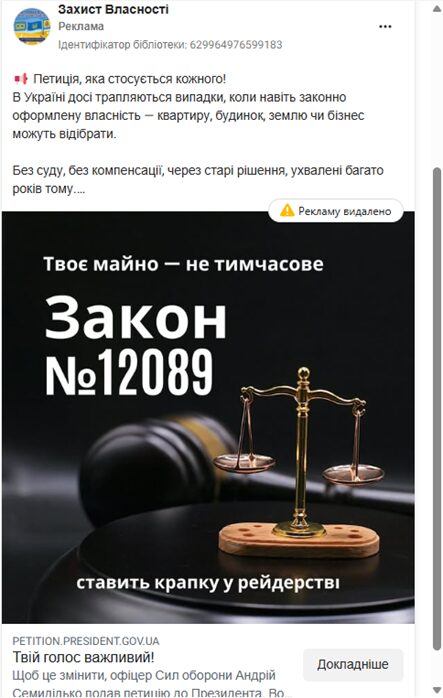
A screenshot from the “Property Protection” page, from which more than $2,000 was spent in total
This is despite the fact that the monitoring period was until April 4, and the ads appeared after that date. Therefore, the amount businesses spend on Facebook is not final.
Moreover, in the last few days of the collection, Tereshchenko’s petition was siphoning off votes by advertising the petition of Ihor Levchenko of the Narodovladstvo party. Therefore, some of the signatories may have made a mistake.
Kateryna Ivanchenko, head of the Center for Innovations Development, which introduced the petition tool in Ukraine, notes:

The vote delay was scheduled for March 26-29. The advertisement featured 3 posts on the pages “Kyiv is our capital”, “Real Kharkiv” ( inactive since 2022), and “Real Lviv” (only 2 posts per page in 2023-2025). Together, these three ads were shown to the audience more than 28 thousand times.
The technology of delayed voting worked in parallel with another one – voting blocking. Throughout the 10 days of signature collection for Michel Tereshchenko’s petition, citizens complained en masse that they received a 404 error. Some tried to vote several dozen times.
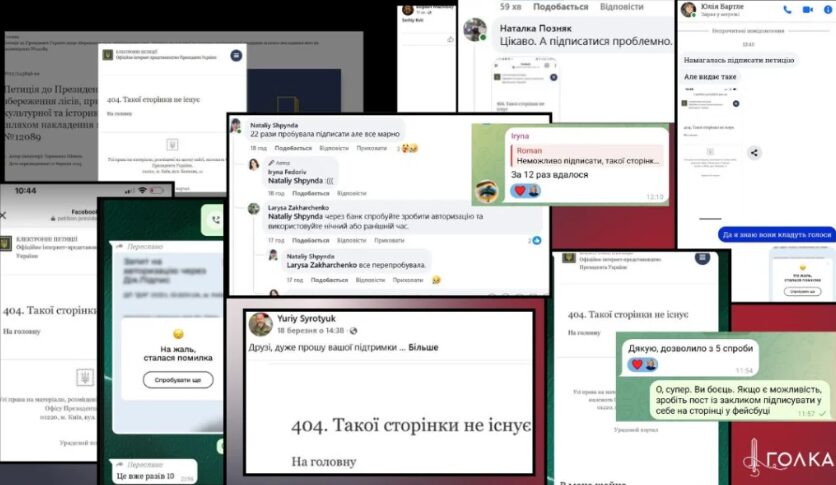
At the same time, the Office of the President informed the Holka civic initiative that there were no problems with collecting votes for the petition.
How were the votes on the Telegram collected?
Activists also turned to Telegram channels to spread their petition, but it was a native partner network. As for Semydidko’s petition, its lobbyists used a combined approach. Some of their channels worked natively, without advertising. A significant number of channels were likely to provide content for money — and a lot of it.

As for Semydidko’s petition, Trukha, Times of Ukraine, and other million-dollar channels were involved. To understand, one post on Ukraina Online can cost almost 90,000 UAH, Trukha costs almost 80,000 UAH, and the Times of Ukraine costs almost 80,000 UAH. The state does not receive any taxes from these funds, and I must emphasize this once again. For “virtuous” businesses, such methods of pressure and shaping the information field have become quite acceptable.

A screenshot from the Telegram ad aggregator when you try to book ads online for Trukha and Times of Ukraine
Although the post was viewed by more than half a million users, it did not help the lobbyists collect the required number of votes for the petition.
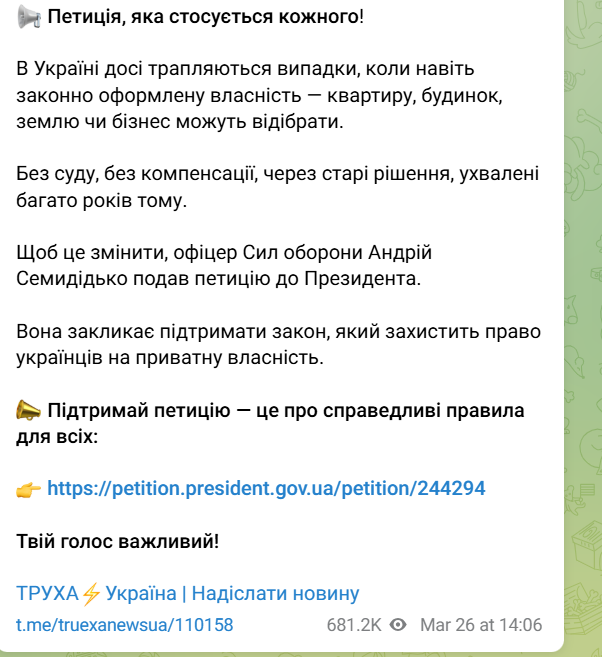
Screenshot from the Telegram channel “Trukha”
Here is a graphic that shows which channels, from 1,000 to over a million, covered the posts.

Of course, not all of them were advertising. After all, lobbyists have their own Telegram channels, and no one paid for posting here, of course. However, the more than 223,000 views of Horokhovsky’s post on his own channel did not help him collect votes either. These figures prove that even the audience loyal to businessman Horokhovsky and MP Fris, who would have been enough to sign the petition, did not support the nullification of claims against the carve-ups.
The messages supporting Semydidko’s petition contained essentially the same thesis: “It’s time to defend your right to land, housing and business. Because tomorrow, all this can be taken away. Without a trial. Without compensation. Without justice” and emphasized that the petition was initiated by an ‘officer of the Defense Forces’.
Sponsored content (without disclosure) in the media and astroturfing
In addition to advertising on Facebook and Telegram channels, several media outlets promoted the petition of the lobbyists of Law 12089.
On March 24, Semydidko’s blog was published on Censor.NET. As a blogger, he posted this text himself without editorial pre-moderation. It is worth noting that the representatives of Censor.NET, Yuriy Butusov and Tetiana Nikolayenko, supported Tereshchenko’s petition, not Semydidko’s.
However, after the blog was published, a number of media outlets turned Semydidko’s column into news (including Gordon, TSN, and others). The same headlines and text suggest that these materials may have signs of “jeansa”, which is a Ukrainian word for sponsored content without disclosure. It is important to note that none of the materials is labeled as “advertising”
A collage of screenshots from the TSN and Gordon websites with the same headlines in the news
Different media outlets cannot take from Semydidko’s blog and make identical news with the same headlines. Therefore, this is a sign that a ready-made text was sent out for posting.
There were media outlets with different headlines that did not refer to Censor.NET. This includes NV. Business.
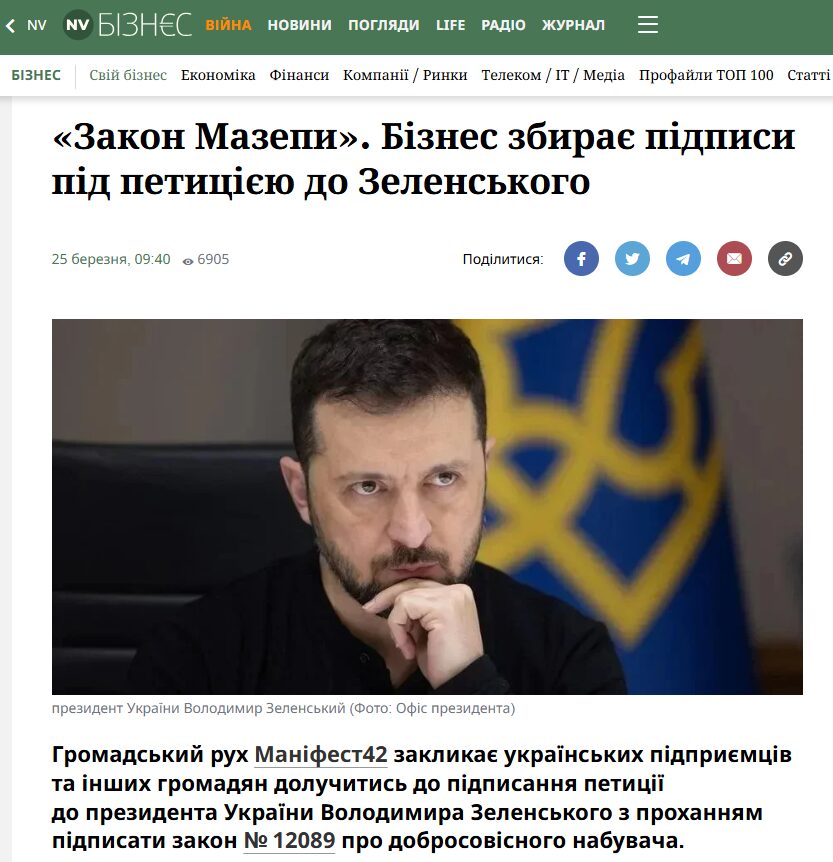
It is worth recalling that in 2024, a number of Telegram channels and media participated in the whitewashing of Ihor Mazepa. Fewer questions arise about anonymous Telegram channels than about the media, which should have a neutral and balanced presentation.

Despite a massive campaign on Telegram, Facebook, and the media, lobbyists failed to collect votes for Semydidko’s petition, but Zelensky signed Law 12089.
Now we should look for 45 MPs who will be ready to appeal to the Constitutional Court and urgently prepare a new bill that will mitigate the effect of legislative initiative 12089. Also, when Parliament and the government fail, the judiciary has repeatedly proved its extremely important role in the country. Therefore, we need to keep an eye on the judicial practice. Here, obviously, the courts should use the Constitution rather than an unconstitutional law.
As a reminder, on March 25, Parliament also passed another scandalous draft law, 9549, which President Volodymyr Zelenskyy vetoed last year. Although MPs did not override the President’s veto, Speaker Ruslan Stefanchuk signed the document and sent it to Zelensky for his signature.
For reference, the research methodology and data can be found here.