European Parliament adopts Resolution highlighting risks in the “Ihor Mazepa Law”


The European Parliament has adopted a resolution stating that the so-called “Ihor Mazepa Law” threatens the restitution of state ownership of forest and coastal land. The controversial draft law No. 12089 was introduced and lobbied by Ihor Fris, an MP from the “Servant of the People” party, whom the media link to the oligarch Ihor Kolomoiskyi.
The European Parliament’s Resolution says:
“Draft Law No. 12089 allows the legalisation of private ownership of land plots that were illegally removed from state ownership, including forests and water bodies. Such an approach does not belong to the EU legal system and, in its current wording, contains legal uncertainty that will make it impossible to return such land to state ownership.”

(Excerpt from the Resolution in the original language).
Yaroslav Teleshun, Head of Policy and Advocacy at WWF-Ukraine, told the civic initiative “Holka” that the Resolution is not legally binding on the governments of candidate countries, but its provisions serve as a guideline for the European Commission in assessing a candidate state’s readiness for EU membership:
“After the Office of the President ignored a letter from civil society organisations demanding a veto of the law and a petition by Michel Tereshchenko, it was only logical for NGOs to appeal to the European Parliament and other EU institutions regarding the potential inconsistency of certain provisions of the draft law with the EU acquis.
It was only a matter of time before the voice of civil society would be heard. And here is the result – a consolidated decision outlining the necessary steps to resolve the existing problem at the level of a Resolution of the representative body of the European Union.”
Teleshun adds that the European Parliament’s Resolution is an excellent example for civil society institutions not to doubt their own strength and to defend their position both nationally and internationally.
Petro Tiestov, an analyst with the Ukrainian Nature Conservation Group, points out that this law violates not only EU requirements but also the Constitution of Ukraine:
“In fact, even before the law was adopted, the Head of the Commercial Cassation Court, Larysa Rohach, stated that the draft contradicts the Basic Law, noting: ‘Will it not happen that the courts will be guided by the Constitution, and not by this law?’ But MPs ignored this, and now we are suffering reputational losses on the international stage. We hope that Parliament and the government will heed this position.”
The civic initiative “Holka” conducted a study confirming that throughout the year developers ran a lobbying campaign in the media to create an information environment favourable to the adoption of the “Mazepa Law”. The first victim of this law was Protasiv Yar – a green zone in Kyiv defended by the now-fallen Ukrainian activist Roman Ratushnyi.
Only the “European Solidarity” faction did not give a single vote for this legislative initiative.
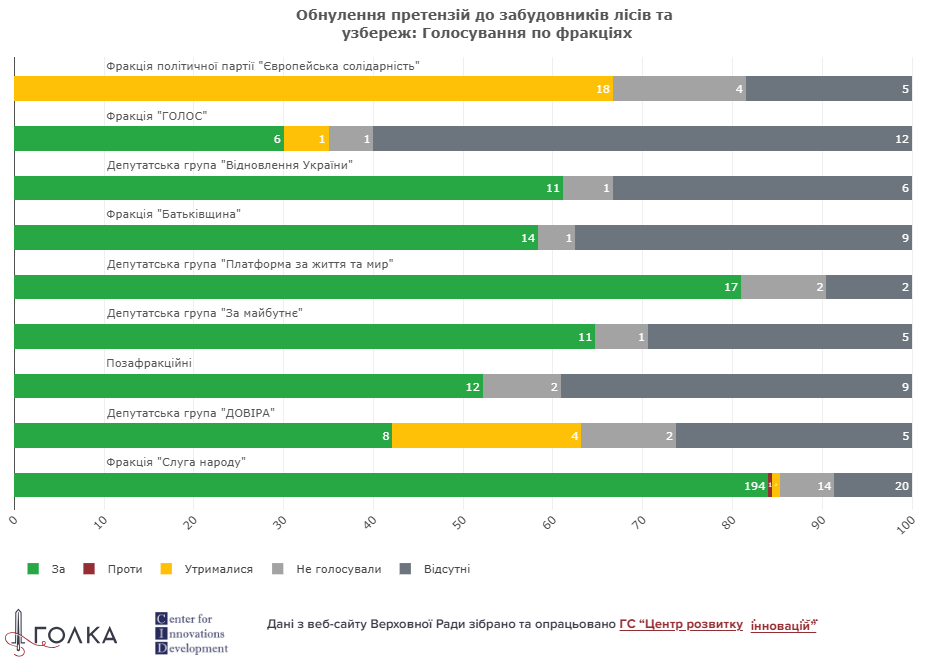
The “REchargeUA is in your power” platform provides a nominal list of MPs who voted for this draft law, including the distribution by faction and single-mandate districts.
Earlier, the European Parliament had already expressed concern about another law – the urban-planning “reform” of the “Servant of the People” party leader Olena Shuliak. The Royal Institute of International Affairs (Chatham House) warned that the provisions of draft law No. 5655 could lead to a cartel collusion among developers. The President subsequently refused to sign it, stating that this was his personal decision.


