The Year of the ‘Ihor Mazepa Law’: Are courts managing to curb the legalization of stolen property, and what is Stefanchuk planning?

Exactly a year ago, the parliament voted for the scandalous “Ihor Mazepa law” (4292-IX), lobbied by MPs from the “Kolomoisky group”. The law was named after one of the lobbyists of this initiative – businessman Ihor Mazepa, who was suspected of creating a criminal organization and seizing land of the Kyiv Hydroelectric Power Plant. The law provides for zeroing out claims against those who plundered forests and coastlines if more than 10 years have passed since their alienation. And if such a period has not yet expired, the case can be considered only if funds are transferred from the budget to the court’s deposit – the market value of the disputed property. They are needed to be given to the acquirer of the disputed property if the court considers them a bona fide acquirer and satisfies the lawsuit.
Last year, President Volodymyr Zelenskyy disregarded a petition supported by Ada Rogovtseva, Taras Topolia, Valeriy Pekar, Oleksandra Matviichuk, and other prominent Ukrainians who demanded a veto on the law. After it entered into force, the European Commission and the European Parliament called such an initiative the legalization of stolen property, and European Commissioner for Environment Jessika Roswall emphasized that forests and wetlands in Europe could become a natural line of defense.

Original fragment of the text of the European Parliament Resolution,
No. 12089 is the draft number of the “Ihor Mazepa law”
Protasiv Yar became the first victim of the new law, which received the number 4292 after adoption. The first-instance judge refused to consider the Protasiv Yar case in the absence of a deposit. It took the prosecutor’s office almost a year to prove in the Supreme Court that the case should be considered, and budget money does not need to be deposited in the court for this. The judges of the Supreme Court formed a positive judicial practice and emphasized that the court will assess the good faith or bad faith of the acquirer during the consideration of the case, and not at the time of filing the lawsuit.
And now the Chairman of the Verkhovna Rada Ruslan Stefanchuk proposes to rewrite the Civil Code and legalize everything entered into the state registers.

As soon as the president signed the law in April 2025, the Commercial Court of the city of Kyiv left the prosecutor’s lawsuit regarding the protection of Protasiv Yar without motion due to the lack of a deposit.
In response to an inquiry from “Holka”, the Prosecutor General’s Office reported that the state did not provide any funds for such deposits in the 2026 budget:
The implementation of the Law requires significant additional expenditures from the State Budget of Ukraine… during martial law. Failure to deposit funds is grounds for returning the statement of claim. And resolving the issue of good faith or bad faith acquisition of property is carried out during the court’s consideration of the case on the merits. That is, in the absence of budget funding, state authorities and local self-government bodies are deprived of judicial protection when reclaiming property from bad faith acquirers.
Ultimately, the prosecutor’s office proved in the Supreme Court that the value of the land plots from the budget of the city of Kyiv should not be deposited into the court’s account. The panel of the Commercial Court of Cassation, among other judges, included the head of this court – Larysa Rohach (this case was also considered by Yehor Krasnov and Hryhoriy Machulskyi).
It was Rohach who, during the consideration of the draft “Ihor Mazepa law” by the relevant parliamentary committee, emphasized to the MPs that the legislative initiative is aimed at protecting the dishonest acquirer, and added that it could happen that judges will use the Constitution altogether, rather than that law. In addition, the judge rightly emphasized that those supposedly bona fide acquirers of state and communal lands cannot fail to understand that this property is located, for example, on the shore or in a protection zone, because in many cases it is obvious.
The lawyer acting on behalf of the community in the Protasiv Yar case, Anton Dykan, notes that the courts will now consider their case without paying deposit funds:

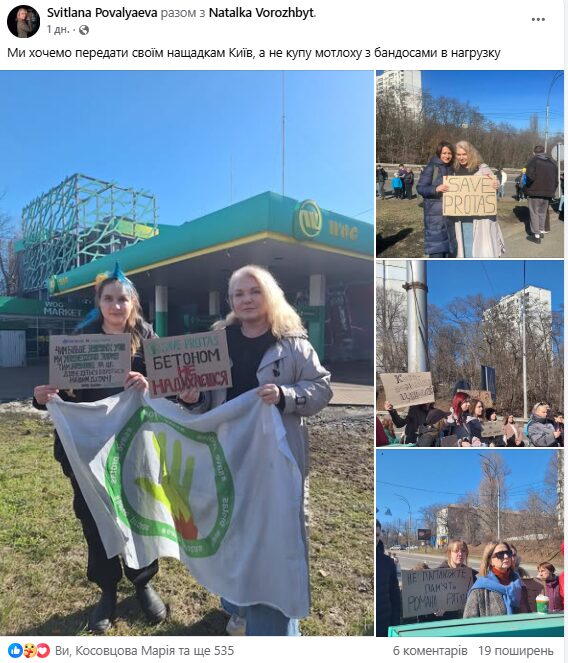
A post by writer Svitlana Povalyaeva, mother of two fallen defenders of Ukraine, one of whom – Roman Ratushnyi – defended Protasiv Yar
Besides Protasiv Yar, there are other cases that fell under the “Ihor Mazepa law”, in which the acquirers of the “stolen” property demanded deposits to be made for the consideration of the cases. This refers, in particular, to land plots in the Ivano-Frankivsk region. But there, unlike Protasiv, where a limited liability company is suing, the defendants are citizens. And therefore, such cases are considered by the judges of the Supreme Court in the Civil Court of Cassation. It was these judges – Dmytro Hudyma, Iryna Dundar, Yevheniy Krasnoshchokov, Vasyl Krat, and Pavlo Parkhomenko – who first in the Supreme Court formed a positive practice regarding the absence of the need to “freeze” budget funds in court accounts as the market value of the property, for the return of which the state and communities are fighting. Their decisions at the end of 2025 formed the basis of all subsequent practice on this issue. Ironically, Judge Vasyl Krat was one of the unofficial co-authors of the “Ihor Mazepa law”, and the key author of the draft law, MP Ihor Fris (“Servant of the People”), thanked him for this.
The Supreme Court noted that it is the judges who must assess whether the acquirer of state or community property is bona fide. This is possible exclusively during the consideration of the case, and not on the day of filing the lawsuit. Therefore, a deposit to start considering such a case, if the plaintiff considers the acquirer dishonest, is not needed. Currently, the prosecutor’s office can still protect the property of the state and the community. In particular, if it proves the bad faith of the acquirers of public property. But this happened not thanks to the new law, but despite it, and requires significantly more evidentiary and time resources from prosecutors. After all, due to the MPs’ manipulations with formulations in laws, the process of changing judicial practice has started. Different courts apply the “Ihor Mazepa law” differently. Until a stable judicial practice is developed on all issues of this law, a lot of time will pass. There are risks of building upon or otherwise destroying natural and cultural objects. There is also a risk of another replacement of all the rules of the game in case of the adoption of a new Civil Code. This is exactly what dishonest acquirers need, who are waiting for the ten-year period to expire from the day they received ownership of what they could not have received under any circumstances.
Previously, the Civil Code worked like this: if it concerned lands or other objects that, according to the Constitution and laws, cannot be in private ownership (for example, coastlines, archaeological monuments, national and regional landscape parks), the state or community could demand their return through the court, removing obstacles to their use and disposal of such property. Because this is public property that belongs to everyone. But the “Ihor Mazepa law” actually changed this logic. Now the right of the state or community to return such objects is no longer considered undeniable. It needs to be proven in court within the limits outlined by this law. That is, now the state or community has to prove that a person or company that received, for example, land near the water or a piece of a national park with century-old trees, acted dishonestly. Otherwise, if the acquirer is bona fide, and the court reclaims the property from them for the state or community, then the latter, in case of depositing funds into the court’s account, actually buy out this property at market value.
Proving the bad faith of the acquirer in court is quite difficult. This is an evaluative and often subjective issue. Because of this, there is a risk that returning such lands or other objects back to the community or state will be much harder. For such a return, the bodies filing lawsuits must use their powers before going to court to collect information about the affiliation of persons involved in transactions with state or communal property, or to obtain evidence that even by visual signs the acquirer should have understood that they have no right to receive this property into private ownership. Open sources on the Internet, maps, and state registers should help with this in a certain way, but unfortunately, the MPs closed some of them from the general public.

Almost all factions and groups voted for the law, which attempted to legalize stolen property, except for “European Solidarity”, where all MPs abstained. A part of the MPs from the “Dovira” group and the one and only politician from “Holos” – Volodymyr Tsabal – also abstained. Even those representatives of “Holos” who position themselves as anti-corruption activists voted “for”. For example, Oleksandra Ustinova and Yaroslav Zheleznyak.
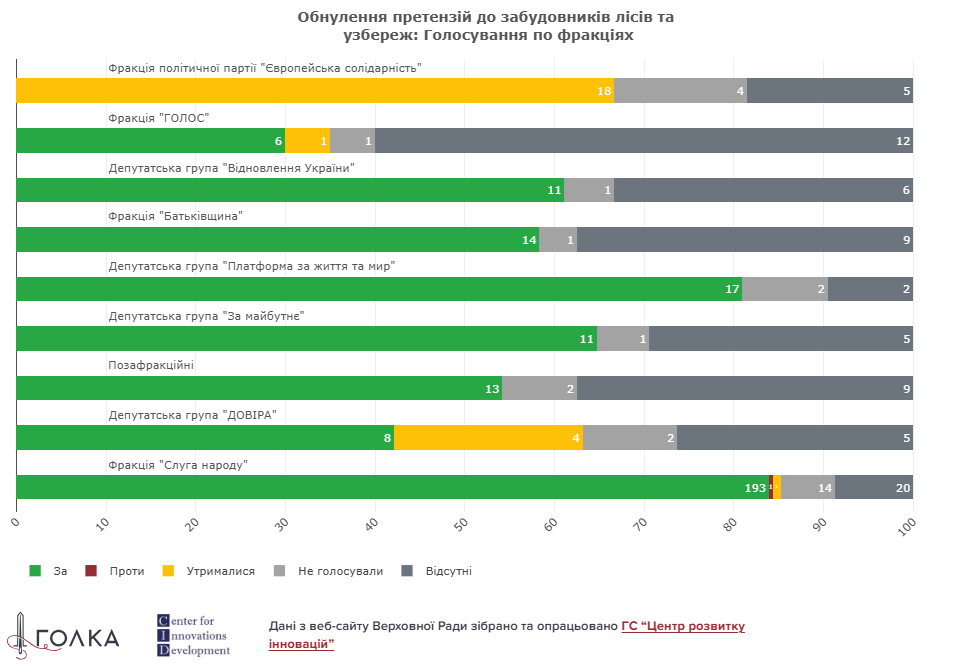
Graphics from the tool “Recharging the country is in your power”
“Holka” wrote letters to the representatives of “Holos”, but as of the publication of the article, they have not answered.
The first author of the draft law 12089 was “Servant of the People” Ihor Fris. Media believe that this politician is part of the informal Kolomoisky group, which is linked to the development of the Carpathians. In response to “Holka”‘s letter, the MP quoted from the explanatory note to the draft law and described a number of cases considered by the European Court of Human Rights. They, according to the politician, should testify to the expediency of depositing into the court’s account exactly the market value of the property that the state or community wants to return through the court.
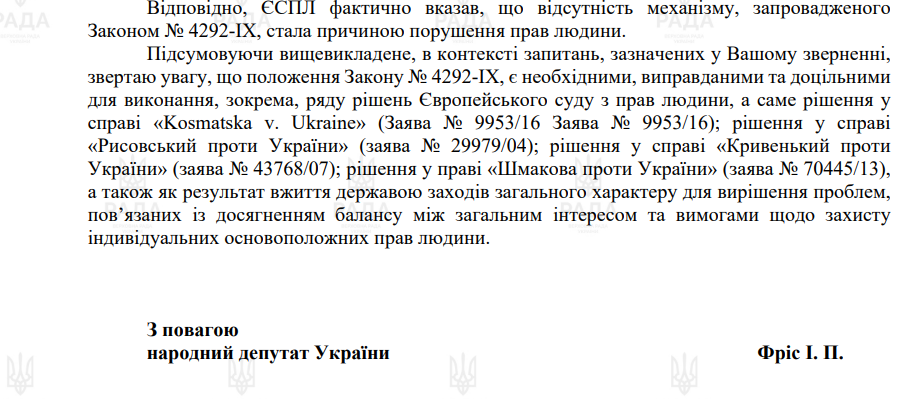
A fragment from Ihor Fris’s response to “Holka”‘s letter
But the examples provided by MP Fris are unrepresentative given that in the practice of the European Court of Human Rights, there are no rules stating that there must be compensation for the court’s return of state or communal property, but none for the return of private property. Just as there is no such thing that in all cases without exception, the return of state or communal property requires paying its market value to the defendant, even if they acquired this property for free. In addition, there are cases that relate, for example, exactly to coastlines. And those are the ones that should be considered. One such case is “Depalle v. France”. In it, a Frenchman whose house on the coast was demolished tried to prove that having a house on the seashore is completely normal and demanded compensation, but lost. The Supreme Court mentioned this case in its decisions when it came to the protection of coastlines.
Supreme Court Judge Dmytro Hudyma, who, like Larysa Rohach, was a judge of the Grand Chamber of the Supreme Court for a long time, emphasized in the program “My Kyiv” that in the decisions of the European Court of Human Rights there is no obligation to pay the market value in all cases without exception to the one from whom the court reclaims state or communal property. And he noted that the law gives such an acquirer the opportunity to return funds, in particular, from the person from whom they purchased this property. The judge noted that there were two main motives for its adoption in the explanatory note to the draft law 12089. The first is the practice of the European Court of Human Rights. And this ideology is generally correct. But what the lawmakers wrote down hardly has much in common with the practice of the European Court. And there was a second motive – to review the established practice of the Supreme Court. And this motive is dubious from the point of view of social progress. The development of legislation should follow the path of implementing the conclusions of the Supreme Court into legislation, and not vice versa. Judicial practice regarding cultural heritage objects that are not subject to privatization, lands of historical and cultural purpose, nature reserve and water funds is clear and predictable. For example, in the case of a coastline, its acquirer can even visually verify exactly what they are receiving into ownership, and that such property cannot belong to them. For the return of such objects, the statute of limitations continues throughout the entire time of the violation of the rights of the state or community.
It is absolutely right that MPs should reflect on how to develop a legislative framework to bring the organizers and perpetrators of land schemes to justice. Especially since land relations are one of the most corrupt areas in Ukraine and lead to the loss of lands by the state and communities. This is stated in the NACP research.
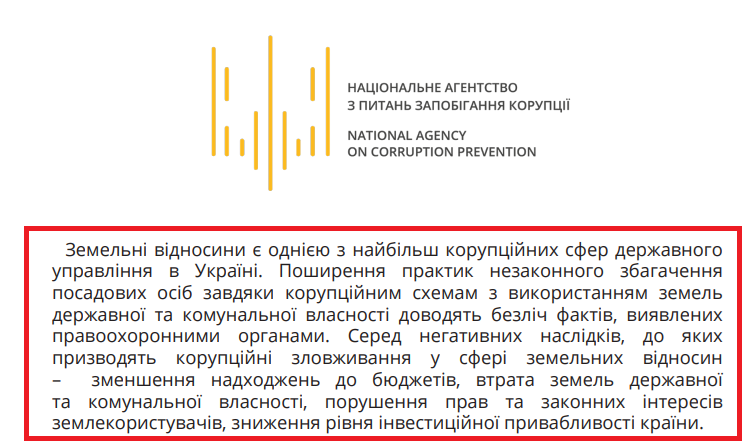
Fragment from the NACP research
The Head of the Commercial Court of Cassation Larysa Rohach emphasizes:

It turns out that until the state regulates this issue, the justice system will stop land schemes whenever it can. And in order to effectively bring to justice for corrupt actions involving the squandering of property, it is necessary to change not the Civil Code, but… the Criminal and Criminal Procedure Codes. However, the MPs once again set about changing precisely the Civil Code. And the flagship in this process is the Chairman of the Verkhovna Rada Ruslan Stefanchuk and his colleagues from the Institute of Lawmaking and Scientific-Legal Expertise.

In a year, dishonest business understood that the plan was not entirely successful, and courts will protect the interests of the state or community from dishonest acquirers without using the “Ihor Mazepa law”. Therefore, it will not be necessary to deposit funds from the budget into the court’s account. However, if there is no evidence of the acquirers’ bad faith, the courts will dismiss the lawsuits. And such acquirers will triumph, forever keeping the fenced shores of seas, rivers, lands in national and regional landscape parks, archaeological sites, etc. And citizens will observe this triumph of the “sacred” right of private ownership of property, which under no circumstances could ever become private.
At the end of last year, the Chairman of the Verkhovna Rada Ruslan Stefanchuk initiated not just amendments to the Civil Code. He has Napoleonic plans – he decided to rewrite the entire Civil Code. Accordingly, those norms that prevent dishonest officials and plunderers from implementing land schemes can be replaced by new ones that are more favorable for such “business”. One of the MPs’ proposals is to recognize everything that ended up in the State Register of Property Rights to Immovable Property as legally acquired. Here is a presentation slide published by Stefanchuk, and he noted: “We are updating the rules by which the country lives”.

Image published on his Facebook page by Ruslan Stefanchuk about the draft Civil Code (Book 9)
The logic of the lawmakers here is simple: if the property was entered into the register, then the state allowed it to happen. That is, even those who entered information into the register using a scheme proven over the years – black notaries and registrars – will be considered bona fide. It should be added that even honest notaries and registrars in many cases do not see land protection zones, coastal protection strips, forest fund lands, etc., when they are missing, in particular, on the public cadastral map. If the cadastre and state registers were filled, there would be significantly fewer violations, and the state and communities would not lose their property. And due to such activity and inactivity of the legislative and executive branches of power, as well as local councils, the justice system remains the only instrument that can block transactions with public property and restore justice.
The NACP says that last year they conducted a study on problems in the forestry sector, which revealed that the cadastre indeed lacks the necessary information about all lands, in particular about forestry lands, and this is a corruption risk. Head of the Anti-Corruption Policy in Recovery Department Olena Kryvoshey notes: “We provided recommendations, in particular to the government, to restore the operation of the state land cadastre. The restoration of cadastral data is the end of the era of ‘shadow land’ – when every plot is accounted for, and its purpose is clearly recorded. Then the space for manipulation disappears, giving way to transparent management and environmental safety”.
If the proposed changes are included in the Civil Code and an archaeological monument with burial mounds or a botanical garden is registered as building land, it may happen that the norms of the Constitution of Ukraine and special laws that establish the protection regimes of these objects, even the norms of the Criminal Code providing for criminal liability for the destruction of such objects, will not be taken into account, because all acquirers will become bona fide, since they will have dominant “registration right”. And if the “Ihor Mazepa law” provides an opportunity for the state or communities to defend their property at least in relations with dishonest acquirers, the new Civil Code can “zero out” absolutely all claims to everyone. Then the right of dishonest acquirers to legalize stolen property will outweigh the people’s right to own what is theirs.

And the Constitutional Court has already begun considering the submission of the Plenum of the Supreme Court. Here they believe that the “Ihor Mazepa law” contradicts the Constitution. True, they posed to the Constitutional Court only the question of the impossibility of retroactive effect of the specified law, that is, its application to old cases already being considered by the courts. And the person who undertook to represent the Supreme Court in the Constitutional Court was not the head of the Supreme Court, nor the supreme judges, as it was before, but a whole temporary acting head of the staff. But the Supreme Court bypassed one important aspect: the Constitution stipulates that all property must have equal protection, while the MPs who supported the “Ihor Mazepa law” decided that the acquisition of state or communal property into private ownership should be protected better than the acquisition of private property by people and enterprises. There will be no deposits to compensate the market value of the property if someone steals a private apartment or a land plot from citizens. Such “compensations” are provided only for those who acquired state or communal property that they could not have acquired. It is worth noting that those MPs who did not support draft law 12089 have the right and civic duty arising from their oath to apply to the Constitutional Court with their submission. For this, only 45 signatures and a conscious choice are needed.
Meanwhile, developers are working systematically not only as lobbyists for laws needed for their sector. Last year, they managed to challenge in the Constitutional Court the right of prosecutors to act in the interests of the state in cases where state interests are inadequately protected. The Constitutional Court forgot that under the current situation, when authorities, instead of fighting schemes, become part of them, there are no other officials than prosecutors who can sue for the return of property. The administrative reform is not completed.
Oleksandra Kutsan, a defender of the Bilychansky Forest, which in 2022 became a line of defense for the city of Kyiv, emphasizes that this looks quite absurd:

The Constitutional Court agreed that the prosecutor has the right to protect the interests of the state in exceptional cases, however, these cases must be clearly spelled out in the law. The Constitutional Court ruled that by 2027 MPs must amend the Law “On the Public Prosecutor’s Office”. Given the legislative initiatives currently being promoted by the parliamentary majority, the direct threat of legalizing the most large-scale schemes of seizing state and communal objects remains.
Specifically for “Glavkom“