‘Rusnia’ is hitting the judiciary. What’s wrong with the Supreme Court’s communications?

A number of telegram channels, including the channel of non-Ukrainian lawyer Rostyslav Kravets, devalue the Supreme Court as an institution, honest judges, and civil society organizations for which judicial reform is important. And this is confirmed by the results of the research we published in the media.
The courts are one of the branches of government without which a strong statehood is impossible.
The question arose as to how the Supreme Court deals with countering fakes. Countering fakes should be part of the communication strategy. We analyzed how communications are conducted on the Supreme Court’s website. The conclusions are disappointing. The leadership is busy with self-promotion, especially Rasim Babanly, the First Deputy Chief of Staff, Head of the Department of Analytical and Legal Work of the Supreme Court, which can be seen on social media pages.
Thus, does the Supreme Court have a communication strategy in times of war?
What did you find out?
The Supreme Court does not have a communication strategy. However, three months ago, it approved the composition of a working group to develop a communication policy.

Holka requested to know the composition of the working group that will develop this communication policy. It turned out that it included a working group working on a communication strategy (!). Well, the strategy that, as follows from the previous answer, does not yet exist.

So, the Supreme Court has been working on a communication strategy for more than a year (!), and there should definitely be a draft because a rather powerful document can be created in a year. Both village councils and NGOs can cope with this task in such a short period of time. The Supreme Court has much more powerful human resources and, if necessary, can attract the support of international partners. If this is not done, then this is a question for the leadership of the Supreme Court – Stanislav Kravchenko and Rasim Babanly.
That’s why we asked if there was at least a draft of these developments…

The answer is impressive. “The report on the results of the working group was not presented,” and the same team is now working on a draft ”communication policy.”
When you read such official answers on letterhead, you wonder if the communication strategy will include a section that says that in crisis communications, the main thing is not to harm yourself and the image of the institution you work for.
But for this to happen, people who have the right to sign the form must think about what they are writing and how they are formulating their answers.
In Ukraine, everyone knows that when you need something to be done for a very long time (or never), the best format is a working group. Accordingly, we sent another request to get, among other things, the regulations on the work of these two working groups (although it may turn out that they never existed and no one will think to develop these documents on the spur of the moment ( a direct hint here), so that there is no more delay, and we will just be told directly that we are doing nothing)… The request has several other questions.
What should be the basis of the strategy?
Given that the working group has been working for more than a year and there is still no strategy, the public sector cannot ignore sleazy attacks on the TG.
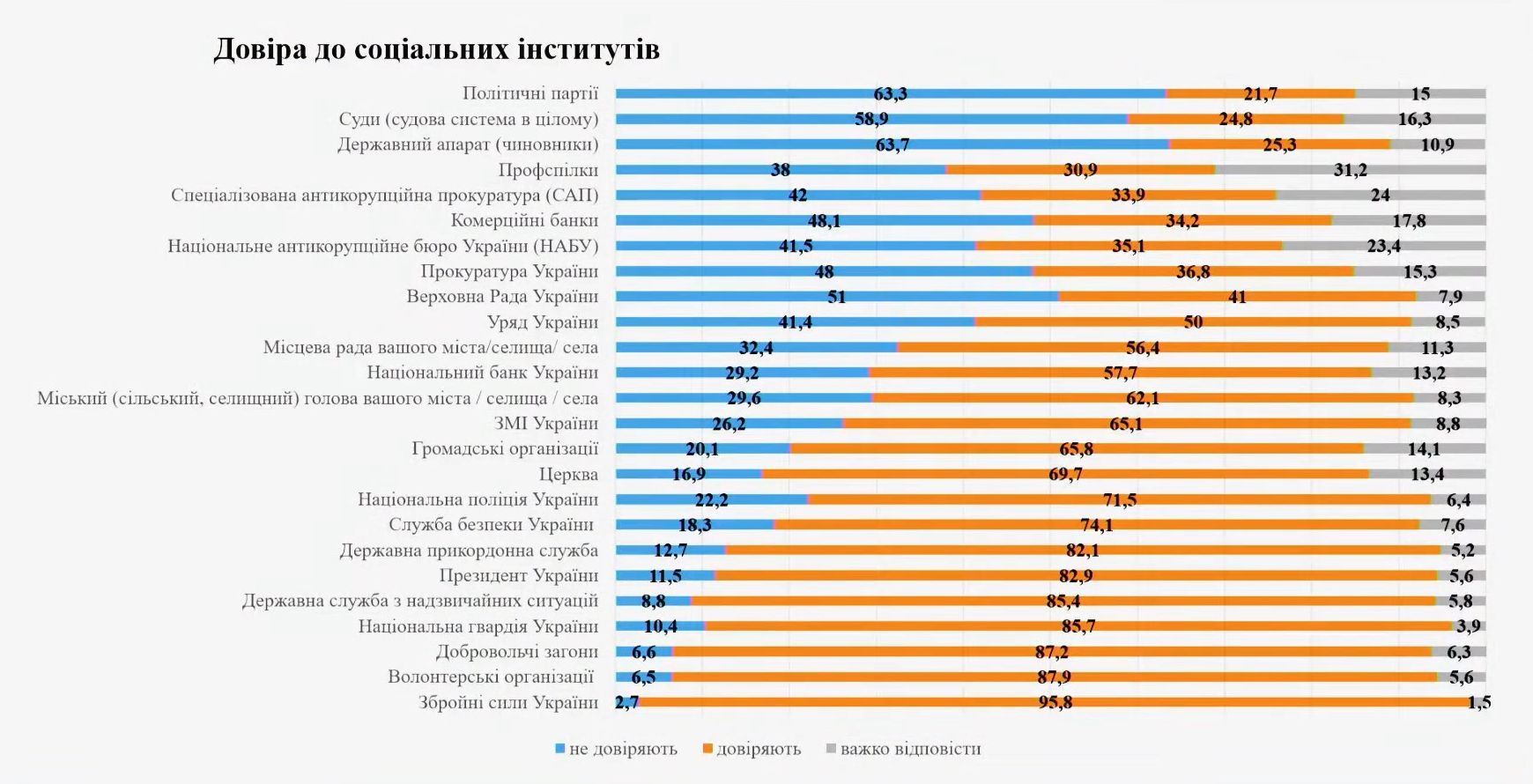
Therefore, we would like to suggest that at a meeting of the working group working on the communication strategy, the need to raise the level of trust in the judiciary be addressed. The growth of trust in the courts will mean that society sees the success of judicial reform. After all, this reform is being done for the sake of society, and the result of a successful reform is high trust in the courts.
Now, unfortunately, the courts are trusted a little more than political parties. This is a critically low level of trust. If it is less than 25% of citizens, the Supreme Court can state in its communication strategy that it needs to raise this figure to 30% in three years. This should be the responsibility of the court’s chief judge, Kravchenko, the chief of staff, and his deputy, Rasim Babanly (who is currently mainly responsible for self-promotion and positions himself as a great expert who has combined AI and justice). But it’s not about posting photos on social media, it’s about developing a strategy, approving KPIs, and… implementing them so that Google Docs do not remain Google Docs for years.

How can this trust be raised? Here, the Supreme Court has something to show because it provides high-quality judicial practice on many issues—it has stood up for green areas. I am grateful for the decision on the Bilychansky Forest, where the court wrote in black and white that the law protects the national park. There were also decisions concerning other green areas and cultural heritage.
Only this should not be written about in the same style as it is done now on social media.
Specially for Ukrayinska Pravda