Judicial reform. Which Telegram channels undermine trust in judicial and public sector reform?


Methodology for Conducting Network Analysis and Content Analysis
Judicial reform is one of the key reforms aimed at strengthening statehood. It not only determines the quality of justice but also the investment climate in Ukraine. A strong economy is one of the best allies for victory.
Hostile intelligence services work actively in the media space before and during the war, particularly in social networks, to spread favorable Russian narratives and fakes. One of the goals is to undermine trust in the judicial system and in civil society organizations advocating for judicial reform and conducting monitoring of judges’ integrity.
The Telegram social network is developing most actively in Ukraine, as evidenced by the results of sociological research, and media experts have repeatedly emphasized that it is anonymous Telegram channels that spread pro-Russian narratives and fakes that need to be countered. Similar informational policies are pursued by some personal channels of pro-Russian politicians and lawyers.
The public initiative “Holka” investigated connections between Telegram channels providing information about the activities of courts and leading civil society organizations in the sector and may be under pro-Russian influence.
To compile a list of Telegram channels for network and content analysis, the method of expert surveys was used:
- representatives of the judiciary;
- prosecutors;
- lawyers;
- members of the Ukrainian Parliament;
- civil society organizations involved in judicial reform and media space research;
- journalists involved in judicial reform and media space research.
Telegram channels reported by the Security Service of Ukraine and the Center for Countering Disinformation were also added to the list.
As a result, a list of over fifty Telegram channels was compiled. After conducting content analysis of reposts in a large network to visualize the data, only those channels that correspond to the research objective – identifying channels discrediting judicial reform and those promoting it – remain.
The citation index, which includes reposts from one channel by another, allows determining the intensity of content dissemination, connections between channels, and identifying key Telegram channels.
Based on the research results covering the period from the creation of the Telegram channel to February 12, 2024, an infographic is created to visualize the collected data.
Data Collection:
Data was extracted on February 12, 2024, using the Python library snscrape. Reposts saved in the channel’s history at the time of extraction were considered. Since the Elena_Lukash channel was closed and not updated, information on reposts was taken from the tgstat.com website. Data collection and processing were conducted by Texty org.ua using the “Holka” methodology.
After network analysis to consider not only quantitative but also qualitative indicators, the public initiative “Holka” selectively conducts content analysis of key Telegram channels to illustrate propaganda messages in the research text.
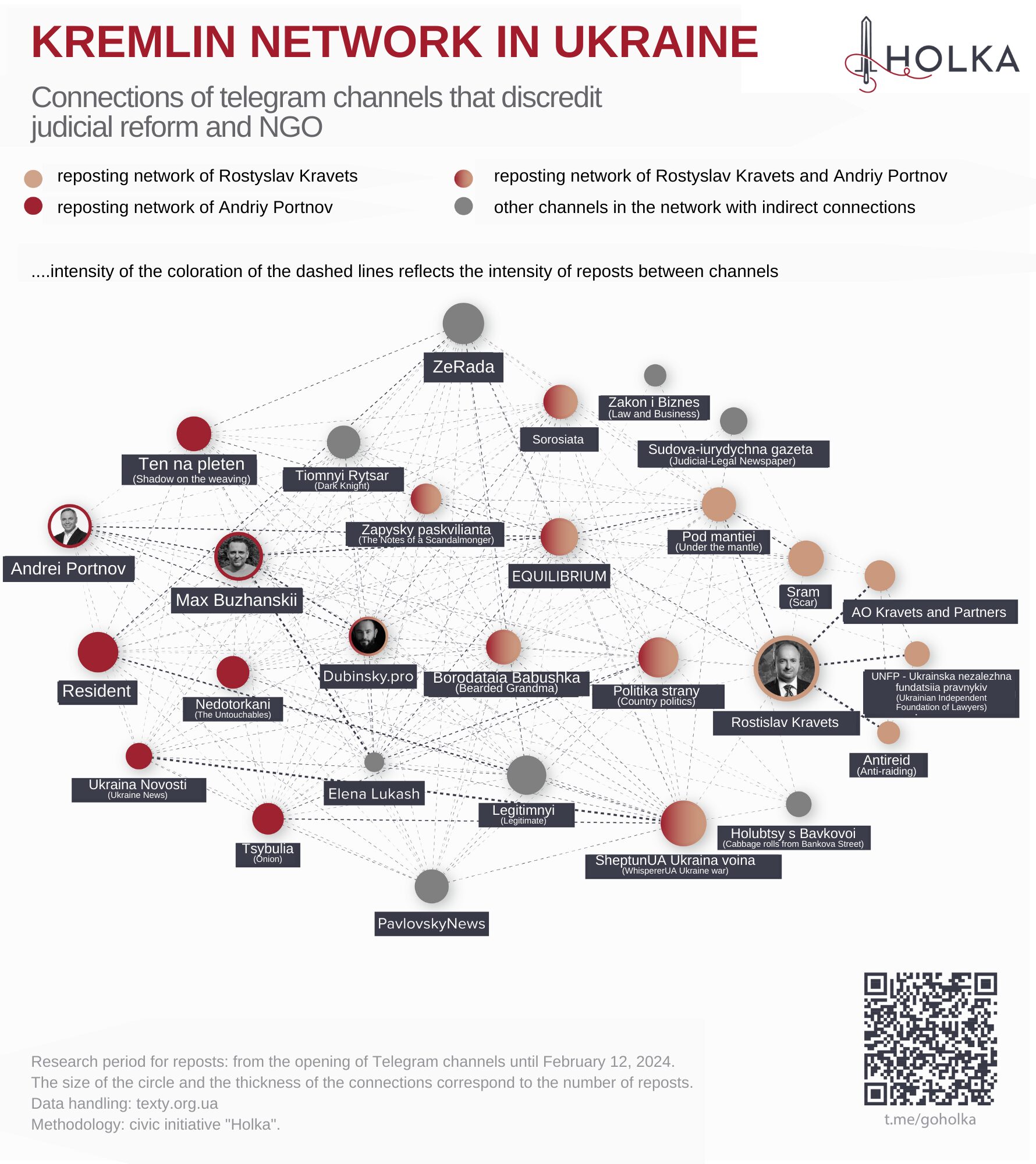
As a result of content analysis, nearly 30 Telegram channels that correspond to the research objective were selected for visualization on the graph. The research was published by “Detector Media,” “Glavcom,” “Espreso,” “Channel 24,” the “Institute of Mass Information,” and several other national media outlets.
The research findings were presented at the Global Media Forum 2024 (Bonn).
You can find the analytical text below.


