
National security and the New Year’s sale of state property. What is Stefanchuk up to?

On January 9, the Parliament is considering a bill lobbied by Speaker Ruslan Stefanchuk (6013).
This legislative initiative could deal irreparable blows to national security, as previously reported by the Holka civic initiative.
Stefanchuk is personally seeking votes. To find them, MPs are convinced that the criticisms previously expressed by the public, judges, scientists, farmers, and representatives of local communities have already been corrected.
The relevant committee on economic development, headed by Dmytro Natalukha (Servant of the People ), did indeed consider the draft earlier this week.

Before the second reading, MPs managed to “consider”1117 amendments to the draft law, of which only 108 proposals were considered and 1096 were rejected.
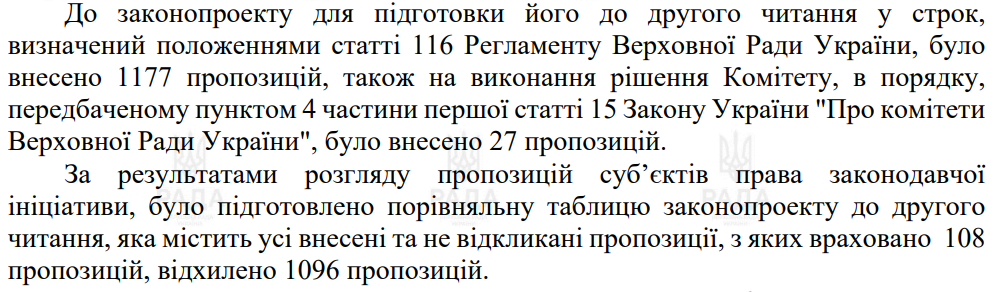
Excerpt from the conclusion of the Verkhovna Rada Committee on Economic Development
As a result, the comparative table of the draft law for the second reading, which contains all the submitted and not withdrawn proposals, increased to 700 pages. As is often the case in the Verkhovna Rada, the document had to be analyzed on an emergency basis. It is unlikely that all MPs did so in order to understand the risks of the draft law and vote consciously.
On January 8, the day before the vote, the amendments were “considered”. This happened in an empty hall. This is what this profanation looked like.
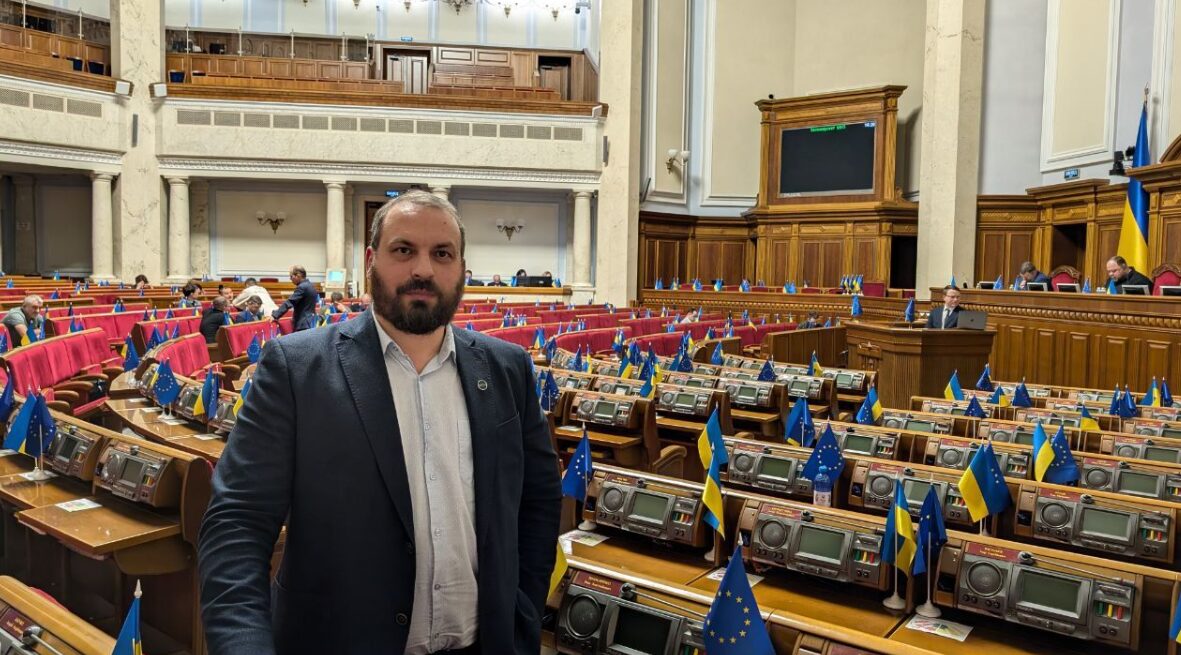
Photo by MP Roman Babiy from Facebook
MP Roman Babiy presented his 40 amendments to an almost empty hall with only a few dozen MPs in attendance.

Babiy says and recalls that he wrote about the risks of this project at the end of last year.
Dzerkalo Tyzhnia wrote that draft law 6013 would destroy the field of commercial law on the way to reform.

The draft law proposes to abolish the Commercial Code, which really needs to be changed, but this will destroy the current system of business organization and bury the judicial practice of applying commercial law that has been developed over the years.
MP and member of the Committee on Legal Policy Serhiy Vlasenko (Batkivshchyna) emphasizes:

The Holka civic initiative has already written that the draft law may actually carry out the largest redistribution of state property since Ukraine’s independence in a non-privatization way, obliging businesses to force companies to transform into joint-stock companies and limited liability companies.
However, risks remain. In addition to the public, judges, scientists, farmers, and representatives of local communities, the Main Legal Department of the Verkhovna Rada of Ukraine also expressed its negative opinion on the draft law today (!). They noted that they had re-examined the draft law “in an extremely short time” and that the department’s previous conclusions are still relevant today. Holka has previously written about the critical position of the Main Legal Department.
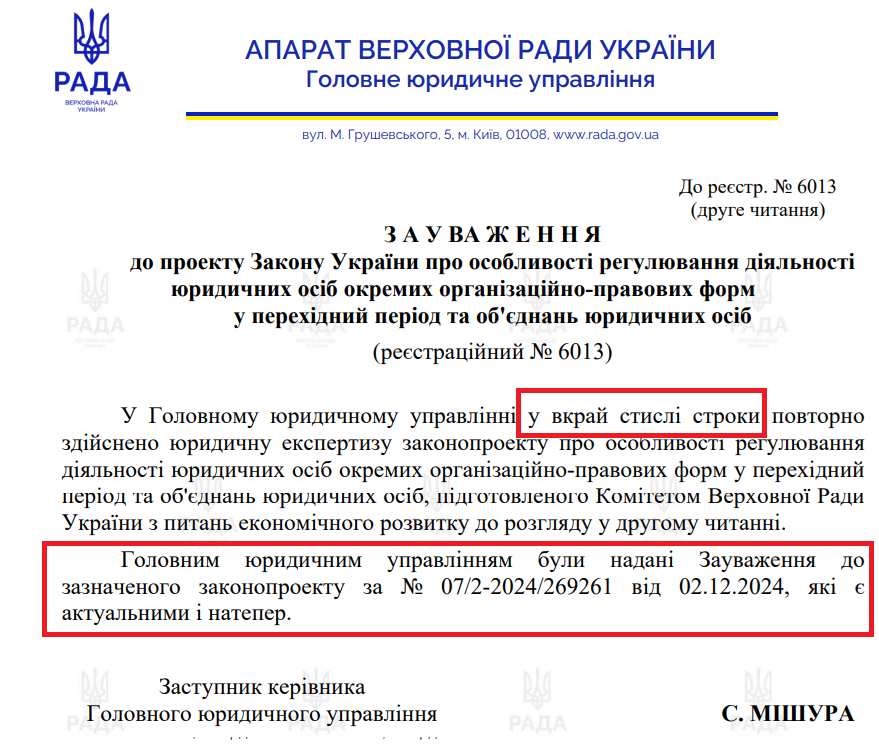
Excerpt from the comments of the Main Legal Department of the Verkhovna Rada on the draft law
Within six months after the adoption of the draft law, the state will have to liquidate or reorganize all enterprises where it is the owner. In other words, it will have to carry out a corporatization procedure.
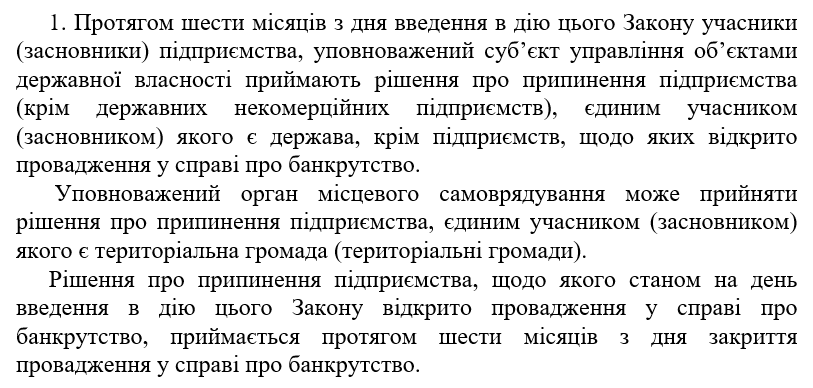
Fragment of part 1 of Article 14 of Draft Law 6013
The consequences may be evident from what is happening now with the state enterprise “Forests of Ukraine” and the property of the joint-stock company “Ukrposhta”.
If, as of the date of the decision to reorganize, a state-owned enterprise has any property assigned to it, the authorized entity managing state-owned objects or the authorized local government body will be forced to make a decision to contribute the property assigned to it on the basis of the results of the inventory of the enterprise’s property to the authorized capital of the legal entity that is the successor to such an enterprise, except for the property that is not subject to privatization. In other words, the state is liquidating state-owned enterprises by law and transferring to private hands absolutely all the property transferred to the authorized capital.

Fragment of part 8 of article 14 of draft law 6013
If such property is transferred to the authorized capital of the company formed as a result of the transformation, then in accordance with Article 11 of the Law of Ukraine “On Management of State-Owned Property,” the property contributed to the authorized capital of such a company is its property.
Such changes in time of war are unacceptable and will, in fact, take the form of shadow privatization, as the Ministry of Finance, the State Property Fund, the Ministry of Education and Science, and the Main Legal Department of the Parliament have pointed out in their comments, as mentioned earlier.

At the same time, international experience shows the importance of state-owned enterprises in many developed countries.
In the EU, state-owned enterprises operate in key sectors such as energy, transportation, and utilities. For example, in France, state-owned enterprises continue to be competitive and efficient. The situation is similar in Poland, where the state retains control over strategic industries. This practice demonstrates that state-owned enterprises can be important market participants if their activities are regulated by clear rules.
In addition, the European Commission insists on the need to improve the management of state-owned enterprises rather than destroy them, in particular when considering the situation with Bulgarian SOEs:
Consolidated reports also assess the compliance of state-owned enterprises with established standards of corporate governance and information disclosure.
In this way, corporate governance standards are created in the state-owned enterprise, but state-owned enterprises are not destroyed.
Finland’s experience, which organizes commercial activities through special joint-stock companies, demonstrates the importance of transparent regulation that preserves economic stability. In Germany, state-owned enterprises play an important role in infrastructure, transportation, and social services.
Abolishing the Commercial Code without proper preparation will only exacerbate existing problems, creating new threats to Ukraine’s legal and economic stability. As other countries’ experience shows, poorly thought-out reforms only complicate the situation, while a strategic approach can achieve significant success.

In addition, Draft Law 6013 affects not only state-owned enterprises but also all state institutions and organizations and municipal enterprises and organizations. By becoming companies, these organizations will become the owners of the property assigned to them, and their management should be carried out through supervisory boards, not directly by state and local authorities.
Oleg Podtserkovnyi, Head of the Department of Commercial Law and Procedure at the National University “Odesa Law Academy”, Doctor of Law, Professor, comments on these changes:

This will also mean the commercialization of the utility sector. Companies will be subject to market rules, which will negatively impact ordinary people.
In his article for Dzerkalo Tyzhnia, the head of the Committee on Commercial Law and Procedure of the Odesa Oblast Bar Council notes that the proposal to privatize community utilities is very controversial:
The authors of the draft law have not fully calculated the possible risks for communities, the idea of privatization may be good in itself, but in the case of such a sensitive industry, clear mechanisms for protecting the interests of the community and obligations for the investor with tangible responsibility for non-compliance with such obligations should be laid down.
The abolition of the Commercial Code threatens to lose control over state property. The lack of clear rules and protection mechanisms opens the way for abuse and corruption. Draft Law 6013 effectively removes barriers that prevent illegal transactions with state assets, which can lead to their theft and transfer to private hands.
Instead of radical abolition of the code, it is advisable to focus on its modernization, elimination of outdated provisions, and adaptation to modern realities. This will help avoid legal chaos and maintain business confidence in the legal system.
It is also necessary to involve the public in discussing these changes. Open consultations with experts, the business community, and citizens will help consider all the risks and avoid hasty decisions. Public participation is a key factor in ensuring transparency.
It is also important to implement reforms gradually. A step-by-step approach will help to synchronize innovations with the current legislation and minimize the risks associated with their application.
Specially for “LB.ua“