
Money for the front. How have the priorities of local authorities changed over the three years of the great war? (Updated)

Last year, Ukrainian communities provided the most support to the defense forces through the purchase of drones, quadcopters, and electronic warfare (EW) systems. In the first three quarters of the year alone, 262 communities spent 1.6 billion UAH on these items. When including expenditures on vehicles, body armor, and fortifications, the total amount rises to 2.4 billion UAH. Over the three years of full-scale war, community support for the defense forces has been steadily increasing.
This is according to data provided by local councils for a study conducted by the Center for Innovation Development and the public initiative “Holka.” These figures were also cross-referenced with data from the Open Budget system. (Updated)
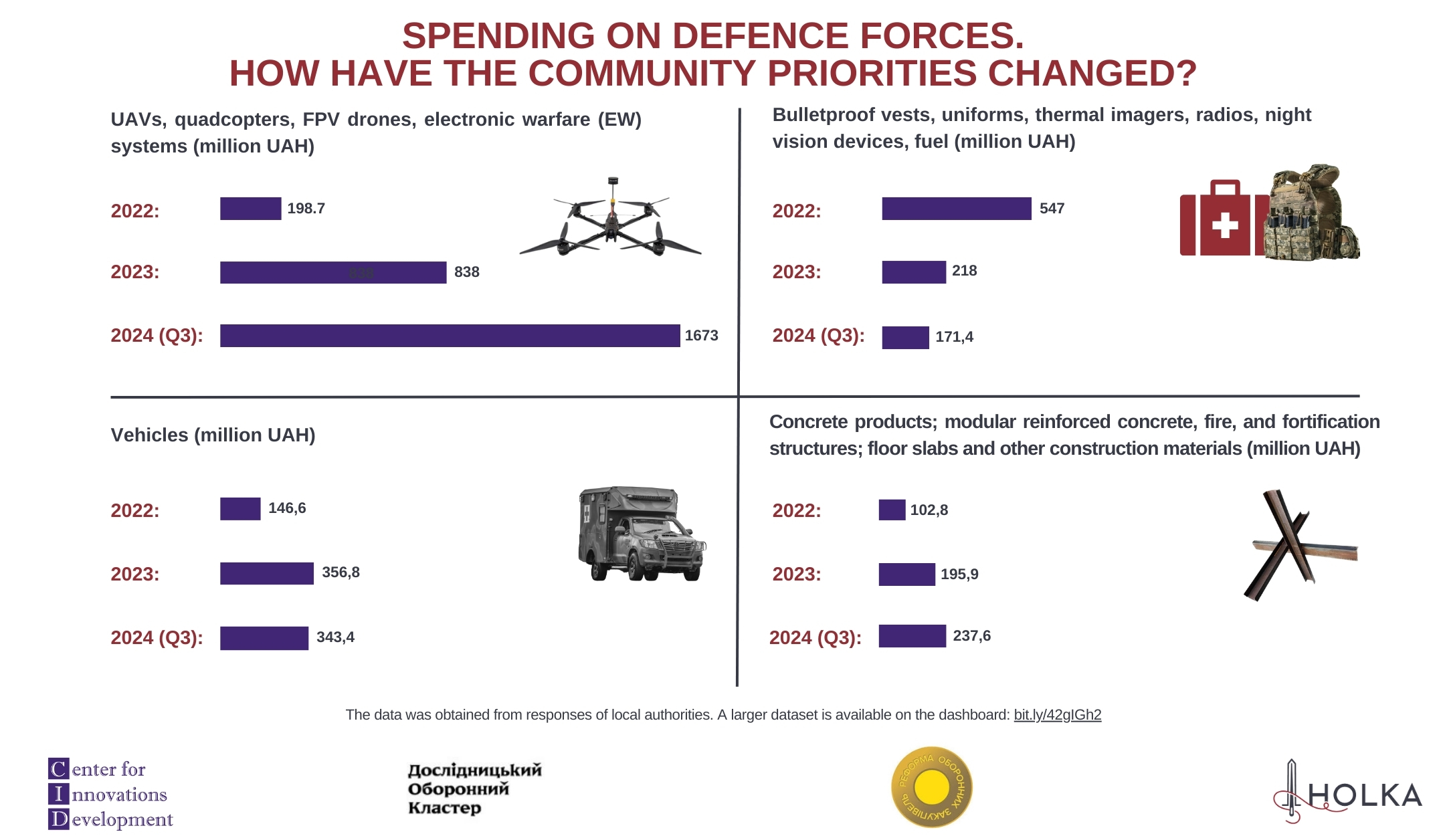
Last year, 262 communities spent UAH 900 million more than in 2023. Apparently, this is despite the fact that in 2024, local budgets did not receive “military ” personal income tax. These are the taxes that used to be paid to local budgets by law enforcement agencies and the military. Yet, at the end of 2023, the Parliament returned these funds to the state budget, given that defense is a state function.
When it comes to purchasing bulletproof vests, thermal imagers, and fuel, spending has almost halved since 2022 as the priorities have changed.
Nelli Stelmakh, an expert of the Defense Procurement Reform Project, uses the example of one of the military units to explain that the defense forces receive in-kind and cash assistance from local authorities:

For example, if we take 100% of the budget of one military unit, 75% of it will be direct subventions from local governments. Last year, the military unit used these funds to purchase UAVs and electronic warfare devices and, the year before that, new vehicles.
Stelmakh notes that the funds for UAVs, electronic warfare devices, and vehicles were provided mainly by the Kyiv and Kyiv region communities. Kyiv is among the leaders in supporting the frontline, given the size of its annual budget.
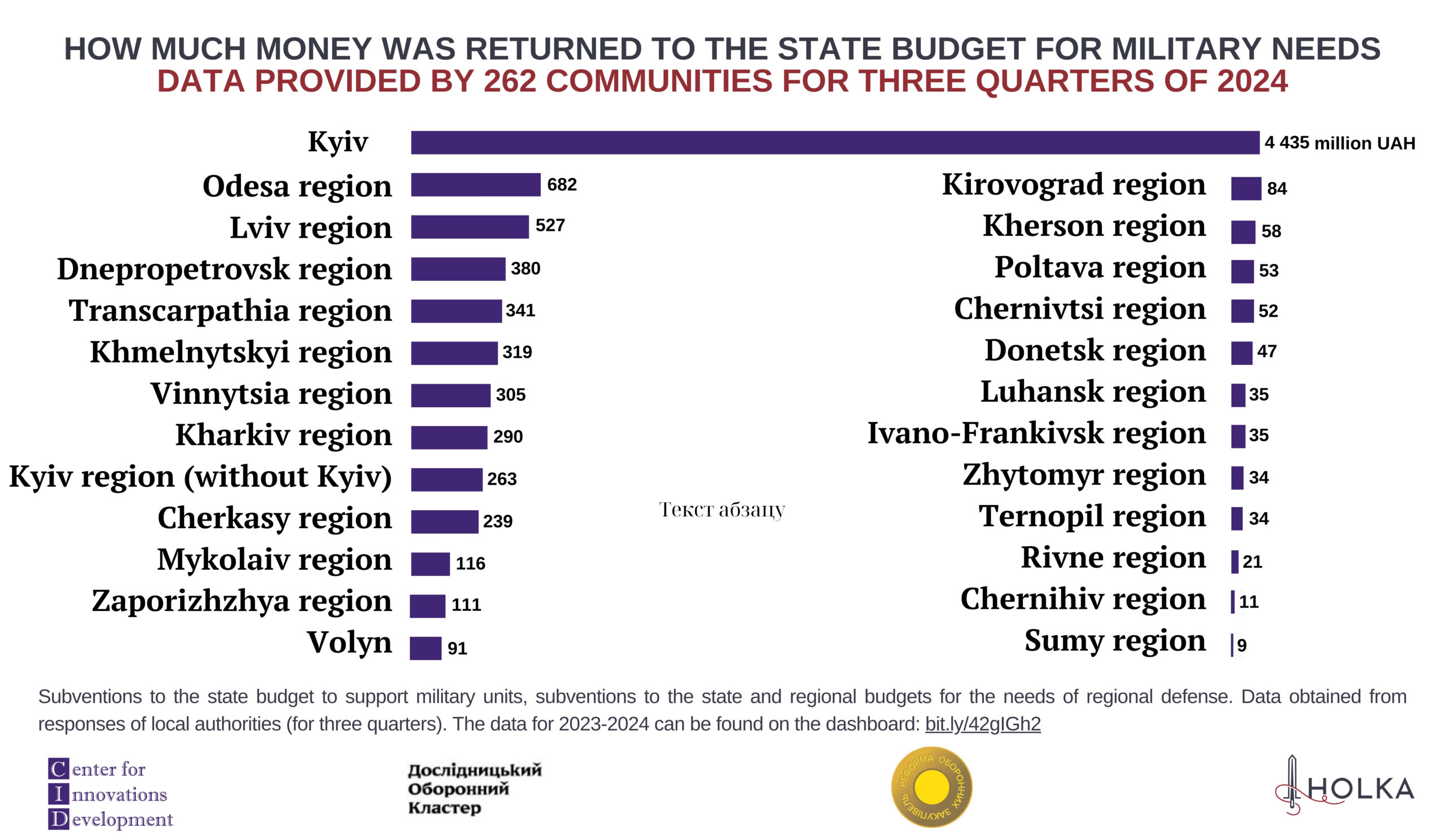
It is worth noting that in 2024, spending on fortifications increased significantly. The deputy mayor of one of the frontline regional centers explains how and why the priorities changed:
In early 2022, the army did not even have basic necessities and personal protective equipment. And the terrorist defense was just being formed, so there was no question of supply at all. That’s why the cities mainly bought helmets, vests, stoves, stove carriers, underwear and thermal underwear, turnstiles, medicines, first aid kits, flashlights, and binoculars. Everything down to nails and wire. At the second stage, when the supply of personal protective equipment and basic necessities was already on track, cities refocused on REBs, special video surveillance equipment, radio communications, thermal imagers, scopes, etc., as well as on items that were in short supply: drones of various types, cars, ATVs, etc. But then the cities got in trouble for it. Suspicions were served, and criminal cases were launched. And now cities mostly give only subventions. And military units decide for themselves what to spend these funds on.
Oleksandr Hanushchyn, a deputy of the Lviv Regional Council who was a soldier himself not long ago, explains that it is precisely because of criminal proceedings that local councils are purchasing less and less on their own:

Mykhailo Leichenko, Deputy Director of the Center for Innovation Development for Analytics and IT, whose team collected and processed the data for this study, notes:

The website contains the research data for almost three years of full-scale war. The Center for Innovation Development and the Holka public initiative jointly developed the research design and methodology.
The study is dedicated to the memory of Serhiy Loboyko, the founder of the Center for Innovations Development, who started this project and passed away at the end of 2024.
Donate to the 503 OBMP for the UAV systems squadron headed by his son, Vsevolod Loboyko, to buy a pickup truck, electronic warfare equipment, and drones.
Link to the bank https://send.monobank.ua/jar/eLFDKP18k
Bank card number 4441 1111 2151 6086
! If a local government body that did not provide its data in time to respond to requests during the preparation of the study wishes to do so, it can be sent to survey@cid.center
Specially for “Glavkom”