
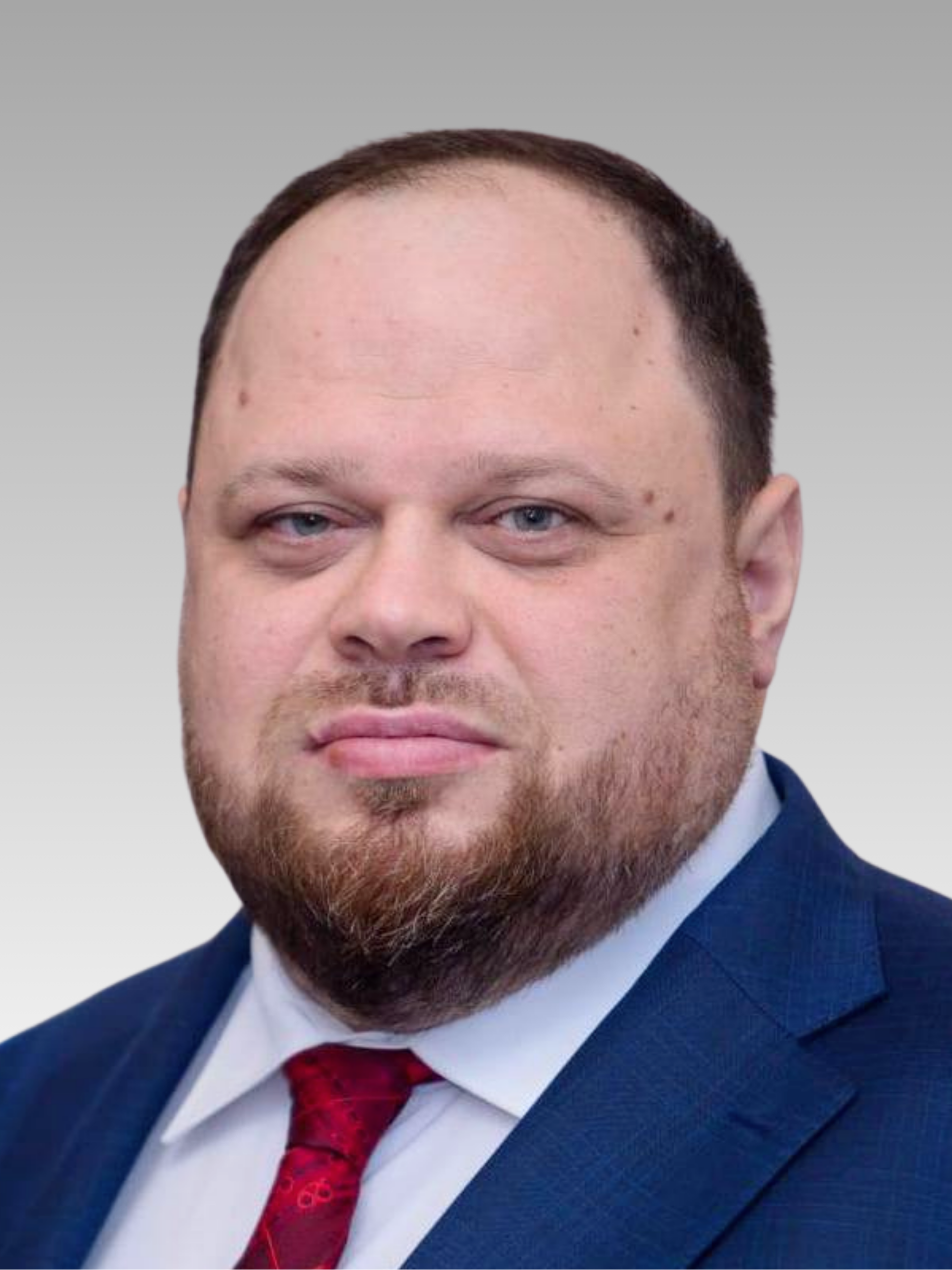
Ruslan Stefanchuk
Позафракційні
Region
None


Green: voted for beneficial and against harmful bills, red: voted against beneficial and for harmful bills. Yellow: abstained. Dark grey: present but did not vote, or absent.
Green: voted for beneficial and against harmful bills, red: voted against beneficial and for harmful bills. Yellow: abstained. Dark grey: present but did not vote, or absent.
Ruslan Stefanchuk is a Member of the Verkhovna Rada of Ukraine of the 9th convocation, elected from the Servant of the People party (#2 on the party list). Prior to the parliamentary elections, he applied for a position as a judge of the Cassation Civil Court, and the High Qualifications Commission of Judges confirmed his suitability to administer justice. Ultimately, however, he entered parliament, running alongside his brother, Mykola Stefanchuk. While Ruslan Stefanchuk was placed second on the party list, his brother ran in a single-member constituency in Khmelnytskyi Oblast that includes part of the city of Khmelnytskyi.
During the 2019 presidential campaign, Stefanchuk coordinated the work of expert groups, became one of the key figures in the Servant of the People team, and was regarded as one of the party’s principal ideologists. He was presented as an expert on reforming state legal institutions. Following the election, he became an adviser to the President of Ukraine and the President’s representative in parliament. He later served as First Deputy Speaker of the Verkhovna Rada, coordinating the preparation and parliamentary consideration of presidential legislative initiatives.
In 2021, following a conflict between then-Speaker Dmytro Razumkov and the Presidential Office, Stefanchuk became Chairman of the Verkhovna Rada, despite previously telling the media that he had no such ambitions.
Stefanchuk publicly argued that the Verkhovna Rada lacked the necessary minimum of 226 votes to adopt legislation banning the Moscow-affiliated church. This later proved untrue, and the law was eventually passed. As Speaker of Parliament, he initiated the repeal of the Commercial Code of Ukraine, a move that enables state- and municipally-owned enterprises to be transferred into private ownership without privatization procedures. Since parliament has not approved a list of enterprises that are prohibited from privatization, critics argue that such an initiative poses risks to national security. Stefanchuk later promoted amendments to the Civil Code that were sharply criticized by the journalistic community due to concerns that they could negatively affect freedom of speech.
Tetiana Krupa, head of the Khmelnytskyi Medical and Social Expert Commission (MSEC), who later became the subject of bribery allegations and criminal charges, received a certificate of recognition from Stefanchuk. Journalists from ZHAR.INFO also examined the Stefanchuk family’s assets and identified, among other issues, concerns regarding the declared value of certain assets.
Before entering parliament, Stefanchuk was a prominent legal scholar, a professor at several law schools, and a corresponding member of the National Academy of Legal Sciences of Ukraine, where Viktor Medvedchuk also held academic status. Notably, the academy did not initiate proceedings in 2022 to revoke Medvedchuk’s academic title.
Stefanchuk worked at the Khmelnytskyi University of Management and Law (formerly the Khmelnytskyi Institute of Regional Management and Law), where he held positions ranging from teaching assistant to Vice-Rector for Research. After completing his postgraduate studies, he continued teaching at the institution.
His involvement in politics predates his parliamentary career. He served as an adviser to First Deputy Prime Minister Stepan Kubiv in the government of Volodymyr Groysman. He also attempted to launch a political career in Khmelnytskyi Oblast, where he studied, running for the Khmelnytskyi City Council from the Sobor Party. At that time, he worked as an assistant to Anatolii Matviienko, a Member of Parliament from the Our Ukraine political force.
During his student years, Stefanchuk played for the Khmelnytskyi KVN comedy team Three Fat Men, whose core members were affiliated with the Khmelnytskyi University of Management and Law. It was there that he met Volodymyr Zelenskyy.
Timeline of Events
2026
Stefanchuk submitted the controversial draft Civil Code of Ukraine (Bill No. 15150) and became its principal author and advocate. The draft, spanning 803 pages, was brought to parliament for consideration under an accelerated procedure, despite the fact that even the Ministry of Justice had not had sufficient time to review it during the three weeks following its registration. Critics argued that the bill contained provisions enabling the transfer of state and municipal assets—including forests, coastlines, and natural resources—into private hands. Concerns were also raised regarding freedom of expression.
Following its passage in parliament, street protests took place in several regions of Ukraine. Demonstrators criticized provisions they believed would undermine the rights of women and LGBTQ+ communities. A petition urging President Volodymyr Zelenskyy to veto the bill gathered more than 25,000 signatures on the first day alone. Judges of the Supreme Court also expressed substantial concerns regarding the proposal. Critics argued that the draft Civil Code, which had not undergone adequate public discussion, would effectively dismantle more than twenty years of judicial practice developed under the current Civil Code.
That same year, Stefanchuk’s daughter, Zlata Stefanchuk, applied to the Ministry of Foreign Affairs for the position of Third Secretary in the Department for Analysis and Monitoring of the Implementation and Effectiveness of Sanctions.
2025
Stefanchuk supported and, as Speaker of Parliament, signed Bill No. 9549, which critics described as unconstitutional. The bill was initially intended to facilitate the rapid restoration and expansion of digital infrastructure during wartime. However, prior to its second reading, additional provisions were inserted in violation of parliamentary procedures. The most controversial amendment established a special procedure for the compulsory acquisition of land in the Uzhhorod district of Zakarpattia Oblast.
According to critics, these provisions created risks of deforestation and enabled a corruption scheme whereby selected property owners could have their real estate purchased with public funds at prices 3 to 3.6 times above market value. Because the provisions were considered inconsistent with several constitutional principles, the President vetoed the bill. Nevertheless, most of the President’s objections were ignored during subsequent revisions.
Further amendments added before the repeat second reading effectively legalized, until 2028, a controversial practice allowing local authorities to approve detailed development plans that contradicted the master plans of municipalities. Although parliament failed to secure enough votes to override the presidential veto, Stefanchuk signed the bill and forwarded it to the President for signature.
Stefanchuk was also the initiator of the controversial legislation that repealed the Commercial Code of Ukraine (Bill No. 6013), which established new principles governing relations between business and the state. The initiative was opposed by the civic initiative Holka, Environment–People–Law, the Ukrainian Nature Conservation Group, and other organizations, which appealed to President Zelenskyy to veto the bill. They argued that the legislation posed national security risks because parliament had not approved a list of state assets exempt from privatization, potentially enabling a large-scale redistribution of public property.
Stefanchuk supported the so-called “Ihor Mazepa Law” (Bill No. 12089). Critics argued that the legislation largely reflected the interests of non-compliant business actors. The law effectively resets legal claims regarding the unlawful privatization of forests and coastal areas if ten years have passed since the property entered private ownership.
He voted in favor of legislation restricting investigative journalists’ access to public registries (Bill No. 11533), a measure that critics argued undermines anti-corruption efforts, democratic development, and the trust of Ukraine’s international partners.
Stefanchuk also supported a bill introducing administrative liability for journalists and civic activists who identify clients with their lawyers (Bill No. 12320). The proposal was opposed by organizations including DEJURE, Holka, the Anti-Corruption Action Center (AntAC), and the CHESNO Movement, which argued that the bill contained elements of censorship.
He further supported and, on the same day as Speaker of Parliament, signed Bill No. 12414, which limited the powers of the National Anti-Corruption Bureau of Ukraine (NABU) and the Specialized Anti-Corruption Prosecutor’s Office (SAPO). According to a number of civil society organizations, the legislation posed a direct threat to the independence of NABU, one of Ukraine’s key anti-corruption institutions established with the support of international partners and designed to be protected from political influence. Following public protests and statements from international partners warning against the rollback of anti-corruption reforms, President Zelenskyy submitted a new bill to parliament, which was subsequently adopted and restored the powers of the anti-corruption institutions.
That year, the National Academy of Sciences declined to grant Stefanchuk the title of Corresponding Member.
2024
Parliament adopted Stefanchuk’s bill abolishing the seasonal clock change between standard time and daylight saving time (Bill No. 4201), generating significant public debate. A petition calling on the President to veto the law collected more than 25,000 signatures. Although President Volodymyr Zelenskyy did not respond to the petition, he also did not sign the law.
In the same year, Stefanchuk voted for legislation prohibiting the activities of religious organizations whose governing centers are located in Russia, including the Russian Orthodox Church (Bill No. 8371).
Several media outlets, citing anonymous sources, reported that Stefanchuk might leave his position as Speaker and become Chairman of the Constitutional Court of Ukraine. This ultimately did not occur.
2023
Stefanchuk expressed doubts that parliament had sufficient votes to prohibit the activities of the Moscow Patriarchate in Ukraine. Following his statement, Members of Parliament Yuliia Sirko (Holos) and Oleksandr Aliksiichuk (Servant of the People) collected more than 226 handwritten signatures from MPs in support of the initiative. As a result, the issue, which supporters argued was important for national security, was eventually brought before the parliamentary chamber, and the government-sponsored Bill No. 8371 was adopted into law.
He supported the Law on the Legalization of Medical Cannabis (Bill No. 7457), which permitted the production of medical cannabis in Ukraine.
2022
Stefanchuk voted for the urban planning “reform” (Bill No. 5655), authored by Olena Shuliak, Chair of the Servant of the People party. The initiative was widely criticized by civil society organizations and the media. The European Parliament publicly cautioned President Zelenskyy against signing the bill, while the European Commission also issued critical remarks regarding the proposal.
He supported legislation dissolving the Kyiv District Administrative Court (Bill No. 5369), often referred to by critics as the “Vovk Court” after its controversial chairman.
Stefanchuk also voted for legislation banning pro-Russian political parties (Bill No. 7172-1).
2021
During consideration of the so-called De-Oligarchization Law (Bill No. 5599), Stefanchuk became involved in a conflict with Speaker of Parliament Dmytro Razumkov, who opposed the bill’s adoption. The legislation was approved in its second reading while Stefanchuk, then serving as First Deputy Speaker, was presiding over the session. Instead of putting all 1,270 amendments to separate votes, he grouped key amendments together for package voting.
Leaders of opposition parliamentary factions accused Stefanchuk of violating parliamentary procedure. Razumkov supported these concerns and refused to sign the law, a dispute that became one of the factors leading to his dismissal as Speaker of Parliament.
Following Razumkov’s removal, Stefanchuk was elected Chairman of the Verkhovna Rada of Ukraine with the support of 261 MPs. Prior to his election, he had repeatedly stated in public that he was not interested in becoming Speaker.
2020
Stefanchuk was elected a Full Member of the National Academy of Legal Sciences of Ukraine.
2019
He was appointed Adviser to the President of Ukraine and the President’s Representative in the Verkhovna Rada. Stefanchuk was considered one of the principal ideologists of Volodymyr Zelenskyy’s presidential campaign and coordinated the work of expert groups.
In the same year, he was elected to parliament from the Servant of the People party (#2 on the electoral list). In the Verkhovna Rada, he became First Deputy Speaker.
Stefanchuk was also the initiator of legislation aimed at ensuring personal voting by Members of Parliament and criminalizing so-called “button pushing” (Bill No. 2148), the practice of voting on behalf of absent colleagues.
2018
Stefanchuk served as Deputy Director of the National Intellectual Property Office.
According to his asset declaration, he lived in an apartment owned by his mother-in-law and, after being elected to parliament, received state compensation for housing. Later, Davyd Arakhamia stated that Stefanchuk had returned the compensation to the state, despite being legally entitled to it because he did not own residential property in Kyiv.
That same year, Stefanchuk applied to become a judge of the Cassation Civil Court, and the High Qualifications Commission of Judges confirmed his suitability to administer justice.
2016
Stefanchuk became Vice-Rector for Research at the Higher School of Advocacy of the National Bar Association of Ukraine.
In the same year, he served as an adviser to First Deputy Prime Minister Stepan Kubiv in the government of Volodymyr Groysman.
2013-2016
He headed the Department of Civil Law Disciplines and later served as Vice-Rector for Research at the National Academy of the Prosecutor’s Office of Ukraine.
2011-2013
Stefanchuk was Head of the Department for the Development of National Legislation at the Institute of Legislation of the Verkhovna Rada of Ukraine.
2009
He was elected a Corresponding Member of the Academy of Legal Sciences of Ukraine.
2008
Stefanchuk defended his doctoral dissertation in law entitled “Personal Non-Property Rights of Individuals in Civil Law” and was awarded the academic title of Professor.
2006
He ran for the Khmelnytskyi City Council from the Sobor Party and served as an assistant to Anatolii Matviienko, a Member of Parliament from the Our Ukraine–People’s Self-Defense bloc.
2005-2006
He served as Vice-Rector for Research at the Khmelnytskyi University of Management and Law.
2000
Stefanchuk defended his PhD dissertation in law entitled “Civil-Law Protection of Honor, Dignity and Reputation.” He subsequently worked at the Khmelnytskyi University of Management and Law as a senior lecturer, department chair, associate professor, and professor of civil law disciplines.
1997
He graduated from the Khmelnytskyi Institute of Regional Management and Law and entered postgraduate studies at the V. M. Koretsky Institute of State and Law of the National Academy of Sciences of Ukraine.
During his student years, he performed with the Khmelnytskyi KVN comedy team Three Fat Men, where he met Volodymyr Zelenskyy.
This profile was prepared with the participation of the editorial team of the online media outlet ZHAR.INFO.
If you believe that any information in this profile is inaccurate, please contact us in writing at ngo.holka@gmail.com. The team of the Holka civic initiative will review your request and provide a response.
Read moreVoting record
For
- Fake Abolition of Parliamentary Immunity (2237)
- Criminalization of “Button-Press Voting” (2148)
- Recognition of the Revolution of Dignity as a Key Moment of State-Building (2739)
- Condemnation of Protests on Bankova Street (5295)
- On the Judiciary and the Status of Judges (3711-д)
- The Emerald Network (4461)
- Reduction of Industrial Emissions (4167)
- Restoration of Financial Reporting for Political Parties (Amendment No. 93) (5253-1)
 Did not vote
 Absent
- Purchase of Russian Reactors from Bulgaria (11392)
- Restoration of official broadcasts from the Verkhovna Rada (13719)
- Restoring Openness of Parliamentary Committees (11321)
- Decolonization of Geographic Names (7253)
- Forest Logging. Abolition of Environmental Impact Assessment (9516)
- Ensuring Constitutional Rights to Life, Health, and Environment (6004-д)
- Corruption Schemes Disguised as Investor-Friendly Changes (9627)
