
Amendments to the Law to Benefit the Wind Farm Business Destroying the Carpathians: Who and How in Parliament Plans to Block Environmental Oversight?

On August 12, the Servant of the People faction will hold a meeting to decide which issues may be included on the Verkhovna Rada’s agenda for the upcoming session. One of the items up for consideration may be a bill on protecting the rights of property owners whose buildings were destroyed as a result of hostilities (No. 13174). Within this legislative initiative, the Agrarian Committee has approved an amendment (No. 103) lobbied by MP Antonina Slavytska, a former assistant to Serhii Kivalov who entered parliament from the now-banned Opposition Platform – For Life party.
This amendment would significantly simplify the procedure for obtaining construction permits, posing serious environmental risks. Those who already install wind turbines in the Carpathians without conducting Environmental Impact Assessments (EIA) would benefit directly. This refers to a business relocated from Kramatorsk to Zakarpattia – the company Wind Farms of Ukraine, which is already building turbines on Polonyna Runa. The company is linked to former Party of Regions MP Maksym Yefimov from Kramatorsk. Yefimov and Slavytska co-chaired the parliamentary group Restoration of Ukraine until Yefimov resigned his mandate in late 2023. It is therefore likely that Slavytska’s amendment serves the interests of Yefimov’s affiliated business.
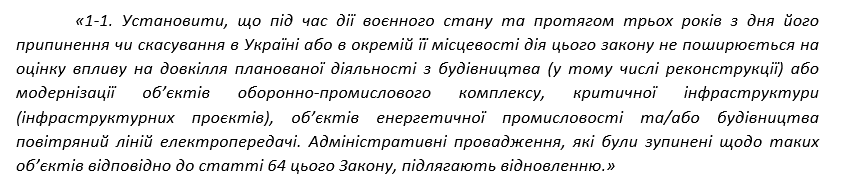
Amendment No. 103

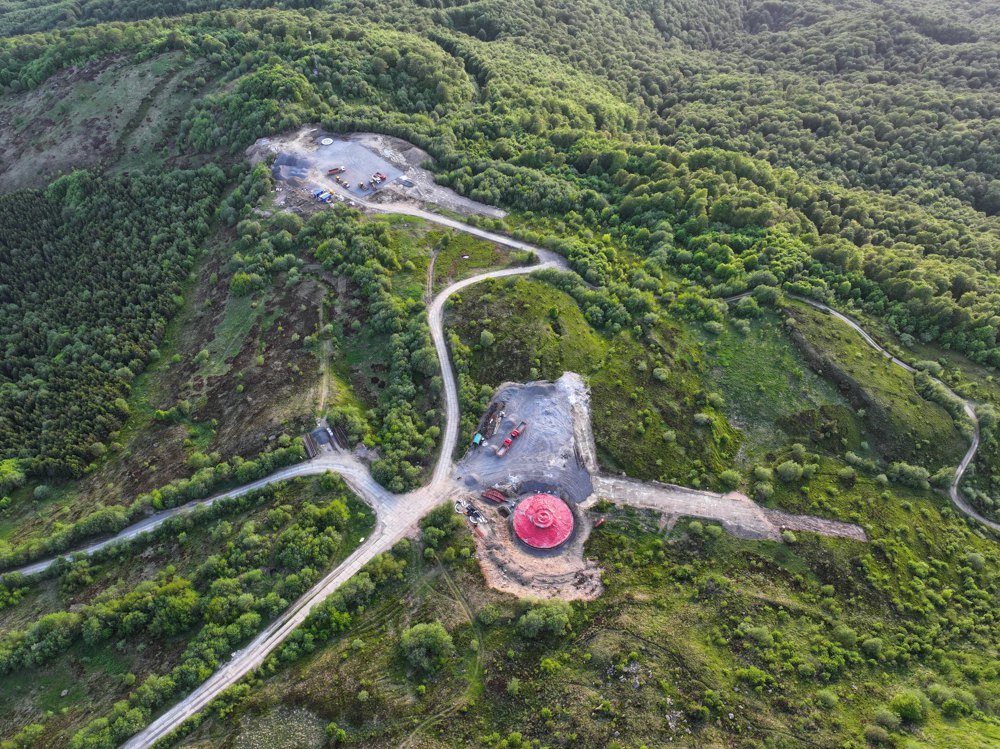
Photo: from the Facebook page “Save Pikuy”
Meteorological masts measuring wind strength have been installed in the Carpathians for years.

She adds that if MPs vote for Slavytska’s amendment, it will create multiple societal problems, including loss of trust in fair judicial processes and in state authorities responsible for issuing environmental permits based on EIA reports.
During the Agrarian Committee meeting, MP Slyvinska claimed that so-called pseudo-activists and lawsuits jeopardize infrastructure projects:
Dishonest activists file artificial lawsuits. Once the court opens proceedings, administrative procedures are suspended. You know how long cases drag on — the shortage of judges and other factors cause delays. As a result, important infrastructure projects are stalled for over a year.

Excerpt from the Agrarian Committee transcript, August 7 — direct quote from MP Antonina Slavytska
Stories about “pseudo-activists” are not new. Similar rhetoric was used when MPs discussed the so-called Ihor Mazepa Law (bill No. 12089), aimed at nullifying accountability for forest and coastal land grabs. At that time, Deputy Head of the President’s Office Oleh Tatarov also mentioned activists who allegedly “make big money.” Yet, no concrete examples were ever presented by MPs or the President’s Office.

Transcript of the discussion on the so-called Mazepa Law
Slavytska’s position was echoed by Servant of the People party leader Olena Shuliak, known for promoting the controversial urban planning “reform” (bill No. 5655) criticized for corruption risks benefiting developers. She agrees that EIA procedures could be partially suspended not only during wartime but even for several years afterward:

Such support from Shuliak for Slavytska’s amendment is not surprising, because during the vote on the urban planning “reform,” when only 228 MPs voted “for” (the critical minimum for the bill to become law is 226), decisive votes were given by former Opposition Platform – For Life representatives. This “reform,” criticized by civil society, the European Parliament, and the European Commission, was supported by Dmytro Isaienko of the group Restoration of Ukraine, who still serves as secretary of the Committee on State Power and Local Governance chaired by Shuliak.
Cynically, this amendment lobbied by Slavytska, as in the case of the infamous “NABU amendments” (bill No. 12414), aimed at eliminating the independence of anti-corruption agencies, was included before the second reading in a bill that has nothing to do with wind turbine construction, but addresses a sensitive societal topic. This violates the Constitution and the Rules of Procedure of the Verkhovna Rada.
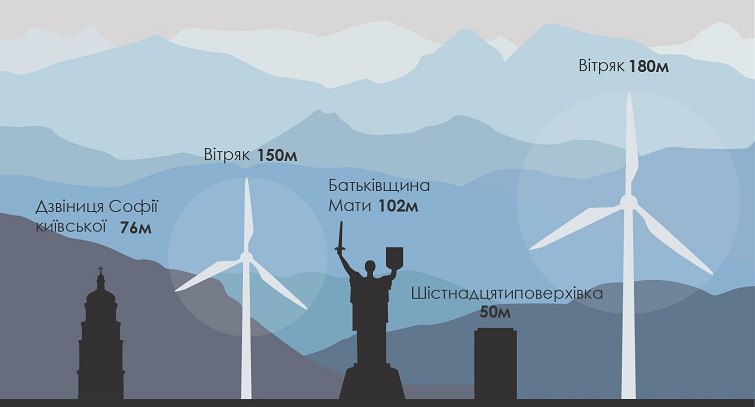
Visualization comparing turbine heights of 150 m and 180 m with building heights. Author: Liza Maksymova
Liudmyla Shemelynets, who at the time of the Agrarian Committee meeting was still Deputy Minister of Agrarian Policy, reminded MPs that the Law “On Administrative Procedures,” which they are trying to amend, was adopted at the request of international partners and noted that both the Ministry of Justice and international partners may react very negatively to this.

Quote from Deputy Minister of Agrarian Policy Liudmyla Shemelynets during the Agrarian Committee meeting of the Verkhovna Rada
It is worth reminding that parliament effectively abolished the specialized Ministry of Environment within the Cabinet of Ministers, merging it with the Ministry of Economy and the Ministry of Agrarian Policy. When the parliamentary majority supported the aforementioned “Ihor Mazepa law,” the Ministry of Environment recommended vetoing it.
Lawyer and member of the civic initiative Holka, Yurii Melnyk, emphasizes: “If the Law ‘On Administrative Procedure,’ to which they want to introduce changes, is not applied to environmental impact assessments, we will return to the times when everything depends solely on the judge. The only tool left to counter illegal construction will be injunctions. And it will be the court that decides whether there are sufficient grounds to satisfy an injunction or not. Considering the workload on judges, it is possible that while the court proceedings are ongoing, the disputed forest plot will be cut down, and then it will be too late to influence the situation.”
Now, in the absence of a specialized Ministry of Environment, if MPs support such an amendment, society will have fewer and fewer tools to protect the environment.
Specially for “Livyi Bereh”