
“The Law on the Transcarpathia”. How is Parliament, without a constitutional majority, trying to make Zelensky and us look foolish?

On March 25, the Parliament adopted the scandalous law “On Amendments to Certain Legislative Acts of Ukraine on the Use of Land for the Development of Digital Infrastructure” (9549). This document introduced special rules for the alienation of property in Zakarpattia (Transcarpathia). In fact, the Cabinet of Ministers, upon the recommendation of the military administration, can simply take away property from citizens.
This legislative initiative was vetoed by President Volodymyr Zelenskyy almost six months ago. At that time, MPs submitted 11 resolutions to block their own law, and citizens filed a petition and demanded that the document be vetoed immediately.
After that, the Parliament has two options: to take into account the amendments of the guarantor of the Constitution or… to override the veto by a constitutional majority, which is ⅔ of the votes. However, a unique case occurred in the history of parliamentarism: the president’s remarks were rejected by a simple majority of MPs. Although the draft law card says that the Agricultural Committee, headed by MP Oleksandr Haidu (Servant of the People), seemingly took Zelensky’s remarks into account, this is a common deception.
Interestingly, MPs submitted 5 resolutions in Parliament to block the draft law, but all 5 were… withdrawn. That is, after Stefanchuk’s signature, the law will go back to Zelenskyi for his signature. The Holka civic initiative studied the text of the adopted draft law and found out where corruption schemes could be hiding.
The President’s proposals were divided into two groups. The first group includes specific instructions on which unconstitutional provisions should be removed and a new version of one of the provisions.
Here, Parliament took into account only 6 provisions and one partially (3 paragraphs were removed, although 33 should have been removed). The other 13 comments were not taken into account at all.
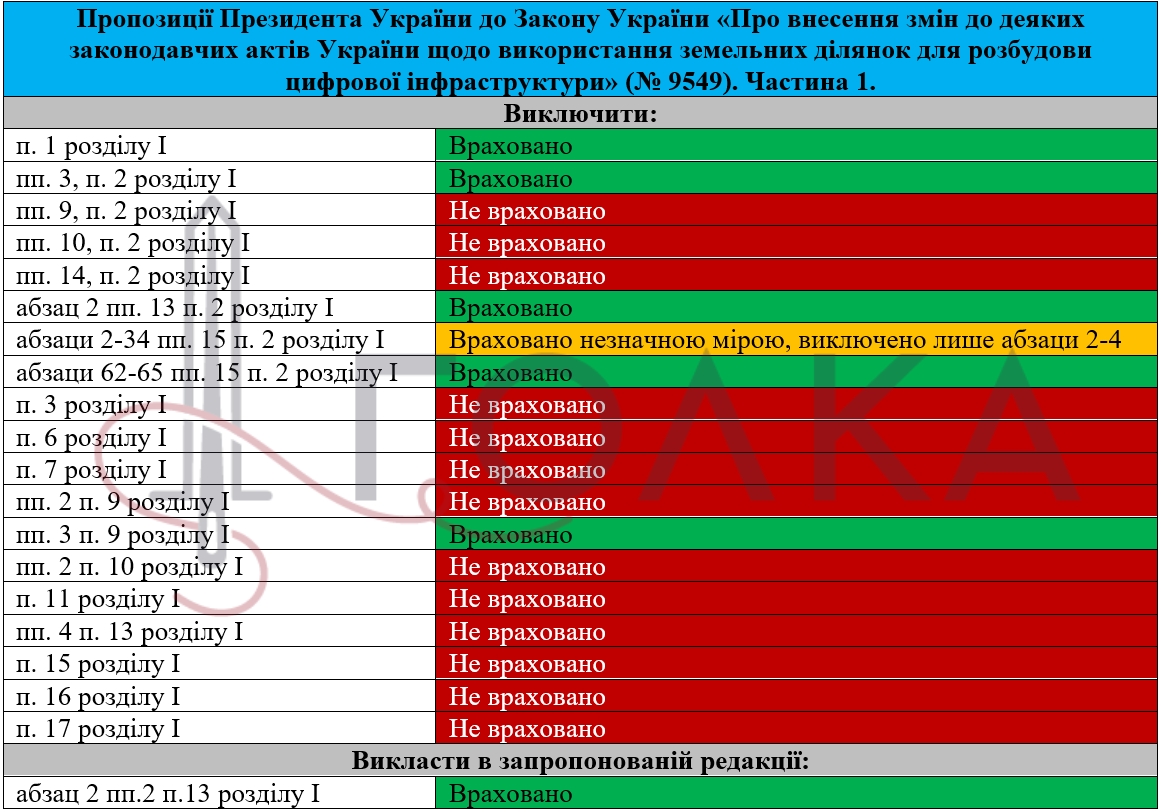
Table of inclusion of the first part of the President’s proposals in the revised law 9549
All of the unaccounted-for proposals are about the same thing: a special procedure for the alienation of land and buildings in the Uzhhorod district of Zakarpattia during the war. This issue was added to draft law 9549 in gross violation of the Rules of Procedure a week before the second reading. It does not relate to the development of digital infrastructure at all, which was supposed to be addressed in the law.
The second group of the President’s proposals is more general: to improve legislation on the alienation of land and other real estate during the war. However, these may not be proposals to Law 9549. For example, during the committee’s consideration of the law in November, a representative of the Ministry of Agrarian Policy defended the position that it was a matter of developing a new draft law for comprehensive legislative changes.
However, Parliament had a different opinion and explained the lengthy revision of the law before the second reading by the need to take this group of amendments into account. Still, as a result of this revision, only one of the President’s six proposals was taken into account, leaving virtually all the questionable provisions on the alienation of land and real estate in the Zakarpattia region unchanged.
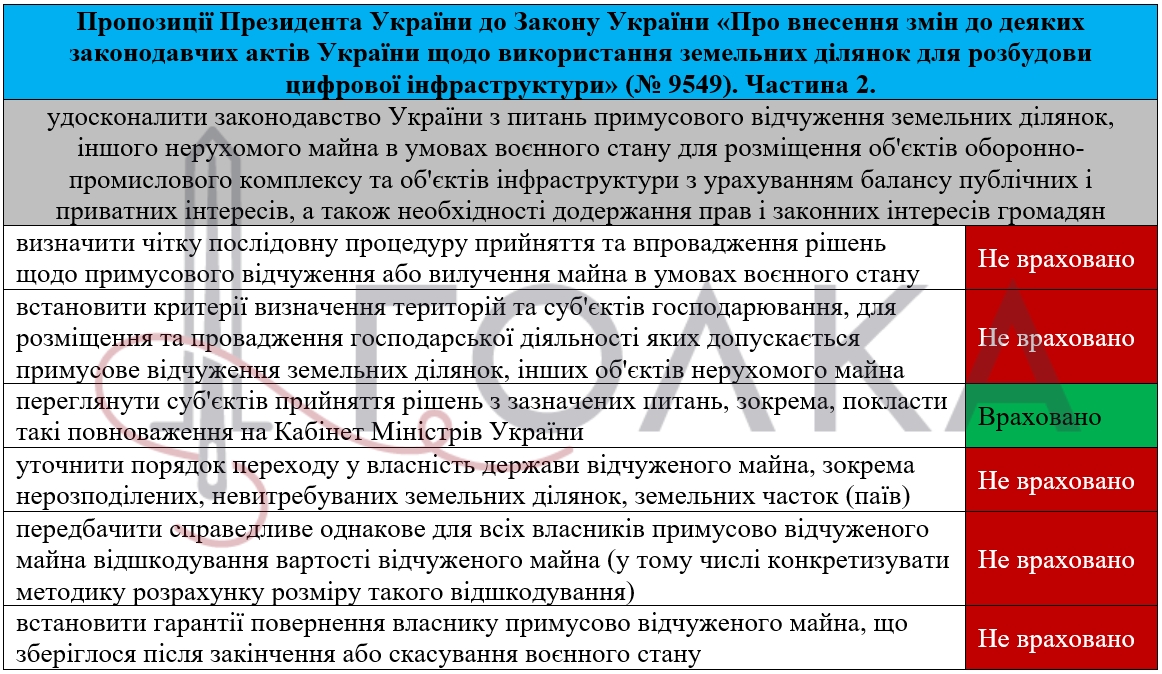
Table of inclusion of the second part of the President’s proposals in the revised law 9549
Hoax. How was the failure to implement the President’s proposals hidden?
The Constitution establishes general rules on vetoes, but it does not contain a procedure for consideration of the President’s proposals and does not answer the question of what to do if the Parliament supports some proposals and rejects others.
Therefore, Articles 132-136 of the Law on the Rules of Procedure of the Verkhovna Rada regulate this in detail. The envisaged sequence of actions should provide sufficiently reliable protection against frauds like the one that occurred with Law 9549.
The relevant committee prepares a comparative table with the President’s proposals. It is then submitted for consideration at the plenary session. Here, the chairman has to put each proposal of the President to a vote. If a proposal is not supported by a majority of votes of the constitutional composition of the Verkhovna Rada, it is considered rejected.
Next, a vote is taken on adopting the law as a whole. The number of votes required to adopt a law depends on the previous voting on the President’s proposals. If all the proposals are supported, a simple majority of the constitutional composition is required.
In cases where at least one proposal was not supported, the law is adopted by at least two-thirds of the votes and is considered supported with the override of the veto.
If a law fails to pass, Article 135, paragraph eight, provides for the possibility of sending it back to the main committee for revision. However, this revision does not exempt from the need to obtain at least 300 votes in favor if not all of the President’s proposals were taken into account.
This procedure is well known to both the Verkhovna Rada leadership and MPs. Only in February did they use it to consider Law 12378 after a veto, and last year, after two vetoes, they considered Law 11150 and a number of others.
However, in the case of Law 9549, the requirements of the Rules of Procedure were completely ignored – the President’s proposals to it were not considered at all at the plenary session. The Committee on Agrarian and Land Policy, chaired by Oleksandr Haidu, did not even submit a mandatory comparative table with Volodymyr Zelenskyi’s proposals and the corresponding changes to the vetoed law if they were supported.
Article 132 of the Rules of Procedure stipulates that the law must be considered out of turn at a plenary session no later than 30 days after it is returned with the President’s proposals unless the Verkhovna Rada decides otherwise.
The law was returned after the veto on October 25. The committee, chaired by Oleksandr Haidu, submitted a draft resolution to send the law for further elaboration of proposals. However, this resolution was not supported at the meeting on November 21. Then, another draft resolution was submitted on further work on the law, and on December 17, the Verkhovna Rada supported it. That is, the deadline for processing the President’s proposals for further consideration was only extended.
But instead, in March, the Committee submitted to the Verkhovna Rada not the President’s proposals but a revised law, which was allegedly sent to the Verkhovna Rada“on December 17, 2024, following the consideration of the President’s proposals” for revision “in accordance with part eight of Article 135 of the Rules of Procedure”.
It was a simple deception with signs of official forgery. After all, on December 17, the Verkhovna Rada did not consider any of the President’s proposals. Consideration in accordance with part eight of Article 135 of the Rules of Procedure is theoretically impossible because for this to happen, the law must be rejected after reconsideration, and the law has not even been submitted to Parliament for reconsideration before.
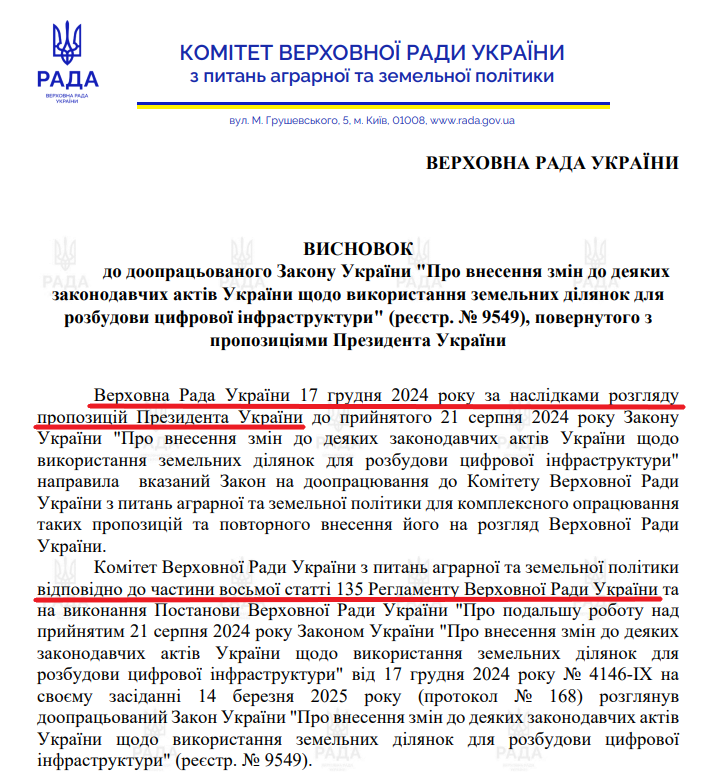
Opinion of the Agrarian Committee on the finalization of the law 9549
The fraud was committed to avoid the mandatory voting on each of the President’s proposals separately, as required by the Rules of Procedure. Hence, if such a vote had taken place, it would have been impossible to hide the fact that most of the proposals were not taken into account. And if they had dared to openly reject the proposals that were not taken into account during the Committee’s finalization, at least 300 votes were needed to pass the law with the veto overridden, which was not the case.
It is clear that not only the Agrarian Committee was involved in this elaborate hoax. Speaker Ruslan Stefanchuk played an equally important role in the fraud, as it was he who deliberately put the revised law to a vote without first considering the President’s proposals. And he was the one who had to make sure that all the proposals were implemented, since the required number of votes for the decision depended on it.
This violation was not spontaneous — it was a deliberate move in Parliament from the very beginning. Evidence of this can be found in the discussion between Deputy Minister of Agrarian Policy Liudmyla Shemelynets and Head of the Committee’s Secretariat Oleksandr Starynets, which can be found in the transcript of the Committee’s meeting on November 29.
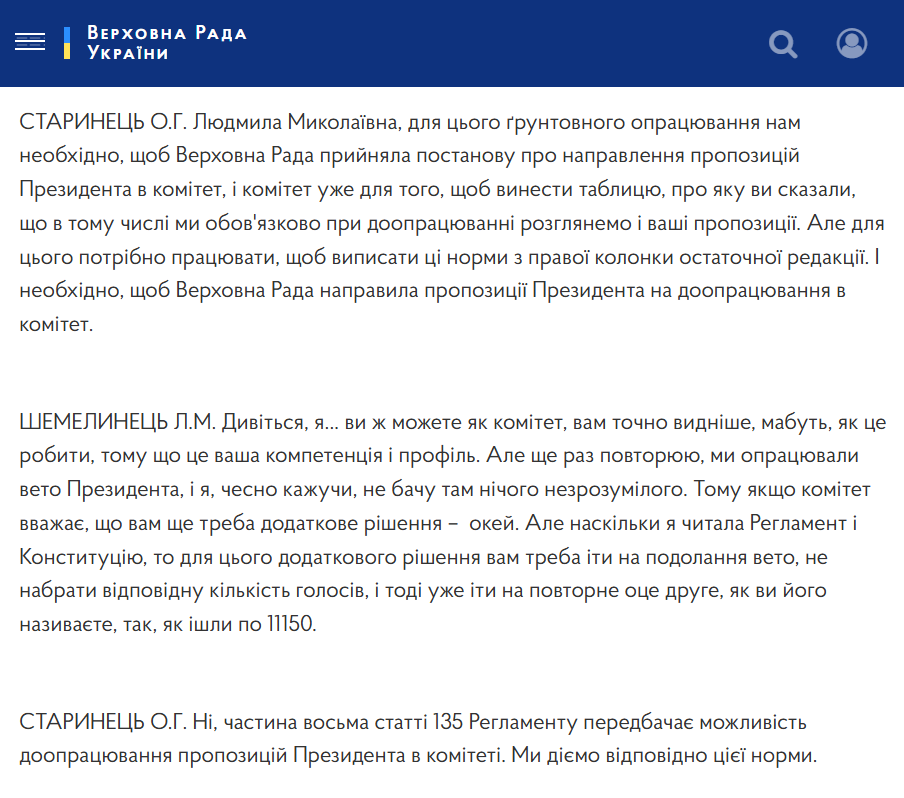
Transcript of the Committee’s meeting of 11/29/2024 with discussion of the veto to law 9549
Who is the one lobbying for violations?
The official author of the amendments on the alienation of land and other real estate in the Zakarpattia region, which have become a stumbling block, is the chairman of the Committee on Agrarian and Land Policy, Oleksandr Haidu. However, the head of the Servant of the People faction, David Arakhamia, came to the Committee’s meeting on August 20 last year to lobby for them.
Arakhamia did not explain much about the amendments, limiting himself to general statements about the need to relocate enterprises from the territories bordering the aggressor and hiding behind statements that most of the information was classified as “top secret.” However, he claimed that all this had been agreed at the highest level and that the President would sign the law with these norms in a matter of days after its adoption.
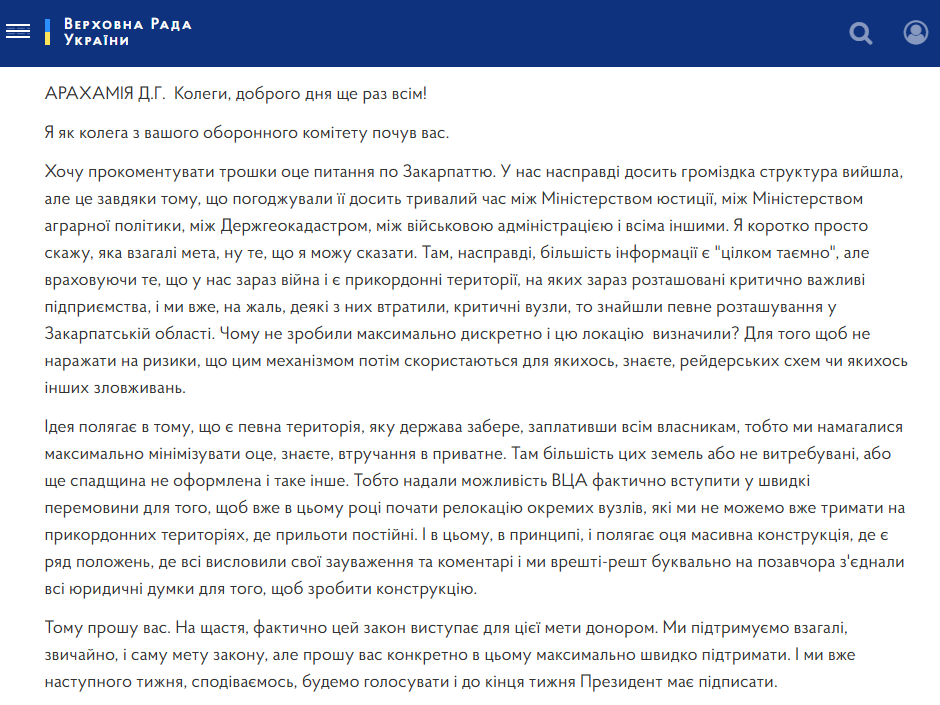
Transcript of the Committee’s meeting on 20.08.2024 with consideration of draft law 9549
Apparently, the information about the real reasons for such changes in the legislation was so secret that even the Supreme Commander-in-Chief did not know about it. Otherwise, how else can we explain why Volodymyr Zelenskyy calmly vetoed the law and the vast majority of his proposals were demanding the removal of the relevant provisions?
It is unlikely that anyone will publicly inform us of all the circumstances of the veto, but it is appropriate to note a certain reshuffling of officials. Law 9549, as previously adopted, gave land alienation to the head of the Zakarpattia Regional State Administration. At the time of the law’s adoption in August last year, it was Viktor Mykyta. But on September 8, he was appointed deputy head of the Presidential Office, and Myroslav Biletsky became the acting head of the RSA.
At the time of the veto, Biletskyi was still the acting head, but on November 8, he was appointed as a full-fledged head. Biletskyi is a representative of the party “Ridne Zakarpattya”, and his appointment is part of a complex game of the OP not only for influence in Zakarpattia but also for the votes of the “Dovira” group in the Parliament, whose four representatives created this party.
Such reshuffling could have been significant in deciding the fate of Law 9549. On the one hand, the new head of the RSA, who is much less dependent on the OP than his predecessor, received additional powers. On the other hand, an influential player who is well acquainted with the specifics of the cases in Zakarpattia appeared in the Office of the President.
When the law was being finalized to (not) take into account the President’s proposals, David Arakhamia came to the Committee’s meeting on March 14 to support the provisions on land alienation in Zakarpattia. He apologized for his previous promise that there would be no problems (confusing the month when everything happened) and reported a certain misunderstanding between two departments in the Presidential Administration, which led to the veto. He went on to say that they had finally worked with all the departments, and he guarantees that this time, there will be no veto of the law in the same wording and that the President is trying to sign it as soon as possible.
He explained the need to adopt the regulations for Zakarpattia this time through memorandums with German companies that were supposed to start building but could not.
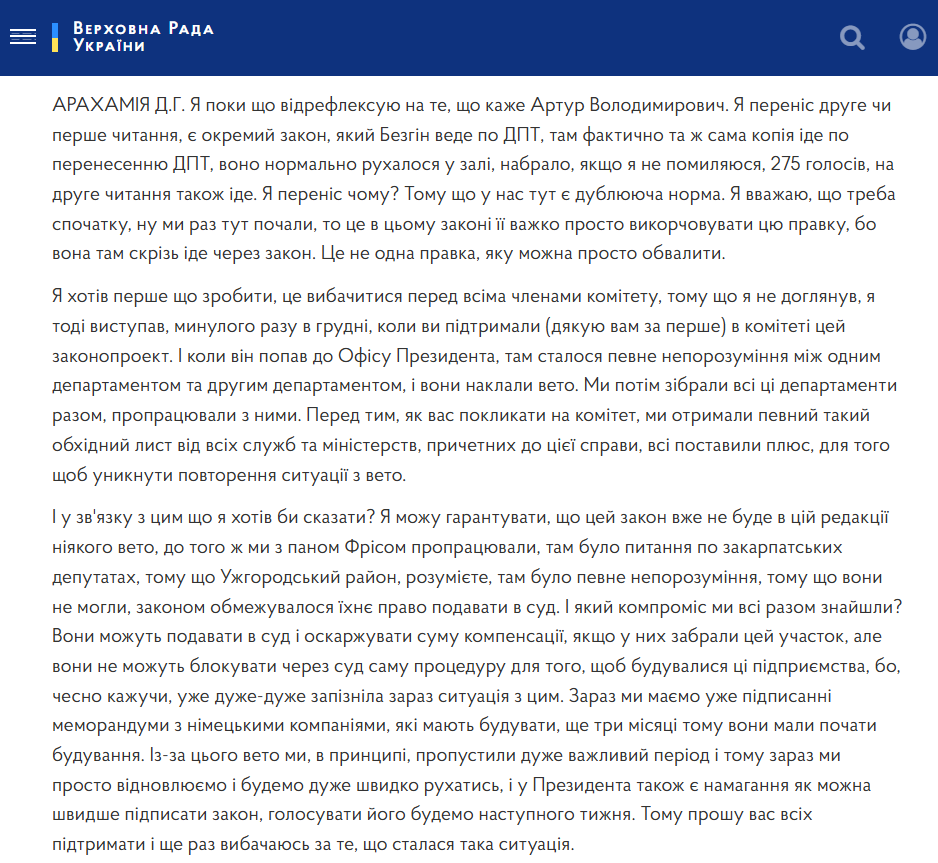
Transcript of the Committee’s meeting on 03/14/2025 with consideration of draft law 9549
The available information allows us to draw conclusions about a confrontation between two influential groups in the President’s Office regarding the rules on the expropriation of land and other real estate in Zakarpattia. Both groups are quite influential — one uses the head of the Servants of the People faction as a messenger, and the other can convince Volodymyr Zelenskyi to veto the bill. And while these two groups have been negotiating for almost five months, the vetoed law has been lying idle in the Verkhovna Rada.
The worst thing about this situation is that neither these groups of influence in the OP nor the members of the presidential party, including the head of the Parliamentary faction, are at all concerned about the damage to Volodymyr Zelenskyi’s reputation as a result of their dealings.
Zelenskyy vetoed it and explained that the provisions of Law 9549 violated the Constitution. He was also the one who officially provided recommendations to the Verkhovna Rada. It does not matter that the documents were prepared by other people — once the President signs them, he can no longer say that he is not aware of the situation.
First, the Parliament publicly nullified the President without considering the proposals at the plenary session. Now, it is trying to make a fool of him in the same way by returning the law for his signature, where all the proposals are supposedly taken into account, although, in fact, most of the proposals were ignored. The Parliament is doing this because the President’s Office promised them that no one would explain to Zelenskyy the need to veto this deal.
Does the end justify the means? And what is the real goal?
Even if Zelensky personally agreed to such a game with his own veto, he cannot afford to admit it, explaining everything by a great goal. This is not a situation where the President can afford to publicly state that he is ready to violate the Constitution and sign unconstitutional laws. It is scary to imagine the position of the Trump administration with its pressure on Ukraine if Zelenskyy himself erases this red line.
Zelenskyy’s team had to be guided by the need to preserve the president’s reputation. Have you decided to reverse the veto? Gather at least 300 votes in the Verkhovna Rada to override it and play democracy, using it as a trump card against the hostile narrative of Zelenskyy as a dictator.
Cannot get 300 votes? Take into account the President’s proposals by removing all the controversial provisions in Law 9549, and then amend the legislation on the alienation of land and real estate during martial law by a separate law. During the five months that the (non-)execution of the veto was being bargained over, new laws could have been passed twice from scratch.
But there is a more interesting question: why pull the wording that contradicts the President’s proposals? Given that the controversial provisions initially appeared through amendments to the second reading, there is no official explanation of their necessity, such as an explanatory note. Therefore, we will have to rely on David Arakhamia’s statements during the proceedings at the Agrarian and Land Committee. His stated goal is to solve the problem of relocating enterprises and building new ones in a safe area.
During the committee meeting in August, Arakhamia explained the choice of only the Uzhhorod district of the Zakarpattia region as a clearly defined discrete location as follows:

Obviously, this approach contradicts the Constitution because it creates unequal conditions for different entities. Thousands of companies in many regions face the problem of land for both relocated enterprises and the construction of new ones in relatively safe areas. The President recommended improving the legislation for the entire country, not just locally. To prevent abuse, a clear, consistent procedure for making decisions on land alienation and criteria for determining the territories and business entities to which the new procedure will apply must be established.
The proposals fully meet the goal declared by the lobbyists of the controversial changes and provide safeguards against abuses that David Arakhamia is so concerned about. But these proposals were completely ignored, and the old rules were extended.
This leads to the first conclusion: the beneficiaries of the changes are not interested in solving the problem in the country as a whole and need extremely corrupt procedures for selecting land plots for alienation and persons in whose interests it will be done manually without clear rules.
Law 9549 provided for compensation for land and buildings alienated in Uzhhorod district in the amount of 360% of the market value if the owner voluntarily agrees to sign a sale and purchase agreement, and 300% of the market value if he or she does not want to and is alienated by force.
The President’s proposal was to remove this obvious discrimination, establish fair and equal compensation for the value of the alienated property, and specify the methodology for calculating such compensation. The proposal was ignored, although it does not contradict the public purpose of the changes.
Hence, the second conclusion: the beneficiaries of the changes are interested in the opportunity to buy back manually seized property at a much higher price than its market value at the expense of the budget.
Law 9549 stipulated that the return of alienated property after the termination or lifting of martial law was not possible. The President proposed to establish guarantees for the return of the owner of the expropriated property that was kept. This is more than reasonable because why would the state throw away money to buy land or buildings at a price many times higher than the market price if they were not needed and were not used to locate relocated or new businesses?
Again, the proposal was ignored. What is the point in not implementing this proposal if the existing rule is useful only for fictitious projects that require the irrevocable purchase of land from the right people at an inflated price with public funds?
All that remains is to recall how the President’s Office persistently tried to simplify the procedure for changing the designated purpose of land. The first attempt with draft law 8178-1 failed, but draft law 9627 was adopted by the Verkhovna Rada. In both cases, there were warnings about the risk of building a corruption scheme based on the alienation of not cheap agricultural land, but ten times more expensive industrial land for public needs.
Law 9549, which was passed through fraud and deception to take into account the President’s proposals, allows the profit from this scheme to increase by another 3.6 times. Therefore, if someone already has a certain land bank in Uzhhorod district or can quickly buy cheap agricultural land in the right place because they know the details of the project or influence the choice of its location, they will be able to sell it to the state at a crazy price.
So maybe this is the real purpose of this shameful story with the law?
Specially for Dzerkalo Tyzhnia