
The reincarnation of Chernovetsky’s building cooperatives and the golden rent of the new housing policy

We remember the days of Kyiv Mayor Leonid Chernovetskyi when there were the loudest carve-ups in the capital: The open-air museum in Pirogovo has been proving in courts for years that its protected areas were illegally given away for construction. The schemes were used not only by the Kyiv City Council but also by neighboring councils. This is how village councils carved up Kyiv’s Bilychanskyi forest. The prosecutor’s office has also been spending resources for years to return these lands to the community through the courts.
So, schemes with cooperatives may return because the government has submitted a draft law, “On the Basic Principles of Housing Policy” (12377), under the slogan “de-Sovietization.”
“Holka” has already partially analyzed this draft and pointed out that those on the waiting list who have been waiting for their apartments for decades may forget about them. Where is the “cooperative scheme” hiding? What should the rental market expect, and why is it important? Does this draft law comply with the Ukraine Facility commitment plan?

The Housing Construction Cooperative (HCC) scheme will be possible if all members of the cooperative are eligible for state support. And during and after the war, there will be no shortage of beneficiaries. Therefore, we need reliable safeguards against abuse. And there are none. The Land Code still provides for the same non-competitive transfer of ownership of communal land that gave rise to rampant corruption in the past.
For your understanding: during just one meeting in 2007, the Kyiv City Council distributed about 1500 hectares of land for residential development to fictitious cooperatives for privatization. This is not bad support for the “needy” when 4-5 people create a cooperative and can get more than a hundred hectares (!) of land worth more than $100 million for free to “improve their living conditions”. And then, the cooperatives gave the land to developers for high-rise buildings.
About 3000 hectares were given away in this way in Kyiv alone. ZN.UA was the first to publish its own investigation into this. Thanks to the efforts of the prosecutor’s office, some of the plots were returned, but not all.
And this is not the first such attempt. In 2021, the Ministry of Regional Development drafted a new Housing Code with similar provisions. The National Agency for the Prevention of Corruption pointed out the existing risks in the anti-corruption expertise and recommended simultaneously providing for changes to the Land Code that would remove the possibility of abuse.
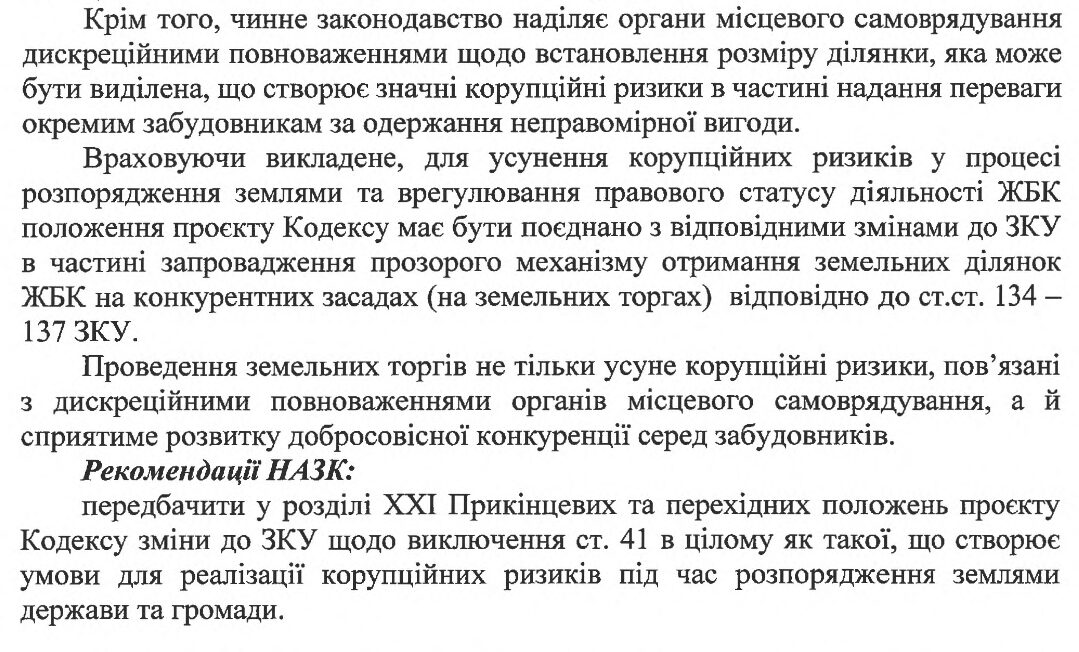
Recommendations of the NACP’s 2022 anti-corruption expertise
According to the explanatory note, the Ministry of Reconstruction (formerly the Ministry of Regional Development) sent draft law No. 12377 to the NACP last summer. However, for some reason, they did not even see the same corruption risk that had previously been identified in the draft Housing Code. It’s a strange thing. What/who this is due to is a rhetorical question. However, it was at this moment that the NACP had a change of personnel (the head of the agency changed), and the authors of the draft law from the Ministry of Reconstruction, who seemed to be very good at hardware work, successfully sent the document for the expert opinion they needed.
Why revive housing cooperatives as a separate form of state support in a hurry, without proper study, given such a negative historical experience? Apparently, this question does not bother the main curator of the draft law, Natalia Kozlovska, the specialized Deputy Minister for Construction of the Ministry of Development.
Yet, it is obvious that the meaning of housing cooperatives for citizens is the possibility of obtaining housing at the cost of construction without the developer’s market markup. The same result, but without additional corruption risks, can be achieved more easily by providing for investment in the construction of a certain share of apartments in social housing stock buildings for certain categories of citizens.
This approach will allow, firstly, to fulfill one of the requirements of Western partners for providing support for the construction of social housing – compliance with the principle of social integration declared in Article 6 of the project. Secondly, these additional investments in construction will increase the number of buildings with social apartments and, accordingly, the territorial coverage of social housing provision.

While the state is canceling the housing waiting list and developing plans for the construction of social housing (which may take decades), people are living their lives. They need support right now. There is no need to explain what role the apartment rental market plays in this. Everyone understood this when, at the time of the full-scale invasion in 2022, tens of thousands of IDPs moved to the center and west of Ukraine. Apartment rental prices there immediately skyrocketed. The same story happened in 2014, when IDPs, unable to find work and pay rent in the center and other regions of the country, returned to the DPR/LPR. Similarly, now the wives of military personnel pay two thousand hryvnias per day to come to support their loved ones in frontline communities. In other words, rent is a serious state tool that can dramatically change the situation within society and influence people’s attitudes toward the state. During the war, it is a super important tool. So what?
It is true that it is always difficult to find a compromise between the dreams of tenants, landlords, and tax authorities. European integration aims to regulate rental issues, and this is difficult unless you overcome the Ukrainian fetish for owning your own home.
Stories about how every second person in Switzerland has been renting all their lives and feels great will not convince anyone that reforms are needed.
The government has decided to cut this Gordian knot: it is mandatory to register the right to rent housing without any fundamental changes in the regulation of tenants’ and landlords’ rights.
What will this do?
Currently, tenants and landlords enter into an agreement to protect their rights but do not publicize it to save on taxes. This is unprofitable for the state, but rental housing is more affordable, and there is some protection for the parties.
If the new law is adopted, entering into an agreement without state registration of the right will make no sense—the courts may consider it void, citing the lack of state registration of the right. And if you register it, you will have to pay taxes because the tax service receives information about the contract.
So there are two options. Either the rent goes up by the amount of taxes, so housing becomes even less affordable in the midst of war. Or the tenant and the landlord become completely unprotected from possible violations of their rights by each other. Both options contradict the stated goals of the reform.
Given the war and the majority of the population’s difficult financial situation, the state is likely to receive little in the form of additional taxes, which will further undermine Ukrainians’ trust in the rental housing institution.

Both the Ministry of Regional Development and the head of the relevant Verkhovna Rada Committee, Olena Shulyak, claim that the adoption of draft law No. 12377 by the end of this year is necessary to fulfill the obligations under the Ukraine Facility plan.
The Ukraine Facility does indeed provide for the adoption of a law with the same title as the government’s draft. However, it does not mention the need to abolish the current right of certain categories of citizens to receive free housing for permanent residence from the state and the privatization of the state housing stock.
It is important to note that social housing is not subject to sale or privatization even under current legislation, so there is nothing to prevent the development of a new system of social rental housing, postponing the abolition of the Housing Code and privatization of housing, which will lead to increased social tension, until a peaceful future.
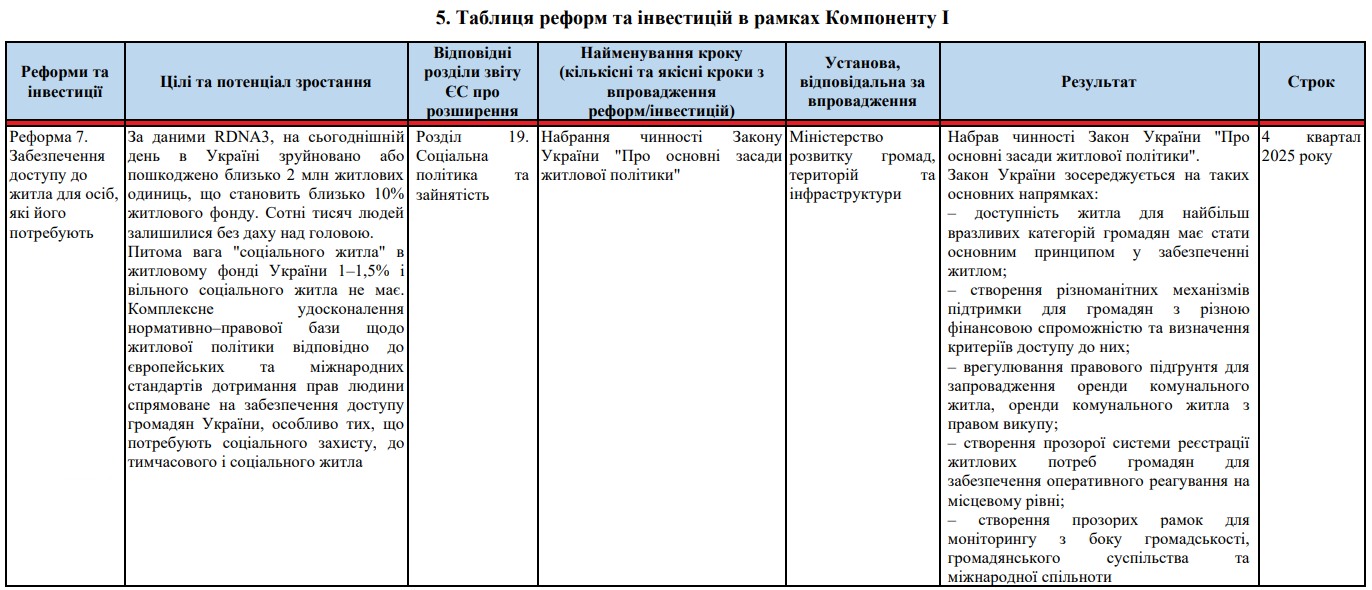
Fragment of the Ukraine Facility’s analysis of the requirements for draft law No. 12377
At the same time, the draft does not fulfill some of the promised requirements.
It is envisaged that“the availability of housing for the most vulnerable categories of citizens should become a basic principle in the provision of housing.” In the context of a catastrophic shortage of social housing, its accessibility is primarily a possibility of receiving it out of turn. However, the project does not prioritize the provision of housing to the most vulnerable categories of citizens.
At the same time, it is not difficult to immediately identify a list of such categories of citizens and provide them with a separate form of support, such as subsidies for renting ordinary private housing and prioritizing its funding.
The new law should not only provide for the creation of various mechanisms to support citizens with different financial capacities but also define the criteria for accessing them. However, the draft law does not define these criteria; rather, it gives the Cabinet of Ministers the authority to approve them in the future. The Ministry of Development should set the general and minimum requirements for the consumer cost of housing, which are key to these criteria.
Specially for “Dzerkalo Tyzhnia”