
Public consultations: the Rada implemented the European Commission’s requirement for the show, what are citizens to do now?

The public will not have a real opportunity to influence the government’s decisions, including those related to reconstruction. The MPs fulfilled the requirements of the partners with the law “On Public Consultations” (4254) only formally (!). They substituted concepts in order to meet the deadline for EU accession negotiations, and the law was passed without discussion.
The MPs did not provide for mandatory public consultations before considering their own and the President’s initiatives. Therefore, the government can easily pass its initiative to parliamentarians and the subjects of legislative initiative do not need to consult with the community at all if there is such a political need.
And if we talk about local self-government, it is unlikely that more than 1% of decisions will fall under this law and require public consultations. There are too many exceptions. Moreover, the law will come into effect only a year after the victory. Therefore, even if it were perfect, the status quo would not change now.
The issue has been delayed for 4 years. The Committee on the Organization of State Power and Local Self-Government had enough time to prepare a proper draft. When the European Commission demanded immediate support, the initiative was immediately included in the Government Action Plan for the Implementation of EU Recommendations and the Ukraine Facility reform program.
The Golka civic initiative analyzed the law, which was passed but not yet signed by the President, and identified a number of risks.

There have been attempts to adopt such an initiative before. In 2020, Denys Shmyhal’s government did not reinvent the wheel but adopted the draft law from the time of Volodymyr Groysman’s government (7453). They modernized it by adding a digital “online platform for interaction with citizens and civil society institutions” and sent it to the Parliament to create the impression of progress. The Cabinet of Ministers did not even bother to take into account the comments of the OSCE Office for Democratic Institutions and Human Rights, which resulted in the initiative being blocked by MPs of the previous convocation. The Main Scientific and Expert Department of the Parliament immediately reminded us of this in its conclusion.
The law was put on hold after the first reading three years ago. However, the European Commission harshly reminded us of it last year in a report. The report incidentally mentioned strong objections to adopting the urban planning “reform” 5655, as well as the requirement to reform the bar.
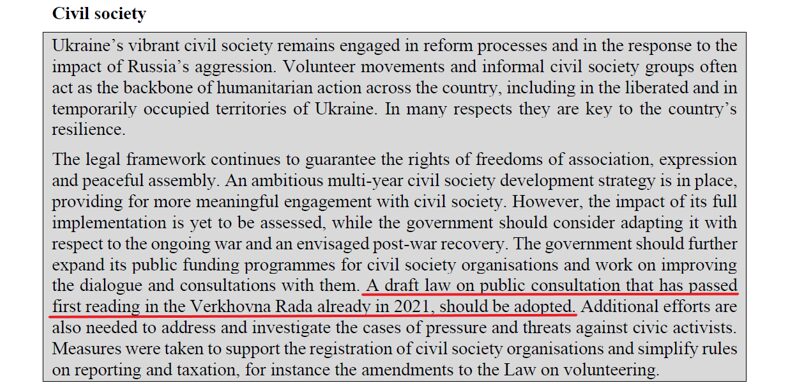
Excerpt from the European Commission’s Report on Ukraine’s progress under the EU Enlargement Package.
As a result, the draft law on public consultations quickly found its way into the Government Action Plan for the implementation of the European Commission’s recommendations in the EU Accession Process Framework cluster on the functioning of democratic institutions and public administration reform.
However, then this adoption suddenly moved to the decentralization section and became aimed solely at strengthening the tools for involving citizens in decision-making processes at the local level (!).

Let’s start with the pros. Before the adoption of the law, public discussions were already required in a large number of cases, but the procedures were mostly regulated at the level of bylaws and decisions of local authorities. Therefore, it was extremely problematic to monitor the activities of many bodies at the same time.
Nowadays, a very wide range of entities have already standardized procedures and established cases when public consultations are mandatory. The list of cases, when consultations become mandatory, has indeed been significantly expanded.
Unification, including the upcoming creation of a single online platform, greatly simplifies the process of monitoring government rulemaking at all levels for the public.
But the devil lies in the details. For which executive bodies are consultations mandatory?
The list of entities subject to the requirements of the Law is quite extensive: MPs, VR committees, the Cabinet of Ministers, ministries, other central executive bodies, local state administrations, the National Bank, local governments, etc. (Article 5). Even self-governing organizations must hold public consultations when exercising their delegated powers. But there are unpleasant nuances.
In the first reading, it was stated that the President should also hold mandatory public consultations. But the MPs decided to exempt him from this obligation, as well as themselves. MPs will hold consultations only if they wish to do so.
That is, if the government wants to avoid consultations, it can simply pass the legislative initiative to MPs.

The law only regulates the preparation of regulatory acts and program documents (concepts, strategies, programs, action plans, etc.). And not all of them. The full list of exceptions is quite long (Article 2).
Therefore, at the local government level, hardly more than 1% of draft decisions of the city council and its executive bodies are subject to the new law.
There are no mandatory public consultations for draft laws, except for those prepared by the Cabinet of Ministers. However, they can be voluntarily held by the MPs who authored the draft before registration. Also, the relevant committee may decide to hold consultations for any draft law at its discretion, but only on the version adopted in the first reading. In the second reading, the drafts are changed beyond recognition. Therefore, the new law does not change anything at all.
Almost all the positive changes will come with a new level of openness of draft government regulations and ministerial orders. It is worth recalling that the situation here is worse than when bills are being prepared for the second reading in the Parliament. In order not to prematurely reveal its intentions, the Government even violated the requirements of anti-corruption legislation and did not send some of the drafts to the National Agency for the Prevention of Corruption for examination.
One of the major drawbacks is the selective approach to the list of exemptions. For example, regulatory acts are explicitly listed, because special legislation for them regulates the consultation procedure much better than the new law does.
However, the list of exceptions does not include decisions subject to strategic environmental assessment (as emphasized by the Ministry of Environmental Protection in its proposals not considered by the Parliament). However, public discussions of strategic environmental assessment are regulated in detail in a separate law adopted to fulfill international obligations.
There are also no exceptions for draft urban planning documents at the local level and comprehensive restoration programs, public hearings for the adoption of which are much better regulated by the Law on Regulation of Urban Development.
This creates legal uncertainty and may lead to the deliberate use of much worse new procedures by the authorities to weaken the level of public involvement in addressing very important issues of both environmental safety and community development planning.
A separate questionable exception is the explicit provision that public consultations shall not be held by local authorities less than 15 days before any election.
Firstly, there is legal uncertainty in the case of early elections – it is not clear to which bodies this exception should apply, since city (or village or settlement), district, and regional councils operate simultaneously on the same territory. This was emphasized by the Main Legal Department in its remarks, nonetheless, the deputies did not hear it.
Secondly, it creates a “window of opportunity” and can lead to populism that is critical for the community for the self-promotion of current deputies, as well as to the adoption of a number of deliberately illegal decisions on the principle of “while there is the last opportunity to make easy money.”

The answer is anyone, even children, foreigners, citizens of the aggressor country, and even the Russian dictator Vladimir Putin himself.
This is not a joke. There are no restrictions on a person if he or she is willing. Proposals may be submitted by “interested parties”, which, as defined in Article 1 of the Law, include “other persons who have expressed a desire to participate in public consultations”.
Add to this that the main form of consultation is electronic consultation. Individuals can send proposals by e-mail, indicating only their surname, name, patronymic, e-mail address, and means of telephone communication. The Law does not provide for any identification of the person’s identity.
But the patronymic is required. If not, proposals from such a person have no right to be considered, because this is mandatory information and there are no exceptions.
In the future, all public consultations should be carried out on an online platform for interaction with citizens and civil society institutions, which is to be operated by the Ministry of Digital Transformation.
But there is a nuance here, too. The Law does not define the terms of its creation and sources of funding, so it is unknown when it will be created. Until then, the transitional provisions stipulate that until the technical capabilities for conducting electronic consultations on this online platform are created, consultations are conducted by the subjects of consultations on their websites and/or social media pages.
Undoubtedly, Ukraine is becoming an undisputed leader in e-democracy. It is unlikely that anyone else would dare to hold consultations on state and local policy on social media pages or their websites with the participation of everyone, including bot farms.

According to the press service of the Verkhovna Rada’s Secretariat, citing Olena Shulyak, the head of the relevant committee, “all suggestions and concerns that will be voiced during the consultations should be taken into account.”
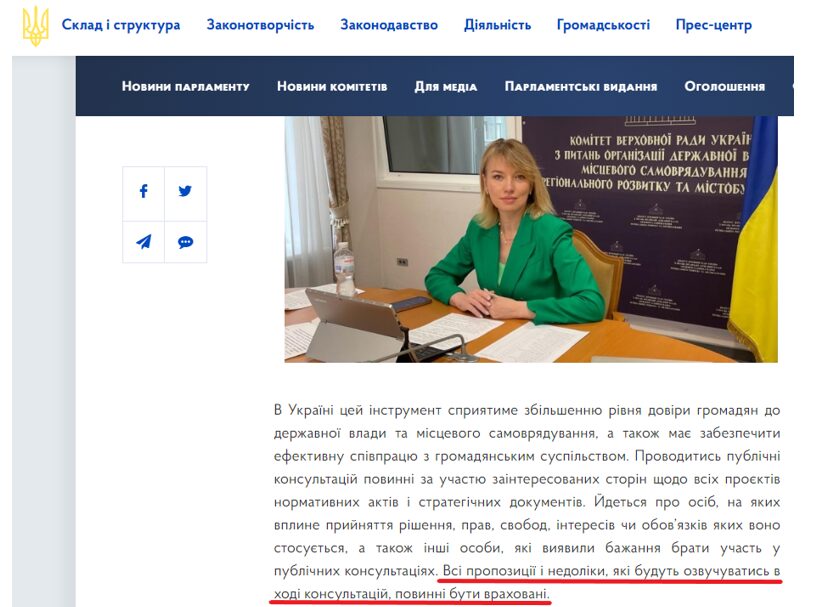
Press release of the Verkhovna Rada on the adoption of the Law “On Public Consultations”
However, these statements are not true – the adopted law does not provide for mandatory consideration of suggestions and shortcomings voiced by the public. It does not even regulate the procedure for reviewing proposals but only establishes that proposals should be recorded, made public, analyzed, and studied, and then the report provides generalized information on the consideration or rejection of proposals with the justification for the decision.
What role can public consultations play if the authorities have the legal right to ignore any proposals at their discretion?
Not only do the mechanisms of public participation in public administration established by the new Law appear to be fictitious, but there also arise the significant risks of building safe corruption schemes under the guise of taking into account the submitted proposals.
Such schemes already exist in areas where special laws provide for public discussions with their procedures not well regulated. This can be best demonstrated in the case of urban planning documentation.
Below is a screenshot of the report on the consideration of public proposals for the draft detailed plan of the territory in Kyiv. An ordinary citizen asks to make changes and provide for the construction of a residential high-rise building near the Dnipro riverbank, as he has allegedly long dreamed of buying a new apartment in such a place. The proposal was taken into account. Numerous proposals to create green areas, which are sorely lacking in the area, or to correct obvious fraud with the indicators of social infrastructure provision were ignored.
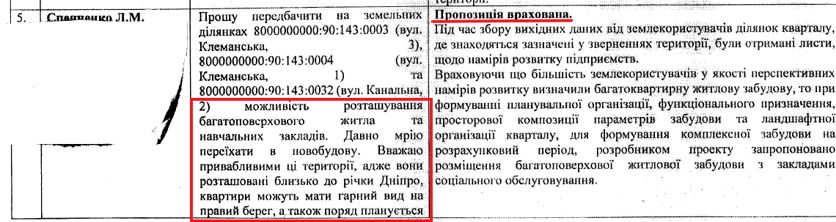
Screenshot of the consideration of public proposals to the draft detailed plan of Kyiv territories
Similar stories happen regularly with urban planning documents, regulatory acts, and ordinary legal acts of the government or ministries that are already subject to public consultation under the current legislation.
The absence of effective procedures established by law for taking into account or rejecting proposals and mechanisms for resolving disputes if mutually exclusive proposals are received is a separate corruption risk.
For officials and authorities, these are ideal conditions for adopting acts in the interests of third parties contrary to the interests of the state or community. Violations occur under the guise of “taking into account public proposals”.
The mentioned earlier shortcomings of the Law with the unlimited number of “interested parties” and the lack of identification of persons submitting proposals enable the mass submission of proposals necessary for corrupt purposes. Whereas the real public will have no chance to win in such a game of “democracy”.
The only known mechanism to mitigate these risks is the creation of a conciliation commission to resolve disputed issues, which includes representatives of the public.
This is not possible in all cases, but Article 12 of the Law defines a list of the most important issues for which public discussions, not just public consultations, should be held. The format of public discussions creates the possibility of electing representatives of the public to the relevant conciliation commission.

The law will come into force 12 months after the victory, although there is no need to postpone its effect. And this is another huge problem. Even if all the other provisions were perfect, the public would still be left out of the process of adopting key rules for future reconstruction, both at the legislative level and at the level of local communities. This regulation should be adopted before our victory or as soon as possible right after it instead of being developed with a year’s delay.
In the meantime, the government and local authorities are to start drafting the relevant bylaws not immediately, but only 6 months after the victory. This is exactly the timeframe for early elections, so the newly elected government may not have enough time to get up to speed and prepare everything properly.
Specially for “Dzerkalo Tyzhnia“