
Hidden privatization: is Ukraine facing a large-scale sale of state property?

The draft law “On Peculiarities of Regulation of Entrepreneurial Activity” (6013), which was withdrawn from consideration in October, is to be put to a vote this Tuesday, December 17.
The Holka civic initiative has already written that the draft law may actually carry out the largest redistribution of state property since Ukraine’s independence in a non-privatization way.
The draft law was then opposed by judges of commercial courts and the head of the Commercial Court of Cassation, Larysa Rohach, scientists, farmers, insolvency officers, and representatives of business associations.
However, various government agencies also see the risks in terms of adopting this draft law.
The Main Legal Department of the Verkhovna Rada of Ukraine emphasizes that the draft law’s concept is wrong.
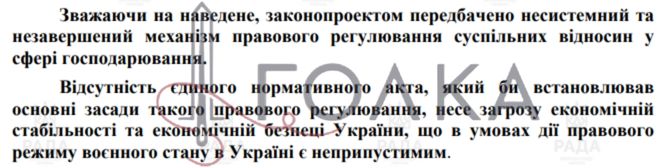
Excerpt from the comments of the Main Legal Department of the Verkhovna Rada on the draft law
In support of its position, the Main Legal Department cites the words of Ursula von der Leyen, President of the European Commission, who, in the “Policy Guidelines for the Next European Commission 2024-2029” on business facilitation noted:

The position of our European partners is unequivocal. Legal regulation should be simplified, and a multitude of laws should be consolidated into codified acts.

The State Property Fund of Ukraine emphasizes that the adoption of Draft Law 6013 will negatively affect the ability of the Fund to perform its powers and lead to significant risks.

Excerpt from the letter of the State Property Fund of Ukraine to the Verkhovna Rada Committee on Economic Development regarding the draft law
All of this can happen through a forced change of ownership of state-owned enterprises to private ownership, which is what the draft law proposes.
At the same time, such a global redistribution of ownership will take place outside the privatization procedure, as is currently required by law.
After the government abolished the list of state-owned companies not subject to privatization in 2019 and the Parliament failed to approve a new list of objects of state-owned companies not subject to privatization, this step seems quite systematic and consistent. Of course, if we are talking about a deliberate policy of depriving the state of elements critical to its existence.
This all resonates with the draft law by MP Ihor Fris (Servant of the People), which provides for amendments to the Civil Code and has already been supported by MPs in the first reading (12089). The draft law was written to protect the property rights of the so-called “bona fide purchasers,” who are proposed to be set time limits after which the state will not be able to make claims against them for property they may have obtained through fraud or schemes. This was also reported earlier by a civic initiative that appealed to the National Agency for the Prevention of Corruption to conduct an anti-corruption assessment of the draft law.
In its conclusion, the NACP found that draft law 12089 does not take into account the interests of the state and guarantees of return of state or municipal property in case of its alienation.

Excerpt from the conclusion of the anti-corruption expertise of draft law 12089
Stefanchuk’s draft law 6013 also proposes to amend the Civil Code and prohibit the state from reclaiming property from its buyer if it bought it at an auction.
The State Property Fund does not support such changes, pointing out that everyone has the right to go to court and decide whether their rights have been violated.
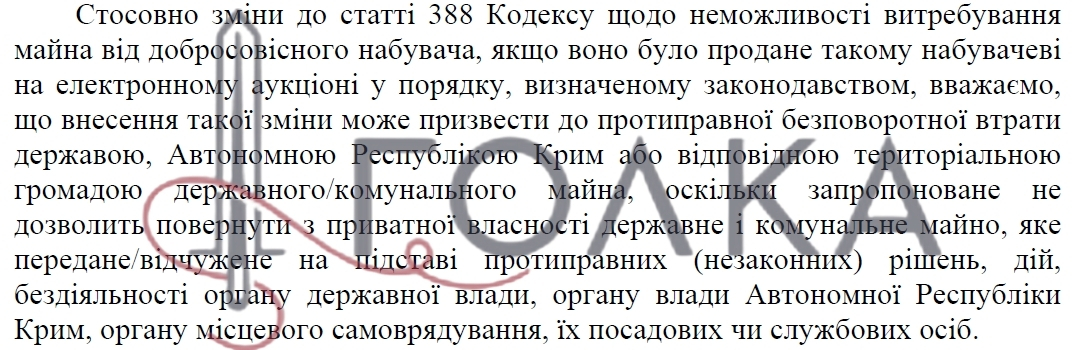
Excerpt from the letter of the State Property Fund to the Verkhovna Rada Committee on Economic Development regarding the draft law
Thus, what unites Draft Laws 6013 and 12098 is that they essentially block the possibility of judicial protection of state and community property at the legislative level. This obviously does not comply with the provisions of the Constitution of Ukraine since everyone whose rights are violated should be able to go to court for protection.
Also, the State Property Fund draws attention to the fact that the draft law 6013 is inconsistent with the Law “On Amendments to Certain Legislative Acts of Ukraine on Improving Corporate Governance” adopted this year, which introduced the State Property Policy.
International partners expected Ukraine to adopt this document to reform the management of state-owned companies, as it is part of the Ukraine Facility plan.
In the agenda for November 08, which was sent out, draft law 6013 was also designated as a Ukraine Facility, but later this designation disappeared and has now reappeared.
In addition, the Ministry of Education is concerned about the prospect of “shadow” privatization of the property of educational and scientific institutions and reminds that the law establishing the list of state property was repealed, and a new list was not adopted.
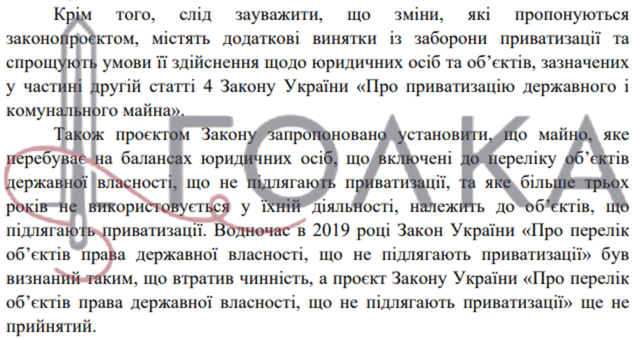
Excerpt from the Ministry of Education and Science of Ukraine’s proposals on the draft law
Therefore, “the application of the mechanisms of legal regulation in the field of education proposed by the draft law contains certain risks of loss of state and municipal property of educational institutions, scientific institutions, and state-owned enterprises, as well as uncertainty in the use of material and technical resources of educational institutions,” the Ministry of Education and Science proposals say.

The military-industrial complex and the Armed Forces of Ukraine will also be affected. For example, the draft law introduces the right to use other people’s property with the right to appropriate income from it, but subject to the integrity of this property (the so-called right of usufruct). This right will also apply to military property assigned to military units, institutions, establishments, and organizations of the Armed Forces of Ukraine. Currently, Ukrainian legislation does not provide for such a right at all. The authors of the draft law are modestly silent on how it will be applied to military property (weapons, military equipment, ammunition).
The same applies to the property of scientific institutions and educational institutions, which, according to the Ministry of Education and Science of Ukraine, may be subject to carve-up.

Excerpt from the proposals of the Ministry of Education and Science of Ukraine on the draft law
Hanna Budurova, PhD in Law, head of the All-Ukrainian Center for Economic Law, notes that:

The Association of Ukrainian Cities also sees risks for the property of local communities. Yaroslav Raboshuk, Director of the Analytical Center of the Association of Ukrainian Cities, said:

Yaroslav Raboshuk also notes that draft law 6013 contains a direct ban on the creation of communal enterprises, stipulates that the property of territorial communities should be transferred to the ownership of business entities, and does not provide for any changes to the Budget Code, which stipulates that the source of local budget revenues is revenues from communal enterprises. Therefore, after the liquidation of municipal enterprises, territorial communities will lose a source of revenue for their budgets.
The initiative on draft law 6013 is a hybrid threat disguised under attractive slogans. It seems to be within the legal framework, but in fact, it is actually a non-privatization division of state and municipal property.
Specially for “Dzerkalo Tyzhnia”