
The Tug-of-War Between Zelenskyy and Klitschko. On Whose Side is the Constitution in the Fight for Kyiv?

The conflict between Kyiv’s Mayor Vitali Klitschko and the head of the capital’s military administration, Timur Tkachenko, raises a number of questions. In April, the Kyiv City Council attempted to strip Tkachenko of some of his powers and transfer them to Klitschko. This, in fact, revived the Kyiv City State Administration as an executive body. Tkachenko responded that only the President could deprive him of his powers, and a week later, a court suspended the controversial decision.
The confrontation between Kyiv’s mayors and the Presidential Office (Bankova) for control over the executive power in the city has been ongoing since the late 1990s as a result of the adoption of the Law on the Capital City. The Kyiv City State Administration (KCSA) combined the functions of state authority and the executive body of the Kyiv City Council, but it was not unequivocally determined who should head this dual-natured body – the mayor elected by the people of Kyiv or an appointee of the President.
However, the current conflict is taking place in an unusual legal environment. On the very first day of the full-scale invasion, Volodymyr Zelenskyy, by his Decree, created the Kyiv City Military Administration and effectively liquidated the Kyiv City State Administration by granting it the status of a military administration.
The Kyiv City Council and the mayor did not challenge Zelenskyy’s Decree in court and silently worked under the new rules for over three years. Moreover, to justify Klitschko in the tragic situation with fatalities from a Russian missile near a closed shelter in 2023, the Kyiv City Council approved a commission report concluding that the KCSA had acquired the status of the Kyiv City Military Administration (KCMA), was not subordinate to the mayor or the council in any way, and did not perform the functions of an executive committee.
The situation is absurd – the Kyiv City Council first recognized that no KCSA exists, and now it has determined that Klitschko should issue orders of the non-existent KCSA within the scope of local self-government powers. Therefore, at first glance, it is Klitschko who appears to be the usurper of power, having demonstratively refused to comply with the President’s Decree and, thanks to the controlled Kyiv City Council, appropriated the powers of the military administration. But is everything really so?
Powers of the KCMA and its Head: What Does the Law Say?
To understand which of Tkachenko’s powers the Kyiv City Council was taking away, one must understand what powers the Kyiv City Military Administration and its head actually have at present. Some might say there is nothing to figure out – only the nameplate on the authority’s office has changed, and the head of the KCMA does the same thing the head of the KCSA used to do. Indeed, nothing has changed. But that is precisely the problem from a legal standpoint.
The powers of military administrations of populated areas depend on whether the parliament has transferred to them all the powers of local self-government bodies. There is no such decision by the Verkhovna Rada for Kyiv, so the exclusive list of powers of the Kyiv City Military Administration is established in Article 15 of the Law “On the Legal Regime of Martial Law.” This list is extensive and includes a range of self-governing powers of local self-government, as well as all the powers of executive authorities delegated to local self-government bodies.
For example, from the very beginning, with the Kyiv City Council still active, the military administration has the right to independently approve Kyiv’s budget and make changes to it, and to lease municipal land plots for up to one year. However, the heads of the military administration in the capital have never used these powers.
But more importantly are the powers the military administration lacks. It is not stipulated that the KCMA can exercise the general powers of a local state administration and a significant number of powers of the executive bodies of the Kyiv City Council.
For example, the military administration does not have the right to approve construction projects financed by the budget, nor the documentation for creating objects of the nature-reserve fund, to prepare programs for socio-economic and cultural development, to organize the development of urban planning documentation, to prepare and submit draft decisions to the Kyiv City Council, and much more. By the way, the district state administrations in Kyiv are also not subordinate to the KCMA by law.
Compared to the Kyiv City State Administration, the military administration has significantly fewer powers. The military administration has sufficient powers to ensure the stable functioning of Kyiv under martial law, but it does not have the powers to ensure the city’s development.
However, there is one fundamental point: the creation of a military administration does not deprive the executive bodies of the Kyiv City Council of their powers defined by legislation. They even have the right to deal with the same problems in parallel with the military administration. The only problem is that they have no ability to exercise these powers, because according to the Law on the Capital City, the sole executive body is the KCSA, which has not existed since the moment the KCMA was created.
That is, the KCMA and its heads (including Timur Tkachenko) have been grossly violating and continue to violate the requirements of the law and are arbitrarily doing things they have no right to do.
So, it is inappropriate to accuse the Kyiv City Council of depriving the KCMA of its powers. After all, the KCMA never legally had some of the powers of the Kyiv City Council’s executive body, and it can continue to perform the duties it is entitled to.
But how did a situation arise where, in the midst of a war, the capital lacks a governing body that simultaneously has all the necessary powers to manage the city and the ability to exercise those powers?
Everything is Permitted for the President-King
Zelenskyy, by his decree, determined that the Kyiv City State Administration and its head acquire the status of a military administration and the head of this military administration, respectively. But according to the Law “On the Legal Regime of Martial Law,” he had no right to do any of this.
As stated in the Decree, the KCMA was created “to exercise leadership in the sphere of ensuring defense, public safety, and order.” But the Law allows for the creation of exclusively regional and district military administrations on such grounds (Part 4 of Art. 4).
No one will deny that the city of Kyiv – although with a special status – is still a populated area, not a region or a district. Therefore, the military administration here is a military administration of a populated area.
Zelenskyy had the right to create a military administration in Kyiv as a populated area only if the Kyiv City Council and/or the KCSA were not exercising their powers (Part 3 of Art. 4). Obviously, on the first day of the invasion, there could not have been any complaints about the exercise of powers by these bodies yet.
But if the President at least had the authority under the Law to create the KCMA if the relevant grounds existed, the situation with the KCSA acquiring the status of the KCMA is even worse. The President has no authority whatsoever to decide such a matter, and the Law (Part 4 of Art. 4) imperatively establishes that in the event of a decision to form district or regional military administrations, the respective district or regional state administrations acquire their status.
When the President, in the absence of authority, begins to resolve issues according to his own will, this is already called a usurpation of power and a dictatorship.
But it was precisely Zelenskyy’s illegal actions that led to the current situation in Kyiv. By law, the military administration could only have been created as an additional body. Consequently, by law, the KCMA does not have the powers to independently ensure the full functioning of executive power in the capital. However, there is a deeper reason for the problem – the President’s ability to create military administrations in the first place.
Poroshenko’s Dictatorial Law in Zelenskyy’s Service
The Constitution does not provide for the existence of such state authorities as military administrations. Accordingly, it does not contain the President’s powers to create military administrations and appoint their heads.
At the same time, the Basic Law (p. 31, part 1, art. 106) specifies that the powers of the President are established exclusively by the Constitution. The Constitutional Court in its decision of 10.04.2003 No. 7-rp/2003 directly stated that this makes it impossible to adopt laws that would establish other powers (rights and duties) for the President. And this is far from the only decision of the Constitutional Court with such conclusions – a similar position has been confirmed by it about ten times, with the latest decision dated 2020 (No. 11-r/2020).
The issue is extremely fundamental. Firstly, the ability to grant the President new powers at the level of laws by a simple majority in the Verkhovna Rada is a direct path to dictatorship. Secondly, it carries corruption risks, because the President can, at his own discretion, either exercise or ignore powers established in this way, citing their unconstitutionality.
The possibility of creating military administrations has been provided for since the summer of 2015 by the new Law “On the Legal Regime of Martial Law” (bill 2541), initiated by Petro Poroshenko. Two main directorates of the parliament (the scientific-expert and the legal) immediately noted the expansion of the President’s powers embedded there in violation of the Constitution.
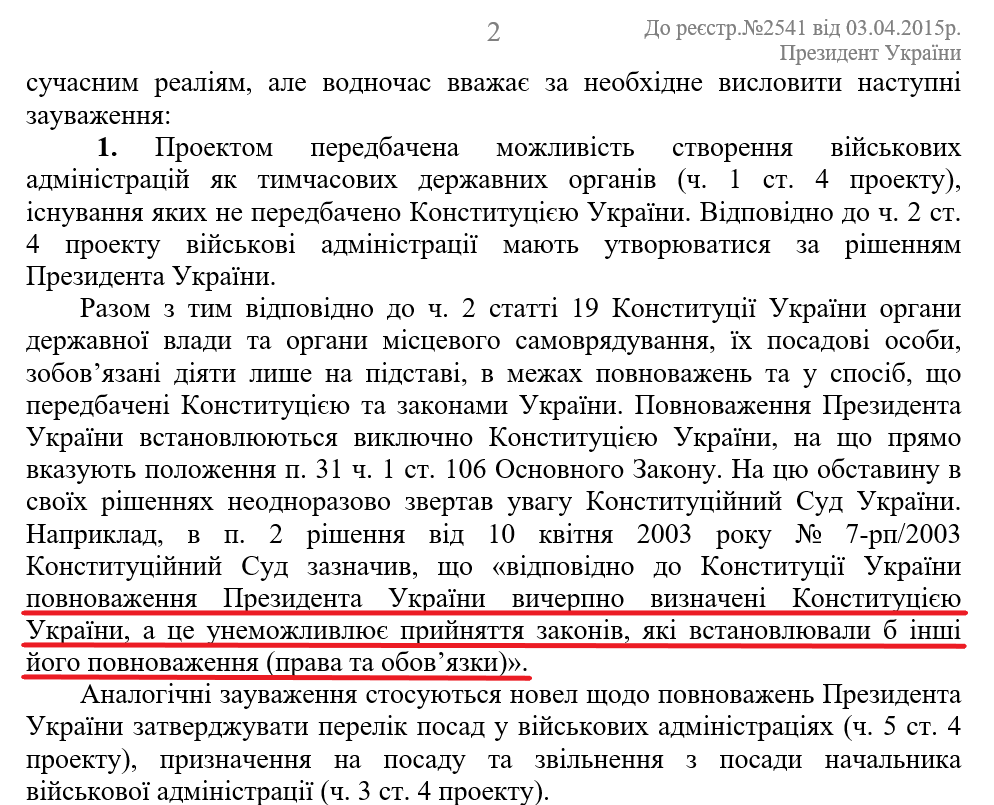
Conclusion of the Main Scientific-Expert Directorate of the Verkhovna Rada on bill 2541
The old Law “On the Legal Regime of Martial Law,” which had been in effect since 2000, provided for the inadmissibility of terminating the powers of, among others, local state administrations and local self-government bodies during martial law. The new law no longer contains such prohibitions and directly provides for the possibility of transferring their constitutionally established exclusive powers to military administrations.
This transfer of exclusive powers of authorities defined by the Constitution to someone else is another violation of the Basic Law. And this was also noted in the remarks of the Main Legal Directorate of the Verkhovna Rada on the bill.
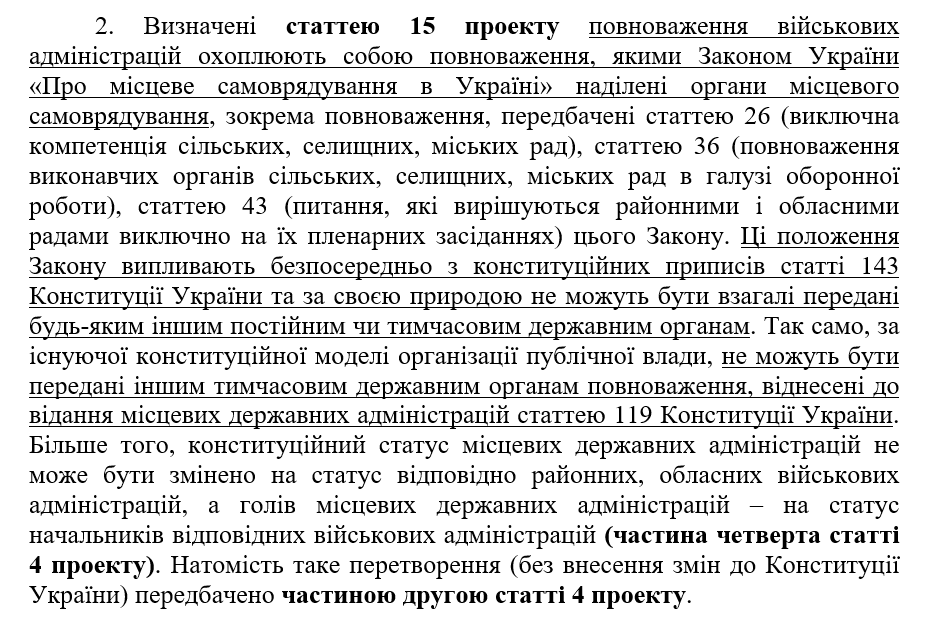
Remarks of the Main Legal Directorate of the Verkhovna Rada on bill 2541
Both Main Directorates of the parliament also pointed to the risks of abuse in the creation of military administrations of populated areas, because the draft law contained only extremely questionable evaluative criteria for such decisions. But all remarks were ignored.
By the way, the situation is similar with the creation of military-civilian administrations by the President in a law that the Verkhovna Rada adopted back in 2015.
Under Zelenskyy, the mechanisms for depriving communities of the right to self-government during martial law were significantly strengthened. Already in the midst of the war, the Verkhovna Rada, with Law 2259-IX, expanded the grounds for creating military administrations of populated areas. Whereas previously it was necessary for the local council and/or its executive bodies not to perform their duties, since May 2022 it is sufficient for the head of the community not to perform their duties.
The same Law empowered the parliament to transfer to military administrations the exercise of all powers of local councils, their executive bodies and apparatuses, and their heads. No conditions under which this is allowed are established – it is enough that the military administration has already been created by the President and that there is a submission from him to the parliament (new parts 2 and 3 of Art. 10 of the Law “On the Legal Regime of Martial Law”).
The Main Legal Directorate of the parliament this time also pointed to the violation of the Constitution and the decision of the Constitutional Court (bill 7269), but this was ignored by the deputies.
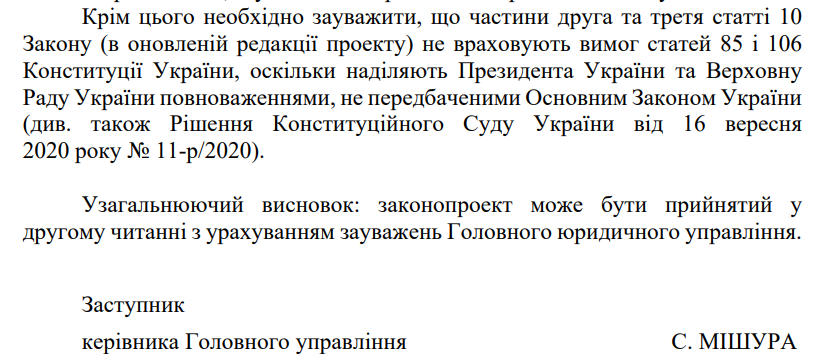
Remarks of the Main Legal Directorate of the Verkhovna Rada on bill 7269
How effective and threatening is the new mechanism in the hands of Bankova? The example of Chernihiv makes everything clear.
Why Aren’t the Unconstitutional Norms of the Law and the President’s Violations Challenged?
Local self-government can be protected by repealing the unconstitutional norms of the Law on Military Administrations. Usually, opposition parliamentarians appeal to the Constitutional Court to repeal norms favorable to the authorities. But the current opposition is largely the previous government, which started this chain of constitutional violations.
In the situation directly concerning the creation of the KCMA, there are no such obstacles – Klitschko or the Kyiv City Council could have easily challenged the legality of the relevant part of the President’s Decree. Zelenskyy’s violation of the law is obvious, and Klitschko has publicly declared at every opportunity the pressure from the President’s Office on local authorities in the capital, so why was there no lawsuit?
It’s simple: it was beneficial for the mayor. Klitschko lost the post, but not the power. The violations in the KCMA’s work were not limited to exceeding the powers established by law. Only its head has the right to appoint and dismiss officials and employees of the military administration. But the personnel policy of the KCMA was formed by the mayor and the Kyiv City Council with reference to the laws on the capital and local self-government.
The Kyiv City Council created new departments of the KCSA and approved regulations for them, although they were structural units of the military administration. The deputy heads of the KCSA, appointed personally by Klitschko, are responsible for the KCMA’s areas of work. And the mayor personally continues to appoint and dismiss all department directors.
The previous heads of the military administration, generals Zhirnov and Popko, did not object to such a violation of the Law. And even the current head, Tkachenko, has not made any statements about Klitschko illegally appropriating his exclusive powers.
At one time, the ex-mayor of Kyiv, Chernovetsky, faced no punishment for his actions because all important documents bore not his personal signature, but a facsimile or a signature made through a stencil. Klitschko has adapted even better – for the last three years, everything in his interest has been signed by the heads of the KCMA appointed by the President.
For all issues that the KCSA handled before the invasion, draft orders of the KCMA continued to be prepared by officials controlled by the mayor. And the heads of the KCMA then took full responsibility for the consequences, silently signing the documents prepared by Klitschko’s people.
This was the case until Zelenskyy appointed Tkachenko. Tkachenko has extensive experience in senior positions in Kyiv’s municipal enterprises and district state administrations, and for two years he headed the scandalous Department of Urban Благоустрій (Public Amenities) of the KCSA. He knows the existing system in Kyiv from the inside because he was a part of it. That is why Klitschko could not simply use him like Zhirnov and Popko, who were inexperienced in power intrigues.
Usurpation of the Usurped
The Kyiv City Council only restored the procedures that existed before Zelenskyy created the military administration – the powers of the executive body are again to be exercised through the issuance of KCSA orders signed by the mayor.
The only thing is, according to the Law “On Local Self-Government” (Art. 51-53), these powers should be exercised by an executive committee, the composition of which is approved by the Kyiv City Council. And the mayor is supposed to hold meetings of the executive committee and sign the decisions it adopts.
The Law on the Capital City does not establish any special provisions that would allow replacing the collegial decisions of an executive committee with orders of the KCSA issued unilaterally by the mayor. That is, Klitschko has simply usurped the powers of the executive committee. And he usurped them long ago – since his appointment as head of the KCSA in 2014.
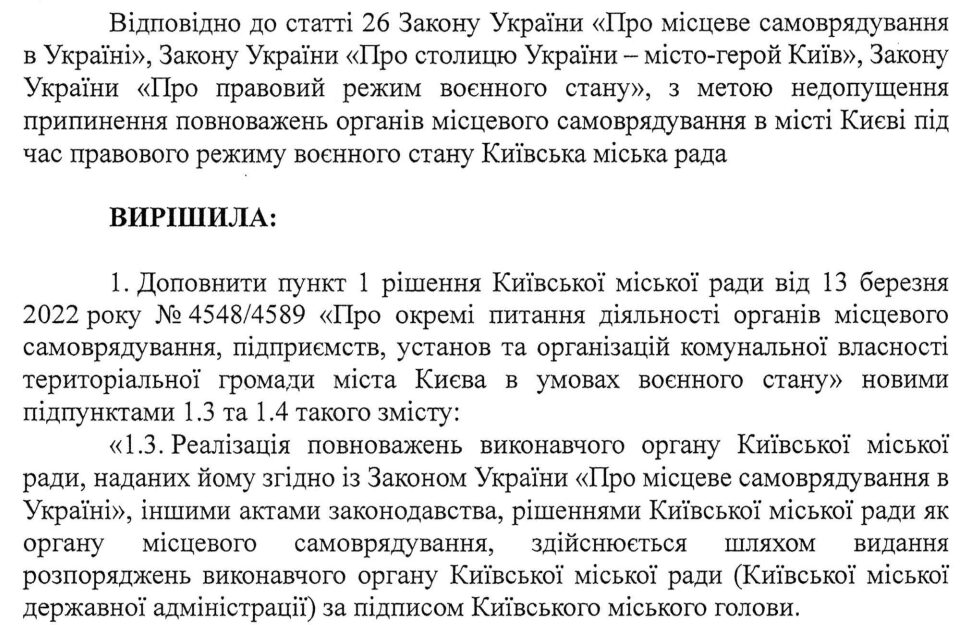
Decision of the Kyiv City Council dated 03.04.2025 No. 35/10502
It is clear that an executive committee is not a panacea for all ills, as it always reflects the balance of power in the local council. But in the absence of an executive committee, the people of Kyiv learn about already adopted orders of the KCMA (KCSA) after the fact and have no influence on the process of their adoption.
An executive committee means publicity in the decision-making process. The Law “On Access to Public Information” (Part 4 of Art. 15) requires the publication of draft decisions of local self-government bodies at least 10 working days before their planned adoption. The agendas of open meetings must also be published.
But when everything is organized through KCSA orders, only drafts of regulatory legal acts must be published. And meetings are not foreseen at all.
Thus, by usurping the powers of the executive committee, Klitschko not only violated the law but also made it impossible for the people of Kyiv to control the activities of the Kyiv City Council’s executive body.
And most importantly for Klitschko personally, or any mayor of the capital. If the powers of local self-government are lawfully exercised by an executive committee, then no President will be able to seize them, even with all the shortcomings of the Law on the Capital City. The executive committee should be part of the KCSA’s structure, but its activities are regulated by separate legal norms and are completely independent of the head of the KCSA.
So, we get another negative consequence of Klitschko’s usurpation of the executive committee’s powers – it was the mayor himself who, through his illegal actions, created the opportunity for the President to seize control of some of the local self-government powers in Kyiv.
Conclusion
In the current battle for power over the capital, there is no right side. Two groups of usurpers are engaged in a tug-of-war, pointing fingers at each other. And the only victim in this game is the community of Kyiv.
One could say: bad laws are to blame for everything. But neither side adheres to even them. So, will they comply with new, good laws if the Verkhovna Rada manages to adopt them?
But if both Klitschko and Zelenskyy find the strength to comply with at least the current laws, the situation could improve significantly.
Specially for “Dzerkalo Tyzhnia“