
The consequences of neo-feudalism. How do we break the demand for corruption and win?

Medical and sanitary examinations are not the only food for corrupt officials. It is not only central and local authorities that are riddled with corruption.
But the case of Tetiana Krupa, head of the Khmelnytskyi Regional Center for Medical and Social Expertise (MP from the Servant of the People party), shows why nothing changes when names are changed, functions are transferred, corrupt officials are fired, and prosecutors resign.
The regional council appoints the heads of the regional MSECs. When a deputy becomes the head, it’s a “one man for his own” case with stories of “disabled prosecutors.” That is how local authorities can get a “roof” from law enforcement. In other words, the state has entrusted political decisions to an unapolitical body.
Holka traced the reasons that led to such dangerous consequences for the country in the war and found out what could help.

Many people liable for military service do not want to go to the front. The most reliable way to get out of the Armed Forces was considered to be to get a “yellow” ticket from doctors. However, this is no longer such a reliable way.
Firstly, the scheme has received considerable attention after Tatiana Krupa’s exposure. Secondly, because of the risks, prices are likely to soar. An economical booking that is both reliable and legal could help.
But more is needed. The problem is more profound and lies in the inefficient management organization on the territory. After all, given the size of the “catch” in Khmelnytskyi, bribery continued for quite some time. But all this time, neither the regional military administration, the local police, the SBU, nor the prosecutor’s office reacted. Failure to see large-scale corruption can be attributed to a lack of professionalism or schemes to help evaders. However, in both cases, this is evidence of a root phenomenon – neo-feudalism. It has only strengthened after the start of decentralization and its incompleteness (money and powers went to communities, but state supervision was not introduced).
This situation benefits local and regional authorities (they can permanently “settle” with law enforcement). It also benefits the central government, which negotiates with local authorities. Still, as soon as it needs to pressure a politically disobedient mayor or deputy, it will pull the rope of its security forces and the head of the regional administration. This is how manual government works, and it is destroying Ukraine from within. Right now.

Neo-federalism manifests in this institution’s very status. A body supposed to perform an exclusive state function is approved and subordinated to a self-government body. Moreover, the Ministry of Health’s influence ends at the level of regions, such as the Autonomous Republic of Crimea, Kyiv, and Sevastopol. MSECs are also created at the city, inter-district, and district levels but by regulations approved at the regional level. That is, the central level has no levers of control at the lower levels.
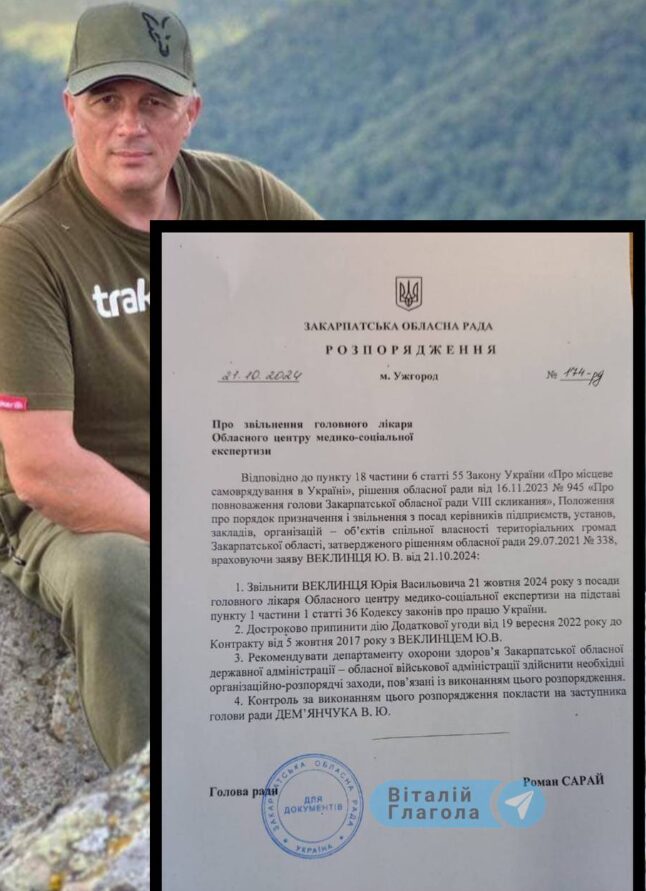
The order to dismiss the head of the Transcarpathian MSEC
And this applies not only to medicine. For example, reservations at enterprises are entrusted to regional state (military) administrations, which by their status have double or even triple subordination – to the regional council, the government, and, in fact, the President’s office.
The absence of a territorial body of general competence that would have exclusively coordinating functions strengthens the encapsulation of power at the level of territories and by sector, which also corresponds to the signs of feudalism. The regional elite resists the central government’s attempts to monitor the situation on the ground. The same applies to ministries and agencies that resist city-state administrations’ attempts to coordinate territorial bodies.

The decentralization of power has partially broken the omnipotence of regional princes. Still, due to its imperfections, the lack of state administrative supervision over the legality of local government activities strengthens the power of local barons represented by mayors.
This is not to say there are no attempts to break down neo-feudalism in Ukraine. The most successful in this regard is the modernization of the budget system. From the “nested doll” principle that existed before the adoption of the Budget Code in 2001 and provided for the investment of budgets, when regional budgets were formed by a political decision of the Ministry of Finance, rayon budgets and budgets of cities of regional significance – by a decision of the regional authorities, and budgets of cities of rayon significance, village and settlement budgets – by the rayon authorities, the system has evolved to direct interbudgetary relations with all public authorities directly.
That is not the case with other public administration sectors, where there is practically a vertical management and subordination line from the center to the oblast, to the district, and without clear legislative regulation of the functions of the central, regional, and district levels. In the system of state administrations, the picture is the same, sometimes grotesque, when regional state administrations serve as a mailbox for forwarding government orders to the district level, and district administrations do not have their legal functions.
Another manifestation of neo-feudalism is in the personnel policy, which is based on a political rather than professional approach.
The lack of reform of the law enforcement system is manifested in the mutual responsibility when the same prosecutors apply for disability, based on which they receive a pension and, therefore, receive both a salary and a pension in the amount of 60% of their salary. Of course, they turn a blind eye to the abuses of their benefactors. It should also be noted that there is no clear legislative delineation of the functions of law enforcement agencies at the district and regional levels, which leads to manual management under orders from above.

First, the law enforcement system must be reformed. That is a separate task for the state to ensure that the law enforcement system ceases to be both a roof for local feudal lords and a leash for the central government. Altogether, with a fair trial, this reform is one of the pillars that will ensure a real fight against corruption horizontally. While the NABU and the SAPO are cleaning up the top, sometimes hitting local nests, as were the cases in Odesa or Dnipro, the law enforcement system should work nationwide. But it only requires the political will of the authorities.
Second, the introduction of state supervision over local governments and coordination of the activities of territorial bodies of ministries and agencies. The problem of territorial governance can be partially solved by adopting the draft law “On Local State Administrations” (4298). The Council of Europe’s Centre of Expertise for Good Governance emphasizes:
Ukraine is the only European country that lacks administrative oversight mechanisms (particularly for legality). The purpose of adopting draft law No. 4298… is to create legal prerequisites and foundations for the functioning of local prefectural state administrations until the relevant amendments to the Constitution of Ukraine are made.
However, this initiative has been stalled since 2021. And according to what the partners demand, the heads of local state administrations must be politically neutral (!) professional officials. That is the only way they can oversee the legality of local authorities’ actions.
The head of a local state administration should be a professional civil servant and oversee the work of local authorities. However, the EU requirements do not clearly articulate the direct functionality of regional and district administrations. That is why regional officials are trying to leave the system of subordination of district-state administrations to regional ones, which is tolerated by the government secretariat, which is uncomfortable with writing orders separately for the district and regional levels. There are also demands to retain sectoral powers for the local state administrations, which sometimes duplicate local authorities’ powers, creating legal uncertainty in the face of competition between regulations, and the law of force wins out.
Important! Administrative supervision of the legality of local government activities should be accompanied by a reduction, or rather, streamlining, the actions of a whole host of especially competent control bodies currently plaguing local governments, either on instructions from above or on their initiative. Their coordination by the regional state administration, primarily at the district level, will guarantee the emergence of such controllers only on legal grounds.
How would the issue of MSECs have been resolved if draft law No. 4298 had been approved in September 2021 and not postponed due to the Bank’s demands to keep the political appointment system of heads of local state administrations in place? First, they would be created only at the district level as territorial bodies of the Ministry of Health, or better yet, as units of the Pension Fund, which district state administrations should control. First, there is no functionality of MSECs, which would lead to their creation as a body that directly provides services to the population at the region’s level and the center. Coordination of their activities at the level of district-state administrations would ensure that corruption is nipped in the bud.
After all, the draft law provides that the head of an RSA may directly appeal to the head of a central executive body if they consider the actions of local appointees to be illegal. And if the latter fails to respond within the established timeframe, they may directly appeal to the Cabinet of Ministers. Such appeals cannot go unnoticed by the public, as all acts of district-state administrations are public, except those with limited access according to the law. Appeals to the central executive authorities on personnel issues cannot fall into the latter category.
The anti-corruption resilience of the RSAs is ensured by rotation every three years, straightforward functionalities defined directly in the law, and political impartiality. Although our Western partners advise increasing this period to five years, the speed of the growth of corruption ties in Ukraine makes it necessary to choose a shorter period for rotation. The latter has already been partially implemented because the heads of district state administrations, unlike the RSAs, cannot be removed from office by a decision of the relevant council due to improper exercise of their delegated powers. For this reason, the district council does not have such sectoral, i.e., budgetary, powers. Moreover, the draft law envisages a complex system of no-confidence motions against the head of the local state administration, which is practically impossible to implement at the district level.
Draft law No. 4298 is far from perfect, and the Association of Ukrainian Cities has comments that echo the comments of the Center, as mentioned above, of Expertise for Good Governance of the Council of Europe. But it needs to be finalized and adopted without delay. The lack of new functionality of local state administrations objectively hinders the reform of local self-government and the executive branch, cementing corruption. Improving the institution of regional state administrations and bringing it closer to the prefectural one is a long and challenging path. However, it is necessary to start.
Specially for Dzerkalo Tyzhnia.