
The Constitution on Pause: Who and How Enabled Procedural Violations During the Scandalous Vote on Draft Law No. 12414

In the case of Draft Law No. 12414, discussions typically focus on the consequences of depriving anti‑corruption bodies of independence or on whose instruction it was carried out. However, the independence of anti‑corruption agencies is not an end in itself demanded by our Western partners, but merely one of the steps toward fulfilling the global requirement of building a rule‑of‑law, democratic state. In this sense, how the law was adopted is no less important than why.
The adoption, on 22 July, of the law in its controversial version is the result of at least five fundamental violations of the Rules of Procedure (Reglament) by both the Verkhovna Rada as a whole and personally by its Chairperson Ruslan Stefanchuk. Each such violation of the Reglament simultaneously breaches at least three requirements of the Constitution.
Conscious, multiple violations of the legislation by the Parliament in adopting laws in the interests of certain individuals constitute high‑level corruption. They demonstrate a refusal to build a rule‑of‑law state, no less than the scandalous provisions of Draft Law No. 12414, and are long since not unique in the work of the current convocation of the Verkhovna Rada.
Law-making is not a ruleless game.
Adopting laws is the exclusive competence of the Verkhovna Rada. And if a bill receives the necessary number of votes from Members of Parliament, it is considered adopted. But this does not mean that the VR has the right to do so “like a policeman in an old joke—‘here’s a gun, now spin however you want.’”
In addition to the general principle of the rule‑of‑law state (Article 1), the Constitution contains a number of specific requirements regarding the actions of the VR.
Article 6 states that the legislative authority shall exercise its powers within the limits established by the Constitution and in accordance with the laws of Ukraine.
Article 19 mandates that state bodies and their officials shall act only on the basis of, within the powers, and in the manner prescribed by the Constitution and the laws of Ukraine.
And Article 83 adds that the procedure of the VR’s work is established by the Constitution and the Reglament.
The Law “On the Legal Regime of Martial Law” (Part 1, Article 9) further stipulates that under martial law, the President and the VR act exclusively on the basis of, within the powers, and in the manner defined by the Constitution and the laws. Therefore, compliance with the Reglament in its activity is a constitutional duty of the VR, as is the duty of citizens to defend the independence and territorial integrity of Ukraine.
The legislative procedure is defined in Section IV of the Reglament, and its observance is mandatory by virtue of the above‑mentioned provisions. Paragraph 3 of Article 50 of the Reglament specifies that ad hoc deviation from procedure is allowed only with respect to a clearly enumerated list of items (postponement of bill consideration, extension or shortening of time limits for submission of alternative bills, proposals and amendments to bills, reduction of time limits for submission to deputies and for committee review).
Legislative procedure is not just a formality. Despite its flaws, compliance ensures a minimum level of both anti‑corruption and public control over the activity of the VR. And Draft Law No. 12414, with provisions to destroy the independence of the National Anti‑Corruption Bureau of Ukraine (NABU) and the Specialized Anti‑Corruption Prosecutor’s Office (SAPO), could not have been adopted if several norms of the Reglament had not been violated during its consideration.
1. Amendments concerning NABU and SAPO could not be included in the bill preparing for second reading
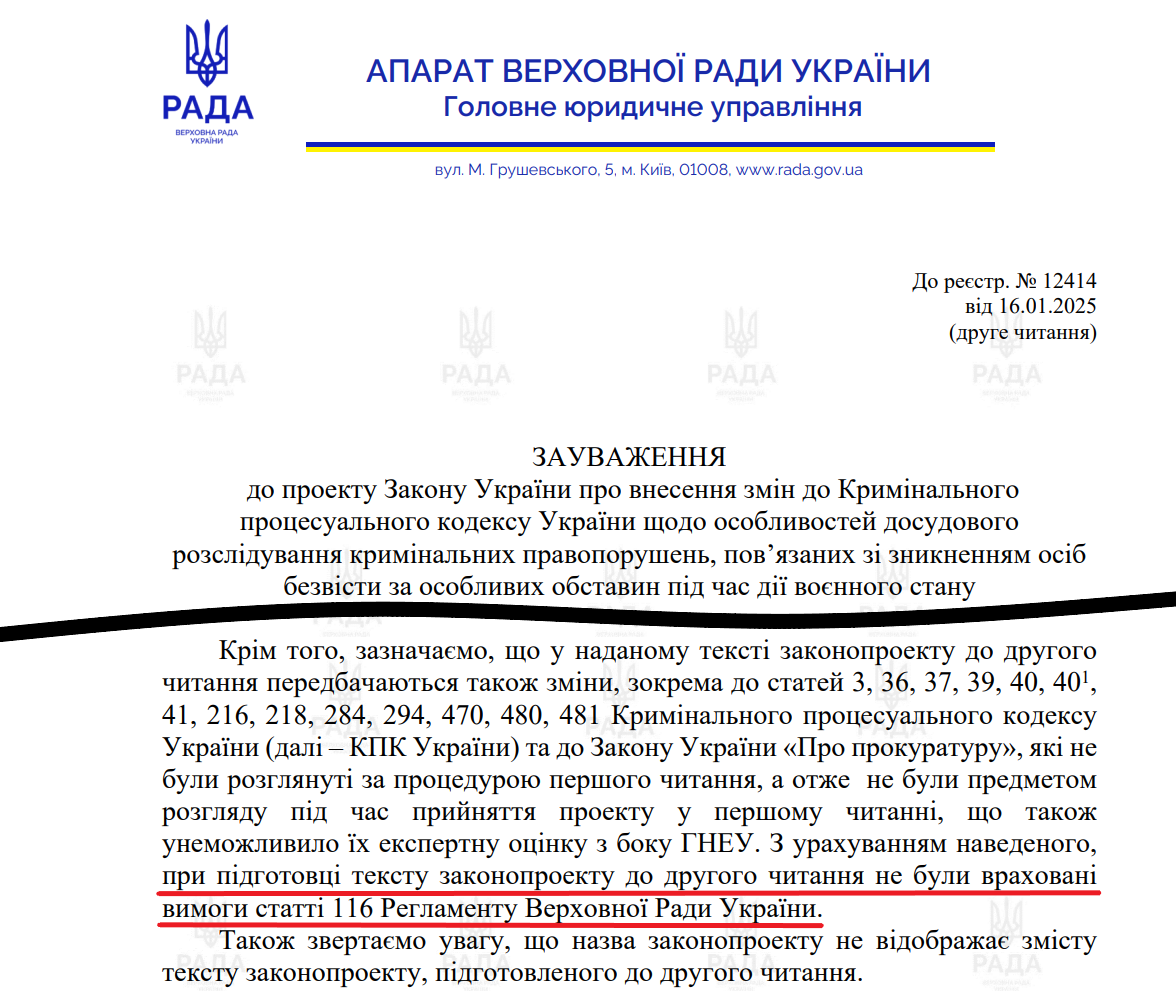
According to Article 116 of the Reglament, proposals and amendments to a bill prepared for second reading may be submitted only to the version adopted in principle. Exceptions are allowed only to correct errors or inconsistencies—and only if:
-
The VR voted for this in the first reading; and
-
the proposals “fall within the subject matter of the bill.”
In the case of Draft Law No. 12414, the VR did not adopt the relevant decision, and the amendments concerning NABU and SAPO are unrelated to the original bill concerning criminal procedural peculiarities in enforced disappearances under martial law. Deputies knowingly violated Article 116 by voting “For” on 22 July, despite warnings in the opinion of the Main Legal Department and repeated notes by MP Yaroslav Zhelezniak in his speeches (in the plenary transcript).
Proposals to the draft law submitted by MP Maksym Buzhanskyi on 22 July 2025
2. Deadline violations for submission of amendments to NABU and SAPO
Article 116 also requires that amendments to a bill preparing for second reading be submitted within 14 days from the date of adoption in principle. Though the VR could have extended this period, they did not.
The bill was adopted in principle on 29 April, but amendments submitted by MP Maksym Buzhanskyi regarding NABU and SAPO were submitted nearly four months later—on 22 July. Responsibility for violating the deadlines falls on the Committee on Law Enforcement Activities and its deputy chairman, Maksym Pavliuk, who chaired the relevant committee meeting.
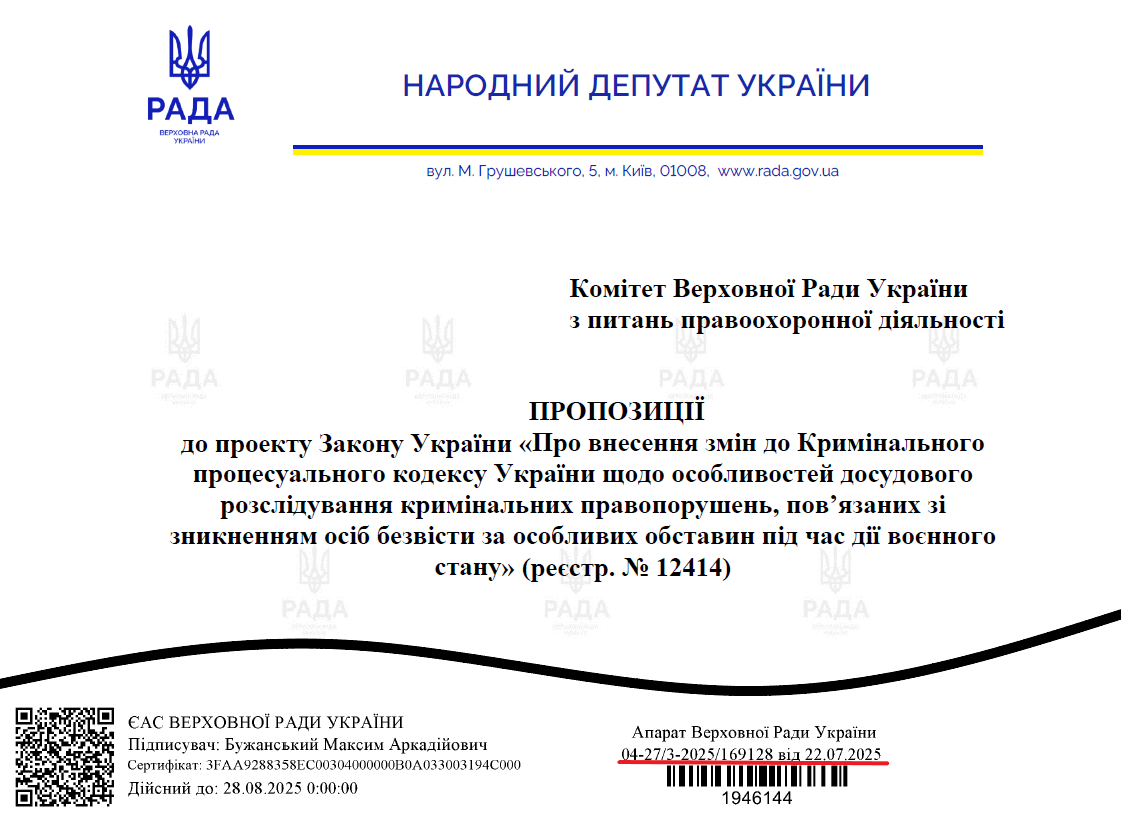
Пропозиції до проєкту подані нардепом Максимом Бужанським 22.07.2025
3. Violations of time limits for providing bill materials to deputies
Under Article 117 of the Reglament, the bill prepared for second reading, the main committee’s opinion, and other documents should be provided to deputies no later than 10 days before the plenary session. Article 101 allows shortening of this period only if the bill is declared urgent—and not by more than half.
These requirements are essential for deputies to fully study the bill and for public oversight. In the case of Draft Law No. 12414, the bill was considered in the committee in the morning just before being brought to the floor, and it was published on the VR website literally five minutes before the session began. Deputies knowingly violated the Reglament when voting “For.”
4. The Chairperson of the VR, Ruslan Stefanchuk, failed to halt violations of the Reglament
Article 88 of the Constitution defines that the Chairperson performs duties according to the Reglament. Article 48 of the Reglament requires that the presiding officer at a plenary session immediately take measures to eliminate procedural violations.
Several MPs repeatedly raised procedural violations and appealed to Ruslan Stefanchuk to address them. Stefanchuk demonstratively refused to carry out his direct duty.
As a result of his gross violations while presiding over the Draft Law No. 12414 consideration, at the request of the European Solidarity and Holos factions, a motion was brought to remove him from the chair during the session. However, it received only 23 votes “For”, once again demonstrating majority support for violating legal requirements in parliamentary work.
5. The VR had no authority to adopt a decision for immediate signing of the law
Immediately after adoption, the VR, at the suggestion of Maksym Buzhanskyi, supported immediate signing of the law by the Chairperson. But the VR had no right to make such a decision.
According to Part 2 of Article 130 of the Reglament, the Chairperson signs a bill not earlier than two days and not later than five days after its submission. Signing is part of the legislative procedure, and Article 50 does not authorize deviations from that timeline. The two‑day period allows deputies to submit petitions in case of procedural violations before the speaker may sign the bill
Stefanchuk’s proposal to support immediate signing after passing a bill introduced by President Volodymyr Zelenskyy—aiming to reverse the amendments introduced by Draft Law No. 12414—is a trap. In effect, Stefanchuk is trying to legitimize systematic violations of the Reglament, under the guise of meeting public and foreign pressure, but using the same violations as during the adoption of Draft Law No. 12414.

A post by Ruslan Stefanchuk on Facebook
Many suspect that the story behind Draft Law No. 12414 reflects the desires of the President, his Office, and numerous MPs to strip NABU and SAPO of their independence. They understood perfectly that such intentions would be seen negatively both by society and foreign partners. Therefore, the plan was a fast “blitzkrieg”—to organize a signed law with desired norms so quickly that nobody could react.
But their path was blocked by the Reglament of the VR, whose observance is constitutionally mandatory. Thus, the Reglament was blatantly violated—not once, but at least five times. All violations were essential to executing the scheme in hours. Each violation simultaneously breached at least three constitutional requirements. The Guarantor of the Constitution (i.e., the Chairperson) traditionally did not care.
The adoption of Draft Law No. 12414 is not the biggest problem—it is merely the result of the habitual style of work of the Verkhovna Rada, which considers itself above the Constitution and Laws. That style of work, directed from the Office of the President, is one of the signs of establishing dictatorship and usurpation of power.
In this story, the mechanisms used by the majority to silence the parliamentary opposition are also very telling: first, the Chairperson, Stefanchuk, fails to perform his duties and violates the rules himself; then the majority unlawfully deprives opposition deputies of their guaranteed right to appeal the VR’s illegal actions within two days after the law is passed.
The planned upcoming restoration of NABU’s and SAPO’s independence is a significant victory for society. But it will hardly impact the country’s overall trajectory if society does not begin to actively demand that the VR unconditionally comply with the Reglamento’s requirements in lawmaking. The Reglament is not a panacea, but its observance creates a mechanism for control without constant public protest.
Unfortunately, deputies can continue to violate the Reglament with impunity, since under Article 80 of the Constitution, they bear no legal responsibility for voting outcomes. The situation with Chairperson Stefanchuk is more complex, as it involves signs of corruption in his actions in organizing consideration of the bill. However, will NABU and SAPO have the desire not only to resolve the problem but also to punish those guilty?
Specially for “LB.ua”