When does Zelensky ignore veto petitions? (Updated)


A total of 163 petitions have been filed with President Volodymyr Zelenskyy demanding that he veto bills. This is almost twice as many as during the work of the Parliament under Petro Poroshenko.
However, only 7 petitions to Zelenskyy demanding that he veto the law passed by the Verkhovna Rada received more than 25,000 signatures, which obliges the president to provide citizens with answers.
During the previous Parliament’s tenure, no veto petition received 25,000 votes. These are the findings of a study by the Holka civic initiative and the Center for Innovation Development.
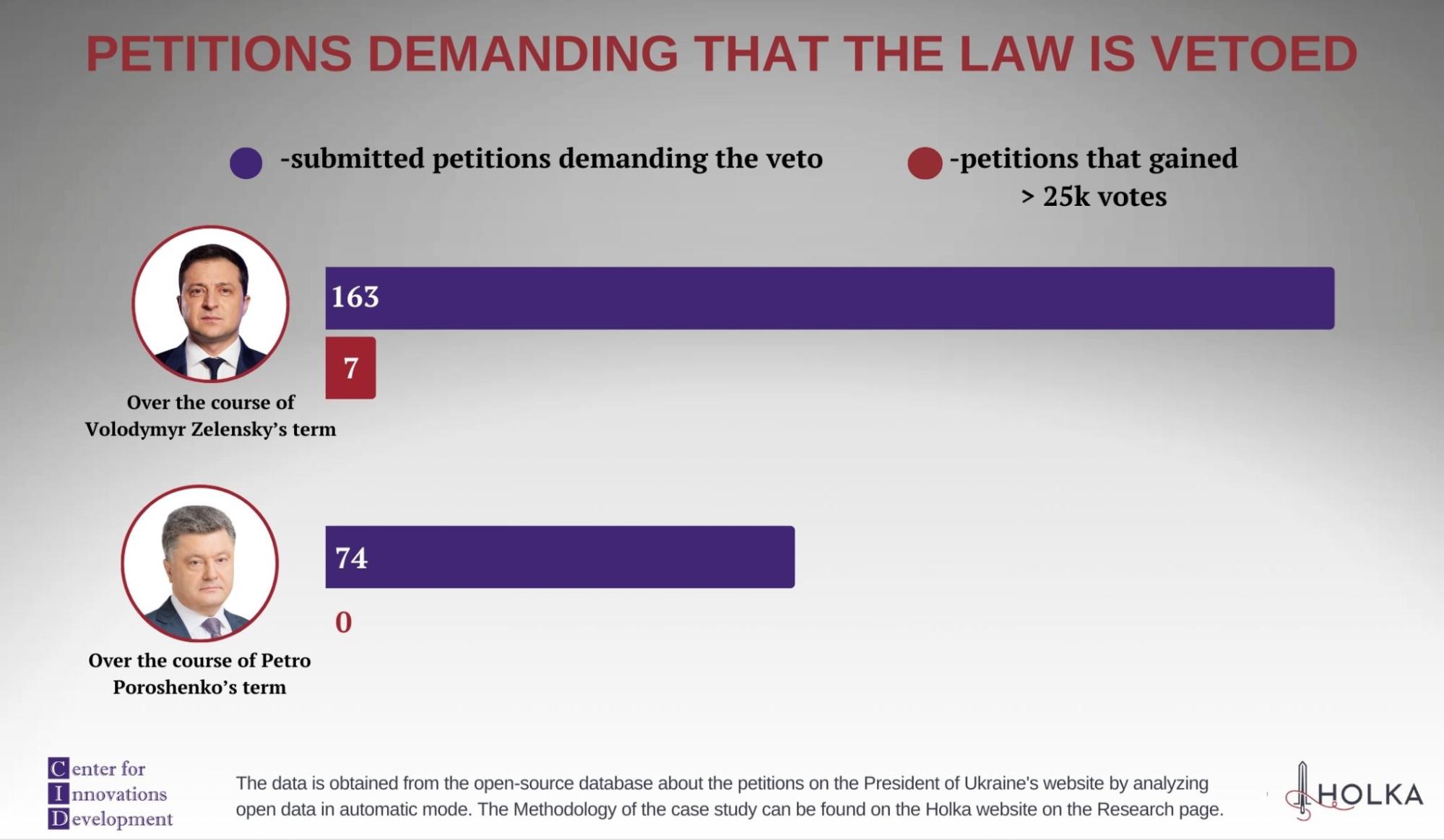
Zelensky responded to 4 of the 7 petitions that received votes. Iryna Fedoriv, head of the Holka civic initiative, notes:

The President ignored two petitions: on vetoing the urban planning 'reform' 5655 by the head of the Servant of the People party Olena Shulyak and the law 'On Time Calculation' by the Speaker of the Parliament Ruslan Stefanchuk. In times of war, when there are no elections, it is important for our Western partners to see that we have digital democracy tools in place. The president cannot respond to some petitions and ignore others, creating a warm bath for Shulyak or Stefanchuk. However, it should be noted that these laws remain unsigned. That is, citizens still achieved results, and there are cases when petitions work. As for the petition of Michel Tereshchenko, a descendant of the Tereshchenko family, who demanded to veto the scandalous project to zero out claims against forest and coastal plunderers, the president unfortunately ignored it. The lobbying of dishonest businesses was often stronger here, and this is despite the fact that their petition demanding the signing of the law did not receive 25,000 votes despite a large-scale information campaign involving advertising."

The graphic has been updated. The President responded to Tereshchenko’s petition to veto the scandalous initiative by Ihor Fris after the publication of the article.
Ukrainians became so united during the war that they could collect 25,000 votes in less than 90 days, and sometimes in a day. All these petitions demanding to veto the project received the required number of votes after February 24, 2022.
Kateryna Ivanchenko, director of the Center for Innovations Development, which introduced the tool of petitions to the president and participatory budgeting in Kyiv, emphasizes:

This study proves that Ukrainians successfully use such a tool as petitions. They are able to mobilize and collect the required 25,000 votes, when the topic is really resonant, within a day. This was the case with Oleksandr Yabchanka's petition to veto the law that only partially restored the declaration of assets. The same happened with the petition to veto the urban planning “reform.” But these two topics were in the public eye. By law, the time limit for vetoes is 15 calendar days. The relevant Regulations state that it takes 2 working days to publish petitions and 3 working days for a petition with 25,000 votes to be submitted for consideration. That is, the procedural moment itself can take up to 10 calendar days. And we have already seen that in some cases, citizens submit veto petitions in advance - before Parliament votes.
The Holka civic initiative has appealed to the Presidential Office to immediately amend the Regulations affecting the timing of publication and consideration of veto petitions. The Center for Development of Innovations, which introduced the petition tool, expressed its readiness to help the Presidential Office improve it immediately.


