

Oleh Arseniuk
Фракція політичної партії "СЛУГА НАРОДУ"
Region
Черкаська область


Green: voted for beneficial and against harmful bills, red: voted against beneficial and for harmful bills. Yellow: abstained. Dark grey: present but did not vote, or absent.
Green: voted for beneficial and against harmful bills, red: voted against beneficial and for harmful bills. Yellow: abstained. Dark grey: present but did not vote, or absent.
Biography
Oleh Arseniuk became a People’s Deputy of the 9th convocation (district #195, covering part of the Sosnivskyi district of Cherkasy, as well as the Drabiv, Chyhyryn, and Chornobai districts) representing the “Servant of the People” party as a non-partisan candidate. At the time of his candidacy, he was the commercial director of “Bereh-2007.” He became a member of the faction of the same name. He was elected a member of the Committee on Social Policy and Protection of Veterans’ Rights. Subsequently, he became the head of the subcommittee on social protection of citizens affected by the Chornobyl disaster.
In 2024, he became a member of the Verkhovna Rada Committee on Anti-Corruption Policy. In 2025, he became the head of the subcommittee on anti-corruption policy in the areas of social, economic, land relations, and urban planning of the Verkhovna Rada Committee on Anti-Corruption Policy.
The MP’s father is a well-known businessman in Cherkasy, Oleksii Arseniuk, who repeatedly ran for parliament representing pro-Russian forces—the “Ne Tak!” bloc, the Party of Regions, and the “Opposition Bloc.” During the 2010 local elections, he was elected to the Cherkasy City Council from the Party of Regions, and in 2015, he headed the “Opposition Bloc” list to the city council. His son, Oleh Arseniuk, who later became a representative of “Servant of the People,” was also on this list as a candidate for the local council.
In parliament, during the vote on decolonisation, Oleh Arseniuk’s card was in the slot, but he did not vote on the matter. It is also important to note that, as a member of the Anti-Corruption Committee, he voted for the liquidation of the independence of the country’s key anti-corruption bodies—the SAPO and NABU.
Timeline of Key Events
2026
Voted in the first reading for the controversial draft Civil Code (15150) submitted by the Chairman of the Verkhovna Rada, Ruslan Stefanchuk. The 803-page draft, which the Ministry of Justice had not managed to review within three weeks of registration, was fast-tracked through parliament. The legislative initiative contained provisions allowing for the carve-up of state and municipal property—forests, coastlines, and subsoil resources. Additionally, the project contained risks to freedom of speech. Following the parliamentary vote, street protests broke out in several regions. A petition demanding a veto garnered over 25,000 signatures on the first day of registration. Judges of the Supreme Court also expressed substantial objections. The draft Civil Code, which had not undergone proper discussion, effectively destroyed judicial practice developed over 20 years.
2025
Voted for the liquidation of the independence of anti-corruption bodies, namely the NABU and the Specialized Anti-Corruption Prosecutor’s Office (Draft Law #12414). Following this vote, protests erupted near Bankova Street, and while Volodymyr Zelenskyy signed the law the same day, Parliament later passed another law to restore the powers of anti-corruption bodies following public and international pressure.
Supported a project regarding a special procedure for the compulsory alienation of land in the Uzhhorod district of the Zakarpattia region (#9549). The initiative contained scandalous provisions creating risks for both deforestation and corrupt schemes involving the purchase of real estate using budget funds at 3–3.6 times the market price.
Voted for the so-called “Ihor Mazepa Law” (Draft Law 12089), which provided for the “resetting” of claims regarding illegally acquired forests and coastal lands if ten years had passed since they entered private ownership. Despite a petition demanding a veto, the President signed the document. The first victim of the law was the case concerning Protasiiv Yar.
Supported Speaker Ruslan Stefanchuk’s controversial bill to abolish the Commercial Code of Ukraine (#6013), which removed general principles governing the interaction between business and the state, posing risks to national security.
2024
Became one of the 212 MPs who voted for bill #10242 on pressure on journalists and their sources, which posed serious risks to freedom of speech and the protection of whistleblowers by proposing up to 8 years in prison for disclosing information from state registries.
Became a member of the Verkhovna Rada Committee on Anti-Corruption Policy.
Voted for bill #8371, which provided for the prohibition of religious organizations in Ukraine affiliated with a state carrying out armed aggression against Ukraine.
2023
Supported the “Medical Cannabis Legalization” bill (#7457).
Became one of the initiators of law #10206, which provided for the closing of all criminal cases opened before 2018, including those of top-level corrupt officials.
Voted for bill #9296-d on strengthening financial monitoring of PEPs (politically exposed persons), introducing a lifetime PEP status for top officials.
Supported a controversial amendment to bill #8011 regarding “ensuring the rights of war participants to biological post-traumatic fatherhood/motherhood,” which initially prevented the wives of fallen soldiers from using their partners’ frozen biological material.
Initiated bill #9223, which proposed criminal liability for using fake social media accounts to spread false information against national security or to criticise the authorities.
Did not vote for the decolonisation of geographical names, although his card was in the slot.
2022
Supported the “Media Law” (#2693-d).
Voted for the urban planning “reform” bill (#5655).
Became a co-founder of the public organization “IDPs of Ukraine.”
2021
Former Prosecutor General Yuriy Lutsenko reported that Arseniuk had started a fight with a visitor at his father’s entertainment venue, “Bochka,” in Cherkasy. The incident began after the MP demanded that the restaurant continue operating after the conclusion of an event commemorating the Chornobyl disaster. Both participants in the altercation were hospitalised with minor injuries.
2020
Did not vote for resolution #4104 on the selection of the SAPO leadership.
Founded the “Oleh Arseniuk Charitable Foundation.” The foundation’s executive director ran for the City Council on the “Servant of the People” list.
Voted for the “anti-Kolomoiskyi law” (#2571-d).
2019
Elected as a People’s Deputy of the 9th convocation (district #195) representing “Servant of the People” as a non-partisan candidate. He expressed his gratitude to voters by placing billboards in his district and two adjacent districts.
Became a member of the Committee on Social Policy and Protection of Veterans’ Rights.
2015
Ran for the Cherkasy City Council from the “Opposition Bloc,” with his father heading the list. An investigation by “Nashi Hroshi” reported that the Arseniuk family had illegally seized over 30 acres of land on the banks of the Dnipro for their “Bochka” restaurant.
2013
Served as a proxy for his father, independent candidate Oleksii Arseniuk, during by-elections to the Verkhovna Rada in district #194 (Cherkasy).
If, in your opinion, this profile contains inaccurate information, please contact us in writing at ngo.holka@gmail.com. The team of the Holka civic initiative will review your submission and provide a response.
Voting record
For
- Fake Abolition of Parliamentary Immunity (2237)
- Criminalization of “Button-Press Voting” (2148)
- Recognition of the Revolution of Dignity as a Key Moment of State-Building (2739)
- Condemnation of Protests on Bankova Street (5295)
- On the Judiciary and the Status of Judges (3711-д)
- Denunciation of Certain Agreements under CIS Treaties (0101)
- Ban on Pro-Russian Political Parties (7172-1)
- Ratification of the Istanbul Convention (0157)
 Did not vote
 Absent
 Відео
Фото
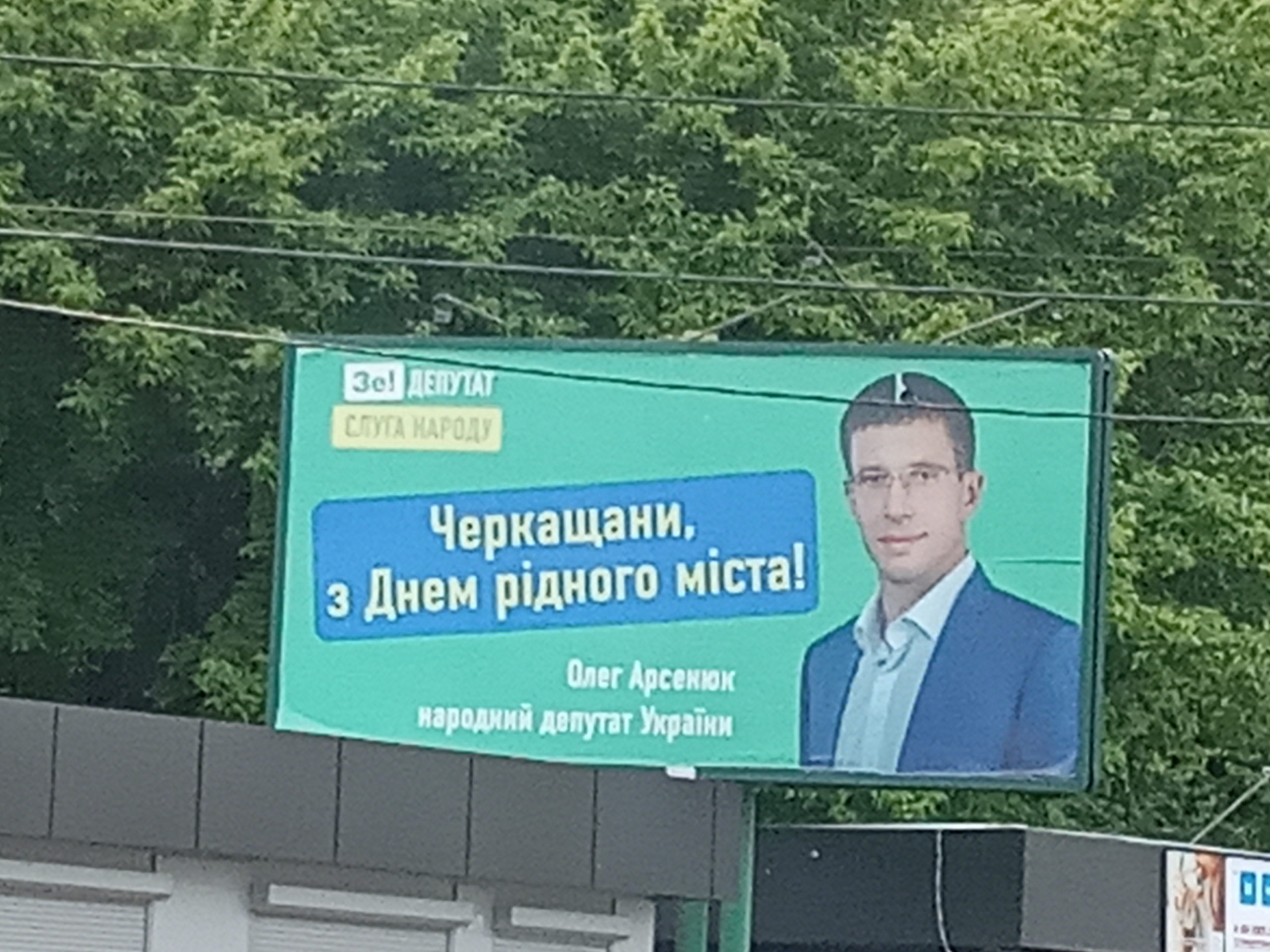 Передвиборча агітація кандидата Олега Арсенюка до дня міста Черкаси