
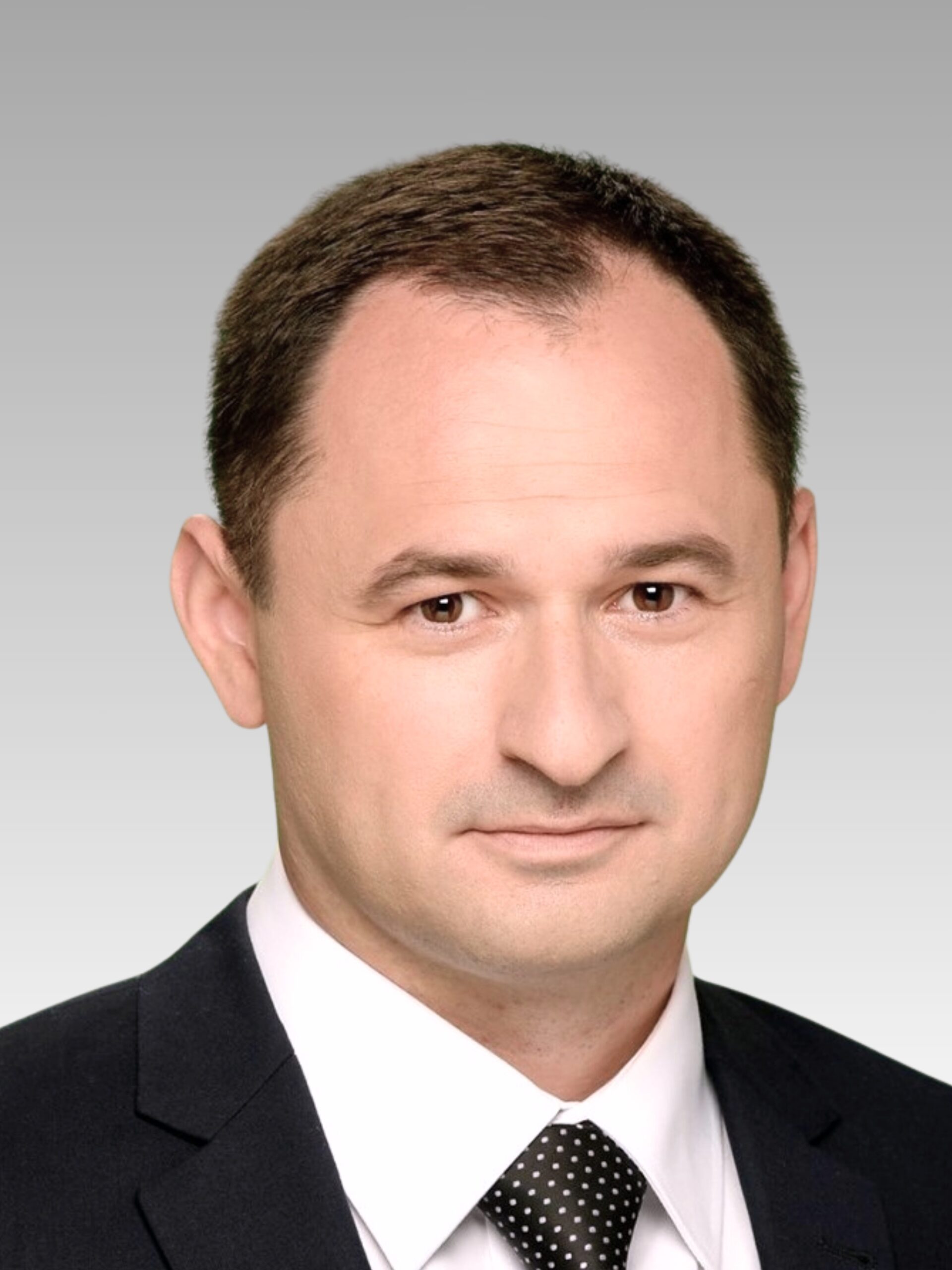
Maksym Dyrdin
Фракція політичної партії "СЛУГА НАРОДУ"
Region
Миколаївська область


Green: voted for beneficial and against harmful bills, red: voted against beneficial and for harmful bills. Yellow: abstained. Dark grey: present but did not vote, or absent.
Green: voted for beneficial and against harmful bills, red: voted against beneficial and for harmful bills. Yellow: abstained. Dark grey: present but did not vote, or absent.
Biography
Maksym Dyrdin became a People’s Deputy of the Verkhovna Rada of the IX convocation from the “Servant of the People” party (district #132, Pervomaisk city, as well as Arbuzynka, Bratske, Vradiivka, Kryve Ozero, and Pervomaisk districts of Mykolaiv region) as a non-partisan candidate. He joined the parliamentary faction of the same name. He was elected chairman of the subcommittee on political reform and constitutional law of the Committee on Legal Policy. He became the permanent representative of the Verkhovna Rada in the Constitutional Court of Ukraine.
The politician hindered the process of decolonization. He stated that he would not allow the renaming of not just Pervomaisk, but any settlements of the Pervomaisk district without referendums and public discussions. Only three years after the full-scale invasion, when public perception had changed, Dyrdin introduced a bill to rename Pervomaisk to Olvia.
The People’s Deputy was the lawyer for Oleksandr Popov, who managed the capital as the head of the Kyiv City State Administration in the absence of mayor Leonid Chernovetskyi and was involved in the case regarding the dispersal of Euromaidan. It was Popov who made the decision to install the Christmas tree on the Maidan and watched the dispersal of Maidan protesters from his office together with those who would later be accused of high treason—Volodymyr Sivkovych and Andrii Derkach.
People’s Deputy Dyrdin supported a controversial bill by which the Verkhovna Rada decided to fine citizens who mention the names of clients alongside the names of lawyers. That is, for the phrase “Dyrdin was Popov’s lawyer,” any citizen would face a fine, but the President never signed the law. Such a legislative initiative, according to the civil sector and international partners, had a chilling effect on freedom of speech.
The deputy’s wife was an assistant to his faction colleague Andrii Kostin. In return, Dyrdin took Olha Kostina, who at that time was the wife of the then-Prosecutor General, as his assistant.
It is important to note that the People’s Deputy’s wife, Iryna Dyrdina, may be involved in money laundering as part of a project from the Yanukovych era regarding the hosting of the Winter Olympic Games in Ukraine. Specifically, Dyrdina coordinated, in the interests of the families of Serhii and Yuliia Lyovochkin, the purchase of land in the Borzhava area in Transcarpathia. This is evidenced by correspondence published by the “Schemes” project, which investigated plans to build a new resort on the specified lands and the potential involvement of the state in this project.
Timeline of Key Events
2026
He voted in the first reading for a controversial draft Civil Code (#15150), submitted by the Chairman of the Verkhovna Rada, Ruslan Stefanchuk. The draft, which is 803 pages long and which even the Ministry of Justice did not have time to review within three weeks of its registration, was brought to parliament for consideration in “turbo mode.” The legislative initiative contained norms that would allow for the plundering of state and communal property—forests, coastlines, and mineral resources. Furthermore, the draft poses risks to freedom of speech. After the Verkhovna Rada vote, street protests took place in a number of regions. In particular, protesters were outraged by the legislators’ proposals that infringed on the rights of women and the LGBT community. A petition addressed to President Volodymyr Zelenskyy demanding a veto on the bill reached over 25,000 votes on the very first day of its registration. The judges of the Supreme Court also had fundamental objections to the project. The draft Civil Code, which had not undergone proper discussion, essentially destroyed the judicial practice that the third branch of government had developed since the adoption of the current Civil Code—over 20 years.
2025
He voted for the liquidation of the independence of anti-corruption bodies—the National Anti-Corruption Bureau of Ukraine (NABU) and the Specialized Anti-Corruption Prosecutor’s Office (SAPO) (draft #12414). After the law was passed, a protest began near Bankova Street, but Volodymyr Zelenskyy signed the law on the same day. Later, the President submitted a draft that restored the independence of anti-corruption bodies. And at the end of July, as a result of public pressure and pressure from international partners, the parliamentary majority, at the initiative of the President, voted for draft #13533, which returned powers to the anti-corruption bodies.
Dyrdin, who was Oleksandr Popov’s lawyer in the Euromaidan case, voted for bill #12320, which provided for fines for all citizens who would voice or write the facts—who was whose lawyer. The bill was lobbied by the lawyer for state traitor Illia Kyva, Oleksii Shevchuk.
The People’s Deputy supported a project concerning a special procedure for the compulsory alienation of land in the Uzhhorod district of the Transcarpathian region (#9549). The initiative contained a number of scandalous norms that created risks of both deforestation and the development of a corrupt scheme involving the redemption of real estate at the expense of the budget from “needed” people at a price 3–3.6 times higher than the market price. The specified norms violated a number of provisions of the Constitution, which is why the President exercised his veto. Despite this, the deputies ignored most of the remarks during the revision. Among other things, during the revision for the second reading, norms were added to the law that legalize a corrupt scheme of local self-government bodies to develop detailed plans contrary to the provisions of settlement master plans until the beginning of 2028.
In the same year, he voted for the so-called “Ihor Mazepa law” (draft #12089). This is a legislative initiative that, in essence, reflected the demands of dishonest business. The law provides for the “zeroing out” of claims against those who plundered forests and coastal strips if 10 years have passed since the plunder and they have fallen into private hands. This means that all plundering that occurred over the last decade can be legalized. If the 10-year period for the plunder has not yet passed, then before filing a lawsuit to save the property, the value of the property one wants to return must be placed on deposit from the state or local budget. President Volodymyr Zelenskyy signed the document despite the fact that a petition demanding a veto on the law collected over 25,000 votes. The first victim of the “Ihor Mazepa law” was the case regarding Protasiv Yar, which was defended by the deceased scout and Kyiv resident Roman Ratushnyi.
Dyrdin supported a scandalous project by Speaker Ruslan Stefanchuk, which canceled the Commercial Code of Ukraine (#6013). The initiators of this law declared the expansion of economic freedoms, but the Law canceled the basic norms of interaction between the state and business, as well as the principles of managing economic activity in the state and communal sectors of the economy. A number of NGOs emphasized that this law carries risks for national security and, as a result of its adoption, a large-scale redistribution of the country will take place, given that the Verkhovna Rada did not approve a list of property that is not subject to privatization.
2024
The deputy became one of 212 deputies who voted for bill #10242 on pressure on journalists and their sources. This bill created serious risks for freedom of speech, the activities of journalists, and the protection of their sources and whistleblowers. Under the guise of combating “data abuse,” it was proposed to amend the Criminal Code, providing for increased penalties for disclosing information from state registers during martial law—up to 8 years in prison, without any exceptions for journalists or whistleblowers.
He voted for bill #8371, which provided for the prohibition of the activities in Ukraine of religious organizations that have a governing center in a state carrying out armed aggression against Ukraine.
2023
He supported bill #7457 “On the legalization of medical cannabis,” which allowed the production of medical cannabis in Ukraine to restore military personnel after injuries, in particular for the purpose of treating PTSD. The adoption of the law was advocated by the NGO “Patients of Ukraine.”
In the same year, he voted for bill #9296-d on strengthening financial monitoring of PEPs (politically exposed persons). A key change provided for by the bill was the introduction of a lifelong PEP status for top officials instead of the current three-year limit after leaving office. In addition, the document strengthened the responsibility of primary financial monitoring entities (in particular banks) for unreasonable refusal to provide financial services.
He did not vote for the immediate opening of electronic declarations during martial law.
2022
He became a permanent representative of the Verkhovna Rada in the Constitutional Court of Ukraine.
He supported law #2693-d “On Media,” which provided for the relaxation of restrictions on Russian content and performers, the introduction of regulation for online media, and the activities of bloggers and various web platforms. The document also provided for the expansion of the powers of the regulator—the National Council of Television and Radio Broadcasting. The adoption of this was one of the conditions for starting negotiations on Ukraine’s accession to the EU. At the same time, journalistic, media, and civic organizations, media outlets, and social media users appealed to the authorities regarding this bill. The appeal stated that the law violated the right to freedom of expression guaranteed by the Constitution of Ukraine and the Convention for the Protection of Human Rights and Fundamental Freedoms.
He voted for the urban planning “reform” #5655, the author of which was the head of the “Servant of the People” party, Olena Shuliak. The civil sector and media criticized this legislative initiative; the Royal Institute of Chatham House (Britain) emphasized that with such rules of the game, there is every chance for the emergence of construction cartels. The European Parliament warned President Zelenskyy against signing this law, and the European Commission also provided its critical remarks.
“Radio Liberty” wrote that the deputy’s wife was an assistant to his faction colleague Andrii Kostin. In return, Dyrdin took Olha Kostina—the wife of the then-Prosecutor General—as his assistant.
2020
He did not vote for resolution #4104, by which parliament approved its representatives to the competition commission for the selection of the leadership of the Specialized Anti-Corruption Prosecutor’s Office. The composition of this commission sparked large-scale criticism from civil society, EU delegations, and G7 countries, as it included individuals about whom there were doubts regarding their independence and integrity.
He voted for the “anti-Kolomoiskyi law” (draft #2571-d), which provided for a ban on returning insolvent banks that had been removed from the market to their former owners.
2019
He voted for bill #1031 on restoring punishment for illicit enrichment and the establishment of civil confiscation of unjustifiably acquired property.
He was elected a People’s Deputy of the Verkhovna Rada of the IX convocation from the “Servant of the People” party (district #132, Pervomaisk city, and Arbuzynka, Bratske, Vradiivka, Kryve Ozero, and Pervomaisk districts of Mykolaiv region) as a non-partisan candidate. He became a member of the faction of the same name. He was elected chairman of the subcommittee on political reform and constitutional law of the Verkhovna Rada Committee on Legal Policy. At the time of his election, he was a chief advisor to his father, Yevhen Dyrdin, the General Director of the private joint-stock company “Santa Ukraine.”
2017
Dyrdin was the lawyer for Oleksandr Popov, the former head of the Kyiv City State Administration, who installed the Christmas tree on the Maidan and, together with those who would later be accused of high treason, watched the dispersal of Maidan protesters. As a lawyer, Dyrdin accompanied Popov specifically in the case regarding the dispersal of the peaceful Maidan.
2014
The People’s Deputy’s wife, Iryna Dyrdina, may have been involved in money laundering as part of a project from the Yanukovych era regarding the hosting of the Winter Olympic Games in Ukraine. Specifically, Dyrdina coordinated, in the interests of the families of Serhii and Yuliia Lyovochkin, the purchase of land in the Borzhava area in Transcarpathia. This is evidenced by correspondence published by the “Schemes” project, which investigated plans to build a new resort on the specified lands and the potential involvement of the state in this project.
Dyrdina is a former director of the law firm “SiTiAr,” which, according to the declarations of the Lyovochkins, the politicians trust with the management of their assets.
2002-2005
He was an assistant to the People’s Deputy of the IV convocation Ivan Kuras on a paid basis and on a voluntary basis (Bloc “For United Ukraine”).
If, in your opinion, this profile contains inaccurate information, please contact us in writing at ngo.holka@gmail.com. The team of the Holka civic initiative will review your submission and provide a response.
Voting record
For
- Fake Abolition of Parliamentary Immunity (2237)
- Criminalization of “Button-Press Voting” (2148)
- Recognition of the Revolution of Dignity as a Key Moment of State-Building (2739)
- Condemnation of Protests on Bankova Street (5295)
- On the Judiciary and the Status of Judges (3711-д)
- The Emerald Network (4461)
- Reduction of Industrial Emissions (4167)
- Restoration of Financial Reporting for Political Parties (Amendment No. 93) (5253-1)