
Digitalization of Corruption from Chernovetsky to Klitschko. How and Why Was Kitaiv Given Over for Construction?

For the second decade, Kyiv residents have been fighting against attempts to build on the Kitaiv tract and the surrounding area. There is much to fight for — on almost 60 hectares of former experimental orchards and berry plantations of the Institute of Horticulture of the National Academy of Agrarian Sciences of Ukraine (NAAS), a new residential neighborhood is planned to appear. At the same time, two plots are located on the territory of the Kitaiv settlement mound, and currently, court cases are underway following a prosecutor’s lawsuit concerning its status as an archaeological monument of national significance. Three more plots in the Samburky and Bolharske tracts adjoin the Holosiivskyi National Nature Park and were reserved for the expansion of the nature reserve fund.
All these years, the question of how exactly agricultural lands were transformed in Kyiv’s general plan into residential development has remained overlooked.
The public initiative “Holka” decided to investigate in more detail what exactly and how the Kyiv City Council approved back in 2007. It turned out that the supposedly approved urban planning justifications did not exist at all. The entire story of intentions to develop the tracts, which started in 2007, still rests solely on official forgery and other manipulations by officials with documents.
How orchards and berry plantations were turned into residential neighborhoods
In 2004, the Kyiv City Council leased the plots to the Institute of Horticulture of NAAS for agricultural use by the Kyiv Vegetable Factory Agricultural Production Cooperative (SVAT “Kyivska Ovocheva Fabrika”). The lease agreement was concluded based on a court decision in 2006, and already on November 29, 2007, the Kyiv City Council permitted their development with public facilities and housing.
For each plot, there was a separate decision (No. 1321/4154, 1322/4155, 1323/4156, 1324/4157, 1325/4158). All contained identical first points (except for the tract name):
-
“Approve the urban planning justification regarding amendments to urban planning documentation and determination of parameters of a separate urban planning object — construction and maintenance of public and commercial facilities, shopping and entertainment complexes, office centers, residential buildings, parking in the tract…” followed by the name Kitaievo, Samburky, or Bolharske in the Holosiivskyi district;
-
“Amend the General Plan of Kyiv city and the suburban zone planning project for the period up to 2020 regarding the functional purpose of the territory transferred according to this decision.”
Full citation of these points is necessary to understand that the Kyiv City Council approved five different urban planning justifications with identical object names for each plot. At the same time, the decisions did not contain information on how the functional purpose of the territory changed in the General Plan.
Determining what functional changes were planned is impossible without analyzing the content of the relevant justifications. This is because under the approved name, up to six significantly different zones on various parts of the plots may be concealed simultaneously: public buildings and structures, four types of residential development (estate, low-, medium-, and high-rise), and streets and roads.
The General Plan of a settlement is urban planning documentation defined by regulatory composition and content. The settlement’s development is determined by this documentation itself, not merely by a local council’s decision to approve the General Plan.
Just as the Troieshchyna metro does not appear simply because the Kyiv City Council decided to build it, the Kyiv General Plan does not change from the phrase “make amendments to the General Plan.” To change the General Plan as urban planning documentation, appropriate amendments must be developed. At that time, these amendments were the urban planning justifications approved as the first points of the decisions.
The existence of urban planning justifications, as a specific type of urban planning documentation, was regulated from 2002 to 2009 by DBN B.1.1-4-2002 “Composition, content, procedure for development, approval and endorsement of urban planning justification.” According to clause 1.4 of this DBN, once approved, the urban planning justification becomes an integral part of the relevant urban planning documentation. Clause 3.11 states that it must be registered and stored in the archive of the authorized urban planning and architecture body, which is currently the relevant department of the Kyiv City State Administration (KCSA).
Additionally, the procedure for changes to the General Plan was regulated at that time by the Kyiv City Council-approved Building Rules. Clause 2.1.6 of these Rules referred to the mentioned DBN and likewise established that approved changes become an integral part of the General Plan and are stored by the Chief Kyiv Architect’s office.
Urban planning justifications for amendments to the master plan that never existed
With the adoption of the 2011 Law “On Regulation of Urban Planning Activity,” the current Kyiv General Plan materials were to be published, including on the website of the Department of Urban Planning and Architecture of KCSA. And, as already noted, approved urban planning justifications became its integral part.
However, during both Popov’s three years in office and Klitschko’s eleven years, this law was not fulfilled — about 1,000 urban planning justifications approved during Chernovetsky’s times were hidden from Kyiv residents.
Moreover, when requested by the relevant Department, these documents were not provided. It turned out that after Kyiv City Council’s 2007 approval, they never arrived there.
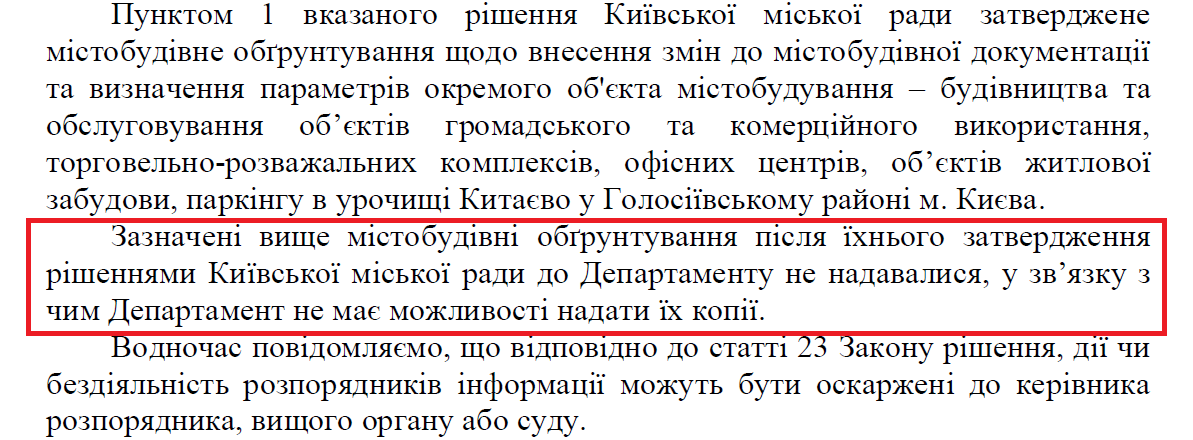
Response from the Department about the absence of urban planning justifications approved by Kyiv City Council
According to current requirements, urban planning justifications could only be approved after coordination by several bodies, including the authorized urban planning and architecture body. But before Kyiv City Council’s approval of the five documents for the separate plots in the tracts Kitaievo, Samburky, and Bolharske, they were neither coordinated there nor even considered at the mandatory session of the architectural and urban planning council required for such issues.
Nevertheless, the Department responded that on August 23, 2007, the urban planning section of the architectural and urban planning council considered a different justification — a joint one for all five plots (case No. 532-a-07).

Department’s response that the urban planning justifications approved by Kyiv City Council were not considered by them
In attempts to find any evidence of the existence of five separate urban planning justifications supposedly approved by Kyiv City Council on November 29, 2007, all available documents were analyzed, including approvals of land management projects.
No signs of the existence of such justifications were found. All materials without exception refer only to the protocol of the urban planning council session on August 23, 2007, for the single justification covering all five plots. And only two weeks before Kyiv City Council’s decision, SVAT “Kyivska Ovocheva Fabrika” submitted to the Ministry of Health for expertise all five land management projects with a single urban planning justification for all plots.

Conclusion of the sanitary-epidemiological examination dated November 15, 2007, for one of the land management projects
Even almost three months after Kyiv City Council’s decisions approving five separate justifications, SVAT “Kyivska Ovocheva Fabrika” addressed KCSA referring to the single urban planning justification for all five plots.
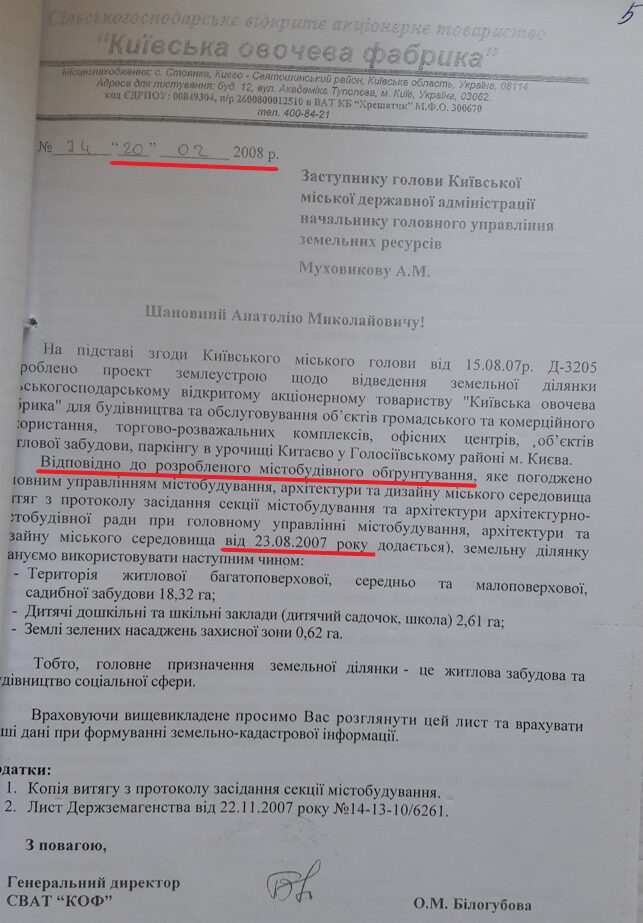
Appeal dated February 20, 2008, regarding consideration of the joint urban planning justification for all plots
Thus, there can be only one conclusion: Kyiv City Council approved non-existent urban planning justifications for amendments to the General Plan. This means that no changes to the General Plan occurred — the relevant points in the decisions are legally null and void, and these territories remain agricultural lands, where construction of housing and public facilities is prohibited.
How the Kyiv City Council approved non-existent documents — and no one noticed
That Kyiv City Council adopted the decisions does not mean it reviewed their projects. The Kyiv City State Land Resources Department approved all five land management projects on November 29, 2007, so the draft decisions could not have been submitted for Kyiv City Council’s consideration before that date. Yet, on that day, between 11:49 and 11:52, Kyiv City Council voted on all five decisions during the session.
These circumstances completely exclude the possibility of prior review of the projects according to the procedure defined by the Regulations and the Procedure for granting land plots for use in Kyiv city.

Conclusion dated November 29, 2007, approving the land management project
Information about registration of the respective projects when submitting them to Kyiv City Council is absent in the registration journal (Kyiv State Archive, Fund No. 1697, description 1, case 1575). In Kyiv City Council session materials of November 29, 2007 (Kyiv State Archive, Fund No. 1697, description 1, case 1553), draft decisions with explanatory notes are present. However, none contain the signature of the head of Kyivzem’s legal department, who must first check and certify the draft decision before submitting it to the Deputy Head of KCSA — Head of Kyivzem. Also missing are any dates (both for submission and consideration in profile commissions), which are always present in other draft decisions.
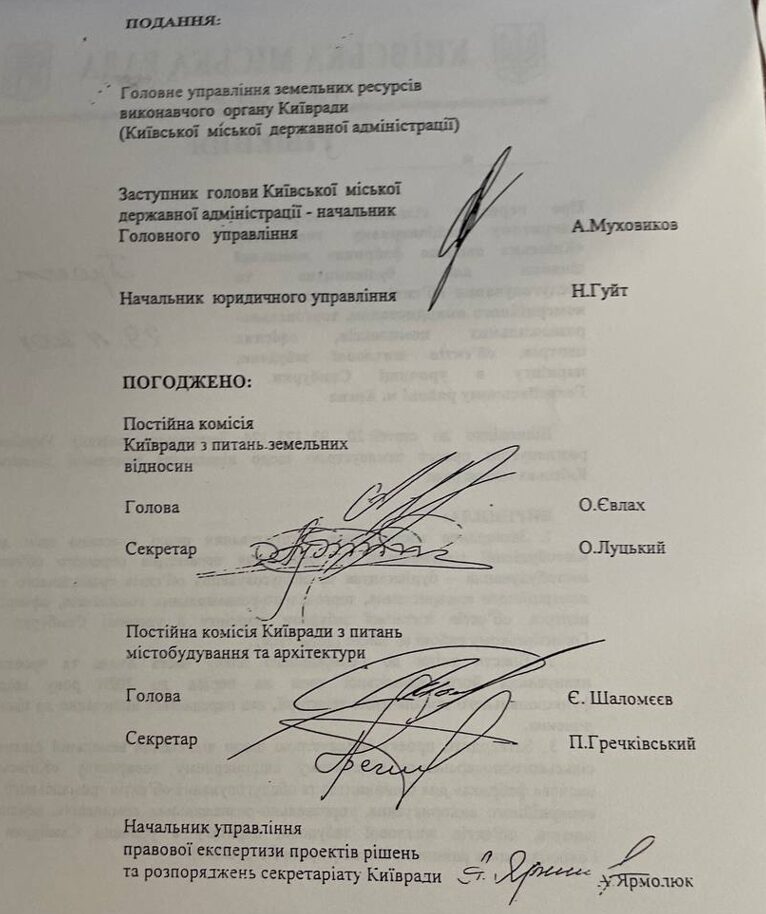
Submission documents to the draft decisions from the archive (identical for all five plots)
According to the transcript of the Kyiv City Council meeting on November 29, 2007, the issue was included in the agenda by voice at the proposal of the head of the land commission, Oleksiy Yevlakh. The draft decisions themselves were not even at the presidium of Kyiv City Council and no information about the content was voiced, except cadastral file numbers and the tenant’s name. Kyiv City Council Secretary Oles Dovhy called it the “vegetable base.”
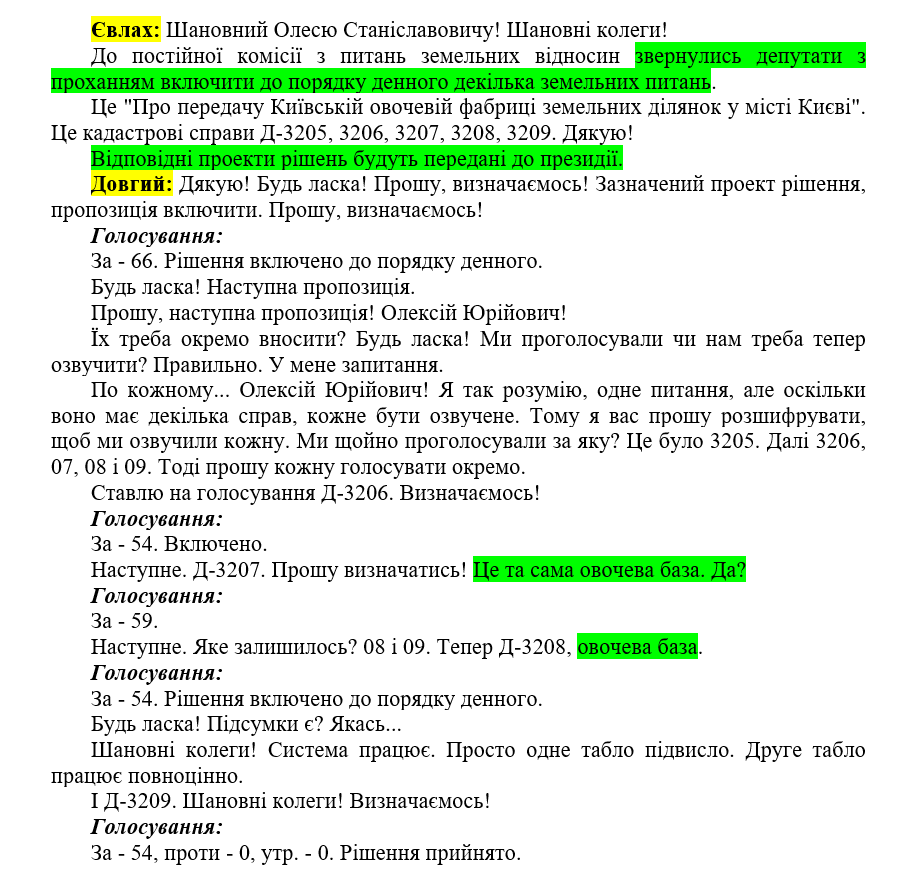
Transcript of Kyiv City Council meeting on November 29, 2007, inclusion in the agenda
During voting on the substance of the decisions, again no information about their content was announced. Yevlakh asked to consider the matter first “to release the people” who were waiting.
Thus, Kyiv City Council deputies voted blindly — they did not see draft decisions and had no idea about either the amendments to Kyiv’s General Plan, the land plots’ designated purpose and area, or their location addresses.
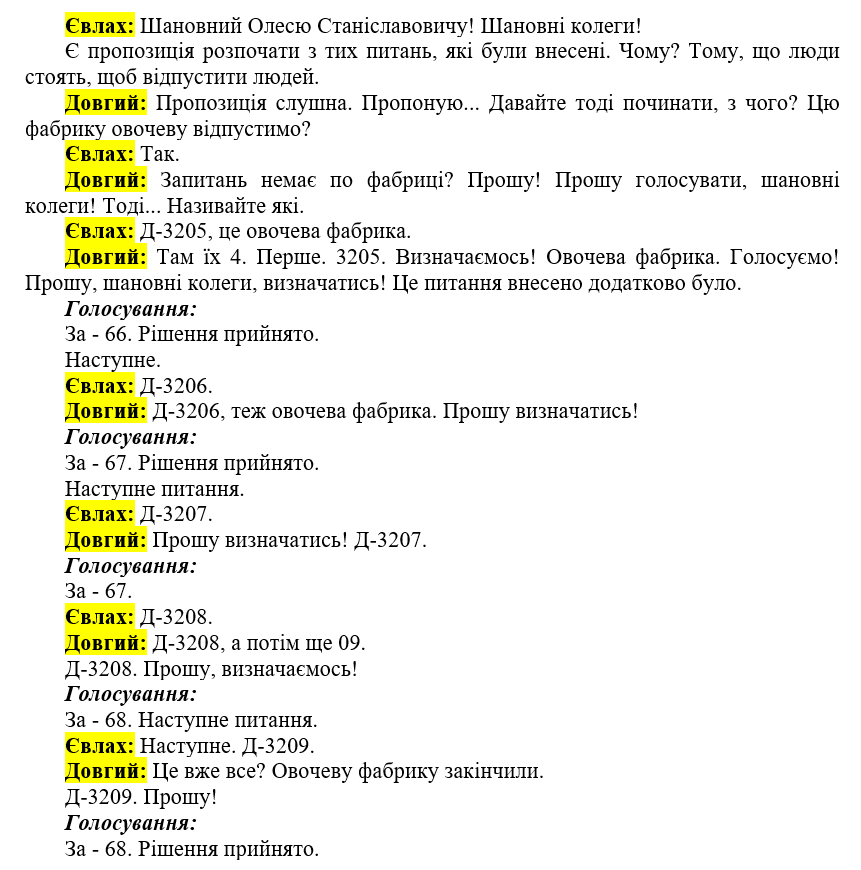
Transcript of Kyiv City Council meeting on November 29, 2007, substantive consideration
All this suggests a high probability that the drafts were prepared after Kyiv City Council’s decisions and added to the materials retroactively. It is worth recalling that land commission head Oleksiy Yevlakh was caught falsifying other Kyiv City Council decisions in the fall of 2007. In October 2011, the court found him guilty and immediately released him under amnesty.
Did they even have the legal right to approve a single urban planning justification for five separate land plots?
It is unknown whether even a single urban planning justification for all five plots, developed according to building norms requirements, existed at all. A document with the required title existed, but it was not an urban planning justification, rather a pre-design proposal.
Directly in the justification considered by the architectural and urban planning council’s urban planning section on August 23, 2007 (case No. 532-a-07), it is stated that it was developed “in accordance with clause 2.6 of DBN A.2.2-3-04 based on the client’s letter-application.”
The full name of this DBN A.2.2-3-2004 is “Composition, procedure for preparation, coordination and approval of project documentation for construction.” Clause 2.6 allows for pre-design work, which cannot be a design stage and is subject only to review and approval by the client and urban planning and architecture bodies.
Thus, these were pre-design development proposals for the plot, not the urban planning documentation established by DBN B.1.1-4-2002 “Composition, content, procedure for development, approval and endorsement of urban planning justification.”
The difference was not only in formal regulatory basis. The submitted “urban planning justification” contained no calculations of the need for engineering, road, and social infrastructure or urban planning conditions for the proposed development. All justifications for changes in the General Plan boiled down to general statements about the client’s investment intentions and the plots’ location attractive for residential development.

Fragment of the “urban planning justification” submitted to the architectural and urban planning counci
The previously mentioned session of the urban planning and architecture council on August 23, 2007, is no coincidence, as the excerpt from its protocol became the main document confirming the legality of General Plan changes by Kyiv City Council decisions. Copies of it and numerous approvals and expertise conclusions in all five land management projects refer exactly to this protocol excerpt. But what legal force does it have?
The architectural and urban planning council was an advisory body providing recommendations to the local urban planning and architecture authority. Prior review of issues such as urban planning justifications for amendments in urban planning documentation was mandatory, but they did not coordinate or approve any documents, only provided professional recommendations. Usually, these recommendations were taken into account because the council chairperson was the head of the relevant urban planning and architecture body by position.
Thus, the protocol excerpt only confirms procedural compliance but has no legal force without approval of the urban planning justification by the authorized body itself.
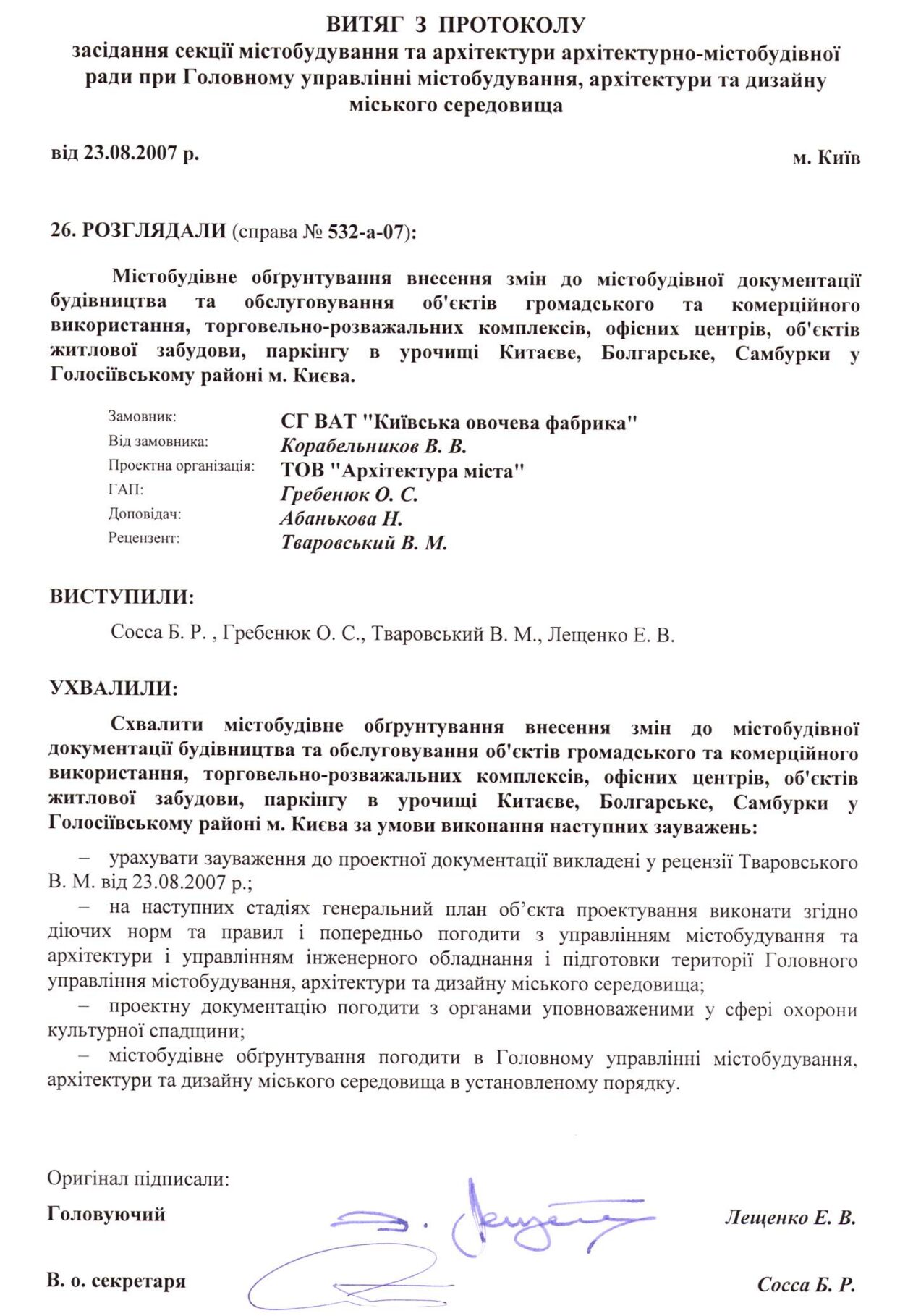
Excerpt from the protocol of the architectural and urban planning council’s urban planning section meeting
According to the protocol, the urban planning justification was approved subject to fulfilling a number of comments, including considering remarks in the review and coordinating the justification with the profile main administration.
A request to the Department of Urban Planning and Architecture of KCSA (which previously was the Main Administration) received a response that they did not have the review with comments, nor was the revised justification submitted for their approval.
Department’s response regarding availability of review and receipt of revised document
And here’s the most interesting. The protocol excerpt is not from the architectural and urban planning council itself but from its urban planning and architecture section. However, these council sections existed only until June 11, 2007, according to the Standard Regulation approved by the State Construction Committee’s order dated September 1, 1999, No. 210. By the time the relevant urban planning justification was considered in August 2007, a new Standard Regulation approved by the Ministry of Regional Development order dated May 14, 2007, No. 15 was already in effect, which did not provide for separate sections of architectural and urban planning councils or the possibility to consider matters at them.
DBN B.1.1-4-2002 and Kyiv Building Rules require mandatory coordination of urban planning justifications by several bodies and organizations — the authorized urban planning and architecture body, the developer of the current General Plan, and others. But among the land allocation materials approved by Kyiv City Council, there were no such mandatory approvals — only approvals of the land management projects themselves and references to a legally null protocol of the architectural and urban planning council section.
Under these circumstances, no legal changes to Kyiv’s General Plan could have occurred even if Kyiv City Council approved a single urban planning justification for all five plots.
Official forgery in issuing urban planning conditions and restrictions for construction
After obtaining the land lease, active attempts at development did not occur for several years. In May 2014, the lessee SVAT “Kyivska Ovocheva Fabrika,” together with sublessee LLC “Altsion,” applied to the Department of Urban Planning and Architecture of KCSA for obtaining urban planning conditions and restrictions (UPC) for developing one of the plots in Kitaiv. Among their submitted documents was the legislatively required urban planning calculation.
This document directly stated that the functional designation of the territory in Kyiv’s General Plan was agricultural. And that for realizing their intentions, the client needed to initiate changes in urban planning documentation.

Urban planning calculation submitted by SVAT “Kyivska Ovocheva Fabrika” for obtaining UPC
Despite the noted inconsistency with the General Plan even in the client’s own submitted construction document, Kyiv’s then Chief Architect Serhiy Tselovalnyk issued UPC on May 29, 2014. But for this, he committed official forgery — referring to a single urban planning justification for all five plots that was never approved, supposedly approved immediately by five Kyiv City Council decisions. He also separately referred to an approved Kyiv City Council justification for one plot in the Kitaievo tract, which did not exist.
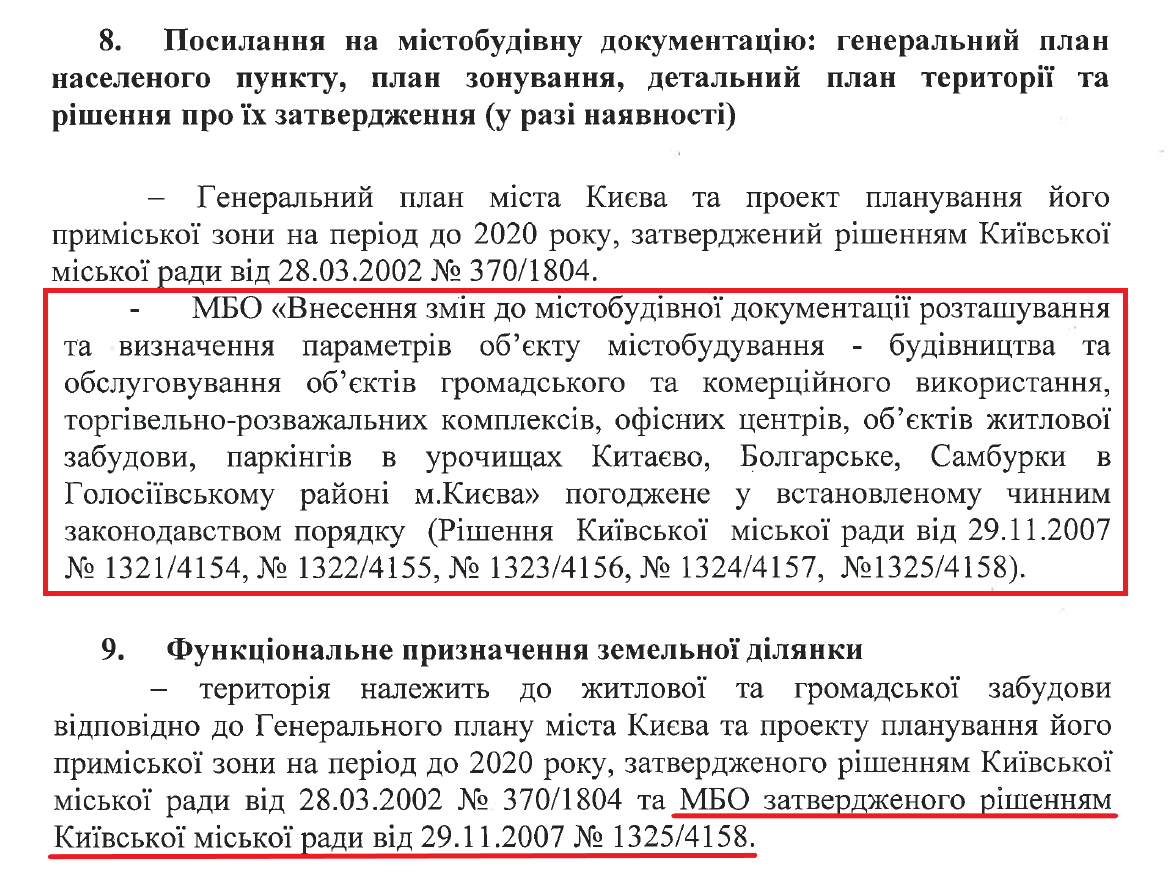
Fragment of UPC No. 5587/0/12/009-14 dated May 29, 2014
It should be noted that Tselovalnyk issued the UPC in advance as part of a typical then corrupt scheme. The very next day after issuance, a contract was signed to develop a detailed territory plan that was to legalize the violations upon UPC issuance after approval. The investor in the development was LLC “Altsion.”
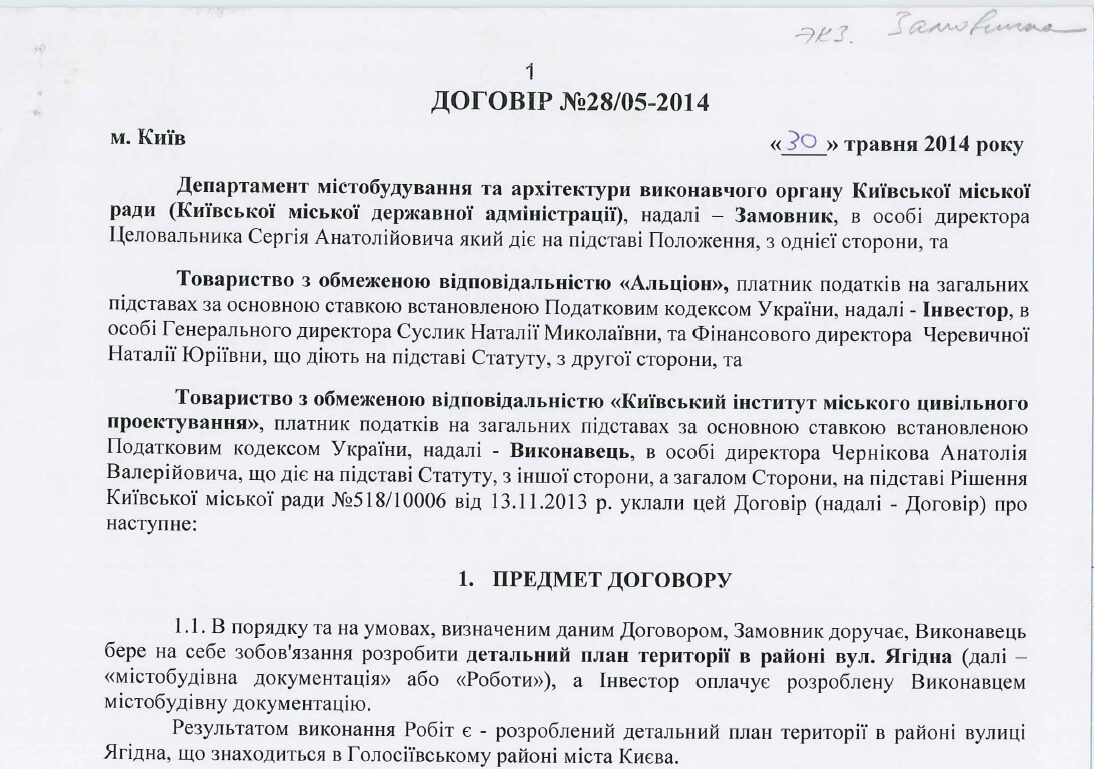
Contract for development of the detailed territory plan including plots in the Kitaievo, Samburky, and Bolharske tracts
This story shows that the lessee SVAT “Kyivska Ovocheva Fabrika,” linked to the former head of the Shevchenkivskyi District State Administration and former MP Viktor Pylypyshyn, knew about the fictitious nature of the General Plan changes and tried to legalize the development through a detailed territory plan.
However, they lacked influence, and in 2017, the project was handed over to the company “Saga Development” of Andriy Vavrysh. Vavrysh well understood the situation, as he, as the relevant deputy, prepared the forged UPC for Tselovalnyk in 2014 and documents for the detailed plan development (some signed by him). Therefore, instead of aggressive development attempts, the strategy became wide advertising of the development concept and attempts to organize approval of the detailed territory plan.
Thanks to active local residents, the approval of the detailed territory plan was blocked, and in 2021, the development rights were given to Vitali Klitschko’s close friend, his first deputy in 2014–2015, Ihor Nikonov.
In October 2022, the Department of Urban Planning and Architecture issued urban planning conditions and restrictions for developing two plots in the Samburky tract. Corruption was involved — both documents state that the functional purpose of the territory according to the General Plan is “residential and public development” per Kyiv City Council’s 2007 decisions.

Fragment of UPC No. 743 dated October 28, 2022
As examined above in detail, in 2007 Kyiv City Council did not establish how the functional designation changed. This can only be determined from the approved urban planning justifications, but the Department responded that it does not have them.
A separate question arises about the functional designation “residential and public development.” Such a designation theoretically cannot exist in the current General Plan because the normative base of those years did not provide for such a possibility — zones of public buildings and structures and residential development were separate functional zones.
So where did this information appear in the UPC? False information about functional zones in the current Kyiv General Plan was entered into Kyiv’s Urban Planning Cadastre.
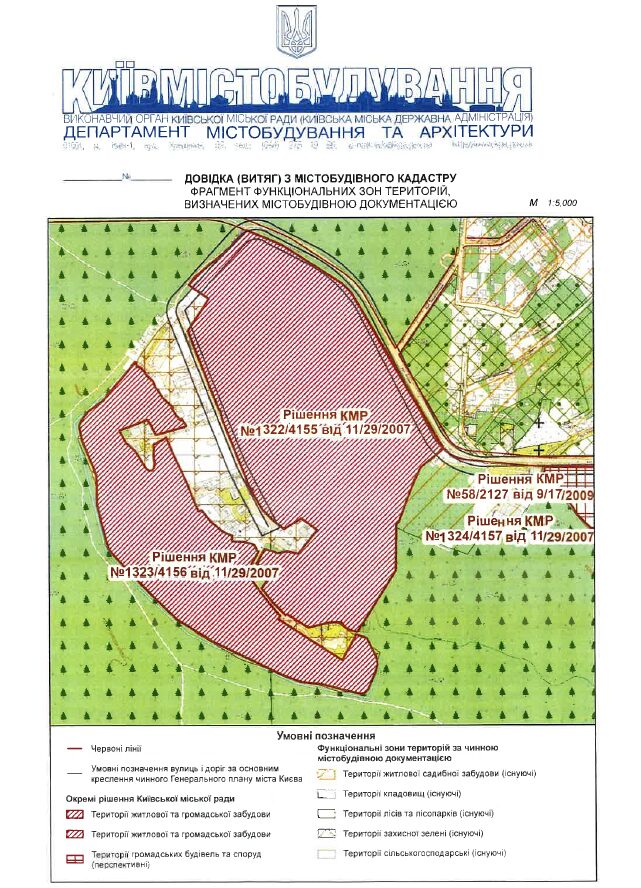
Excerpt from the Urban Planning Cadastre attached to the UPCs issued in 2022
This falsification took place under Vitali Klitschko’s city leadership since earlier there was no Urban Planning Cadastre. When filling the Cadastre, information should have been taken from urban planning documentation. In the process, the absence of the supposedly approved urban planning justifications should have been detected even if unknown before.
But instead of correcting the consequences of corruption from Chernovetsky’s times, they decided to cover it by digitalizing corruption.
With the Urban Planning Cadastre available, officials do not work with the actual urban planning documentation — they take excerpts from the Cadastre and consider the information reliable. The responsible persons in the Department of Urban Planning and Architecture entered false information — and all city officials regarding this territory will live in a virtual reality.
The worst part is that no one is held accountable for the violations. Those who use false information from the Urban Planning Cadastre are not obliged to verify it. And those who enter false data into the Cadastre can always explain it away as a simple mistake—because without catching someone red-handed while receiving a bribe, it’s nearly impossible to prove criminal intent.
Corrupt schemes in the renewal of land leases for development
The Kyiv City Council had a real opportunity to put an end to this shameful story—by simply refusing to extend the land lease agreements. The overwhelming public demand for such action was reflected in petition №12969, which received a record number of votes.
However, Mayor Vitalii Klitschko did not support the petition. In his response dated May 23, 2024, he stated that the Kyiv City Council would make the final decision during consideration of the lease renewal issues. It is important to note that Klitschko’s response included false information, claiming that according to Kyiv’s General Plan, all the plots in question fall under the “residential and public development” functional zone.
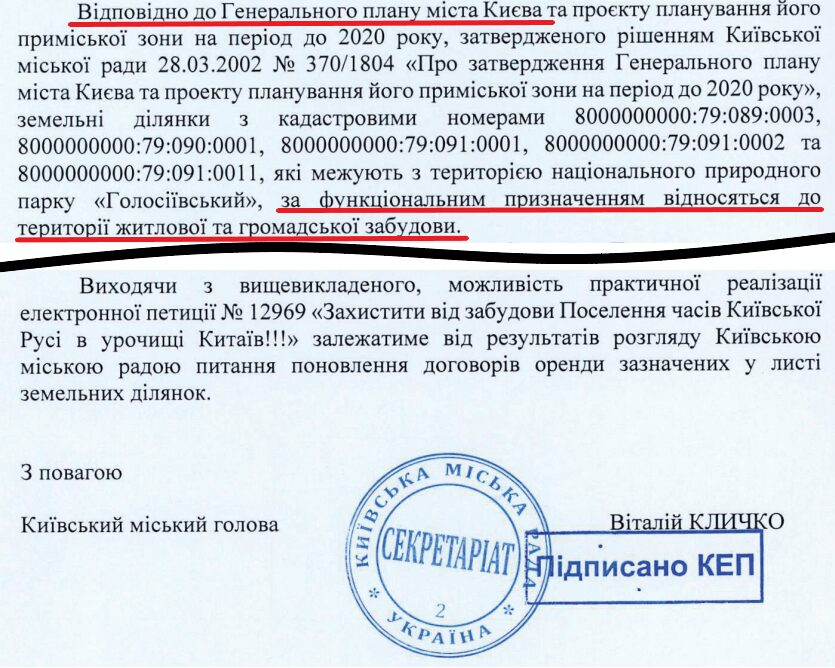
Vitaliy Klychko’s Response to Petition No. 12969
Coincidentally — or not — on the very same day that Klychko issued his response to the petition, draft decisions were submitted to the Kyiv City Council to renew all five lease agreements. Three of these — in the Samburky (1, 2) and Bolharske tracts — were swiftly renewed. The other two — in the Kitaieve tract (1, 2) — were postponed until a court decision is issued in response to a prosecutor’s claim that the land is part of an archaeological site.
In all five cases, the explanatory notes to the draft decisions contained false information, claiming that in 2007 the Kyiv City Council amended the Master Plan and reclassified the relevant land as being designated for “residential and public development.”
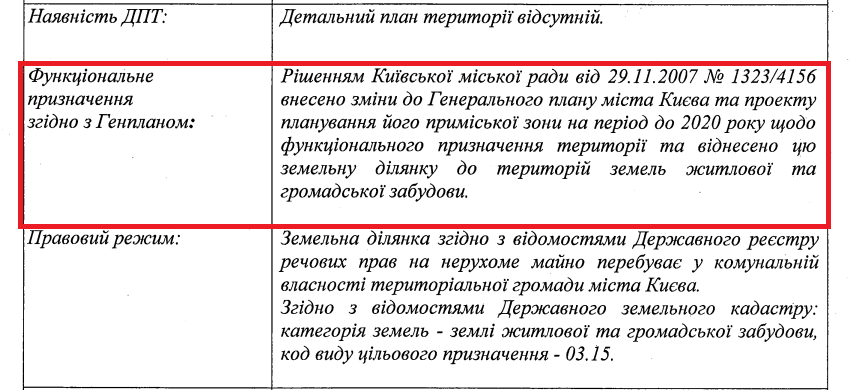
Fragment from the explanatory note to the Kyiv City Council’s draft decision on lease renewal
One can only wonder whether the council members would have supported the lease renewals if the explanatory notes had honestly stated that no changes were made to the Master Plan in 2007, and that the land is still classified as agricultural. Back then, under Mayor Chernovetsky, the city council falsely approved non-existent urban planning justifications. But the fact remains: officials subordinate to Klychko provided council members with false information — information that was critically important to the decision-making process.
Let’s sum it up
The Kyiv City Council’s 2007 approval of non-existent urban planning justifications for Master Plan amendments could have no legal consequences. The land in the Kitaieve, Samburky, and Bolharske tracts remains agricultural and cannot legally be developed for residential or public use. The lack of any changes to the Master Plan also invalidates the change in land use designation.
The story of the non-existent urban planning justifications would likely have come to light much earlier if the Kyiv authorities had not systematically violated citizens’ right to access Master Plan materials. The abuses of the Chernovetsky era may seem like a thing of the past — but in fact, they represent a kind of “corruption investment,” which continues to pay dividends to those currently in power.
The situation around the attempted development of Kitaieve is a clear example. Although the original fraud dates back to 2007, the lessee of the illegally obtained plots still requires ongoing corrupt support to stay afloat and push for construction: concealing valid planning documents, pushing through new ones to legalize violations, obtaining illegal planning conditions and restrictions, and renewing lease agreements…
Exclusively for “Dzerkalo Tyzhnia”
This project is supported by the The European Endowment for Democracy (EED).