
Does the government have the right to experiment with 5655, and are there signs of cartel conspiracy?

Last week, it became known that the scandalous resolution-clone of the urban planning “reform” 5655 may be brought up for consideration by the government again.
This was reported by sources to ZN.UA.
To confirm this, the public initiative “Holka” managed to obtain a document dated April 5, which documentary confirms that the resolution-clone is indeed being prepared for the government meeting.
 Photo of the minutes of the Government Committee meeting dated April 5th.
After the exposure of the first attempt, the Ministry of Infrastructure hastily released a report on the results of the public discussion of the project “On the Implementation of Experimental Projects in Urban Planning”, which is mentioned in the protocol.
The Ministry received a vast number of comments indicating that the provisions of the “experiment” project directly contradict the provisions of the laws. Only our organization submitted comments totaling more than 90 pages. And this is only regarding cultural heritage. Of course, they were not taken into account, just like most of the comments from MP Hanna Bondar (“Servant of the People”), who heads the working group developing the Urban Planning Code.
Blatant lobbying by developers cannot be influenced by warnings from the European Parliament, reports from the European Commission, or documents from the Chatham House Royal Institute. Incidentally, the latter sees the risk of a construction cartel in the government’s clone resolution 5655.

Screenshot from the Chatham House document, stating that due to imperfect regulation, construction cartels may arise.
What is a cartel and why is it dangerous?
A cartel is when large players from one sector come together and do everything to create favorable conditions for themselves.
Cartel agreements are prohibited by European law, specifically the Treaty on the Functioning of the European Union. The Antimonopoly Committee of Ukraine also long ago spoke about the harm caused by cartels, noting that they significantly affect the reduction of society’s welfare.
Of course, when someone tries to interfere with these plans, pressure begins. A civil society institution, which lost funding for one of its projects, has already stated that it sees this as a manifestation of informal pressure from the Ministry of Infrastructure. Similarly, there have been documented instances of censorship in the media when it comes to the urban planning “reform”.
And the logical question arises: why, in the presence of positions from the European Parliament, the European Commission, and Chatham House, did the Ministry of Infrastructure not take into account the comments of the public sector and the member of parliament?
Where does the government’s “right to experiment” end?
To introduce rules of the game that President Volodymyr Zelensky refused to sign, Oleksandr Kubrakov decided to go through a government resolution. Here, the signature of the guarantor of the Constitution is not required. And such actions are justified by the right of the government to conduct… experiments. This right was indeed guaranteed by the Law “On Amendments to Some Laws of Ukraine on Powers in the Field of Environmental Protection” (hereinafter – Law 2362-VIII).

Fragment from the report on the results of the public discussion.
This provision didn’t appear out of nowhere. When this legislative initiative was being prepared for consideration back in 2018, there was no mention of any experiment at the outset. Moreover, there was no mention of it even in the second reading. This provision was introduced as a “technical-legal amendment” by the then-chairman of the Committee on Environmental Policy, Pavlo Dziublyk, in a voice vote. The transcript attests to this.
Technical-legal amendments are simply corrections of certain technical-legal errors, i.e., violations of logical, linguistic, and procedural requirements of legislative technique. And new norms in laws cannot arise from such amendments.
It is unlikely that anyone will argue that granting the Government the right to conduct experiments on Ukraine is not such an amendment to the law on the natural reserve fund. In other words, taking advantage of the negligence of elected officials, a provision was inserted into the law, which in principle could not have been there, in violation of the regulations.

Fragment from the verbatim record of the session of the Verkhovna Rada in 2018 (consideration of bill No. 4551).
Then the Verkhovna Rada voted on an amendment granting the government the authority to “make decisions” (singular) and regarding “ecological state management.”
However, in the version signed by Petro Poroshenko and published, the text of the law already refers to “making decisions” (plural), and “ecological state management” has been transformed into separate “ecology” and “state management.”
As a result of this substitution in the text of the law, the Cabinet of Ministers obtained the ability, during the experiment, to make an unlimited number of decisions on a wide range of issues, even though the Verkhovna Rada did not vote for it.

The text of the Law “On Amendments to Certain Laws of Ukraine Regarding Powers in the Field of Environmental Protection” in the official legislative database.
But this right of the Cabinet is still not unlimited and infinite.
The Cabinet can make an unlimited number of decisions in various areas, but regarding the experiment (in the singular), the duration of which does not exceed two years (Section 2 of Chapter II of Law 2362-VIII).
In other words, the Government has the right to conduct a very broad experiment only once, and this experiment cannot last more than two years.
The first decision within the framework of the experiment found in the legislative database is the order of 2019 “On the introduction of an experimental project to improve the efficiency of management processes in the Secretariat of the Cabinet of Ministers of Ukraine.”
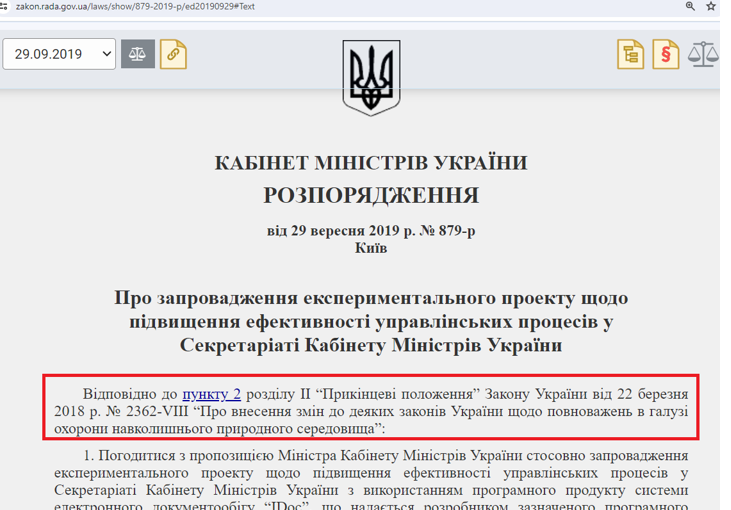
The decision of the Cabinet, which initiated the implementation of the experiment allowed by Law 2362-VIII.
From this decree began the countdown of the maximum possible term of the experiment established by Law 2362-VIII, which is two years, during which the Cabinet could make an unlimited number of decisions within its implementation. And in October 2021, this term… expired.
The Government has long used its one-time (!) opportunity and no longer has the right to initiate “experimental projects” based on the same norm of the law.
In fact, this is legislative fraud by the Ministry of Infrastructure.
The Ministry, through deception and abuse of trust, tries to extend the project of its “experiment,” citing a provision of the law that no longer grants the Government the authority to make such decisions.
What is the second argument of the Cabinet?
The Ministry of Infrastructure claims that the Cabinet has the right to conduct experiments that contradict the laws because the provisions on the experiment in Law 2362-VIII do not prohibit doing so. This argument is of secondary importance because the Cabinet has no right at all to conduct these experiments. But it is very indicative in terms of demonstrating the attitude of government officials towards the Constitution of Ukraine.
Here, Vice Prime Minister Oleksandr Kubrakov and his subordinates justify their actions as if they are not engaged in the management of the state, but only in politics or business, where Articles 15 and 42 of the Constitution indeed allow everything that is not prohibited by law.
The Ministry’s justification directly contradicts the provisions of Article 19 of the Constitution, according to which state authorities and their officials are obliged to act only on the basis of, within the limits of authority, and in the manner provided by the Constitution and laws of Ukraine. In simple terms, they are prohibited from doing anything that is not explicitly allowed.
The provisions of Law 2362-VIII do not contain instructions that, during the experiment, the Cabinet had the right to establish regulations contrary to the law, so the Cabinet had the right to approve the experiment only if it did not contradict existing laws.
What specific violations of the legislation in the planned four experimental projects is the Ministry of Infrastructure trying to justify?
The final version of the draft resolution is not yet published, so the intentions of the Ministry of Infrastructure were analyzed based on the project sent on March 4 for an anti-corruption examination by the National Agency on Corruption Prevention (NACP) and the Report on the consideration of public proposals dated April 11.
A detailed list of violations of the requirements of the Constitution of Ukraine, international obligations ratified by the Verkhovna Rada, and laws is too long, so we will limit ourselves to the main ones.
1. Procedure for implementing an experimental project on providing urban planning conditions and restrictions on land development.
Providing urban planning conditions and restrictions is a self-governmental authority of the executive bodies of village, town, and city councils. The procedure for its implementation is directly established by Article 29 of the Law “On Regulation of Urban Planning Activities,” and according to the law, the Cabinet has no authority to change it.
However, the experiment involves defining a new procedure that does not comply with the mentioned norms of the special law, partially deprives local self-government bodies of their self-government powers defined by paragraphs 9 of part one of Article 31 of the Law “On Local Self-Government in Ukraine,” which simultaneously violates the requirements of Articles 140 and 146 of the Constitution, and the possibility of canceling decisions of local self-government bodies not by a court, but by orders of the State Inspectorate of Architecture and Urban Planning, which is a violation of Article 144 of the Constitution.
Such violations of the rights of local self-government also violate the European Charter of Local Self-Government.

2. Procedure for implementing an experimental project on development, approval, and expertise of project documentation for construction.
The new procedure does not comply with some requirements of Article 31 of the Law “On Regulation of Urban Planning Activities.”
Significantly weakens the protection of cultural heritage. Part of the exclusive powers regarding the preservation of cultural heritage is transferred to private individuals (violation of Article 54 of the Constitution and the Convention for the Protection of the Architectural Heritage of Europe). The proposed regulation also contradicts the provisions of the Law “On the Protection of Cultural Heritage.”
3. Procedure for implementing an experimental project on obtaining the right to perform preparatory and construction works, commissioning completed construction objects.
Establishes new rules for providing administrative services and issuing permits that do not correspond to the provisions of Articles 34-37, 39, 39-1 of the Law “On Regulation of Urban Planning Activities.” This is also a violation of part one of Article 4 of the Law “On the Permitting System in the Field of Economic Activity” and Article 5 of the Law “On Administrative Services,” according to which such matters are exclusively regulated by laws.
In addition, local self-government bodies are planned to be deprived of some delegated powers (violation of Article 143 of the Constitution) and obliged to perform new powers not provided for by law (violation of Article 146 of the Constitution). As mentioned earlier, violations of the rights of local self-government are also violations of the European Charter of Local Self-Government.
4. Procedure for implementing an experimental project on conducting state architectural and construction control.
It is planned to fundamentally change the entire construction control system by establishing new rules contrary to the norms of Article 41 of the Law “On Regulation of Urban Planning Activities.” Changes include amending the list of persons subject to inspection, grounds for conducting inspections, and the powers of the authorities carrying out the control. However, according to part four of Article 4 of the Law “On the Basic Principles of State Supervision (Control) in the Field of Economic Activity,” such matters can only be regulated by laws.
Part of the exclusive powers of the state regarding control is transferred to private entities, which is a violation of Article 42 of the Constitution.
There are also violations of the rights of local self-government, similar in type to those specified in the description of the previous procedure.
What are the risks?
“Experimenters” should understand that the government can only adopt regulatory acts within the limits allowed by law. Otherwise, this document can be challenged in court. And such cases have already occurred when government resolutions were overturned in court. Legal proceedings can take some time.
It is worth noting that the President of Ukraine, in accordance with paragraph 15 of part one of Article 106 of the Constitution, suspends the implementation of Cabinet acts due to inconsistency with the Constitution while simultaneously referring them to the Constitutional Court for their constitutionality.
The losses arising from the implementation of such an “experiment” will be compensated by the state.
Specially for “Mirror of the Week”