
Defenders of Moscow Priests vs. Capital’s Decolonizers: What Has Worried Kyiv Residents Most Over the Past 10 Years? – A Petition Ranking

When the petition tool was launched ten years ago, it was skillfully used by adherents of Moscow’s priests to defend the Lavra, and by opponents of LGBT Pride. That was in 2015. Now, petitions attract the most public attention as a tool for decolonizing the capital and for fighting Moscow’s priests – “FSB_in_robes.”
Moreover, capital residents have always used petitions to defend green zones, cultural heritage, and the archaeology of the city.
“For Holka” and the “Center for Innovation Development,” which launched the petition tool in the city ten years ago, determined for Kyiv Day how during this time the tool changed citizens’ demands, which petitions gained the most and the fastest votes, and how the authorities responded. This research was conducted as part of the special projects “My Dear Kyiv” and “People’s Agenda.”
Kyivites’ War Against “FSB in Robes” and the Struggle for Decolonization
Previously, in Kyiv one had to collect 10,000 signatures under a petition; now – only 6,000. Everything changed in 2021. And whereas previously three months were allowed to gather signatures, now it is 60 days.
Furthermore, supporting petitions became possible through the “Kyiv Digital” app, where in the year of the full-scale invasion the “Electronic Democracy” section appeared. It allowed Kyivans to vote from their phone in one click and blocked the option to “inflate” votes. This app also helps record non-local participants, who are sometimes used for political manipulation. Indeed, during the battles over renaming Povitroflotskyi Avenue and related petitions, one political force recruited a record number of residents from other localities – 79%.
If we look at the ranking of petitions, it is clear that even ten years ago Kyivans were trying to expel hostile agents in robes from churches – those of the Moscow Patriarchate. And this is evident from the first months of the digital tool’s operation.
On December 6, 2015, Kyiv resident Oleksii Kononenko called on the city authorities to transfer the Lavra under the jurisdiction of the Kyiv Patriarchate. The petition quickly gained signatures and eventually received over 13,600 votes. A few days after Kononenko’s petition was submitted, two counter-petitions appeared. They were submitted by Serhii Kryukov and former pro-Russian people’s deputy Vasyl Volha—who led the now-banned “Union of Left Forces” party. Ten years ago, despite the ongoing Russian-Ukrainian war, pro-Russian petitions had serious support among Kyivans. Kryukov’s petition gained over 20,600 signatures and topped the city’s petition ranking, while Volha’s petition gathered over 11,200 signatures and rounded out the top 10.
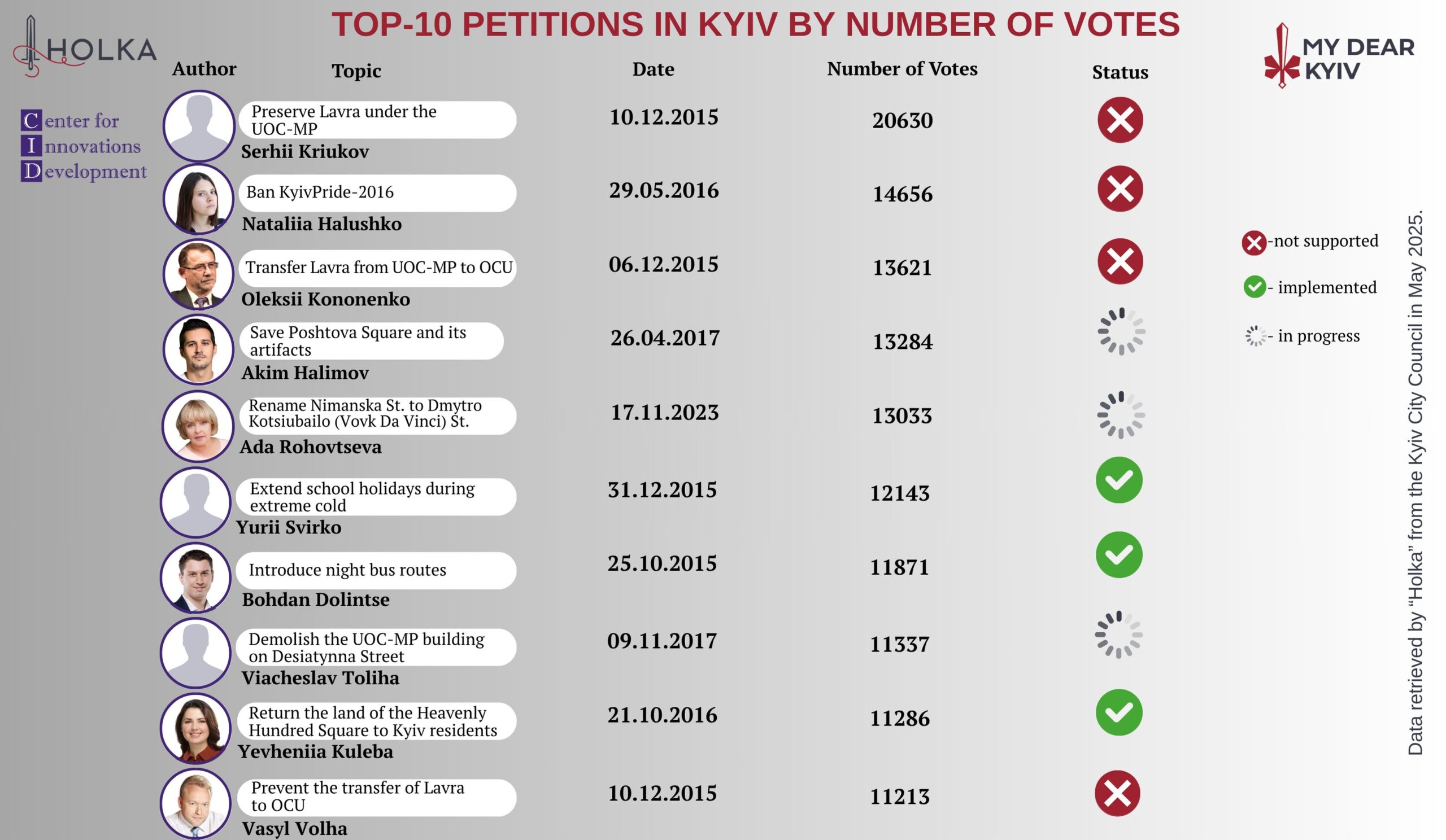
None of these three petitions was supported by the Kyiv authorities. All three authors were informed that the Lavra was “transferred to state ownership with assignment of these buildings to the management sphere of the Ministry of Culture of Ukraine,” and it was emphasized that they did not want interconfessional hostility.
Later, Viacheslav Tolpyha submitted a petition to demolish a pavilion belonging to Moscow’s priests on Desiatynna Street near the National Museum of the History of Ukraine. Over 11,000 citizens supported this initiative. The city administration appointed the Department of State Architectural Control responsible for the demolition of this small architectural form in 2021. But the illegally constructed structure, defended by Moscow’s priests, was actually demolished only after the full-scale war began – at night in 2024.
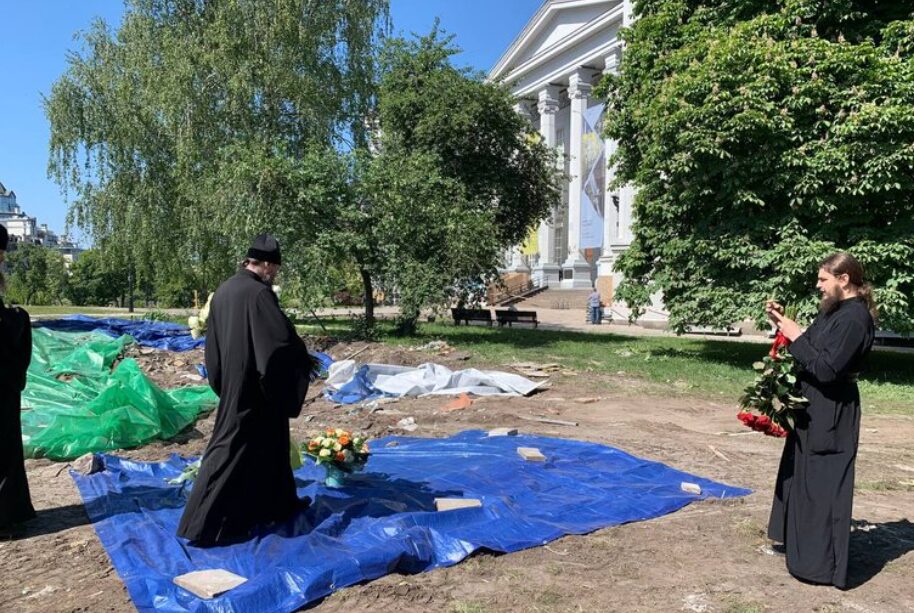
Photo: Suspilne, 2024 – demolition of Moscow priests’ pavilion on Desiatynna
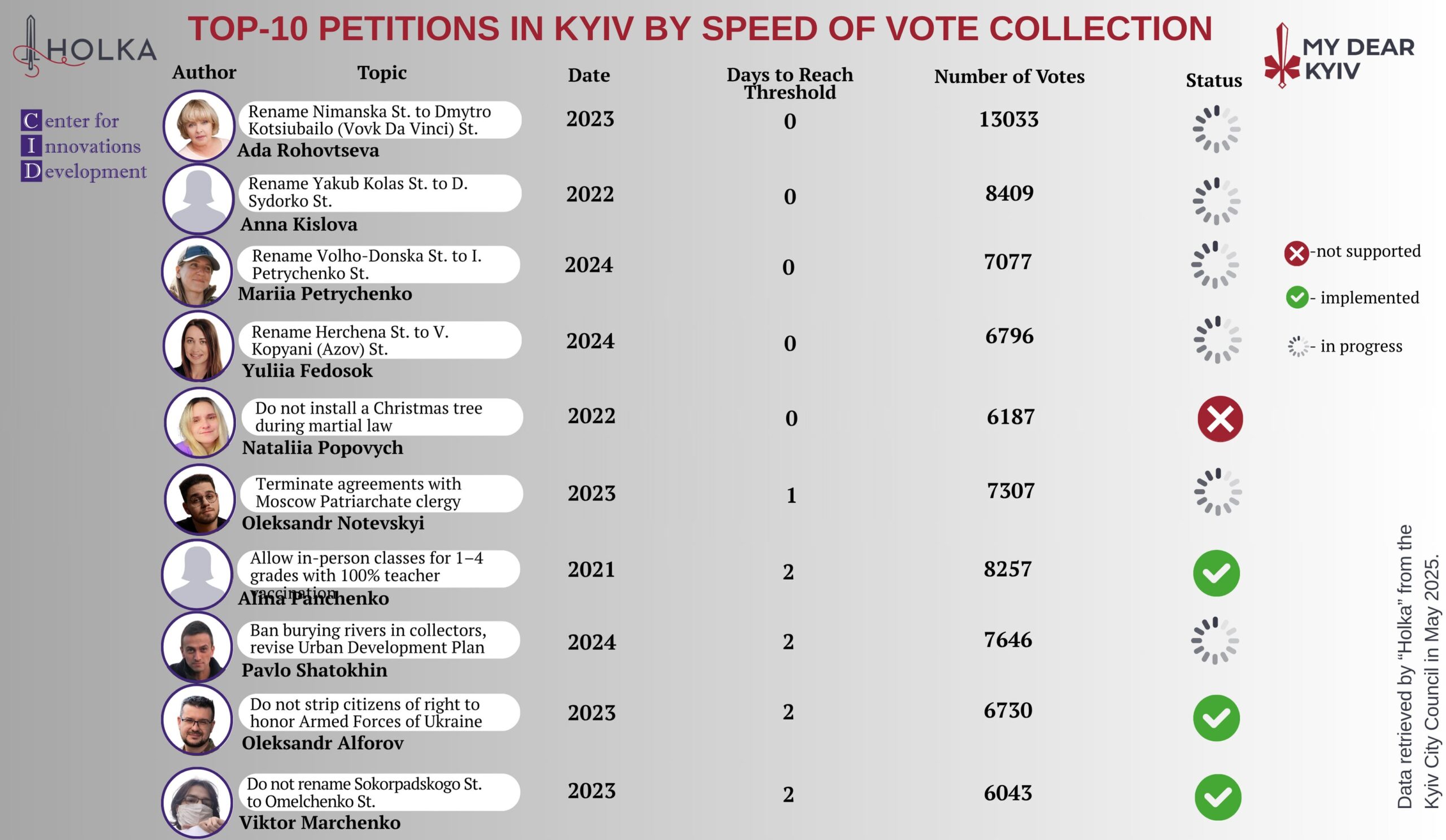
If we consider petitions that collected votes the fastest, there are also initiatives related to the activities of Moscow’s priests. In particular, a year before the demolition of the pavilion on Desiatynna, “Hrunth” host Oleksandr Notevskyi demanded that the city authorities terminate all contracts with Moscow’s priests. He gathered over 7,300 signatures in one day in 2023. At that time, the parliament was only considering banning the activity of FSB-in-robes, and the law was adopted only in 2024.
How many religious communities joined the OCU?
Viktoriia Mukha
Kyiv City Council deputy (“UDAR”)
Since February 24, 2022, only six religious communities have left under the jurisdiction of the Moscow Patriarchate and joined the Orthodox Church of Ukraine. This year, on May 9, the government adopted two resolutions to implement the mentioned law. These two regulatory documents will make it possible to clarify which religious organizations are connected to the aggressor country and spread the deadly ideology of the “Russian World.”
However, topping the list for fastest vote collection are petitions where Kyivans demanded renaming streets in honor of fallen heroes. For such petitions, the required vote threshold was 0 days—they closed basically instantly.
For example, the petition by Hero of Ukraine and honorary Kyiv citizen Ada Rohovtseva to rename Nymanska Street in honor of the fallen Dmytro Kotsiubailo (“Vovka Da Vinci”) gathered over 13,000 votes.
During the renaming, political speculation was inevitable. “European Solidarity” demanded that Povitroflotskyi Avenue become “EU Avenue.” The thing is, that avenue leads to the Ministry of Defense, and it was Petro Poroshenko’s personal will to rename the avenue to the EU (similar in name to the party). From “European Solidarity” there were even threats not to vote for the city budget and to hold Kyivans hostage. Then a Kyiv resident, Oleksandr Alfiorov, who serves in the Armed Forces, had to submit a petition to rename the avenue in honor of the Air Force’s feat. In two days, he managed to collect almost 7,000 votes. Ultimately, the Kyiv City Council agreed to that renaming.
What was achieved?
Pavlo Ostrovskyi
Member of the Naming Commission under the Mayor of Kyiv
After the full-scale invasion, taking into account the trend toward de-Russification and the Kyiv City Council’s decision to simplify this process, a public opinion survey module appeared on the site, where people could choose new street names instead of Russian and “Soviet” ones. Through this survey service, about 400 toponyms have already been de-Russified, and several more decisions are awaiting their turn. Thanks to successful petitions that gained over 6,000 votes, since 2022 Kyiv has acquired Air Force Avenue, Volodymyr Ivasiuk Avenue, Halytska Square, Mykola Mikhnovskyi Boulevard, Vakhtang Kikabidze Boulevard, and streets named after fallen heroes—Andrii Verkholyad, Serhii Myronov, Maksym Tokarev, Valerii Chybineiev, Hennadii Afanasiev, Oleh Mudrak—as well as “Vovka Da Vinci” Dmytro Kotsiubailo Square, Mykhailo Reutskyi Square, Andrii Zhovanyk Square. Petitions to rename Lavrska Street (to Ivan Mazepa and Novonavodnytska), Alla Tarasova Street (to historical heritage defender Mykola Makarenko), Volho-Don Street to Pavlo Petrychenko, and Chervona Street to Vasyl Kopan are at various stages of implementation.
Ostrovskyi emphasizes that the introduction and improvement of the digital petition tool was promoted by the Head of the Kyiv City Council Secretariat, Ihor Khatevych.
If we look at the petition rankings, the research by “Holka” and CRI shows that Kyivans quickly gathered votes over a few days for a petition against renaming one of the capital’s streets after former Mayor Oleksandr Omelchenko, who was featured in several anti-corruption investigations. In this case, public discussion outcomes played a role.
The Heavenly Hundred Heroes Square and Poshtova Square:
Where Citizens’ Voices Roared the Loudest
As soon as the petition tool appeared, city residents immediately began defending historic buildings. The first such petition was submitted by Arsenii Finberg—the head of the “Zakhoplennyi Kyiv” community—and it gained over 10,600 votes and is still under implementation.
Was it hard to gather such a number of votes?
Arsenii Finberg
Head of the “Zakhoplennyi Kyiv” community
I spoke with Serhii Loboiko’s team—the Center for Innovation Development that launched this tool—and I knew about it even before the launch. I submitted a petition on day one. I thought that with my 20,000 Facebook followers, it would be easy. They were then considering what threshold to set, and decided to leave it at 10,000 if I reached it. I asked the most popular bloggers; “Diia” didn’t exist yet; for the last 2–3 thousand I had to ask IT companies. They have their own mailings. As for implementation, I had my own action plan, volunteers described and photographed the condition of the monuments. But the biggest problem is that the city cannot influence owners of monuments who neglect and destroy them. Some of what I requested was done. A register of monuments appeared, an online map of monuments. Not every issue needs a petition. Sometimes it is worth meeting with an official. But petitions help draw media and public attention.
When comparing petitions to protect cultural heritage and archaeology, the loudest was citizens’ voice when it was necessary to protect archaeologists’ significant finds at Poshtova Square. There, where Yanukovych’s “estate manager” wanted to build a shopping and entertainment center, remnants of streets from Kyivan Rus were found. The petition was submitted by Crimean Tatar and journalist Akim Halimov, who now runs the YouTube channel “Realna Istoriia,” and it received nearly 13,300 votes.
Do petitions work?
Anabella Morina
Defender of Poshtova Square
For several years, officials reported monthly, but it was more about why the petition could not be implemented. Since the investor saw no point in further scientific research or in creating a full-fledged museum, the Kyiv City Council brought forward the issue of terminating the investment agreement—and the decision was indeed made in 2018. But it is still not actually being implemented. Nevertheless, the community managed to cancel the urban planning conditions and restrictions for the shopping center in court, and five years ago this territory received the status of a historical and archaeological monument of national significance. Since 2018 the excavation site has effectively been preserved and protected by Kyivans, and since 2019 there has been the “Museum of One Nation” in the underground pit at Poshtova Square, created by the NGO of the same name. But due to official inaction, the museum building has not been constructed; Poshtova Square remains in disrepair, although KMDA does not admit it. It seems they are still considering a shopping center, so the struggle continues.
In 2016, Kyiv resident Yevheniia Kuleba—now a Kyiv City Council deputy from “Servant of the People”—submitted a petition to return the Nebesna Sotnia Square to the community. During Chernovetsky’s time, that plot was transferred to the “Green Plaza” company, and traces led to the former son-in-law of the ex-mayor.
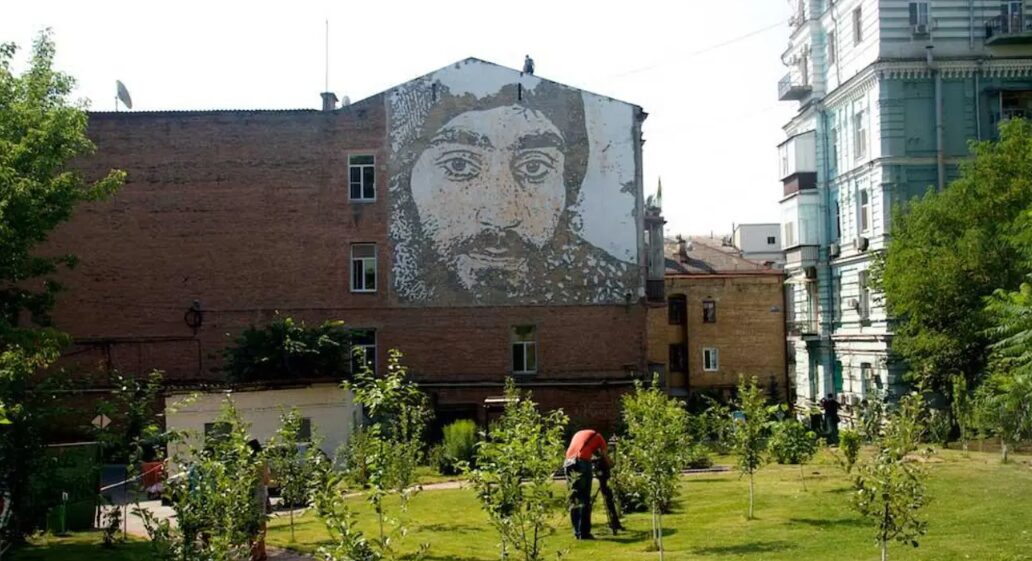
Photo of Nebesna Sotnia Square: hmarochos.kiev.ua
Was a petition one of the tools to pressure the mayor and city authorities?
Yevheniia Kuleba
Kyiv City Council deputy (“Servant of the People”)
If there had been only a petition, nothing would have worked. There were also protests, a planted garden, letters. And, on top of that, won court cases.
If we speak about the protection of green zones, the fight to preserve the Holosiivskyi National Nature Park—which is located in the capital—has been going on for nearly twenty years. Over ten years ago, a petition demanding protection of the territories adjacent to the national park gained over 10,000 votes and is still under implementation. Had the Kyiv authorities implemented that petition, activists in the capital would have had less work. This concerns, in particular, the Holosiiv Tower and Kytaiv, which are located near the national park.
And here, given that the threshold has been lowered to 6,000, it is worth noting a few petitions that received a significant number of votes. In particular, the requirement to protect Kytaiv from development (almost 8,700 votes – a record number for 2024). Kytaiv is a monument of national significance. On this territory, remains of fortification structures, Trypillian ceramics, dwellings from Kyivan Rus with clay stoves, etc., were discovered. We are the only European capital that has preserved a complex of archaeological cultural heritage of an ancient city within its boundaries.
Also noteworthy are petitions to protect the Osokorky Eco-park, which has been defended for over 10 years. The first petition was submitted in 2015 and received over 11,150 signatures. In essence, it lacked fewer than a hundred votes to get into the top 10. Another petition by activists tried to block access for construction machinery to the Eco-park. Notably, from the opposite side there were two counter-petitions, which barely gathered a little over 6,000 votes. These petitions are now under implementation.
What was the path to protecting the Osokorky Eco‑park?
Oleksandr Pylypenko
One of the defenders of Osokorky Eco‑park
Actually, the story of the Osokorky Eco‑park began with a petition about preserving the natural territory south of Kolektorna Street. In 2015, the mechanism of electronic petitions to the Kyiv City Council had only just launched, so people’s expectations were very high. Although the petition has not yet worked fully, it united caring and motivated people into one team and became the foundation of our activities.Today, there is an ongoing petition demanding the preservation of the “Zhytniy Market,” and conscious Kyivans are being urged to sign it, as well as a petition to remove council deputy Dmytro Moskal (“Batkivshchyna”) from the position of Chair of the Environmental Commission in the Kyiv City Council. It is precisely Yulia Tymoshenko’s party that is associated in the capital with development projects, including the Literary Square.
How Has the Petition Tool Changed
Over the Past Decade?
In 2015, the Center for Innovation Development successfully advocated changes to the Ukrainian Law “On Citizens’ Appeals” concerning electronic appeals and electronic petitions. These changes introduced, for the first time, the electronic petition instrument to the President of Ukraine, the Verkhovna Rada of Ukraine, the Cabinet of Ministers of Ukraine, and at the local level. Unique users, who only in the first two and a half weeks accessed the President’s website and began to be interested in and use this tool, totaled more than one million. In the same year, the Kyiv City Council approved the Regulations on the Procedure for Submitting and Reviewing Electronic Petitions in Kyiv.
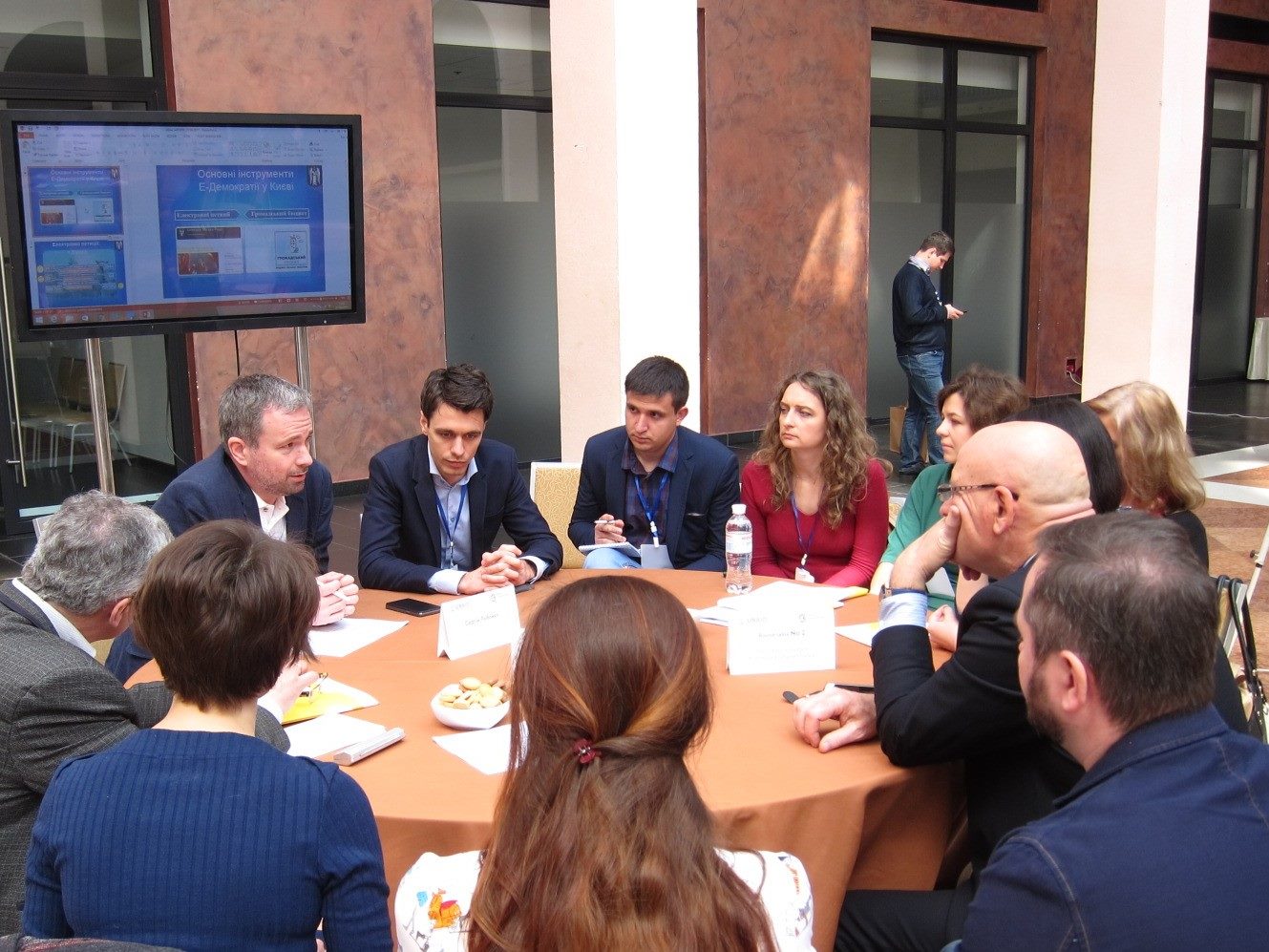
10 years ago, the founder of the Center for Innovation Development, Serhii Loboiko, discussed the introduction of petitions in the capital.
Mikhail Leichenko, Deputy Director for Analytics and IT at the “Center for Innovation Development,” notes:
What is special about Kyiv’s electronic petitions?
Mykhailo Leichenko
Deputy Director of the “Center for Innovation Development” for Analytics and IT
For their implementation, a responsible official is appointed, who works with the author of the petition, a roadmap is developed, and there must be a monthly report. A few years after launching the petitions, the Regulations were improved and became one of the most democratic among cities of regional significance. Citizens used the tool most intensively as soon as it was launched. In the first years, almost one million Kyivans used petitions. Now the number has grown to 1.7 million. That is about 40% of the city’s actual residents. But petitions begin to lose effectiveness due to weak or delayed responses from the authorities, including due to changes in petition executors. Now is the time to rethink the role of petitions. They are indicators of public moods and needs. The authorities must read such signals even before the voting ends. This will strengthen trust in electronic democracy tools and make them effective mechanisms for improving life in the capital.
It is worth adding that besides the electronic petition instrument, the Center for Innovation Development launched a participatory budget in the capital, which was suspended during the war, but the public is demanding its restoration. It allowed residents to directly implement changes in the city and influence its development. The participatory budget became a logical complement to petitions — enabling Kyivans to move from identifying problems to practically implementing solutions.
Statistical data on petitions and officials responsible for implementing Kyivans’ demands can be found on the Kyiv City State Administration’s website. In particular, it shows that out of 228 petitions that reached the required number of votes, the authorities supported 152, and around 20% have been implemented.
Let us remind you: the Center for Innovation Development, together with the public initiative “Holka,” researched how the President’s Office responds to petitions demanding vetoing parliamentary laws.
Special for LB.ua