
Deputy Head of the Office of the President Rostyslav Shurma now oversees not only the reform of forestry but also the water industry.

The State Water Agency presented a vision for the creation of the joint-stock company “Water of Ukraine.” The dispute over who will control the reclamation systems has been going on for a long time. Two ministries are vying for control in this area – the Ministry of Ecology and the Ministry of Agrarian Policy. Two different philosophies are at play: ecologists seek to preserve the right to manage water bodies and water management facilities as much as possible, while agrarians aim to gain maximum effective access to them for agricultural business purposes.

While the two ministries were sorting out their relations, the Office of the President developed its own vision of the problem. They decided to follow the path the state had already taken with forests. It is worth noting that the government has already established a state enterprise “Forests of Ukraine” bypassing the parliament. According to a government resolution, it has every chance of becoming a joint-stock company in the future, potentially leading to further privatization. As for water, “Water of Ukraine” is set to become a joint-stock company from the start.

Rostyslav Shurma, Deputy Head of the Office of the President, is overseeing the reform in the forestry sector, and it turns out he’s also taken on the reform of the water industry.

Last September, Yermak’s deputy stated that after “Forests of Ukraine,” there would be another similar project because they are now “dealing with water.” And the ultimate goal in all this is to transfer the maximum number of economic functions to private owners through privatization.

The struggle for control over water resources began after the presidential elections in 2019

How did the discussion take place?
Oleg Bondarenko
Oleg Bondarenko
Member of Parliament for the 'Servant of the People' party, Chair of the Environmental Committee
Indeed, there was a lively debate about who should control the State Water Agency. The Ministry of Agrarian Policy made initial attempts to gain control over the agency, but our Environmental Committee prevented this.

As a result of such a struggle, an interim agreement was reached: the State Water Agency and ecologists would manage water as a resource, while agriculturalists would oversee the reclamation infrastructure. They prepared legislation to strengthen their influence over reclamation systems. Just a few days before the full-scale intrusion, the law “On the Organization of Water Users and Stimulating Hydraulic Reclamation” was passed. Currently, another bill (7577) on irrigation systems is being prepared, essentially proposed by members of the agricultural committee.

Sergii Afanasiev criticizes this approach and emphasizes that the primary task is to preserve the ecological state of water. According to the scientist, everything used to be very clear, and the water sector was one of the first to begin real implementation of European principles.

How do you assess such an initiative?
Sergii Afanasiev
Sergii Afanasiev
Director of the Institute of Hydrobiology, Corresponding Member of the National Academy of Sciences
This was until this distribution between reclamation and water management began. Eurointegration obliges us to care for the ecological state of surface water bodies – this is the top priority task of the State Water Agency. But some, in my opinion, not very correct things have happened. We extracted all these "reclamation moments" and handed them over to the State Agency for Reclamation and Fisheries, but forgot that any water body is a holistic ecosystem. That's essentially what the agriculturists took control of, while the State Water Agency is now leaning towards the Ministry of Ecology. This is the current state of our water management. I don't quite understand what concept they want to implement in the "Water of Ukraine" National Joint Stock Company, but what I've read has raised concerns for me.

Afanasiev emphasizes: if we follow the example of creating the State Enterprise “Forests of Ukraine,” then forests in this case are considered as a commodity being traded:

“But water is not just a resource. This way, we may lose what is truly essential – the habitat for fish, mollusks, algae, undermine the self-purification and self-reproduction abilities of our rivers and lakes. And this jeopardizes our European integration.”

Petro Tyestov, Head of the Expert Department of the NGO “Ukrainian Nature Conservation Group,” emphasizes that perceiving forests, land, and water as sources of profit is a mindset of the past century.

How are similar issues addressed around the world?
Petro Tiestov
Petro Tiestov
Head of the Expert Department of the NGO "Ukrainian Nature Conservation Group
The concept of ecosystem services has long been applied worldwide. It is necessary to assess not the value of a cubic meter of water or timber, but the overall impact of forests or water bodies on the environment and human livelihoods. There is already a negative example in the law "On the Organization of Water Users and Stimulating Hydraulic Reclamation" where the "efficient" use of reclamation systems by agriculturalists through increased water intake after reconstruction has led to the disappearance of water in ponds used by local residents. It has also resulted in the drying up of the Tnia and Tenka rivers within the "Green Lagoon" reserve. In many cases, it is better not to modernize reclamation systems but simply dismantle them and restore wetlands. This would be a true modern ecological policy. Unfortunately, the focus solely on the economic component of natural resources is the consistent policy of the President's Office, leaving central authorities with the role of executor.

The process of creating the National Joint Stock Company “Water of Ukraine” is planned to be completed by the end of this year, according to the State Water Agency. A perfectly logical question arises: who will gain control over one of the most valuable resources?

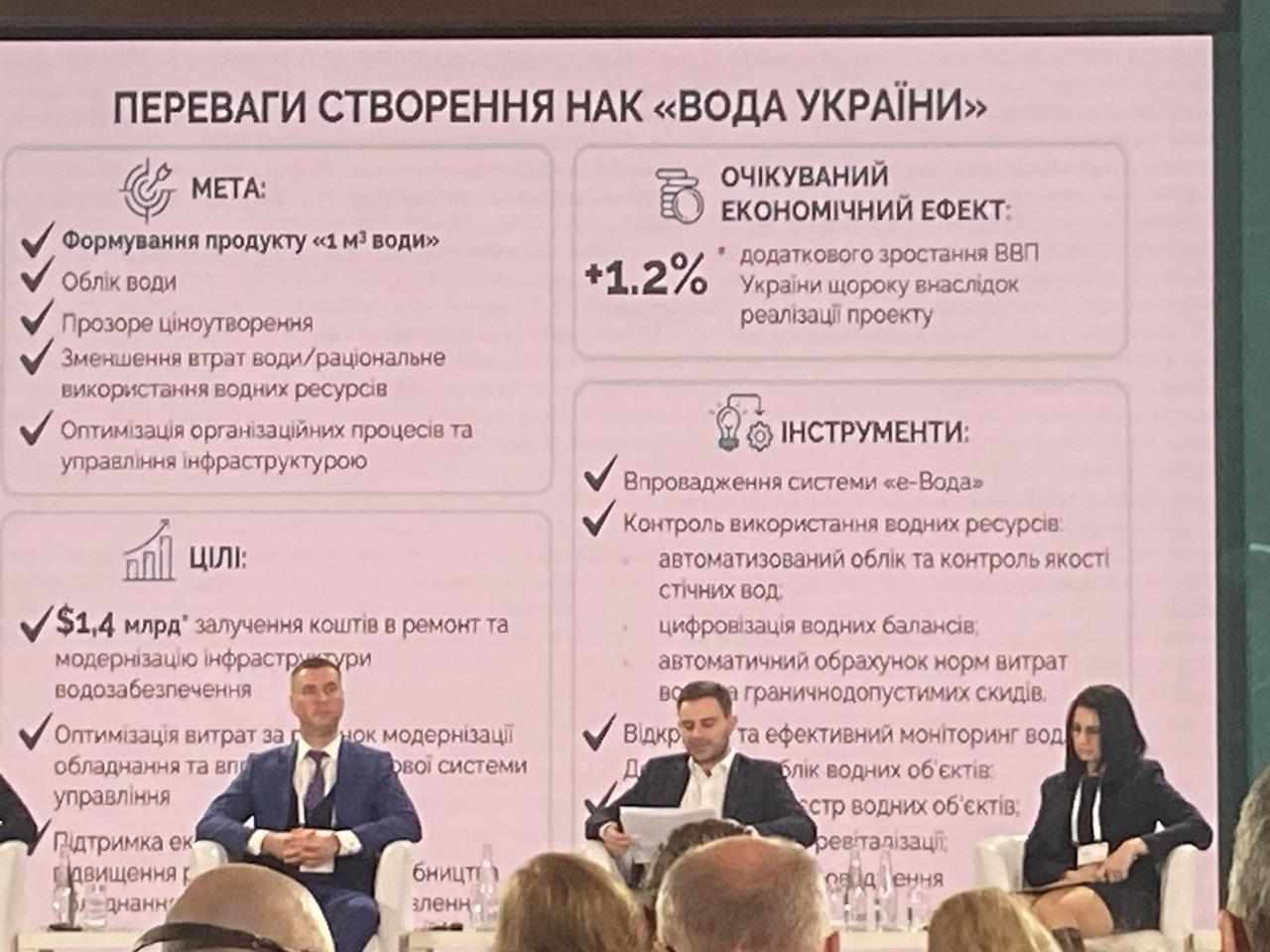
Currently, the State Water Agency is responsible for the ecological state of the country’s water resources. Here’s why “Water of Ukraine” is explained:

“The limited availability of water resources requires more efficient use. The existing model does not meet modern demands. Among the major shortcomings: significant underfunding, lack of actual control over water use, over 90% infrastructure wear and tear, lack of transparent pricing, and so on. The creation of the national joint-stock company “Water of Ukraine” aims to ensure water accounting, fair pricing, optimization of organizational processes, and infrastructure management. This provides an opportunity to attract investment for modernization and development, carry out reconstruction of main channels, implement projects for hydroelectric facilities, and install solar panels on water bodies.”

In the presentation recently presented by the State Water Agency during the United for Nature forum, Agenda for Ukraine, the benefits expected from the creation of the joint-stock company are outlined, one of which is an additional annual GDP growth of 1.2%.

Presentation of the concept of the National Joint-Stock Company “Water of Ukraine”. Slide about the advantages of this structure.

What risks could there be?
Mikhail Khoriev
Mikhail Khoriev
Lecturer at the Kyiv-Mohyla Academy, former Deputy Minister of Ecology
It should be emphasized that they will create not a state enterprise, but a joint-stock company. Water cannot be a regular commodity, so we do not have a commercial product for sale. When it comes to a joint-stock company, profitability becomes a measure of effectiveness. Profitability is the main indicator for the operation of joint-stock companies. If there are losses, shareholders are dissatisfied - and then the price of the product must increase. Therefore, tariffs for the population will increase. And then the state, since water must be accessible, will provide subsidies. This won't work. A similar attempt has already been made in North Macedonia, Bulgaria, Georgia, and they abandoned it there.

The special nature of water as a resource is addressed in the directive of the European Parliament and the Council: “Water is not like any other commercial product but rather a heritage that must be protected, defended, and treated accordingly“.
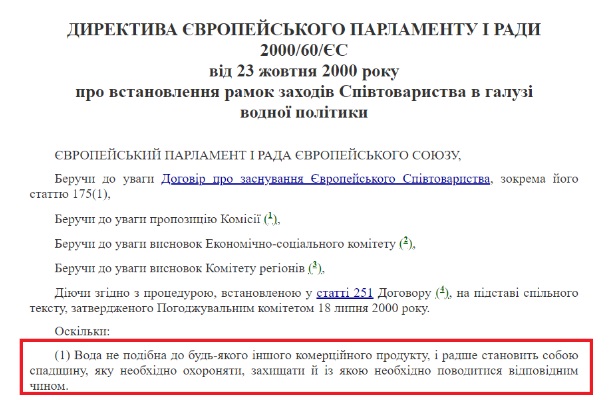
Excerpt from the Directive of the European Parliament and of the Council

People’s Deputy Olga Vasilevska-Smaglyuk (“Servant of the People”) resigned from the board of the State Forest Agency precisely because she disagreed with the creation of the State Enterprise “Forests of Ukraine,” which could subsequently become a joint-stock company. She explains: the creation of the National Joint Stock Company “Water of Ukraine” is a lengthy and extensive process.

What are the risks during the creation of a joint-stock company?
Olga Vasilevska-Smaglyuk
People's Deputy, "Servant of the People"
It almost always entails a loss of resources "along the way" to corporatization in favor of private interests, mass layoffs, and centralized management. The future corporatization, which, as I understand it, is planned by the initiators, is likely to result in a decrease in service quality, unjustifiably high salaries for management and supervisory boards, procurement manipulations, and complete lack of accountability.

Members of Parliament from the ruling party are surprised that such issues are being addressed without the involvement of the Verkhovna Rada, which should have worked on legislative changes related to the new division of functions, as in the case of the creation of the State Enterprise “Forests of Ukraine,” as well as in the case of the National Joint Stock Company “Water of Ukraine”.

Why are they bypassing the Verkhovna Rada?
Alexander Alixeychuk
People's Deputy, "Servant of the People"
Regarding the idea of ​​creating the National Joint Stock Company "Water of Ukraine," I would like to note that I see nothing but the desire of certain "operators" (I cannot call them statesmen) to steal the nation's natural wealth, water, from the citizens. They have already done this with the forests of the country, and now they want to do the same with water using the same scheme. And all this is being done bypassing the parliament because the ideological inspirers of this understand that the Parliament will not pass such decisions. Therefore, they went through the government. But I would like to warn those who put their signatures under such documents that they will have to answer for it eventually, whereas those who push signatories to such decisions will be sitting abroad and spending the money stolen by your hands. So think three times!


By the way, in the fall, when Rostyslav Shurma commented on his plans regarding water, he focused exclusively on the role of the government and did not mention the parliament at all.

And what did they intend?
Rostyslav Shurma
Rostyslav Shurma
Deputy Head of the Office of the President
Our understanding is that the Cabinet of Ministers and executive bodies should focus on legislative activities, on regulation, on establishing specific rules, while, based on the experience of many countries, there should be a single large economic entity - a single mega-holding, where economic functions will be concentrated.

But Shurma’s sphere of interests is not only limited to water or forest resources. He has also been lobbying legislative initiatives related to agricultural land.

Currently, one of the controversial bills, positioned as an initiative for rapid investment attraction and rebuilding of Ukraine, is being prepared for the second reading (9627).

Specially for “Glavkom“.