How to circumvent 400 million hryvnias during the war? Special rules designed for Verkhovna Rada officials (Update)

It appears that the Parliament bent the rules when it fulfilled the demand of its European partners to reform the civil service and make all civil servants have the same working conditions: 70% salary and 30% bonuses. This is an important reform, because it should break the system in which a manager could pay a civil servant a penny salary, and it depended only on the manager’s decision whether the subordinate would receive a significant bonus, which made up most of the income.
As the civic initiative “Holka” previously wrote in Dzerkalo Tyzhnia, the 2024 budget reveals how the Verkhovna Rada’s Administration insulated its personnel from planned reforms. In the final provisions of the Budget-2024, special conditions were prescribed for them. The corresponding amendment was submitted by Vice Speaker Oleksandr Kornienko.
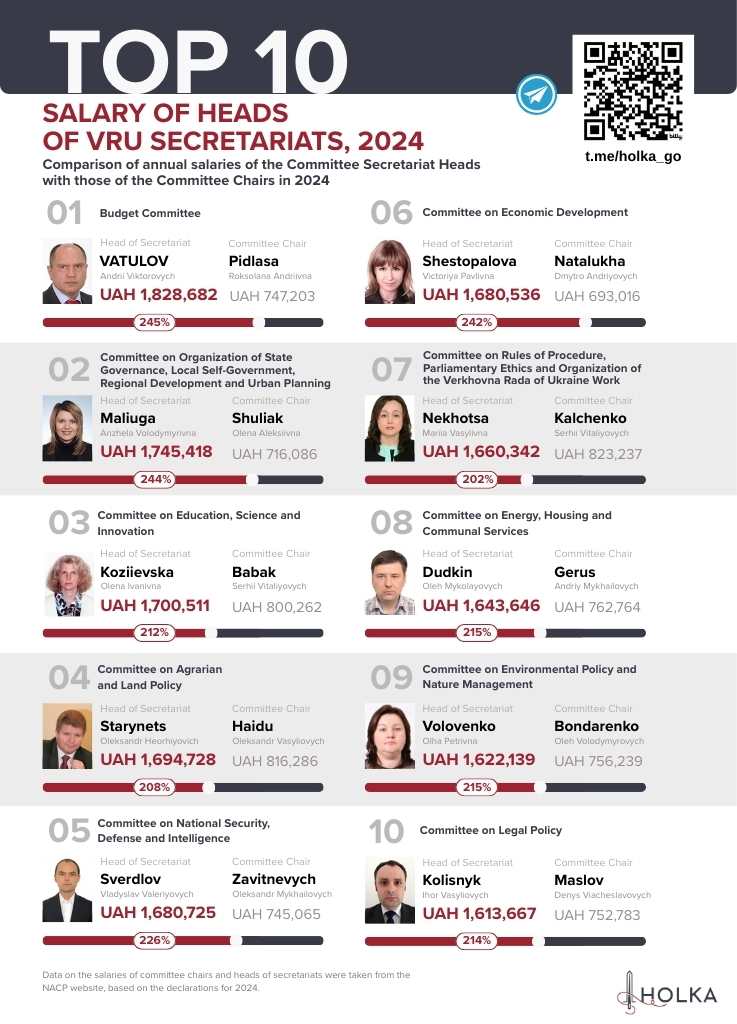
Therefore, if we study the declarations of the heads of the secretariats of the Verkhovna Rada Committees for the past year 2024, we can see millions of dollars in income, which is definitely higher than that of other civil servants in similar positions. They have not stopped exploiting the law in the interests of the Verkhovna Rada Secretariat, and now this trick can cost the budget more than UAH 400 million during the war.
It would seem that on March 17, Parliament supported the government’s draft law on amendments to the law “On Civil Service” (8222), which has already been sent to the President for his signature. Since the new law would be in effect, the conditions were supposed to be equal for all civil servants. However, as it turned out, there will be equal and… more equal before the law. Employees of the Verkhovna Rada Secretariat will have a privileged status in the civil service.

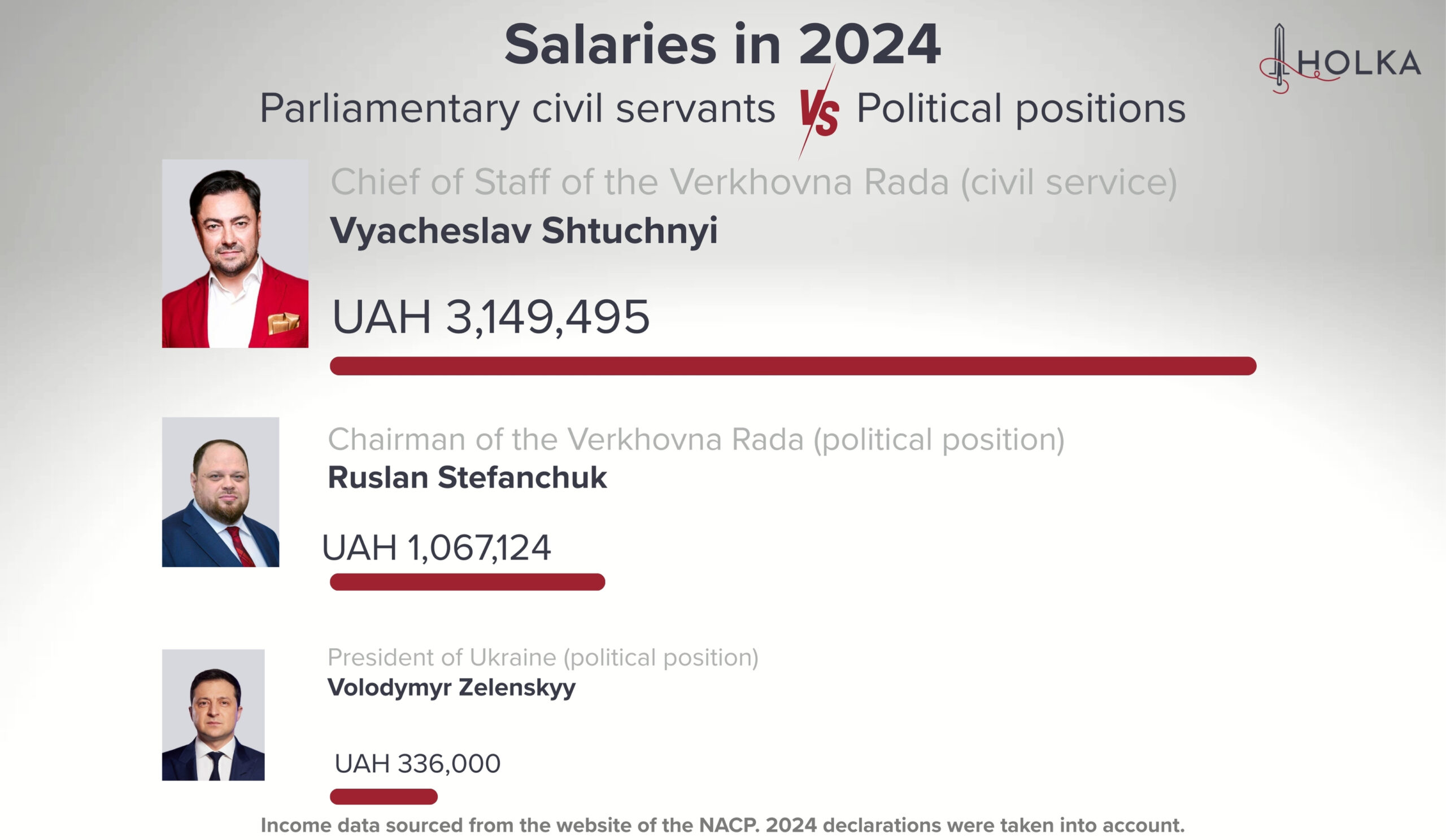
At the same time, the second problem remains unresolved: the salaries of those who work in political positions, such as MPs or the President, cannot be lower than those of civil servants. Currently, heads of committee secretariats receive twice as much as committee chairmen. From the point of view of management and common sense, this destroys the motivation system and carries corruption risks.
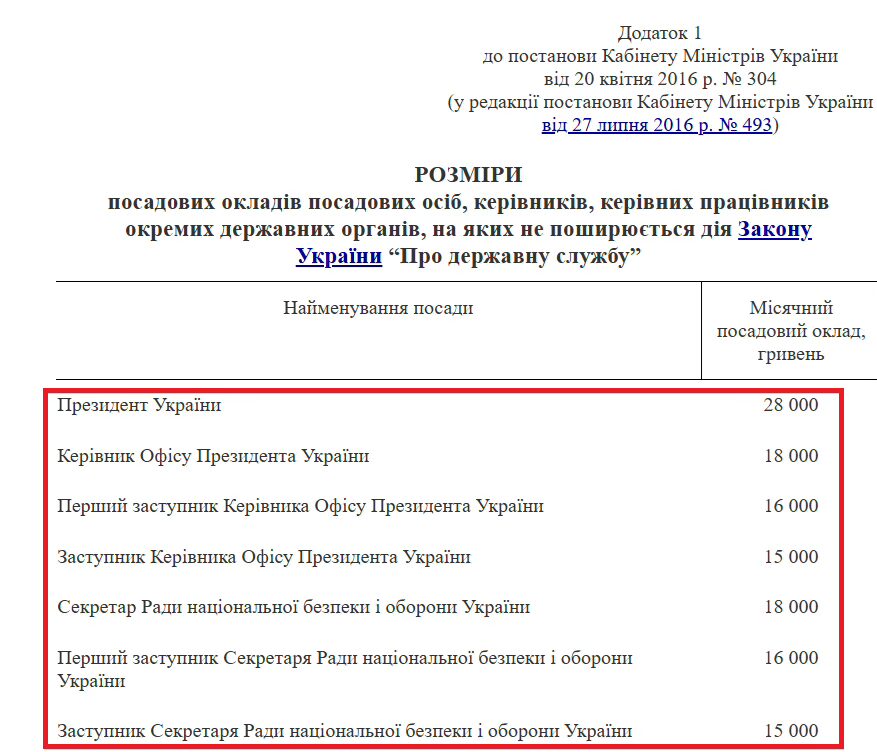
Screenshot from the appendix to the government resolution on salaries for political positions
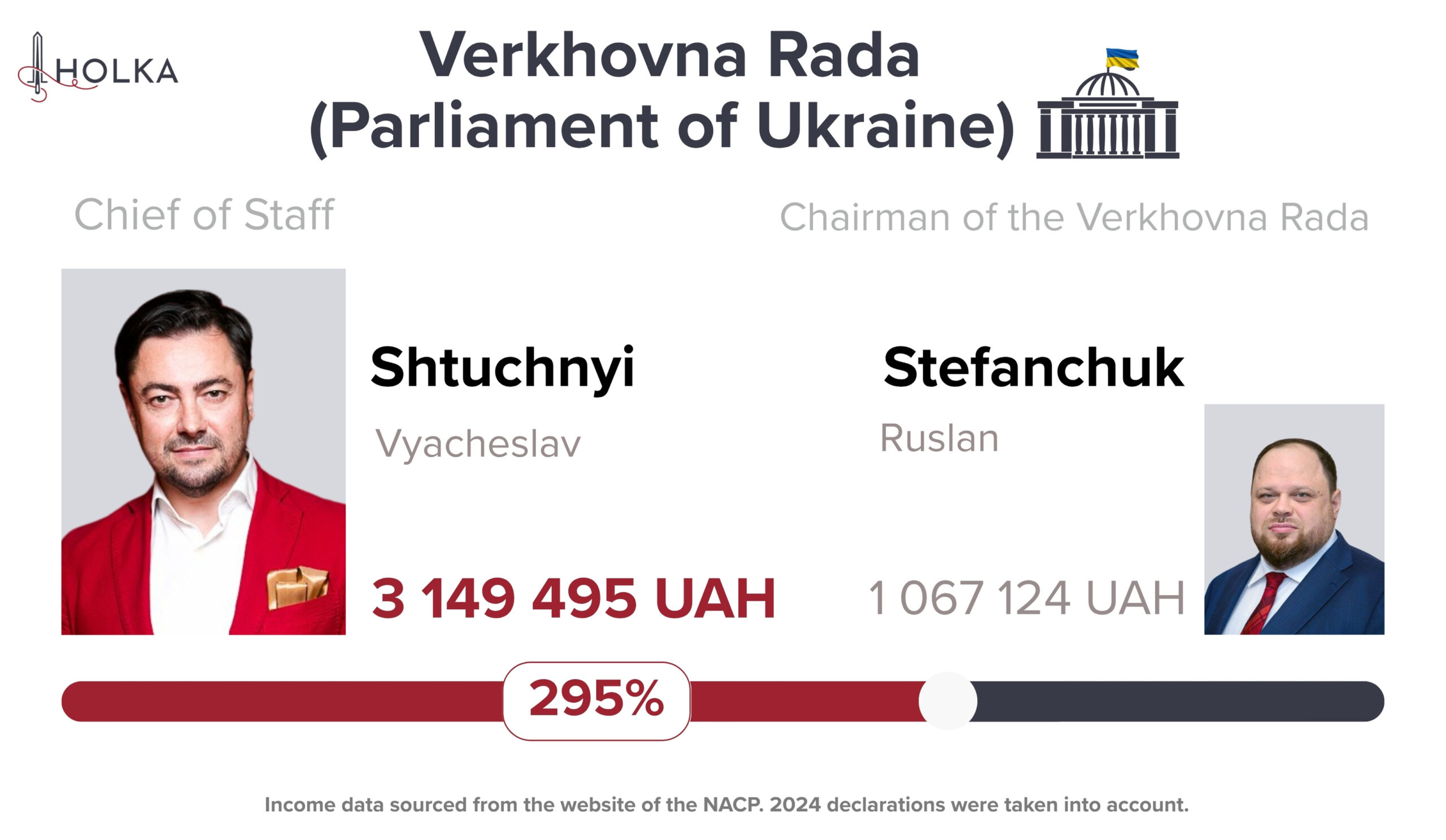
Volodymyr Zelenskyy earned 336 thousand hryvnias for his work as President during the war last year. At the same time, the head of the Verkhovna Rada’s Secretariat, Vyacheslav Shtuchnyi, received almost ten times more than the President, 3.1 million.
It is important to understand that special conditions have been created for the Verkhovna Rada Secretariat and classifiers and grades for positions ( salary levels based on the classification of civil service positions) have been approved separately. This is evidenced by the government’s resolution of April 11, 2025.
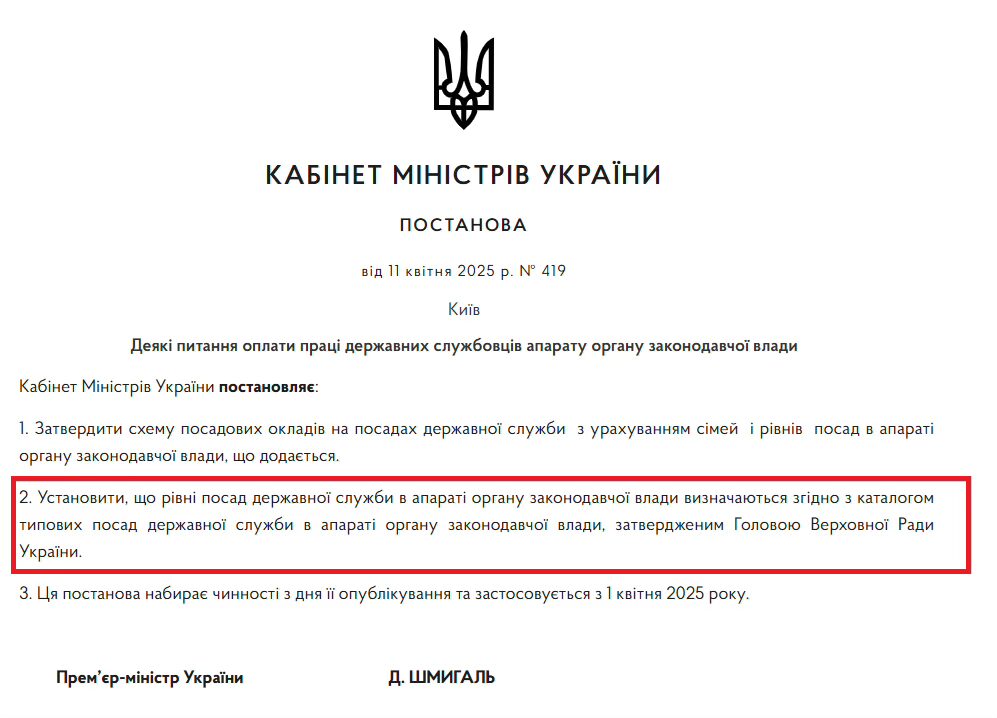
Government Resolution Introducing Special Remuneration Conditions for the Verkhovna Rada Secretariat
If we take the formula of 70% of salary and 30% of bonuses for civil servants throughout Ukraine, then the employees of the Verkhovna Rada’s Secretariat will always be at the top of the civil service salary ladder in absolute terms, provided these exceptional rules are maintained. While the devil is in the details, which are the allowances as part of the salary.
Those who currently work in the Parliament’s Secretariat are guaranteed much higher bonuses for years of service than 30% (here, these 30% are percentages of bonuses, not bonuses). This provision was introduced due to an amendment by MP Andriy Klochko ( Servant of the People) in another draft law that also amends the Law of Ukraine “On Civil Service” (9748). The document containing this discriminatory provision is now awaiting consideration by the President, who can either sign or veto the law.
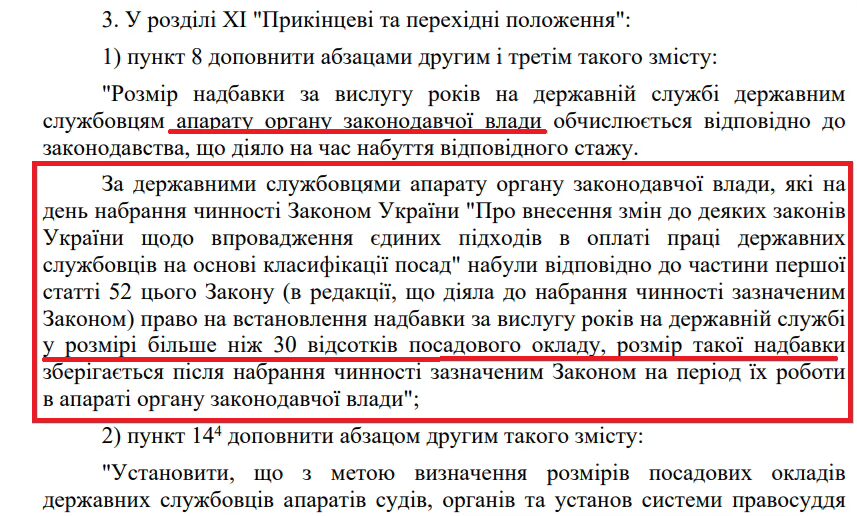
Excerpt from draft law 9478, which is awaiting the president’s signature
For comparison, the maximum allowance for other civil servants will be only 30%.
One of the MPs, on condition of anonymity, told the Holka civic initiative that those who did not support Klochko’s amendment during the vote had problems:
Some of them were not allowed to go abroad on work (!) trips, where there were official invitations from the organizers. They sent the application for finalization in accordance with the order of the Chairman of the Verkhovna Rada, Ruslan Stefanchuk. Of course, the chairman has room for maneuver. However, Stefanchuk is hardly playing first fiddle in this situation. Shtuchnyi is, to put it mildly, a very autonomous figure.
Member of the Regulatory Committee Oleh Synyutka ( European Solidarity) adds that MPs’ right to inter-parliamentary activities is currently limited, and the issue of business trips cannot be resolved without Stefanchuk and the Verkhovna Rada Secretariat.

As for Stuchnyi’s increasingly noticeable influence on the activities of the Verkhovna Rada, Synyutka emphasizes that this is the area of responsibility of the Speaker of the Verkhovna Rada, Ruslan Stefanchuk.
And it is important to understand that we are talking about both political influence and budgetary funds. Special approaches to the formation of salaries for the Verkhovna Rada Secretariat will require additional costs. And the amounts are not insignificant – they reach more than UAH 400 million a year. These figures were provided to the Government by the Secretariat of the Verkhovna Rada to implement the remuneration conditions proposed by the Secretariat. The Holka civic initiative asked Shtukhnyi for a comment, but has not yet received a response. As soon as he is ready to comment on the situation, the editorial board will publish his position.
It is worth recalling here that when MPs adopted the budget for 2024, they created special working conditions for their Office thanks to the Kornienko amendment. Various budgetary institutions, including the Supreme Court, realized that the game was not fair. And, of course, not only did the Supreme Court realize this. That is when a creative approach to staffing in a number of state institutions began.
The number of departments kept growing, and new directorates began to appear. These were soon followed by the creation of entire divisions. In some cases, entirely independent units within the administration were established. This led to a rise in the number of managerial positions — and with them, an upgrade in the status of certain units. And that, in turn, had a positive effect on salaries.
On paper, it all looks simple: the overall number of employees has not increased. But in reality, those who benefit financially are either the ones promoted to management or those whose units were upgraded — either by being transferred “upward” or through a mere change in the unit’s name. Everyone else remains on the same pay conditions.
This is where the chain reaction begins: if one government body offers better conditions, others that have not undergone transformation risk losing staff to more attractive positions in the civil service.

A year ago, they tried to resolve the issue of salaries in the Parliament’s Secretariat and registered a resolution to reallocate budget funds to pay their assistants. However, the MPs’ signatures on the resolution suddenly started to disappear. Tretyakova provided screenshots as evidence that showed the Secretariat asking MPs not to sign the resolution or to remove their signatures.
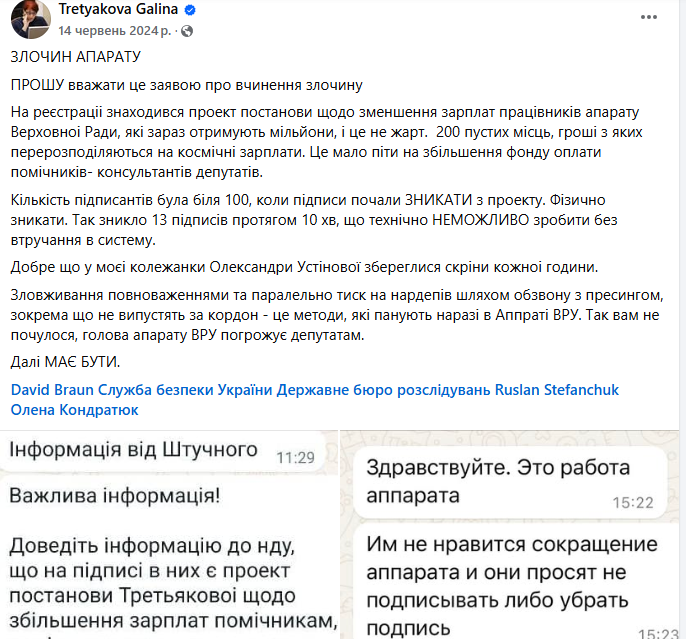
Screenshot from MP Tretyakova’s post in June 2024
While addressing the problem of unequal treatment of civil servants in different branches of government, we should not forget that we have not resolved the issue of low salaries in political positions for years.
It is unacceptable, when it comes to protecting state sovereignty and fighting corruption, to leave the salaries of MPs or the President at the current level. Salaries in political positions cannot be so drastically different from those in the civil service.
During the next elections, which will definitely take place after our victory, we must ensure decent working conditions in political positions in order to recruit a high-quality political elite that will change the state. The European integration course and the development of democracy do not allow for scoliosis in the branches of power. This is why reforms need to be fully implemented, rather than creating a system of “equals and those who are more equal.”
Specially for Dzerkalo Tyzhnia