
Reconstruction and corruption. What are the plans for agricultural land and who has them?

Today, the parliament will consider the controversial bill (9627), which under the guise of reconstruction and investment allows for new land schemes, but in reality, will only add problems for foreign investors.
A similar story was pushed last year by the Deputy Head of the Office of the President, former member of the Party of Regions, Rostyslav Shurma, but this plan failed in the session hall. In such cases, the approach on Bankova Street has always been the same: the bill is rewritten, and a lighter version is submitted to the council, so that necessary changes can be made before the second reading and an attempt can be made to gain support. That’s what’s happening now.
The public initiative “Holka” received information a week ago that the bill would be fast-tracked to the second reading. Since then, they have repeatedly contacted the main author, MP Dmytro Kysylevskyi (“Servant of the People”), to obtain the final text.
The link to the bill text on the website of the Verkhovna Rada was provided only on Friday around midnight, leaving essentially only 1 working day for review — Monday. But even in this short time, serious risks were identified. The initiative not only hinders Eurointegration processes but also is corruption-prone.

Any developer or investor would like to change the land use designation without additional problems with the community or local authorities. Despite European practice, the new initiative allows this to be done outside of settlements if there is no urban planning documentation. And this does not require land management projects. We are talking about the construction of industrial and agricultural enterprises.

Similar rules for the construction of industrial facilities already exist, but only for enterprises evacuated from the combat zone. And the term of these rules is until the end of the martial law. That is, the new bill does not address the urgent problem during the war. And these innovations will be in effect for another 5 years after its end.
The author of the bill, Dmytro Kysylevskyi, explains the problems he would like to address.

Firstly, the claims about the timeframes for changing the land use designation do not correspond to reality, as nobody knows how much time this procedure currently takes on average.
The reason is simple: over the past years, several deregulation reforms have been carried out to simplify this procedure (key laws — 711-IX and 1423-IX). The changes gradually came into effect until May 2022, and due to the full-scale Russian invasion, they have practically not been used in practice yet.
Moreover, the change of agricultural land use designation outside populated areas was completely blocked from July 2021 to June 2022, including with the support of the same MP, Dmytro Kysilevskyi.
One of the legislative initiatives prohibited the development of detailed territorial plans outside populated areas in the absence of comprehensive territorial development plans of territorial communities, and without these plans, changing the land use designation was impossible. Later, this issue was addressed by another law after the full-scale invasion (2254-IX). The development of detailed territorial plans was allowed in the absence of comprehensive plans.
So, the requirements for the detailed territorial plans themselves have also been fundamentally changed (No. 711-IX), and it has not yet been verified how these norms work.
In other words, changes to the legislation involving the same Kysilevskyi were already made, but they were so unsuccessful that they had to be corrected immediately by other legislative initiatives. And here arises the question: will the project 9627 achieve the stated results if there were already erroneous attempts and openly harmful miscalculations?
Secondly, Kysilevskyi’s claims about eliminating corruption in changing the land use designation contradict the content of this project.
The bill provides for changing the land use designation based on a “reasoned conclusion of the authorized body of urban planning and architecture of the rural, settlement, city council regarding the possibility of locating the relevant object on the land plot in accordance with the requirements of regulatory acts, construction norms, other regulatory documents, the mandatory application of which is established by law.”
However, there are no safeguards that would prevent issuing this conclusion only to “their” people or for a bribe. Therefore, corruption will not disappear — only the construction of a corrupt scheme will change, as the key body in the procedure remains the same, and it will decide manually whom to provide a conclusion of possibility and whom to provide a conclusion of impossibility.
In terms of corruption schemes, everything will indeed become possible to resolve very quickly, while without corruption, it may take years just to obtain the necessary conclusion through a court decision.

In addition to corruption risks, each project’s adoption must have a clear understanding: does it harm Eurointegration. This legislative initiative does harm. Essentially, it proposes to abandon compliance with the “Strategic Environmental Assessment Law,” which was enacted to comply with the corresponding Directive of the European Parliament and Council.
However, MP Kysilevskyi, who submitted this project in collaboration with Mariana Bezuhla, Artem Chornomorov, Oleksandr Haydu, and a number of other colleagues, disagrees with this.
In fact, all industrial and agricultural facilities have a negative impact on the environment. Ukraine, in fulfilling its obligations under the Aarhus Convention and other documents, has already adopted two key laws – on environmental impact assessment and strategic environmental assessment.
Environmental impact assessments are required for individual projects before construction, which exceed certain thresholds. However, firstly, in many cases, developers can circumvent this assessment as easily as they bypass requirements for tenders in public procurement – on paper, one large project is divided into several small-scale ones.
Secondly, a large number of small industrial facilities owned by different owners will harm the environment no less than one large facility, but they do not require an environmental impact assessment.
Strategic environmental assessment is conducted for comprehensive environmental impact assessment and is carried out during the development of urban planning documentation. Thus, by allowing a change in land use without urban planning documentation, strategic environmental assessment is simultaneously abolished, and public involvement in addressing environmental issues is excluded.
And this backward step in already fulfilled international commitments on the environment can have extremely negative consequences for Eurointegration.
Regarding the current procedure, similar rules have been in place since 2022 for the construction of industrial facilities, but only for enterprises evacuated from the combat zone and until the end of the state of war. That is, it concerns a real necessity in wartime conditions.
And the question arises: how should restrictions on land use, particularly sanitary protection zones for new enterprises, be entered into the State Land Cadastre if the bill provides for a change in land use without the development of urban planning documentation and land management projects?
This is how the key author of the bill explains it.
In fact, the draft law does not provide a mechanism for establishing sanitary protection zones and their inclusion in the State Land Cadastre.
However, such land use restrictions, according to the Land Code (Article 111), are effective from the moment of their state registration in the State Land Cadastre.
The draft law creates an extremely dangerous situation where pollution from new enterprises will exist, but there will be no restrictions on land use in pollution zones.
This concerns quite large territories, as the width of sanitary protection zones can reach 1000 meters and more. Thus, around the plant, there may be hundreds of hectares of land owned by others, the use of which should be restricted depending on the type of pollution. However, in practice, there will be no restrictions because de jure the restrictions will not exist. Do you like products with heavy metal salts and other equally harmful consequences of such deregulation?
There is another problem with the sanitary zones.
Confident businessmen who take advantage of the new “simplified” procedure for changing the designated purpose of land automatically become potential victims of both public protests and pressure from owners of adjacent land plots that fall into sanitary protection zones.
Starting construction quickly does not necessarily mean finishing it quickly.

The procedure for developing and publicly discussing urban planning documentation, which currently precedes the change of land use, was precisely a safeguard against such cases.
By eliminating the development of urban planning documentation and public involvement at the early stages of the project, legislators only increase the risks of halting the implementation of an investment project at later stages, when significant funds have been invested in its realization. This is not an improvement of the country’s economy and investment attractiveness, but rather a deterioration.

Agricultural land cannot be bought by either foreigners or our legal entities with foreign owners. Thus, a scheme is created for those who are aware of it and can take advantage of it, while foreigners will ultimately buy already expensive land after changing its purpose.
The author of the bill promises in official documents to attract both domestic and foreign investments. However, his bill reduces Ukraine’s attractiveness to foreign investors because it makes them uncompetitive compared to our own.
Ukrainian businesses get the opportunity to buy agricultural land for a pittance and quickly convert it into industrial land. Foreign investors, on the other hand, will only be able to buy land from Ukrainian intermediaries at a higher price.
To attract investments and quickly restore the country, we need to create not just favorable conditions exclusively for domestic businesses but competitive market conditions so that foreigners are also interested in investing in Ukraine.
Need investors? Create more technoparks where both domestic and foreign investors can obtain land for construction under equal competitive conditions.
Yet another important question: have calculations been made and is there existing economic justification for the increase in construction costs of state and regional level projects due to the necessity of alienating not cheap agricultural land, but land for industrial purposes, which is tens of times more expensive?
Kysylevsky claims that the bill is not about that: “It regulates situations where the ownership of a land plot changes its purpose.”
However, the problem lies precisely in the simplification of the procedure for changing the land use purpose. It is beneficial for the state to buy agricultural land from private owners for the construction of critical infrastructure objects – this will allow saving only on the purchase of land from hundreds of thousands to several million budget dollars for each object.
However, bill 9627 allows cheap private agricultural land plots to quickly be transformed into expensive industrial land. And those who influence the reconstruction process or have access to insider information can easily profit from selling land to the state at inflated prices.
Current legislation allows for the creation of safeguards against such schemes by establishing certain prohibitions in urban planning documentation and prohibiting changes in land use purposes contrary to or in the absence of urban planning documentation. However, bill 9627 removes these protective mechanisms.
But the list of problems does not end there. There may be banking scams where loans are taken out against land that has become artificially expensive due to a change in its purpose from agricultural to industrial.
Kisylevsky believes that this issue is also unrelated to the bill. However, this is not the case. Land has always been considered a liquid asset, so the scheme of providing loans secured by land with an inflated valuation to withdraw assets from banks has been and remains very popular among banking scams.
Bill 9627 creates almost ideal conditions for such scams because it allows for a very easy virtual increase in land value by tens of times. Why would someone use “junk securities” that are closely monitored by the National Bank when you can quickly and cheaply create “expensive” land?

Deputy Chairman of the “Servant of the People” faction Andriy Motovilovets also contributed to this legislative initiative and introduced a rather harmful amendment. By the way, it is Motovilovets who has influence over the agenda-setting process during the conciliation council, so it’s not surprising that the bill is being rushed to the session hall in such a turbo mode.
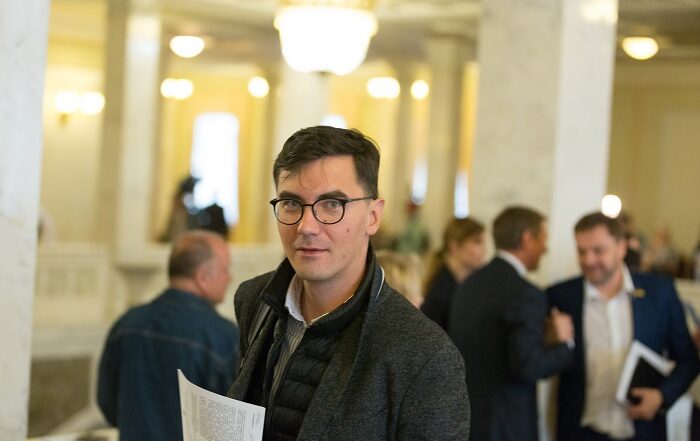
Photo: Rubryka. Deputy Chairman of the “Servant of the People” faction Andriy Motovilovets.
What is Motovilovets up to? He submitted an amendment that involves establishing retail facilities in the forest. It seems that the “reforms” in the forestry sector, which resulted in the creation of “Forests of Ukraine” supervised by the Deputy Head of the President’s Office Rostyslav Shurma, were not enough for someone in the President’s Office. If this bill is passed, recreational facilities can be installed in the forests without an auction. What are these facilities? Hotels, sports complexes, or entire hunting estates and reserves for wild animals. In other words, all the conditions for the authorities to create their own “Mezhyhiryas”.
Moreover, the scheme of dealing with land without auctions and competitions is not new. The leader of the “Servant of the People” party, Olena Shulyak, who submitted a bill on “sea ports”, had a similar idea with servitude, as in the urban planning reform.
By the way, when the National Agency on Corruption Prevention (NACP) analyzed this “reform” before the first reading, it pointed out the corrupt nature of such a mechanism. But it didn’t seem to notice this in the initiative regarding seaports, and now, it seems, it doesn’t see the risks when it comes to the bill that will be in the session hall today.
An equally interesting new initiative was added to the final version by the chairman of the relevant committee, Oleksandr Haydu: anti-corruption norms are being removed from Article 28 of the Land Code, which prohibits land surveyors from working in conditions of conflict of interest.
Moreover, these anti-corruption norms were added just two years ago as part of the previous land reform.
The civil sector and journalists should carefully monitor the roll-call vote on this bill to understand who supports corrupt rules for the reconstruction of Ukraine and poses a threat to European integration.
Specially for “Left Bank“.