
To protect green zones and cultural heritage, Kyiv residents use petitions, but city authorities do not always take them into account. This point is emphasized by Kyiv resident Mia Kyrylenko:
Top 5 land schemes used by the Kyiv City Council

Exactly five years ago, local elections took place, and Kyiv residents, like other communities, were supposed to re-elect the authorities of the capital. However, due to the war, parliament postponed the elections that were to be held on October 26. This means that residents of every city now face a challenge: how to control city authorities, since it is precisely before and after elections that a window of opportunity for change appears. Without elections, another window of opportunity opens up — for schemes.
When there are no elections, some of the remaining tools for citizens to exercise oversight over the authorities are the analysis of Kyiv City Council decisions and petitions, which can demonstrate protest sentiments and influence local politicians. However, the authorities do not always take petitions into account.
The civic initiative “Holka” analyzed Kyiv City Council decisions over five years of its term and identified the five most harmful schemes that, with the involvement of Vitali Klitschko and the parliamentary majority, caused damage to the capital. The most scandalous was the so-called “toilet scheme.” However, there are less well-known but no less harmful schemes — the “ghost buildings” scheme, the scheme of “complicity in the sins of predecessors,” and the scheme of “expanding” land plots. There is also the classic and long-known scheme involving detailed development plans, which is used to bypass the city’s Master Plan — this is how land grabbing begins.

Although the “toilet scheme” is a classic, it only drew public attention this year. This happened after Bihus.info journalists released the “Komarnytskyi tapes.” Komarnytskyi is a former Kyiv City Council deputy from Leonid Chernovetskyi’s team, accused of land fraud.
Ukrainians learned about the toilet scheme through NABU’s special operation “Clean City,” which exposed the cynicism of the capital’s authorities. The scheme works very simply: a small structure stands on a plot – a so-called “summer toilet” or “doghouse” – and this gives the right to claim a disproportionately large piece of land. No auction is required, and the city loses the opportunity to earn from the sale and fill its budget during the war.
When the public learned about the deals in Komarnytskyi’s developer office, protests began outside the Kyiv City State Administration, demanding that the local authorities purge officials involved in the toilet schemes.
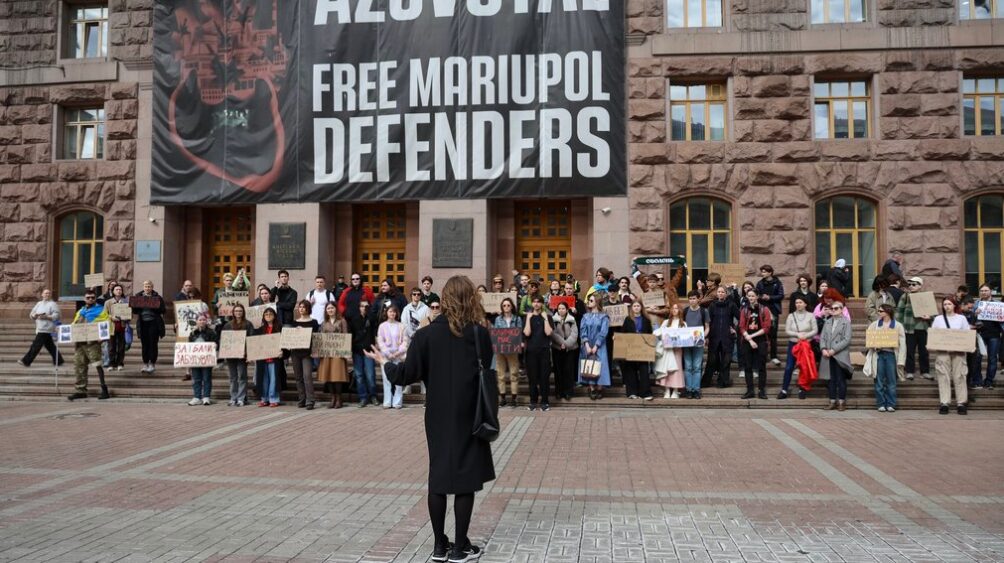
The “Clean Thursday” protest in April 2025 outside the Kyiv City State Administration. Photo: Suspilne
Investigative journalists reported that the search for suitable plots was overseen at the time by Klychko’s deputy, Petro Olenych, and the head of the land commission, UDAR deputy Mykhailo Terentyev. The plots had to be in locations attractive to developers, near metro stations. Using this scheme, the group illegally seized six plots: near the “Kontraktova Ploshcha” metro station, in Troyeshchyna, in Nyvky, near Holosiivskyi Park, and two near the “Zhytomyrska” metro station. Another plot near the “Beresteiska” metro station, acquired through the same scheme, was used to build a shopping center despite resistance from nearby residents.

If the “toilet scheme” requires at least a toilet or a doghouse to be present on a plot of land, developers who are desperate to obtain prime land in the capital have come up with a scheme for cases where there is absolutely nothing on the plot. This is the so-called “ghost buildings” scheme.
When developers spotted lucrative plots, something that had never existed would appear there on paper — some kind of structure. A know-how of the current convocation is the mass inventory of land, during which, among dozens or even hundreds of plots in each decision, templates for the “toilet scheme” are hidden. The Kyiv City Council has adopted more than 170 such decisions. In this case, it is even difficult to accuse the parliamentary majority of voting consciously. Even civic activists in the capital did not notice this scheme until the NABU investigation “Clean City.”
These dealings can be traced in the case of the shopping mall owned by the company “Zhensan,” which is linked to Vagif Aliyev. Although the company received the land plot for the shopping mall back during Omelchenko’s tenure, the business decided to expand at the expense of neighboring plots, where, allegedly, something had already existed.
If deputies had looked at satellite images before voting, they would have seen that there were no buildings there — only an excavation pit and a destroyed part of Kyoto Park.
However, sometimes such schemes are exposed. This happens when a developer fails to restrain their appetite and encroaches on a plot that is very large in area. This was the case with a plot in the Pechersk district, where documents claimed there was a public building of 193 square meters. But de facto it was… a small storage room for janitors’ equipment.
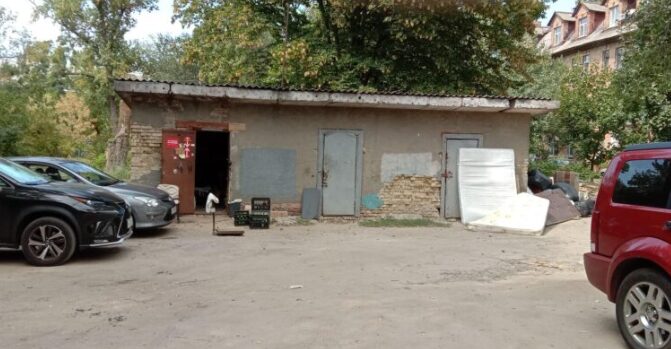
A building in the courtyards at 6D Kateryny Bilokur Street
The scheme was exposed, and the vote in this specific case did not take place.

For the city authorities, the “predecessors’ scheme” is the most convenient. Deputies can always claim it’s not their fault, creating a situation where “the government sighs and shrugs.”
However, Kyiv authorities always have a choice: whether to extend a lease or not. In practice, leases are usually extended. This scheme affected the Museum of Outstanding Ukrainians, the Literary Square (defended by Lina Kostenko, Ada Rohovtseva, and Ivan Malkovych), the Kytaiv tract, the Holosiivska Tower, and several other sites protected by Kyiv residents.
The issue of preserving the Museum of Outstanding Ukrainians has been particularly urgent in recent years. This heritage was left to us by the Frankos, Lysenko, Kosachs, Starytskis, and Tobilevyches. A hotel is being planned right next to the building, which could damage the museum. Several times, Kyiv City Council sessions raised the question of not renewing the lease with Restin LLC, but initially, the voting was sabotaged by Servant of the People deputies, and later by European Solidarity. Notably, UDAR deputies voted in favor. In this case, the prosecution reached the Supreme Court’s Grand Chamber and ultimately won.

Mia Kyrylenko
She is protecting the Kytaiv tract in Kyiv.
We initiated a petition and gathered a record number of votes for 2024, but it did not help block the decision, and the lease for several plots was still extended. This is despite the fact that there were all the grounds to terminate the lease—the developer did not have the proper documents. The land is still classified as agricultural, where high-rise construction is not allowed. The current composition of the Kyiv City Council had the opportunity to properly resolve the Kytaiv case by not renewing the controversial leases, as the public petition demanded. Instead, the lessee received a “suitcase without a handle,” and court proceedings to return part of the land to state ownership are still ongoing.

Another scheme is called “plot accumulation.” In this case, a developer may already legally own a plot for construction, but cannot fully realize their plans because the area is insufficient. The developer then approaches the city council and requests an adjacent plot, often claiming it is needed for “supporting infrastructure.” The Land Code allows this without problems, and crucially, no auction is required. This means the city does not put the land up for public bidding and receives no revenue from it.
Victims of this scheme included two plots in Kyoto Park in the Desnianskyi district, which were transferred to the company “Zhensan.” Sometimes even the National Agency for Corruption Prevention (NACP), which is supposed to combat corruption, becomes involved. Under the plot accumulation scheme, NACP received a plot on Mykhnovsky Boulevard, which included not only a parking lot but also a green area.
If NACP overlooks such transactions in the Kyiv City Council, this could explain why these practices persist.
For example, under this scheme, a plot near Pryrichna Street, close to the Dog Mouth (Sobache Hylo) spit on the Dnipro River, was given for building a parking lot. Locals call it the “aqua-parking” because the area floods during high water. Citizens’ petitions, as in the case of the Kytaiv tract, were ignored by the authorities.

Another scheme – using detailed territorial plans instead of the Master Plan. Currently, this has become a universal tool that allows authorities and developers to bypass the law and public oversight. It legalizes old schemes and enables the creation of new ones.
For example, the “Voskresensky” detailed plan legalized the Freedom residential complex, which was originally started by “Ukrbud” under Maksym Mykytas and later completed by Kyivmiskbud. In the Darnytskyi district, a detailed territorial plan legalized the “Lebedynyi” residential complex by Perfect Group, associated with MP Dmytro Isaienko, who was elected from the banned OPZZh party and promoted a controversial urban development reform.
Regarding the Lybidska area, this scheme legalized the construction of the second phase of the Ocean Plaza mall in the protected zone of the “Flying Saucer,” the A136 Highlight Tower high-rise residential complex by the DIM group in partnership with Denys Komarnytskyi, and several other projects.
This list of Kyiv City Council schemes is not exhaustive. That is why every session of the local council must be closely monitored by residents. Citizens have already learned to quickly mobilize votes through petitions to hold authorities accountable.
By the way, this petition to rename a street in honor of the fallen Dmytro Kotsiubailo (call sign “Da Vinci”) topped the list of the ten fastest petitions to collect the required number of votes in 2023. It was submitted by an Honored Citizen of Kyiv and Hero of Ukraine, Ada Rohovtseva.
Serhii Kostiantchuk, co-author of the “Kyieve Mii” project by the civic initiative “Holka” and founder of the public association Museum of Outstanding Kyivans, notes that two years ago Turgenev Street was renamed in honor of former Kyiv City Council deputy Oleksandr Konyskyi:

Serhii Kostianchuk
co-author of the “Kyieve Mii” project
Hardly anyone remembers that the author of the “Prayer for Ukraine” was a Kyiv City Council deputy. As early as 1885, he wrote “God, Great and Only, protect Ukraine for us” – meaning he advocated for Ukraine’s distinctiveness more than a century ago. We can also recall Kyiv City Council deputy Mosiyuk, who in 1990, even before independence was declared, was assertive enough to raise the blue-and-yellow flag over Kyiv against the central authorities’ will, disrupt a military parade on Khreshchatyk, and ukrainianize the capital’s education…
And the deputies representing Kyiv residents today during the war should be aware of their responsibility in this historic moment. Each of them should reflect on how to become an outstanding citizen of Kyiv, so that centuries from now, the community would demand that a street be named in their honor.
And the deputies representing Kyiv residents today during the war should be aware of their responsibility in this historic moment. Each of them should reflect on how to become an outstanding citizen of Kyiv, so that centuries from now, the community would demand that a street be named in their honor.
The public initiative “Holka,” with the support of the European Endowment for Democracy, is implementing the project “Active Citizens Network,” which brings together defenders of green zones, cultural heritage, and archaeology from across Ukraine.
Especially for “Glavkom”


