
“Temnyky at Ukrinform”: How Could Matsuka Be a Member of the Commission on Journalistic Ethics?

After the scandal with the ‘temnyky ‘(сensorship directives for media from authorities) at Ukrinform, a very simple question arises. How could the CEO of Ukrinform, Oleksiy Matsuka, who is now accused of censorship, be a member of the Commission on Journalistic Ethics? And he is still listed there on the website.
I’ve had questions about the work of the Commission on Journalistic Ethics for a long time, even before the scandal with Oleksiy Matsuka and the ‘temniks’ erupted.
The thing is, at the end of 2022, this commission issued me a ‘friendly warning’ and suggested limiting access to my blog on the ‘Ukrainska Pravda’ website, which concerned the activities of my constituency’s Member of Parliament, Oleksandr Horbatyuk (‘Servant of the People’). I found out about the ‘warning’ from a post by the former mayor of Irpin, Volodymyr Karplyuk, who is mentioned in a number of journalistic anti-corruption investigations.
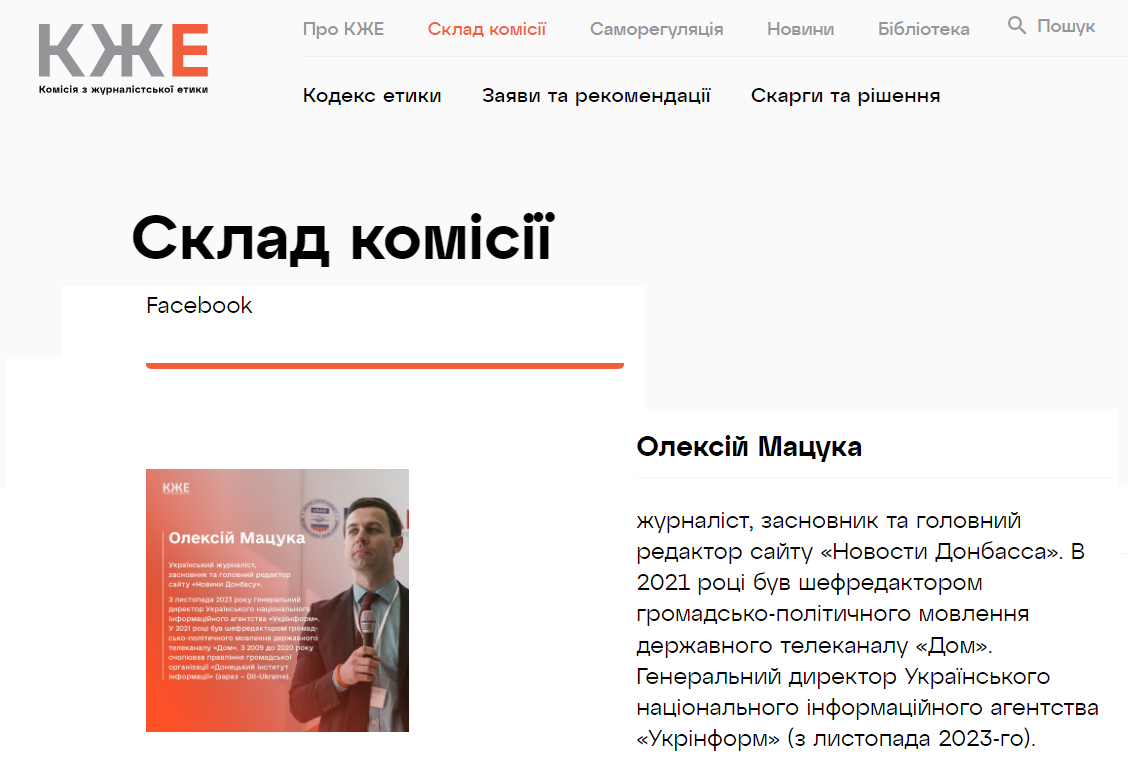
Screenshot from the website of the Commission on Journalistic Ethics for May 30, 2024
How did it happen that Karplyuk learned about the commission’s decision before the journalist, whom they ‘judged,’ that is, me? How was the communication with the applicant Horobets, who interacts with Karplyuk and his team, conducted?
For those who have forgotten, I remind you that at the end of 2022, the enemy targeted our infrastructure objects and there were blackouts. But the Commission on Journalistic Ethics still promptly considers a strange appeal from the representative of the mono-majority in such difficult conditions. It’s about priorities.
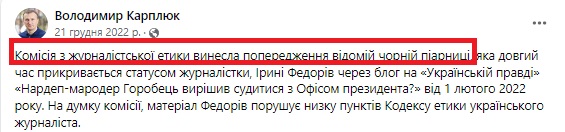
Screenshot. Post by the former mayor of Irpin, Karplyuk, dated December 21, 2022.
For the post where I was called a black PR agent by the Commission on Journalistic Ethics…, thanked. It’s also about standards.
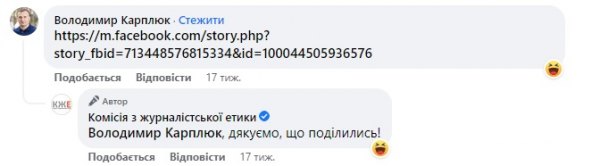
Screenshot. Comments by Karplyuk and the Commission on Journalistic Ethics on the Commission’s Facebook page.
After the decision of the Commission on Journalistic Ethics was announced, news emerged that I had received a friendly warning, but no one ever contacted me, and no one inquired about my position. It turns out that the Commission on Journalistic Ethics quietly accommodates the demands of controversial politicians, news about which then surfaces, while your opinion is never even asked for. This also raises questions about standards.
I sent a series of letters to the Commission, asking them to provide me with their operating rules. I was particularly interested in how the Commission should inform the subject of a complaint about the time and place of its consideration. The response was silence. Similarly, I asked for the results of the voting to be provided by name. I never received them. It’s very strange to see this considering that journalists demand accountability from government bodies for their decisions and monitor roll-call votes. And we’re not just talking about journalists here. We’re talking about those who have decided to establish rules and call themselves a self-regulatory body.
I emphasized to the Commission on Journalistic Ethics that I act as a voter in the 95th district (where the interests of voters are represented by MP Horobets), and my blog on “Ukrainska Pravda” was opened to me as a deputy of the Kotsubynske village council because I promised to inform everyone about the fight to preserve the Bilichansk Forest. But no one took that into account.
Furthermore, the Commission on Journalistic Ethics believes that its conclusions cannot be used in court because it is a body that resolves disputes in an extrajudicial manner. Well, that’s their decision. But those who use the services of the Commission and receive the necessary conclusions then use them as they see fit. Including in courts.
Therefore, the decision of the Commission to issue a ‘friendly warning’ against me was added to MP Oleksandr Horobets’s lawsuit against me. Former Mayor of Irpin Volodymyr Karplyuk also mentions this decision in his lawsuit against me. So, the Commission on Journalistic Ethics has become a tool in the hands of scandalous developers who want to destroy the Bilichansk Forest.
Of course, I didn’t expect the Commission on Journalistic Ethics to somehow inform the Irpin court about its position and rules in the lawsuit filed by MP Horobets against me.
And now the question arises, which requires much deeper reflection than just the story with ‘Ukrinform’ and the temniks.
It turns out that someone in the media community is trying to establish some rules and boundaries. But at the same time, they are not willing to adhere to transparency criteria (informing about meetings, providing roll-call votes, informing about their position in court).
And all this undermines the trust of citizens, including colleagues in the sector.
Our problems are not only in the media sector but also in the civil sector. When you see that someone came up with a rating of reformers for 2023, and it was topped by the MP of my district, Oleksandr Horobets, then you also wonder: how did they come up with such a methodology that Horobets, who has nowhere to put a shovel, became the reformer of the year?
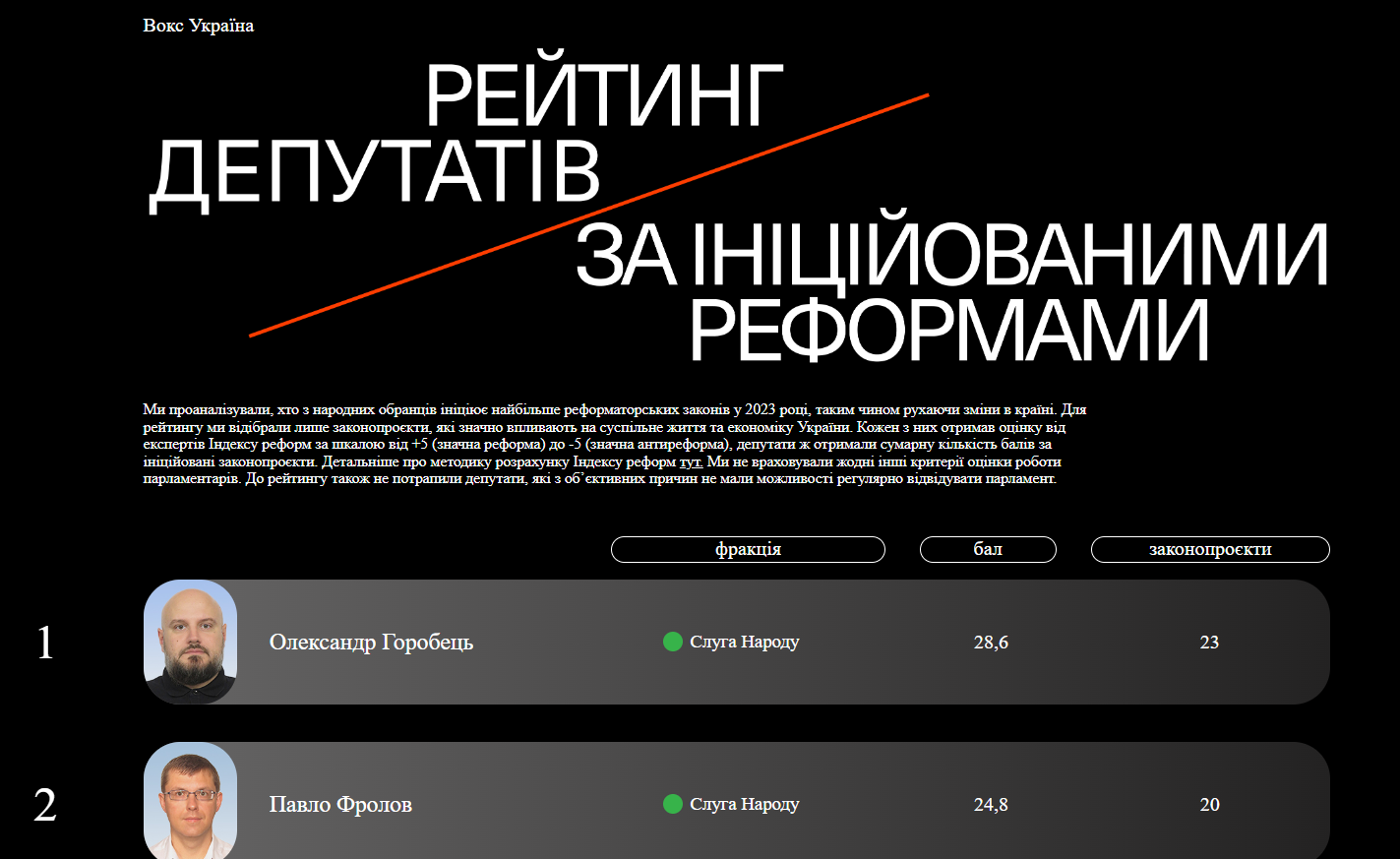
Screenshot from the Vox Ukraine website, which presented the ranking of reformist deputies.
There are also questions about the so-called “white lists” rankings of the media. Readers question why violations of standards in some media are “strictly punished,” while similar violations in other media are overlooked. Society and grant donors are right to question the trustworthiness of such lists, as well as the ranking of MPs – “reformers.”
The issue of methodology and rankings is also something that both the media sector and the public sector need to work on responsibly.
Because it is not only the media and the public sector that can ask politicians why they act in a certain way. Society, too, can and should ask this question of both the media and public organizations that take on the mission of self-regulation and mentoring. Because self-regulation sometimes does not work as it should.
Specially for “Glavcom”