
Judgment day: Will the community succeed in protecting the lake and drinking water in Zhytomyr region?

The company “Dolomine” plans to extract the useful mineral dolomite near the lake and our homes in Zhytomyr region (Negrebivka). The distance from the future quarry to the village border is 230 meters.
If allowed, not only the incredibly beautiful lake and forest will disappear but people will also lose drinking water and access to recreation areas. The state will lose a large reserve of high-quality underground water, as we wrote in the “Economic Truth”. But that’s not all.
“Annual radiation control” – that’s what they write in the special permit of the mining company. This means that it should be regularly conducted to understand the extent of the impact on the environment and people. Therefore, those who live nearby are against it.
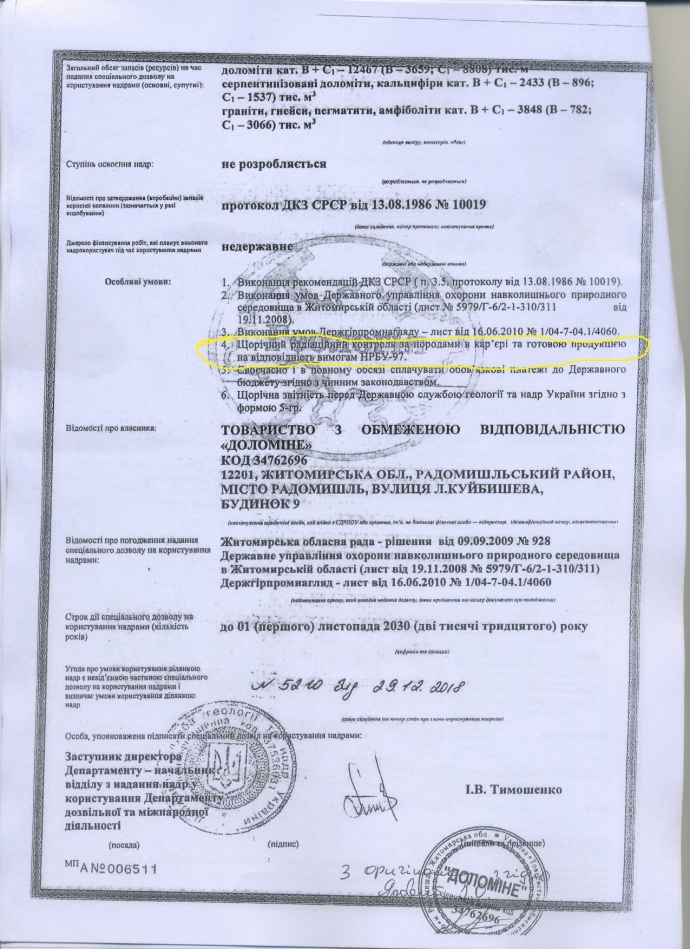
Special permit of LLC “Dolomine”
The activities of this enterprise can affect not only the territory of the Zhytomyr region but also that of the Kyiv region, which is less than 15 km away. And the residents of these regions are well aware of the effects of radiation following the Chernobyl nuclear power plant explosion. Local residents claim that the quarry was once closed because uranium was found, and they compare previously heard information with official documents.
Why annual radiation monitoring is needed is currently unclear, and these are the questions that both the company and the authorities should explain to the community.

Colleague Testov, biologist Yegor Grynnyk explains that EU practices and legislation require not only calculating profits from extraction:
“There must be a comprehensive environmental impact assessment. And access to drinking water, forests, recreation, and community interests are all no less, and even more important than the interests of a single private company. Unfortunately, officials often ignore European approaches.”
A month ago, the deputies of the Radomyshl Council considered the issue of leasing a land plot to the company “Dolomine”. Thanks to the active position of the community, the issue was removed from the agenda because it is important for everyone to first see and study the environmental impact assessment. It is this assessment that should provide an understanding of how the company’s plans could affect the quality of life of the community.
The Radomyshl City Council voices the community’s position, insisting on the legal sequence of actions: first prove the safety of the company’s activities for the community, and then consider land issues.
Instead, the “Dolomine” company first tries to take the land.
And since this was not successful at the local level, the miner went to court. They do not want to conduct an environmental impact assessment. “The Radomyshl City Council violated the requirements of Articles 123 and 124-1 of the Land Code of Ukraine, since the documentation regarding the environmental impact assessment is not included in the list of documents provided for in Articles 123 and 124-1,” it is noted in the lawsuit filed by LLC “Dolomine”.
The defendants are the Radomyshl City Council, the State Geological and Subsoil Survey, and the Ministry of Justice.
The lawsuit concerns several land plots. One of them is 7.5 hectares, essentially the territory of the lake, where there was previously a quarry. In Soviet times, they wanted to extract this valuable mineral here, but they hit a powerful aquifer, and as a result, the water quickly flooded this quarry. They tried to pump it out, but it was beyond their capability. Thus, this reservoir was formed, which is now a beautiful recreation area for residents of Zhytomyr and Kyiv regions.
As for another 40 hectares, these are several plots without cadastral numbers located around the lake. The “Dolomine” company wants an easement on this land. (An easement is the right to use someone else’s property when it is impossible to exercise the rights of the owner in any other way).
Here’s what LLC “Dolomine” stated in its lawsuit:
“To establish a temporary land easement as of November 1, 2030 (for the duration of the Special Permit). The purpose of establishing the land easement is for the extraction of dolomites, serpentinized dolomites and calciphyres, granites, gneisses, pegmatites, amphibolites,” the text reads.
During the court hearing, the representative of the Ministry of Justice emphasized:
“I have a question for the plaintiff: How do you envision the execution of the decision in case it is satisfied by the court when you want an easement, while asking not to register it? What requirements do you have for the Ministry of Justice?”
Community representatives decided to intervene in the case as a third party – to monitor the situation, with their own lawyers.
But how else can the community protect its right to a safe environment? If we look at the practice of the Grand Chamber of the Supreme Court, which should be taken into account by the courts of Ukraine when considering cases, it stands in defense of people’s right to access to water resources.
Indeed, the Grand Chamber considered a case regarding ex-regional Yuri Miroshnichenko, who decided to build on the shores of the Blue Lake. In an attempt to legalize construction on the shore of the reservoir, the documents stated “artificially created quarry”. This was an attempt to circumvent the prohibition of building within a 100-meter zone from water bodies.
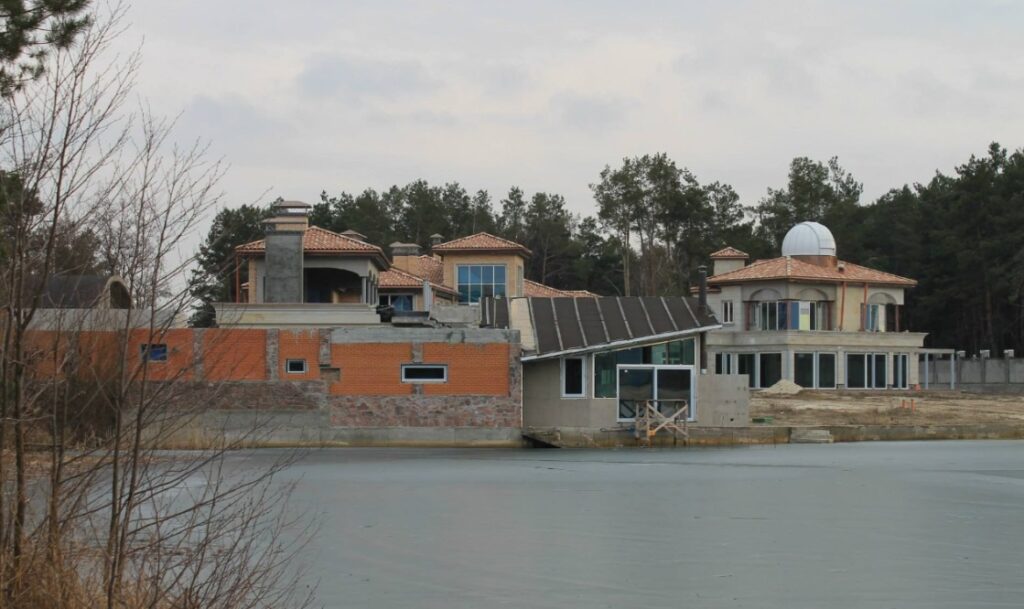
Photo: Construction on the shores of the Blue Lake by ex-regional Yuri Miroshnichenko Source: TSN.ua
In its decision, the Grand Chamber emphasized:
“The lands occupied by surface waters, natural water bodies (lakes), watercourses (rivers, streams), artificial water bodies (reservoirs, ponds), canals, and other water bodies, as well as the lands of coastal protective strips, are the lands of the water fund of Ukraine, to which a separate procedure for granting and use applies. The court of first instance… did not properly evaluate the evidence submitted by the parties, although one of the grounds for the claim was a reference to the fact that these land plots have beaches and are in close proximity to the water depletion of the ‘Blue Lake’.”
Thus, it doesn’t matter whether it’s an artificial reservoir or natural rivers and lakes—it’s all part of the country’s water fund. This means there are special conditions for its use.
Albina Nikonenko, the head of the initiative group of the Rakovitsky township, addressing the involvement in the case as a third party, noted:
“The commencement of dolomite mining operations will be impossible without dewatering works, which will inevitably lead to the depletion of the Negrebivsky aquifer, as confirmed by relevant documents.”
To this, the representative of “Dolomine,” Tetiana Lysytsia, responded:
“At the moment, there is no activity regarding deterioration or any impact on the water used directly by the residents of territorial communities. Right now, we are talking about assumptions. We cannot talk about assumptions and about your possible right, which will arise for filing a lawsuit. If it arises, there will be grounds for such a lawsuit. I want to note separately that an individual can be involved in commercial court proceedings in certain cases. In the motion, I didn’t hear a reference to the provision of the Economic Code that would allow involving this individual as a participant.”
Interestingly, the Radomyshl City Council requested that the extractor provide a complete copy of the working project and the mining-technical recultivation of the deposit. Then it would be clear what works the company plans and what consequences it will lead to. But the judge emphasized:
“You haven’t taken any steps to obtain these documents on your own. I deny this motion.”
At the same time, the company’s representative, Hlib Kravtsov, noted:
“The list of documents requested by the respondent is not provided for by Articles 123, 124 of the Land Code of Ukraine, it is not related to the case, and it is not established what evidence can be established by these documents. They constitute the financial and commercial secrets of the enterprise.”
So, finding out what the community will actually face is impossible because neither the environmental impact assessment nor the working documents of “Dolomine” are publicly available.
On January 29, during the hearing, Judge Anton Pukas decided that representatives of the community would not be involved as a third party:
“Involving you (Albina Nikonenko — ed.) as an individual will set a precedent where I have to involve 25 thousand people (note: 25,000 people live in the Radomyshl OTG). I won’t do that.”
It should be emphasized that in judicial practice, it is quite normal to involve representatives of the community as a third party in the case. For example, in the case of protecting the Bilichansky Forest in Kyiv, Oleksandr Dyadyuk was involved. This is despite the fact that Kyiv is a million-strong city.
On February 19, the case will be considered on its merits. It’s a case about land and people living nearby. And there’s no understanding of the consequences.
Specially for “Economichna Pravda“


