
Regulating Telegram and other social networks: what do MPs propose?

A bill has been registered in parliament that could affect the operation of Telegram, Viber, Facebook, and other social networks (11115).
This bill was introduced by Mykola Knyazhytskyi (European Solidarity), and among the co-authors of the bill are the chairman of the committee on legal and information policy, Mykyta Poturayev (Servant of the People), and the chairman of the committee on freedom of speech, Yaroslav Yurchyshyn (Voice). Therefore, this legislative initiative may initially receive support from these two profile committees. However, MPs note that it still needs to undergo expert discussions before it is considered by the main committee on legal and information policy.
The main author of the project, Mykola Knyazhytskyi, says that his initiative has already been dubbed in social networks as the “law on banning Telegram.” He explains that it applies to all social networks that disseminate information as media.

The MP emphasizes that after registering the project, anonymous Telegram channels began a smear campaign against him personally and against the bill. He adds that the head of the Main Intelligence Directorate, Kyrylo Budanov, also points out that we need to regulate Telegram specifically in the context of national security.
“We are not restricting freedom of speech; the project complies with European standards,” Knyazhitsky concludes.
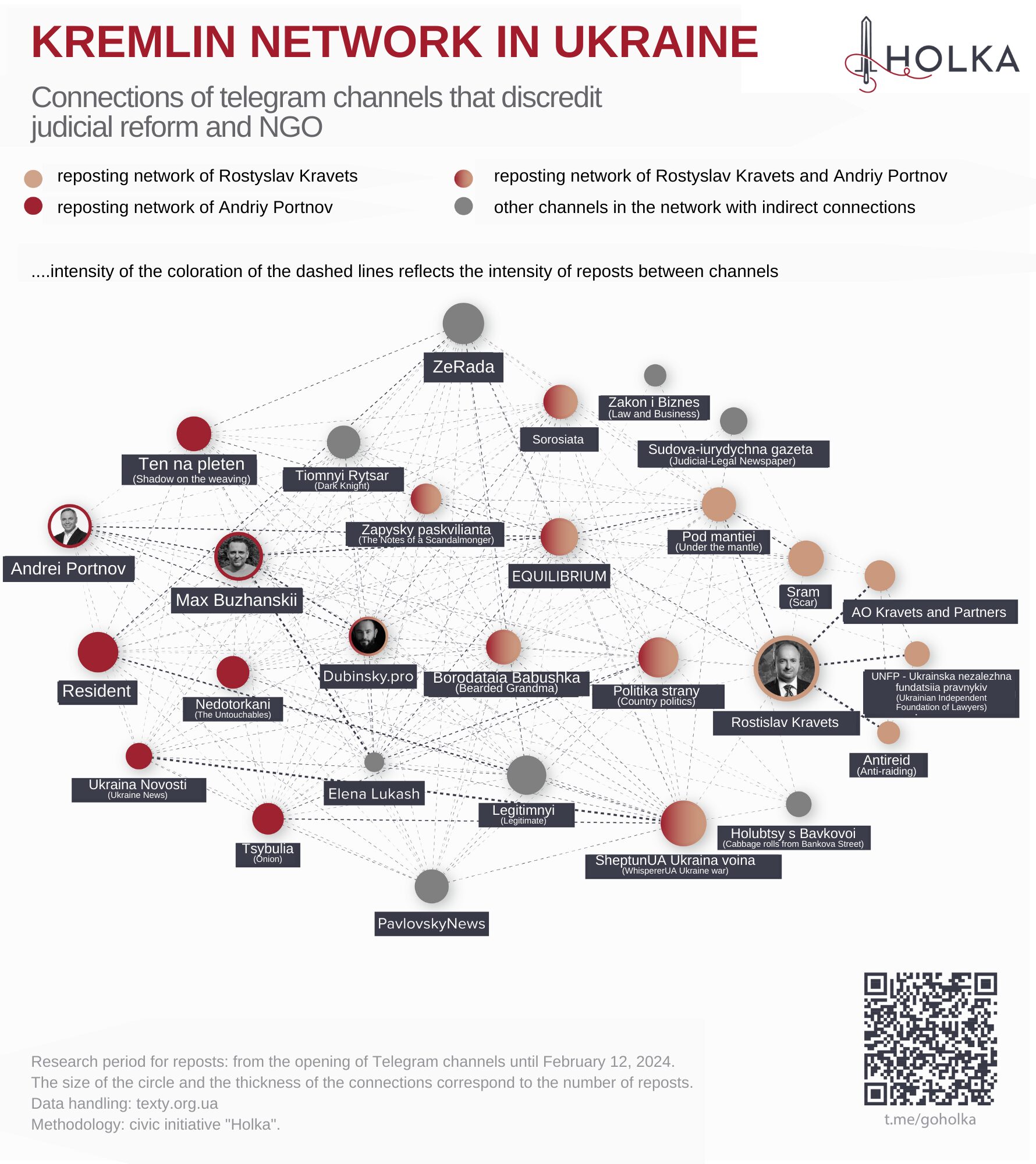
As for national security, in February, the public initiative “Holka” investigated Telegram channels and identified a “Kremlin network” that discredits judicial reform, honest judges, and representatives of the civil sector who monitor the conduct of judicial reform.
Chairman of the Committee on Freedom of Speech Yurchyshyn emphasizes that the lack of media status in social networks like Telegram is a huge “black” advertising market.

The bill introduced to the Verkhovna Rada partially reflects the provisions of the Digital Services Act, which is legislation of the European Union that applies equally to all member states.
Yurchyshyn emphasizes that if networks exert significant informational influence, they must open representations and disclose ownership. Otherwise, they are considered non-transparent, and the state restricts their use by government bodies and representatives.
At the legislative level, MPs propose to introduce the following definition: “information sharing platform, through which mass information is disseminated – a platform through which accounts (pages, channels, etc.) of users are created and operate, through which mass information is disseminated.”
They also propose to add providers of information sharing platforms, through which mass information is disseminated, to the subjects in the media sector. And most of the bill is dedicated to requirements for these providers. The Media Institute has already covered this in detail.
If the Verkhovna Rada supports this bill, providers will be obliged to disclose contact information for users, thus eliminating the anonymity currently used by many Telegram channels. They will be required to respond to requests from the responsible regulatory authority and restrict the dissemination of content that harms national security, incites hatred, hostility, or cruelty towards individuals or groups based on ethnic or social origin, etc. These are all the requirements that traditional media currently have to comply with.
The co-author of the bill and the chairman of the relevant committee tasked with considering this initiative, Mykyta Poturayev, notes that there is currently a discussion about which body will be the regulator in Ukraine – the National Council, as proposed by Knyazhitsky, or the National Commission, which regulates state regulation in the electronic communications sphere, as proposed by some other MPs.

As for Telegram and the use of other social networks for hostile disinformation, expert discussions in the media community on this issue have been ongoing for a long time.
Konstantin Kvurt, Chairman of the Board of Internews-Ukraine, when it comes to Telegram, founded by Russian Pavel Durov, emphasizes that in conditions of existential warfare, the discussion should not only focus on the preservation of personal data, regulation of the advertising market, and piracy.

Especially for “Espresso“