Gossip and scandals on social networks. What other information should the “Servants of the People” collect across Ukraine?


In early March, the “Servant of the People” party cells across the country were directed to fill out special spreadsheets with information. This was reported to the public initiative “Holka” by sources within the ruling party.
“What kind of information is being collected? It’s a mix between information needed for political passports (made before elections) and reports on the activities of the cells (conducted during the inter-election period), spiced up with some quite odd requirements. Typically, the stir in the electoral field is not caused by the onset of spring but by election preparations. Or perhaps, someone from the top of the party suddenly needs to showcase themselves and their activities. At the end of autumn, we wrote about how telegrams from the presidential vertical were sent out in the Kyiv region demanding the preparation of political passports. But in the fall, this phenomenon only covered a few districts. At least, we had no other confirmations then — sources were afraid to speak out because the instructions were coming through the Office of the President’s vertical. Now, it’s a nationwide trend among the “Servant of the People” cells. Currently, some of the data collection requirements among the “Servants” are astonishing. There’s a separate category for “Gossip and scandals” on social networks. It’s interesting how they plan to construct the media field based on rumors or how they will react to them during the development of crisis communication strategies… And there’s another column in the table: “distribution of campaign materials”… What kind of campaigning is distributed when there are no elections? If compared with data collection in “European Solidarity,” there, too, work is being done — information is collected and systematized, but on a continuous basis, and it pertains to the work of cells and deputies in the regions. This is how classic monitoring of the activities of their party members in the inter-election period happens. We remain to wait and see what the ruling party will do with the information collected according to these parameters,” explains Irina Fedoriv, head of the public initiative “Holka.”
Regarding how political passports are formed in the regions, “Holka” prepared a separate material for the International Republican Institute (IRI).

Political passports are documents usually created by the campaign headquarters of political parties or candidates for planning an electoral campaign.
These include the comprehensive collection of data about all players on the political field and the voters. Regarding the players, political passports contain information about the loyalty of heads of localities to the government, the distribution of forces in local councils (who represents the majority and who is in opposition), potential government and opposition candidates in elections. They may also include information about opinion leaders who influence the informational field of a certain territory, results of sociological surveys, etc.
There have been instances where the central government in Ukraine formed political passports with the help of regional state administrations. Using administrative resources is a violation of the law, as this does not correspond to the functions these bodies should perform (note that using voter lists to form a political passport is also an abuse).
Thus, in 2023, representatives of the public initiative “Holka” recorded a telegram and official letters requesting local councils to provide information by filling out tables with data.
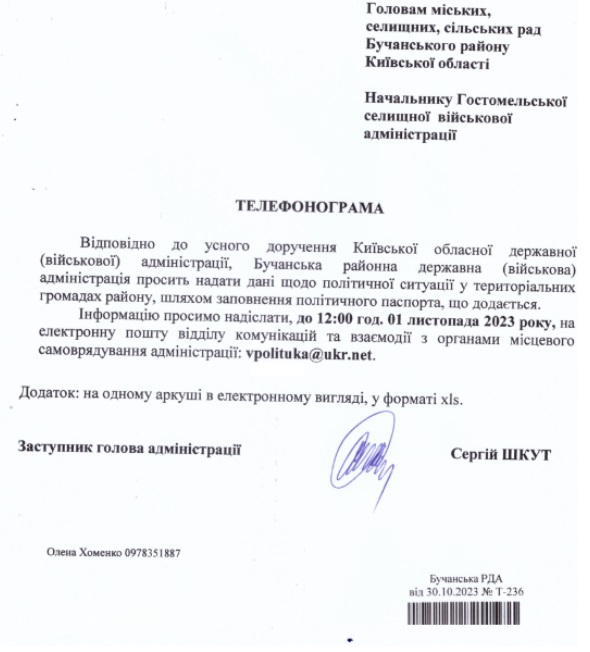
Letter from the Deputy Head of the Bucha District State (Military) Administration to Local Self-Government Authorities, 2023
As an attachment to such letters were tables, which, by the way, give an idea of what a community’s political passport might look like and what information it can contain. You can view which specific tables the presidential vertical sent out for passport formation and what data were collected via the link.
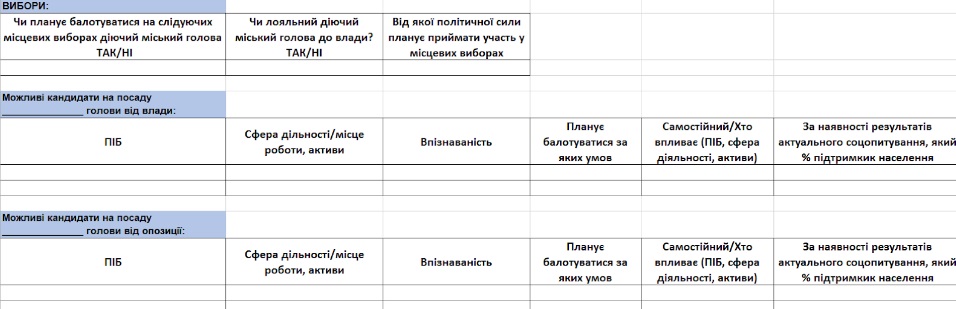
Screenshot of the table sent as an attachment to requests from regional administrations in 2023
Speaking publicly about instances of abuse of administrative resources by political opponents is essential, especially considering that the ruling party, like any parliamentary party, receives state funding. It should utilize this funding for party development.
Information about players in the political arena can be obtained from the Central Election Commission (CEC) website. It’s essential to pay attention not only to the results of the latest elections but also to review and analyze data from previous elections. Additional information can be obtained from the websites of leading civil society organizations that monitor candidates and the electoral process during elections.
However, one source of information about political players in the constituency for forming a political passport is insufficient. It’s necessary to understand the financial resources of political opponents.
Of course, every political party has official and unofficial budgets. Information about unofficial budgets can be obtained if there are verified sources that provide information.
As for official budgets, the amount of money received by parties into their accounts and how they spend it can be viewed on the National Agency for Prevention of Corruption (NAPC) website. There is a separate register called “POLITDATA” where you can view the reports of parties. It’s also worth noting that there are several civil society organizations and media outlets that systematically monitor the income and expenses of parties, and their investigation results can also be used, as well as reports from candidates on the income and expenses of their election funds, which should be posted on the CEC website.
However, financial resources are not the only thing parties and candidates should have during the campaign. One of the key resources that can replace or supplement financial resources is the time of people who can be loyal to the candidate and the party and participate in the campaign. Every party and politician must work on attracting supporters to their team.
As for voters, it is essential to understand how many of them are in the constituency, what they do, and what their interests are.
Creating or updating existing passports usually occurs just before elections because in six months, the information may become so outdated that it will be impossible to build an effective campaign strategy.
Therefore, political passports should include the results of the latest sociological surveys. And it doesn’t necessarily have to be surveys conducted by the party’s or candidate’s headquarters because such surveys usually require significant funds. Data from publicly available opinion polls can be used. For example, such surveys with subsequent publication of information are commissioned by the International Republican Institute (IRI).
Therefore, to update political passports, we recommend monitoring the results of new sociological surveys, which may be published on the websites of “Rating,” the Kyiv International Institute of Sociology, or the Razumkov Center.
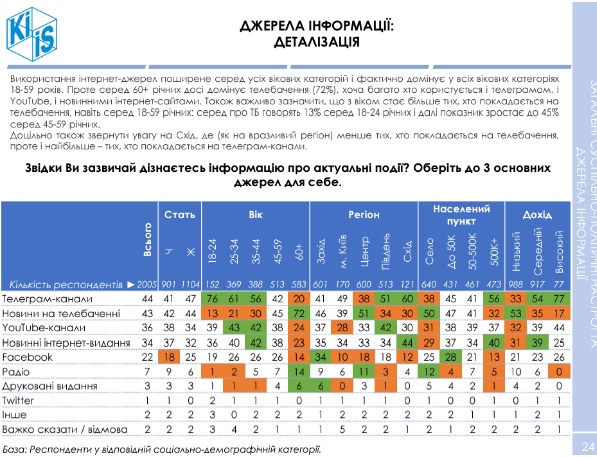
In particular, when planning media strategy and campaigning, it’s essential to consider information about what sources of information voters use.
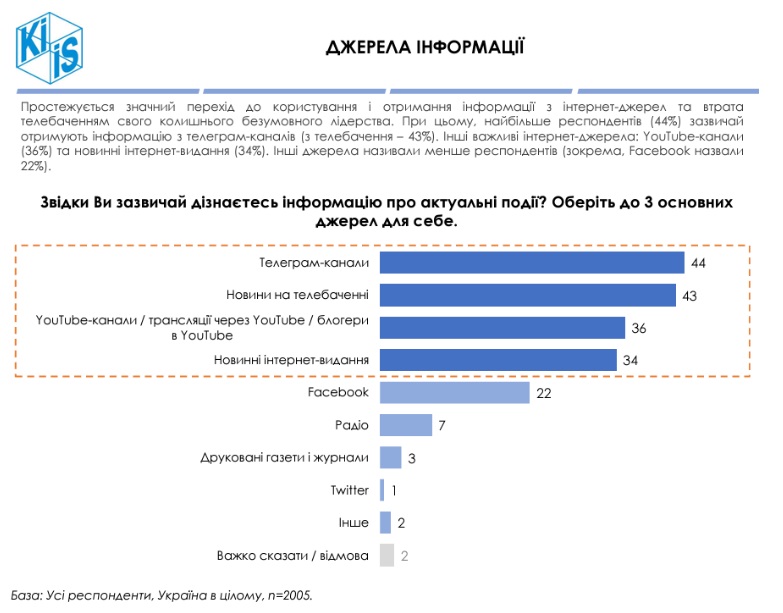
Results of the sociological research conducted by KMIC, September 2023
When it comes to sociological research, it’s essential to pay attention not only to general information but also to detailed breakdowns and explanations concerning gender, age, region, types of settlements, and income. This applies not only to the sources of information utilized by voters.