
The “Silent Consent” Trap. How, Under the Cover of the EU, the Government Will Continue Destroying Cultural Heritage

The destruction of monuments, the demolition of historic buildings, and the construction of high-rises in historical areas have always been among the most resonant issues. Even in the midst of war, our cultural heritage is being destroyed and desecrated not only by Russian missiles and drones but also by domestic developers.
Among the primary reasons for this situation are the flaws in heritage protection legislation. The updating of regulations for permitting procedures seems to have been forgotten, and as a result, the existing norms in the Law “On the Protection of Cultural Heritage” have themselves become living historical monuments.
Since the Yanukovych era, officials from the Ministry of Culture and relevant departments in regional administrations and the Kyiv City State Administration (KCSA) have acted as if Article 19 of the Constitution does not exist. This is because, on the basis and in the manner established by laws, it is impossible to refuse approval for construction projects or the issuance of restoration permits.
Two laws simultaneously (“On Administrative Services” and “On the Licensing System in the Sphere of Economic Activity”) stipulate that the list of documents submitted to receive a service, and the exhaustive list of grounds for refusal, are established exclusively by laws. They prohibit demanding documents not provided for by laws and refusing on grounds not defined by laws. However, for over 10 years, these requirements have not been established at the legislative level for any administrative service or permitting document in the field of cultural heritage protection. What should be determined exclusively by law is established at the discretion of the Ministry of Culture, which approves “information cards” for the provision of administrative services.
Furthermore, as a result of the adoption of the Law “On Regulation of Urban Development Activity” in 2011 and subsequent deregulation, numerous legal conflicts have emerged. Urban planning legislation allows developers to ignore heritage protection laws. Conversely, heritage protection legislation allows the prohibition of construction due to the absence of documents that are not required under urban planning law.
To complete the picture, add to this the impossibility of exercising effective public control. The Law “On the Protection of Cultural Heritage” does not provide for any openness or publicity in the performance of permitting functions—information on received applications, as well as information on granted approvals and permits, is not published anywhere.
Under such conditions, how could rampant corruption not arise, and what chances of survival does cultural heritage have?
In June 2022, the Cabinet of Ministers decided to simplify permitting and registration procedures in construction under martial law. Resolution 722 established, among other things, that the approval of design and scientific-design documentation and the issuance of permits by cultural heritage protection authorities must be carried out through the Unified State Electronic System in the Construction Sector (USESCS). It was also established that if no response is provided within 30 days, the design documentation is considered approved by default. Unfortunately, the Law “On the Protection of Cultural Heritage” only prohibits the granting of approvals and permits on a declarative basis, while tacit consent is allowed by the general law on the licensing system.
In September of this year, the Government, following a submission by the Ministry of Culture, decided to change these temporary rules via Resolution 1130.
For design and scientific-design documentation, a third option was added: in addition to approval or refusal, cultural heritage protection authorities can now provide information within 30 days stating that the documentation is not subject to approval according to legislative requirements.
The changes regarding the issuance of permits for the restoration of monuments were more significant and caused great concern to the National Union of Architects. Contrary to the norms of the specialized law, the period for granting a permit was reduced from one month to 10 calendar days. If no decision is made within this tripled-shortened timeframe, the permit is considered granted by default.
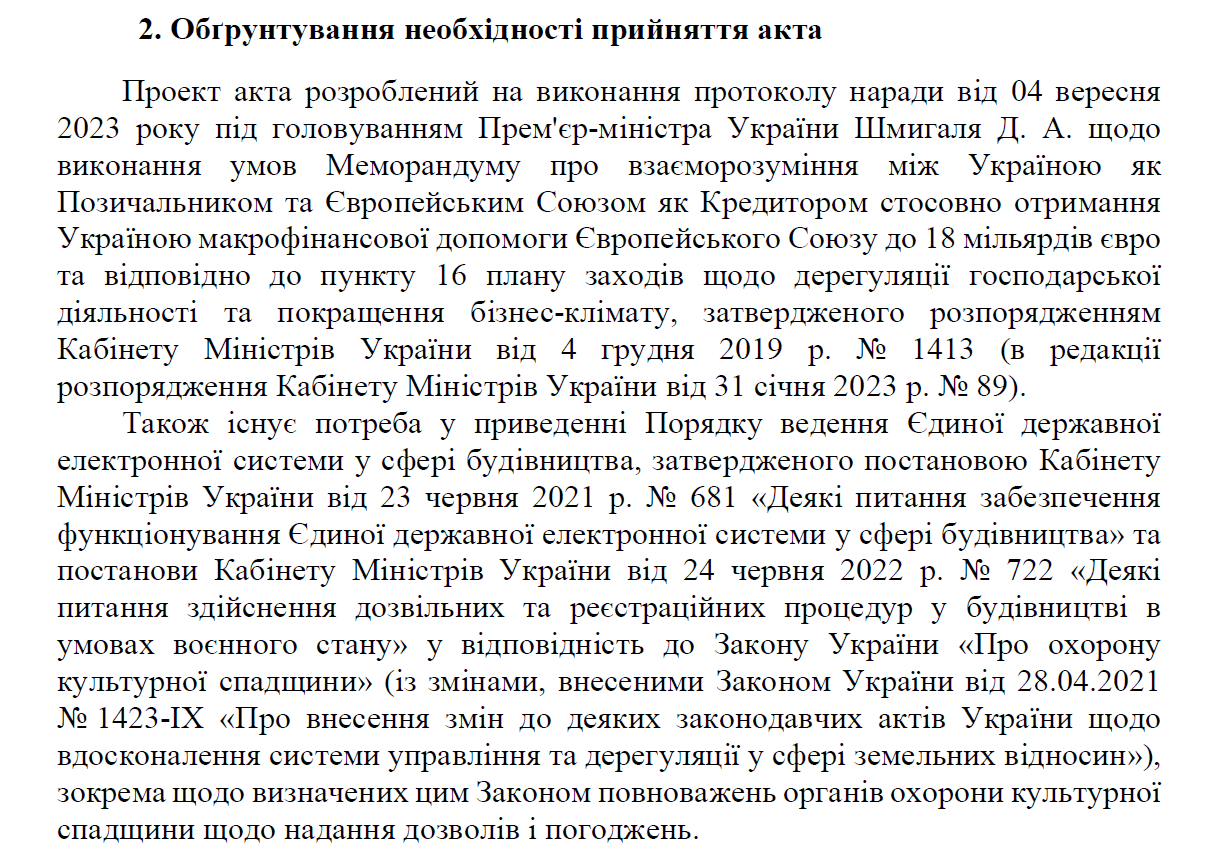
Fragment of the explanatory note to the Resolution of the CMU dated 10.09.2025 No. 1130
How critical are the consequences of the order established by the Cabinet, and what is wrong with it?
Approval of construction projects in territories with heritage protection restrictions
The Cabinet justifies the changes to permitting procedures during martial law by the need to facilitate business operations, so it is appropriate to start the analysis with this aspect.
The Law “On the Protection of Cultural Heritage” (previously in part four of Art. 32, and after the amendments by Law 1423-IX — in part seven of this article) prohibited urban planning, architectural, or landscape transformations, construction, reclamation, road, and earthworks without the permission of the relevant cultural heritage protection authority in protected archaeological territories, within the boundaries of monument protection zones, and historical areas of settlements. The Ministry of Culture still refers to this norm in the information card for the administrative service of approving design documentation.
However, this does not mean that construction clients were obliged to receive such approval. The Law “On Regulation of Urban Development Activity” (Part 6 of Art. 31) stipulates that design documentation does not require approvals not provided for by this Law. And it does not provide for approvals from cultural heritage protection authorities. Since July 2021, this same article of the law additionally prohibits the refusal to provide administrative services in construction on the grounds of the absence of such approvals.
Furthermore, if a construction client has a notification of the commencement of construction work (Part 2 of Art. 36) or a permit to perform construction work (Part 2 of Art. 37), no other permitting documents are required to perform construction work.
Therefore, from the point of view of urban planning legislation, everything was clear: it is forbidden to refuse to accept a notification or issue a permit on the grounds of the absence of approval by cultural heritage protection authorities, and if there is a notification or permit, obtaining approval for construction is no longer required.
Despite this, construction clients almost always had their projects approved. The Law “On the Protection of Cultural Heritage” provides that heritage protection authorities must stop work carried out in the absence of approvals or permits provided for by this Law. It didn’t matter that urban planning legislation stated the exact opposite—the Ministry of Culture and other heritage protection authorities were obliged to stop construction simply due to the lack of project approval, regardless of whether there was a threat to cultural heritage. Law enforcement agencies also did not miss the opportunity to open criminal proceedings. Developers could eventually prove they were right, but this meant months, and sometimes years, of halting construction with corresponding losses. It was cheaper to “reach an agreement” immediately.
Exploiting this conflict, architectural and building control authorities violated the requirements of their specialized law and refused to issue construction permits, citing the lack of project approval. Meanwhile, heritage protection authorities, when necessary, traded “indulgences” for violations of heritage legislation and approved projects with double or triple the maximum allowed height or the demolition of significant historical buildings.
Officials of all these bodies had certain “red lines” and did not want to take responsibility in cases that were too high-profile. In such cases, the developer would go to court, which would recognize either that the approval was granted by tacit consent or that the refusal to issue a permit due to the lack of approval was illegal.
By mandating the submission of projects for approval during permitting procedures in construction via Resolution 722, the Cabinet, firstly, violated the requirements of three laws simultaneously — “On Regulation of Urban Development Activity,” “On Administrative Services,” and “On the Licensing System in the Sphere of Economic Activity.” Obviously, forcing someone to obtain a permitting document that is not needed for construction is by no means a simplification of doing business.
Secondly, the Cabinet created opportunities for an effective corruption scheme. It became enough for developers to agree with heritage protection officials to delay the consideration of an application. Without any courts, after just 30 days, they received approval for a project with any violations by tacit consent. Subsequently, architectural and building control authorities issue a permit for such illegal construction without checking compliance with heritage protection legislation—it is enough for them that the heritage protection authority has de jure approved the project.
Illegal construction with all permits exists in territories with heritage protection restrictions—but there are no guilty officials. The developer also bears no responsibility, as they are only doing what the authorities allowed them to do after “checks.”
The problem should have disappeared from January 1, 2023. On that day, the provisions of the law on deregulation of land relations No. 1423-IX canceled the aforementioned sole norm of the Law “On the Protection of Cultural Heritage” that required project approval.
The permitting and control systems in construction should have fully transitioned to a new format. Architectural and building control authorities should have finally started checking compliance with restrictions themselves, and a specific official should have been held accountable for a construction permit issued with violations. Cultural heritage protection authorities should have been engaged not in project approvals, but in checking compliance with heritage restrictions during construction.
But nothing changed. Because the Cabinet did not amend Resolution 722, and construction clients had to continue applying through USESCS for an approval that had already been finally abolished.
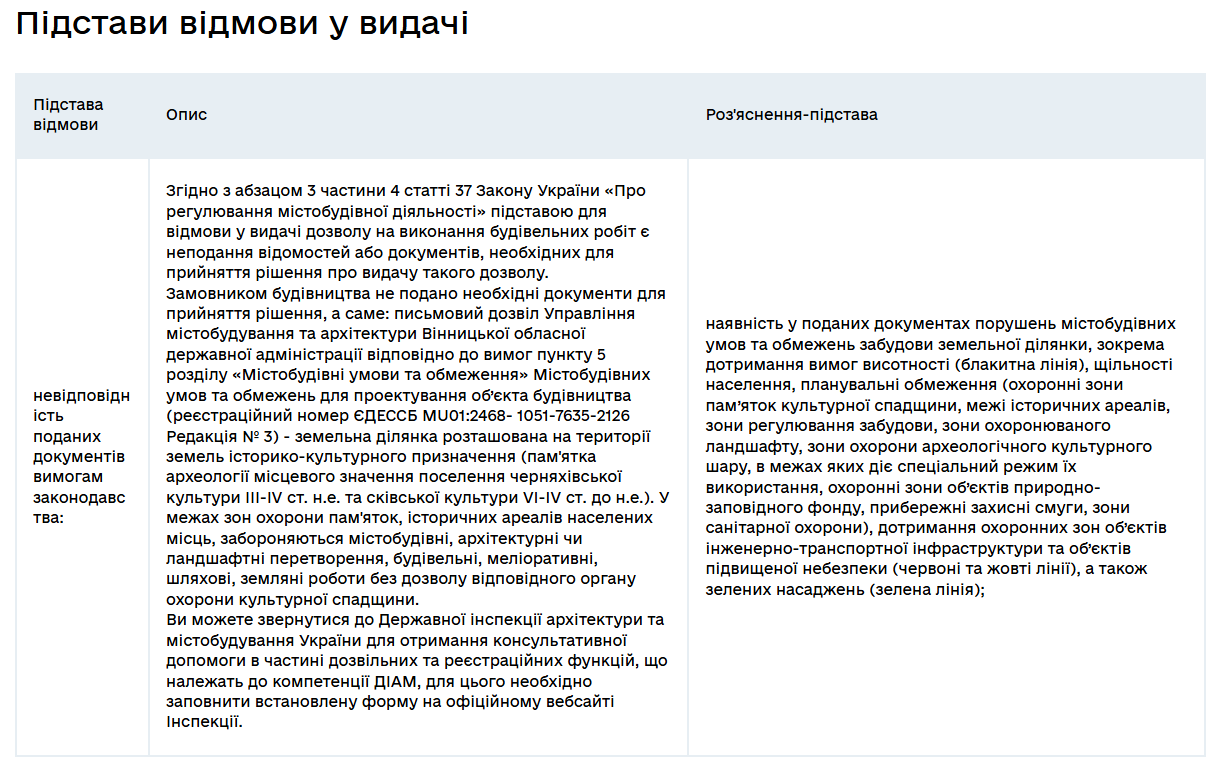
Refusal of DIAM to issue a permit on the grounds of the absence of approvals canceled since 2023
The adoption of Resolution 1130 was justified, among other things, by the need to take into account the changes resulting from the entry into force of the law on deregulation of land relations No. 1423-IX. But instead of removing the need to obtain approvals already canceled by the Law, the Cabinet provided for the possibility of providing information in response within 30 (!) days stating that the documentation is not subject to approval according to legislative requirements.
A similar approach was used starting in 2020 regarding the provision of urban planning conditions and restrictions (UPCR). Although the list of construction objects that do not require UPCR is fixed by regulation, the Government provided for receiving letters stating that UPCR are not issued. This led to the emergence of a new permitting document not provided for by law, for which there is even a separate section in the USESCS. In five and a half years, construction clients were forced to obtain this document about 16,000 times.
This is deregulation “Ukrainian-style”: the Law cancels a permitting document—the Cabinet invents a new one to replace it with the same issuance period. It should be added that a 30-day period is a significant delay, so one should expect the emergence of a new corruption scheme to speed up the response.
But something else is more important. If, within 30 days, information about the lack of need for approval is not provided, the project is considered approved by tacit consent. Thus, the Government has completely preserved the corruption scheme described above for illegal construction in territories with heritage protection restrictions.
Permitting procedures during restoration
If new construction or reconstruction in territories with heritage protection restrictions occurs with violations, the consequences can be corrected. Even the destruction of significant or ordinary historical buildings is not a catastrophe, because their exact copies will create the same backdrop for monuments as the originals. Therefore, one can “play” with the deregulation of permitting procedures for such construction, but only on the condition of preliminary archaeological research and the creation of an effective system for identifying and eliminating violations.
The destruction or even just the damage of monuments constitutes irreversible losses. An authentic object or part of it will be lost forever, and no copy can fully replace it. Therefore, the protection of monuments should be aimed at creating an effective system for preventing their destruction, and the deregulation of restoration poses a direct threat to the preservation of cultural heritage.
The system for preventing the destruction of monuments is based on Article 298 of the Criminal Code, which establishes punishment for “intentional illegal destruction, demolition, or damage of cultural heritage objects or parts thereof.” However, if the work is framed under the guise of restoration, it is not so simple to determine whether the intentional destruction or damage was illegal or legal.
The Law “On the Protection of Cultural Heritage” (Part 1 of Art. 26) provides for a two-stage permitting procedure for restoration. It must be carried out only with the written permission of the relevant cultural heritage protection authority on the basis of scientific-design documentation approved by it.
The conflicts of this procedure with the requirements of urban planning legislation are similar to those discussed above. Scientific-design documentation for restoration is a type of design documentation for construction, so its approval is not required during construction. The submission of both such approval and a restoration permit when obtaining a permit to perform construction work is not provided for by the Law, so DIAM has no right to refuse to issue a permit on the grounds of the absence of such documents.
As already noted, if there is a construction permit, other permitting documents for construction work are not needed. Therefore, according to the letter of the law, if a monument is damaged or destroyed under the guise of restoration in the presence of a construction permit but without any approvals and permits from the heritage protection authority, there is no corpus delicti.
However, the system does not work according to the laws when it comes to restoration.
The police and the prosecutor’s office do not care about the subtleties of urban planning legislation—for them, the fact of the absence of a permit from the cultural heritage protection authority is enough to open criminal proceedings. And far from always are such actions related to a desire to protect a monument.
DIAM also ignores the requirements of its special law. It is the norm for them to illegally refuse to issue a construction permit in the absence of a restoration permit. They do not even check compliance with state building codes for restoration themselves, so they illegally demand an additional piece of paper just to absolve themselves of responsibility for the consequences.
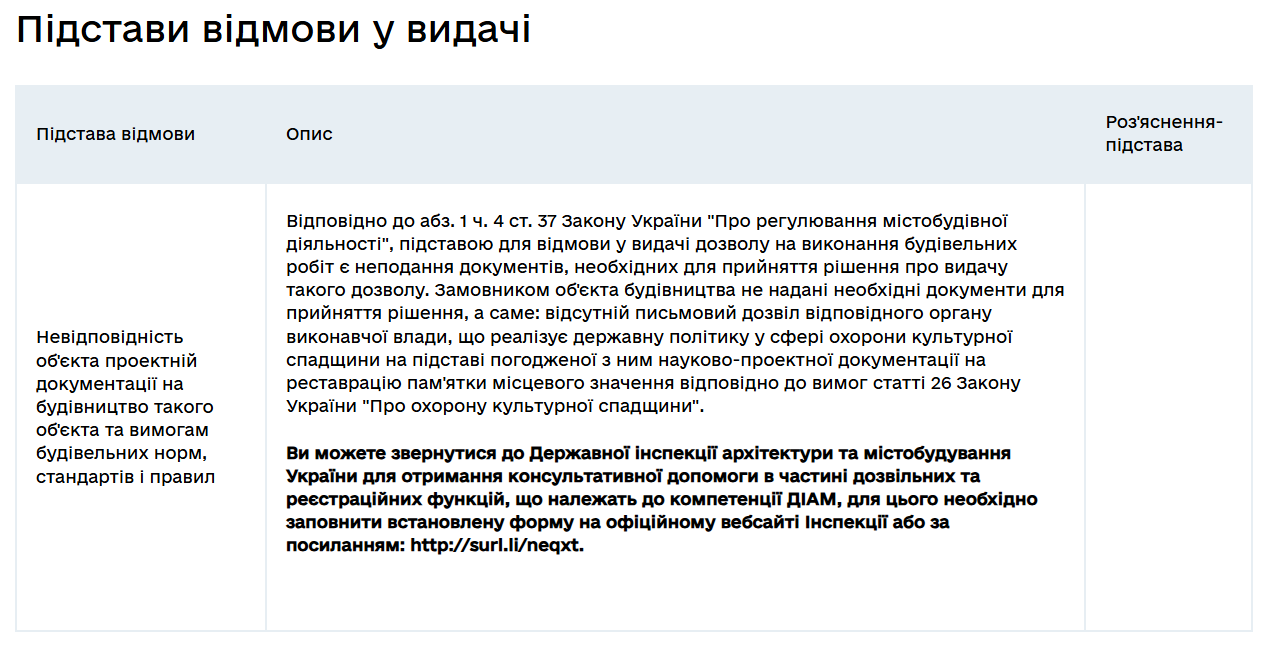
Refusal of DIAM to grant a construction permit on the grounds of the absence of a restoration permit
The Ministry of Culture and other heritage protection authorities also have their levers of influence. And unlike law enforcement and DIAM, their actions will be legal—they are obliged to stop restoration carried out in the absence of permits and approvals provided for by the Law “On the Protection of Cultural Heritage.”
All this does not guarantee the protection of monuments, but only shifts the responsibility for violations to heritage protection authorities. They do not always issue a permit only for restoration without violations. There are known cases of permits for superstructures, the destruction of the entire internal layout of a building, etc.
But heritage protection officials have “red lines”—they do not want to bear responsibility, and too serious violations during restoration often cause public resonance, and the official guilty in the situation may be sacrificed. Therefore, various schemes aimed at depriving a building of its status as a cultural heritage object are used to destroy a monument. And the new order established by the Cabinet has every chance of removing the last “red lines.”
Resolution 722, adopted in 2022, had no impact on restoration. September’s Resolution 1130 introduced two critical changes to the procedure at once—the principle of tacit consent was introduced both for the approval of scientific-design documentation and for the issuance of permits, and the decision-making period for issuing permits was reduced to 10 days.
The period for issuing a permit according to the Law “On the Protection of Cultural Heritage” (Art. 6-1) is one month. The laws “On Administrative Services” and “On the Licensing System in the Sphere of Economic Activity” stipulate that such periods are established exclusively by laws. Thus, the Cabinet made a knowingly illegal decision to shorten the period established by law. Therefore, it is impossible to hold heritage protection officials accountable even for negligence if they do not make a decision within the 10 days specified by the Government.
This creates an ideal scheme for unpunished corruption—officials, without any negative consequences for themselves, do not provide a response within the period established by Resolution 1130, thanks to which the interested person automatically receives the restoration permit required by heritage legislation even if the planned work carries risks of destroying the monument. Well, then DIAM, without checking the impact of the planned work on the historic building and referring to the presence of a permit from the heritage protection authority, issues a construction permit.
As a result, the developer has permits from all relevant authorities in hand. And if the monument “accidentally” falls apart during “restoration,” neither the developer nor the officials face criminal responsibility.
Anti-corruption only in words
We have an Anti-Corruption Strategy and a State Anti-Corruption Program (hereinafter — SAP) adopted under pressure from Western partners. At the time Resolution 722 was adopted in June 2022, these documents were not yet in effect. But the new Resolution 1130 should have complied with them.
The Anti-Corruption Strategy, approved by law, identifies conflicts in urban planning and heritage protection legislation in paragraph 3.5.2 as one of the causes of abuse. And as directions for solving the problem, it directly provides for the adoption of a law that will limit the application of the principle of tacit consent and revise the list of administrative services in the heritage field provided in connection with urban development activities.
Measure 2.5.2.4.1 of the SAP approved by the Cabinet obliges the Ministry of Culture to develop and submit for further referral to the Verkhovna Rada a draft law that, among other things, will provide for the impossibility of receiving services in the field of cultural heritage protection via tacit consent.
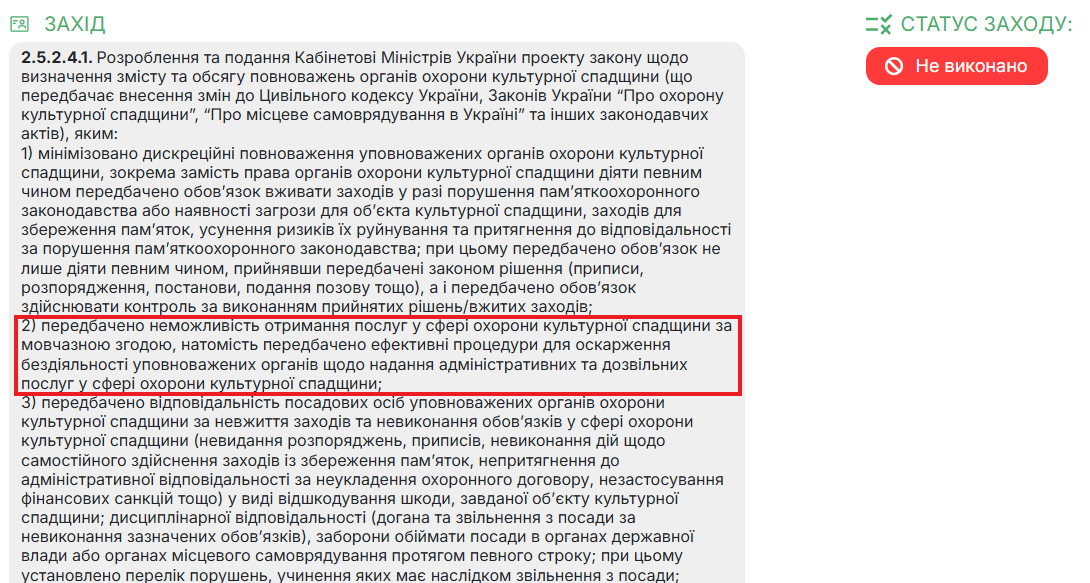
Information from the SAP implementation monitoring system regarding measure 2.5.2.4.1
Measure 2.5.2.5.1 provided for the development of another draft law which, firstly, would organize the provision of permitting procedures to bring them into compliance with general legislative requirements for the licensing system and eliminate conflicts with urban planning legislation. Thus, it was meant to eliminate the shortcomings described above. Secondly, it was supposed to prevent the automatic receipt of permits or approvals in the event of the expiration of the period for their consideration. That is, once again, a ban on the principle of tacit consent.
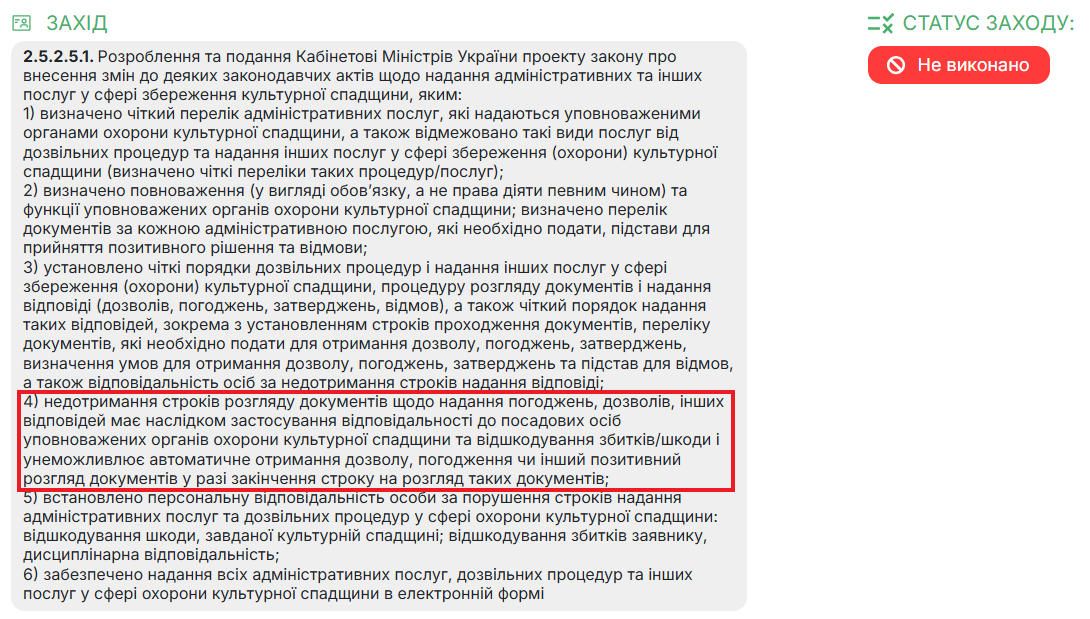
Information from the SAP implementation monitoring system regarding measure 2.5.2.5.1
The Ministry of Culture was supposed to fulfill these measures by the end of November 2023. But they remain unfulfilled.
Importantly, both draft laws provided for by the SAP were supposed to ensure the creation of an effective system to counter the intentional delay in the consideration of applications during the issuance of permitting documents. The first was to provide for an effective system for appealing the inaction of authorized bodies, and the second — for the liability of officials and compensation for damages.
If the Ministry of Culture had fulfilled its duties, there would have been no need at all to adopt Resolution 1130. But instead, the Ministry of Culture developed a project that directly contradicts the provisions of the Anti-Corruption Strategy and the SAP. The Cabinet, which constantly tells Western partners about its successes in fighting corruption, instead of forcing the Ministry to implement the SAP, supported such actions and approved a knowingly illegal project.
National Agency on Corruption Prevention or Promotion?
Given the violations of legal requirements by the resolution described above, there are many questions for several ministries that approved its draft without comments. But in this article, it makes no sense to dwell, for example, on the work of the Ministry of Justice, which traditionally turns a blind eye to real violations and only clings to compliance with the requirements of legislative drafting techniques.
We have a specialized anti-corruption body that is simultaneously supposed to conduct anti-corruption expertise of such drafts and control the implementation of the SAP. This is the National Agency on Corruption Prevention (NAPC). The draft resolution was sent to it for expertise in accordance with the requirements of the Cabinet’s Rules of Procedure. And it was even sent twice in two fundamentally different versions.
The first version of the draft was sent to the NAPC in December 2023. It did not contradict the SAP because it did not provide for the establishment of tacit consent for the issuance of restoration permits, and even provided for the removal of tacit consent for the approval of design documentation that was initiated with the adoption of Resolution 722.
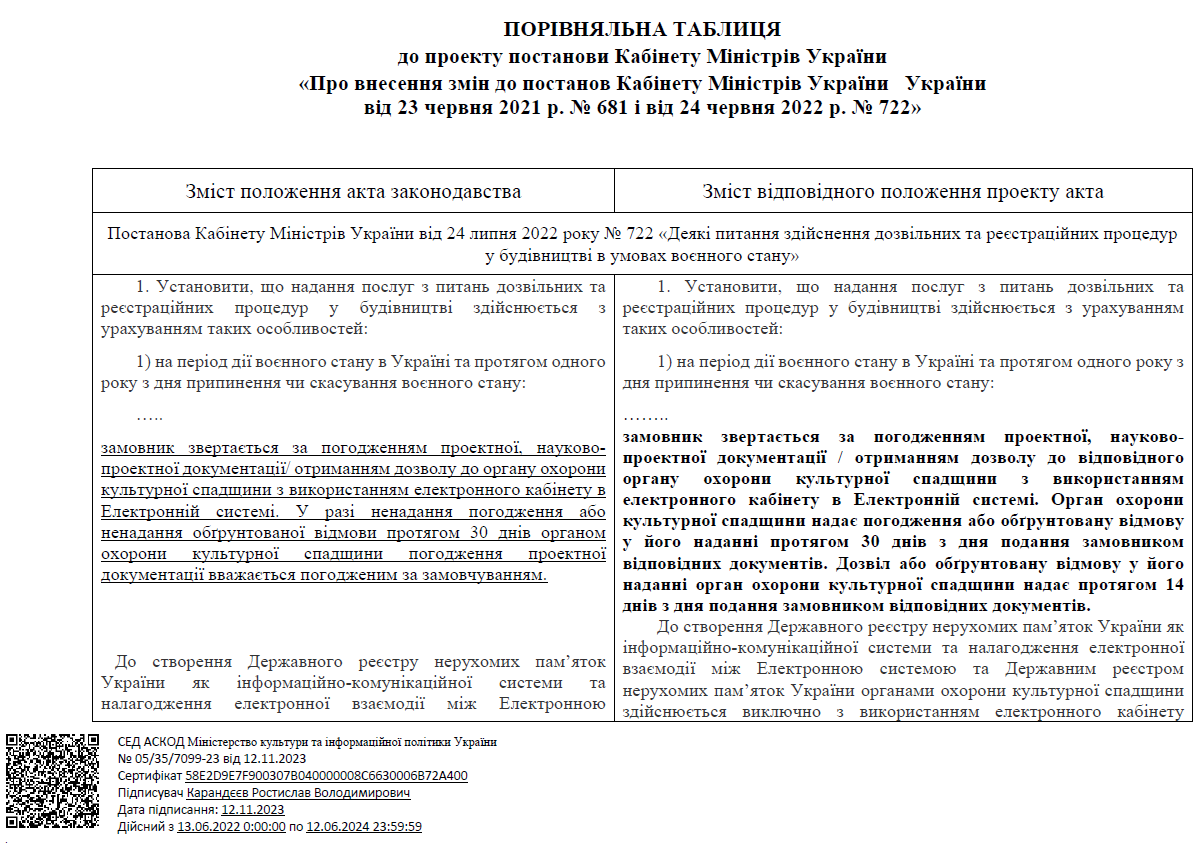
The first version of the draft resolution that underwent anti-corruption expertise by the NAPC
In the final days of Oleksandr Novikov’s leadership of the Agency, they did not notice the issuance of approvals already canceled at the legislative level, but they did identify some of the problems related to the discrepancy in the periods for providing permitting documents and the names of the documents themselves, and provided a corresponding conclusion with recommendations for eliminating corruption risks.
Subsequently, the Ministry of Culture fundamentally revised the project to the version described in the first part of the article, which is saturated with corruption risks and directly violates the SAP, and in May 2024 sent the project again, but under a different name, to the NAPC for anti-corruption expertise.
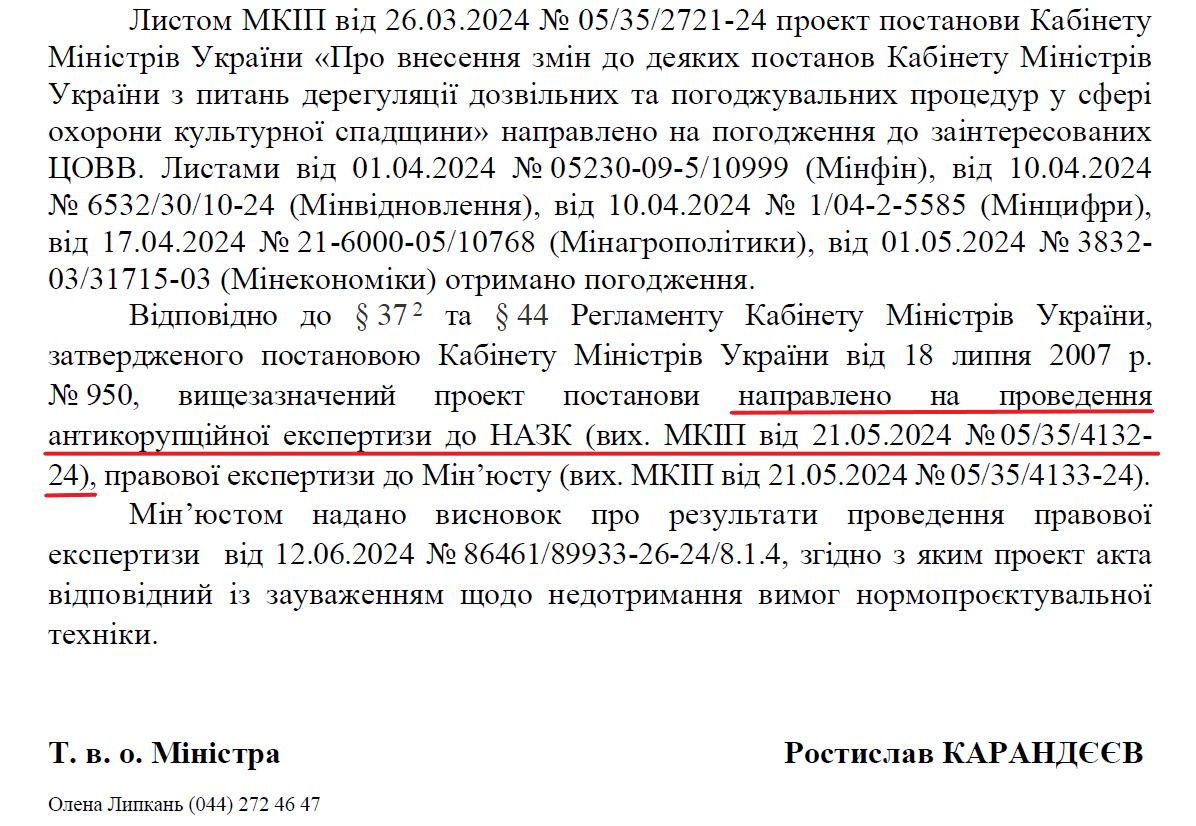
Fragment of the cover letter for the draft resolution in its final version
This time, the Agency, already under the leadership of Viktor Pavlushchyk, miraculously found no corruption risks at all. They managed not to notice even the risks previously identified by the NAPC itself and not corrected during the revision of the project, such as those concerning the periods for granting permits that contradicted the Law “On the Protection of Cultural Heritage.”
How the European Union was used to push through a corrupt reform
The adoption of Resolution 1130 came as a total surprise to the public—its content was carefully hidden for over a year and a half. The resolution changes the procedures for obtaining permitting documents and is by definition a regulatory act, so its draft should have been published for the purpose of obtaining comments and proposals in accordance with the Law “On the Principles of State Regulatory Policy in the Sphere of Economic Activity.”
However, at the end of 2022, the list of exceptions to which this law does not apply was expanded. Among these exceptions are normative legal acts containing provisions related to any stage of conclusion, ratification, approval, adoption, accession, implementation, prolongation, registration, termination, and/or suspension of international treaties of Ukraine.
This is a very convenient norm for the authorities to hide their rule-making intentions. A draft act can contain dozens of pages of various norms, but if among them there is at least one paragraph related in some way to an international treaty, then public opinion no longer needs to be consulted.
As already noted, the Memorandum between Ukraine and the EU regarding macro-financial assistance in 2023 is indicated among the grounds for developing Resolution 1130. And its implementation is a stage in the execution of the relevant Loan Agreement, which is an international treaty. That’s it—regulatory procedures, including the publication of the project to take public opinion into account, do not have to be carried out.
The situation is extremely unpleasant. Improving the mechanism for public consultations is one of the fundamental requirements for European integration. But through a barely noticeable amendment in the legislation, a mechanism was created to use agreements with the EU to curtail already existing mechanisms for taking public opinion into account.
The Memorandum does not directly provide for any changes in monument protection during construction, but among the conditions for providing financial assistance is the initiation of the implementation of the Action Plan for the deregulation of economic activity and the improvement of the business climate.
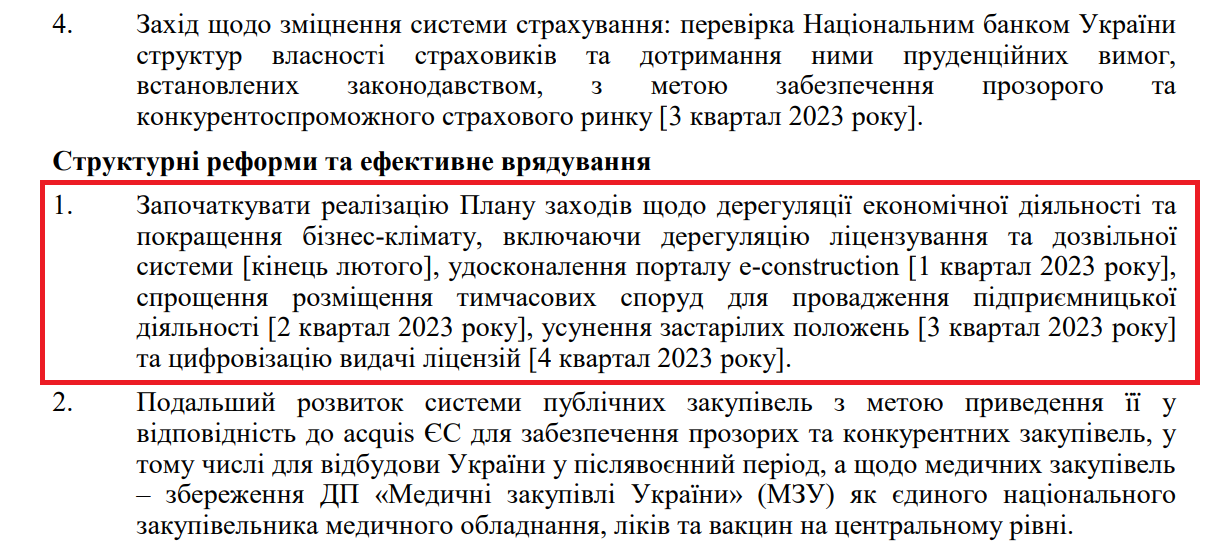
Requirements for Ukraine under the Memorandum on the provision of EU macro-financial assistance in 2023
At the time the Memorandum was signed (16.01.2023), the relevant Action Plan provided (item 56) for the development of a draft law to review the list of administrative services provided by cultural heritage protection authorities to urban development entities and to improve the procedure for providing them.
But just two weeks later, the Cabinet approved the Action Plan in a new edition. The draft law that was supposed to remove existing contradictions at the legislative level disappeared from it. Instead, measures appeared regarding the clarification of administrative services provided through the USESCS and the introduction of changes to Resolution 722 to shorten the period for granting a restoration permit.
As already noted, the reduction of the period for granting a restoration permit by a government resolution violates the requirements of three laws simultaneously and, accordingly, Article 19 of the Constitution. But through sleight of hand, this gross violation of legislation became an EU requirement for providing macro-financial assistance. It is unlikely the European Commission even suspected they were demanding such a thing.
However, tacit consent, which created the greatest corruption risks in Resolution 1130, is not provided for in any of the documents referred to by the Ministry of Culture in the explanatory note.
Thus, the Cabinet used the EU to push through some of the illegal changes that pose a threat to cultural heritage and to hide the intentions of the deal from the public.
Such games of pushing through corruption-prone reforms under the guise of fulfilling EU requirements could continue for a long time, as the implementation of the Action Plan for deregulation has been consolidated since 2024 as an obligation of Ukraine in the “Ukraine Facility.”
What is the bottom line?
In August, the Verkhovna Rada, via the Law “On the Principles of State Policy of National Memory of the Ukrainian People,” defined cultural heritage as one of the main elements of Ukraine’s national interests. And already in September, the Cabinet made a decision that creates new corruption risks and could lead to the destruction or demolition of monuments during construction.
There are serious questions for Deputy Prime Minister Yulia Svyrydenko. The problematic draft resolution was submitted last year by then-Acting Minister of Culture Rostyslav Karandieiev. Но while the government was headed by Denys Shmyhal, this project gathered dust for over a year.
The systematic fight against corruption exists only on paper. If the government deems it necessary, it calmly does the exact opposite of what is provided for by the Anti-Corruption Strategy and the State Anti-Corruption Program.
The NAPC, after the appointment of Viktor Pavlushchyk as chairman, has started working even worse and does not notice obvious corruption risks in the Cabinet’s draft resolutions.
Foreign partners should carefully check not only the targeted use of financial assistance but also all changes in legislation that are formally carried out as part of fulfilling their requirements. Trust is one thing, but the mentality of Ukrainian officials must also be taken into account.
Specially for “Dzerkalo Tyzhnia”