
New housing legislation for developers. People on the waiting list may leave!

The government’s draft law “On the Basic Principles of Housing Policy” (No. 12377 ) contains both positive and negative changes in the state’s housing policy.
First, the “Soviet” Housing Code will be canceled, and this is good.
Secondly, the Unified Information and Analytical Housing System should finally appear as a public electronic registry. It should contain information about the housing stock, people entitled to receive state support, and available offers of social and affordable housing.
Thirdly, it will be mandatory to develop a number of program housing policy documents. We are talking about national, regional, and local strategies and the corresponding targeted programs developed on their basis, the funding for which should be included in the budgets of all levels.
However, all this is a theory that can lead to very different practices. Because in the principles of housing policy declared by the draft law, the struggle against the soviet populism of the old Code does not have a human touch. And it is not a given that it will appear when the government starts developing the regulatory framework for this law. Yet, human problems cannot be canceled by a simple stroke of the pen. And this primarily concerns the state’s obligation to provide free housing, which those on the waiting list can privatize.
According to the “modest” estimates of the Ministry of Regional Development (the project was prepared by the old team of the ministry, headed by the current deputy head Natalia Kozlovska), it is envisaged that this will “write off” the obligation to provide housing worth about UAH 900 billion. Those on the waiting list will not be left to fend for themselves. They will be offered “social housing.” But it will be for rent and at a reduced price, and it has yet to be built. And it will be provided to those who do not have the income to rent at market price.
Of course, during the war, the state cannot provide everyone with the necessary social benefits. The issue of the waiting list, which has been around since the days of socialism, requires a balanced state approach and honesty: there is no more free cheese. This approach is supported by both the government and communities at this time. However, has the government conducted a thorough analysis of the housing sector? Is “social housing” the only tool that the government can use to find ways to protect the most vulnerable and not violate the Constitution? What other options are there for diversifying risks for citizens who have been waiting for housing for years? And is it right to promote the interests of developers exclusively under the slogans of “fighting Soviet populism” during a war when the population is already actively emigrating?

The Housing Code will lose its validity, and a year after the war, the same will happen to the Law on Privatization of the State Housing Stock. This is in the final provisions of the government’s draft law. So, there will be no free apartments from the state with the possibility of privatization.
The discussion of “whether social housing should be privatized,” which is certainly welcomed by populist politicians, is stopped by the Constitution: “The adoption of new laws or amendments to existing laws shall not narrow the content and scope of existing rights and freedoms” (Article 22). Therefore, you cannot simply say to the people on the waiting list: “Go away”.

The state can, firstly, stop the queue from getting longer, and secondly, create conditions under which people either finally receive the promised apartments (those who are in critical need) or can improve their living conditions themselves (mortgages and other government programs, etc.).
Otherwise, it is a violation of the Constitution and undermines trust in the state during the war. The contradictions between the new legislation and the restored Housing Code will create legal chaos in the midst of reconstruction. All of this affects the desire of refugees to return or the intentions of some to emigrate. We are talking about 1.5 million citizens on the waiting list. The State Statistics Service reports that most of them have been waiting for apartments for more than 20 years. The state’s refusal to fulfill its promises could be decisive here.

The Ministry of Regional Development, being the administrator of the Unified State Register of Citizens in Need of Improved Housing Conditions, should have had updated data on the size of the housing waiting list a long time ago. However, it refers to the State Statistics Service’s data from a decade ago.
Describing the problems with the regulation of rental housing, the Ministry of Regional Development claims that “according to expert estimates, 90% of privately owned housing is rented.” This is absurd. At the same time, the Ministry does not provide any information about the existing housing stock or the reasons that led to high housing prices, the almost complete halt in the provision of housing to those on the waiting list, and the formation of social housing funds.
An analysis of the State Statistics Service data shows that before the full-scale invasion, a reserve of about 3 million vacant apartments and manor houses (18% of the total housing stock) had been accumulated. However, due to the imbalance in living standards in the regions, there was intense internal migration, which led to a local housing shortage in large cities.
The number of vacant apartments will not change much after the end of the war: the decrease in the number of housing units due to complete destruction will be largely offset by a decrease in the need for housing due to emigration.
The draft law declares that the task of housing legislation is to ensure the rational and efficient use of the housing stock. However, its provisions are more focused on the construction of new housing than on prioritizing regional development and stimulating the use of existing vacant housing stock in small and medium-sized cities.
The reason for the steady rise in housing prices in large cities is well known: its financialization. Instead of fulfilling its natural function, housing is being turned into an investment asset to generate profit or preserve savings. Both investors and developers are interested in increasing the cost of housing, so they constantly inflate the price bubble. At the same time, communities have lost the opportunity to develop their social housing stock at the expense of developers. And this is one of the global instruments that should have started working again after the abolition of the old Housing Code. However, this instrument is not included in the list of principles of the new housing policy. Nor is its elimination mentioned among the reasons that led to the freezing of the formation of the social housing fund of communities.
Moreover, the draft law leaves developers with hidden subsidies at the expense of communities. This deprives communities of the opportunity to have communal housing of several categories: social and for those who have a priority right to receive housing out of turn. These may include veterans with disabilities, children with disabilities, large families, etc.
In this case, the new state social policy suggests that the Ukrainian state is working in favor of developers rather than citizens.

Many people have heard accusations against the leadership of state-owned structures, such as “I transferred a land plot in Kyiv to a private company in exchange for 5% of apartments, although market conditions are 10%.” This was the case with hundreds of hectares of the state-owned agricultural enterprise Pushcha-Vodytsia, land owned by the Ministry of Defense, and many others.
Law enforcement is dealing with such cases because the accusations of corruption are not unfounded. Private companies transfer leased communal land to developers in Kyiv for construction in exchange for 12-25% of future apartments, depending on the plot’s location.
Don’t you think it’s strange that when a state-owned enterprise gives away land for 5% of apartments, it’s corruption because it’s not enough, but when the city council gives away land for the equivalent of 0.2-0.5% of apartments in the form of rent, it’s not corruption, and it’s normal?
The reason is that the law prohibits local councils from imposing requirements for the transfer of some apartments to communal ownership when allocating land.
However, this has not always been the case.
In the early 2000s, when providing municipal land for development, it was allowed to provide for the transfer of apartments to meet the waiting list or to form social housing funds. By the way, the Law “On the Social Housing Fund” still provides for such a mechanism, but its implementation is impossible.
For example, in Kyiv, this mandatory share of apartments in 2007 was 20% for the city center and 7% for other areas. In addition to the apartments, the tenant had to pay 5% of the standard cost of construction to a special fund for the development of housing construction. It is worth remembering about share contributions, which at one time could reach 25% of the estimated construction cost and fully cover the need to provide the residents with the necessary infrastructure.
In other words, although the land plot was leased out very cheaply, the city received market compensation for its development with commercial housing to provide free housing to those on the waiting list.
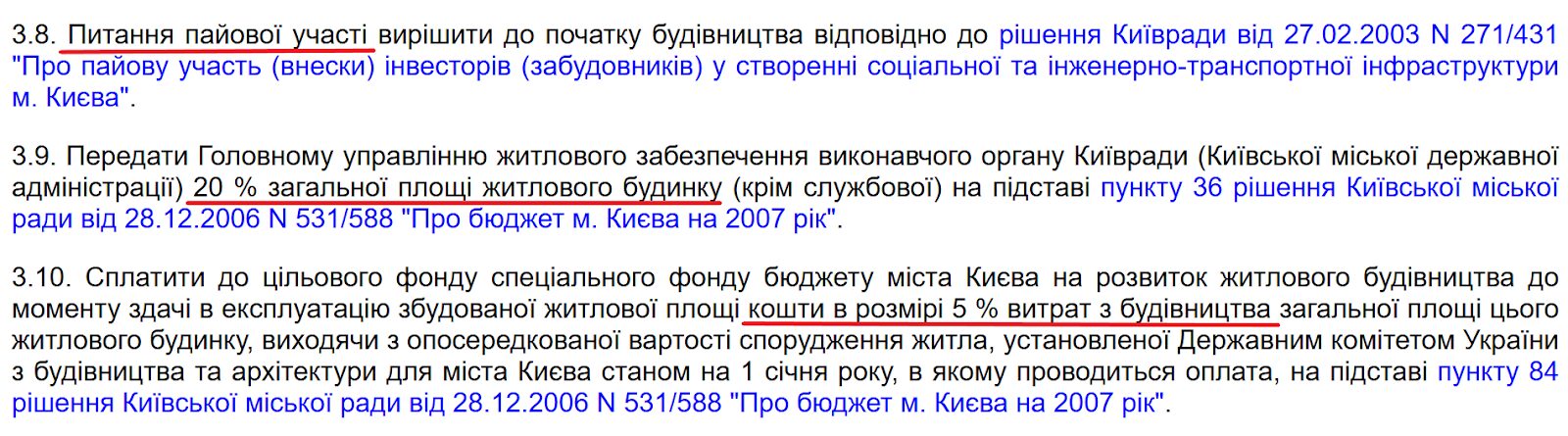
A typical decision of the Kyiv City Council to lease a land plot in 2007
However, in 2008, to support housing construction during the financial crisis, local authorities were prohibited from demanding any further payments or transfers from developers, except for share contributions. The share contributions themselves were reduced to a meager 4%.
Over the years, the crisis has passed, and the construction industry has recovered, but its subsidization at the expense of territorial communities has not been removed. Moreover, the Law on Regulation of Urban Development not only confirmed the restrictions on local authorities but also ordered the cancellation of all obligations to transfer some apartments to communal ownership, which were established by contracts before 2008. And in 2020, share contributions to infrastructure development were finally canceled. ZN.UA wrote about this in detail.
Thus, over the past 16 years, Ukraine’s housing policy has been de facto based on the principle of “Depriving the poor of opportunities to support the rich.” Territorial communities are obliged to lease land for housing construction for nothing, receiving a fee for the entire lease term that does not exceed 10-12% of its market value. At the same time, they are obliged to provide housing with the necessary infrastructure at the expense of the local budget, the cost of which is 10-20% of the cost of building the housing itself. In other words, communities are heavily subsidizing the construction of all housing, including business and elite-class housing.
Under current economic conditions, only people with above-average incomes can buy new housing at market prices. As a result of this system, territorial communities are deprived of the opportunity to fill social housing funds to provide it to low-income citizens.
Can such support lead to a reduction in the price of new buildings? It is unlikely, as the transfer of land for nothing established by law has only led to increased corruption and the emergence of intermediaries who lease communal land and then transfer it to private developers on market terms. Only those who are particularly close to the current local authorities can get land “on the cheap” from the developers themselves. Under market conditions, this means that apartment buyers still pay the market value of communal land out of their own pockets, but these funds go to developers or intermediaries, not to the city budget.
In turn, the abolition of share contributions for infrastructure development does indeed result in a significant reduction in the total cost of construction. However, under market conditions of housing price formation, this does not lead to a reduction in the cost of housing but only to an increase in developers’ profits.
The current system directly contradicts the European principles of housing policy. Don’t the officials who wrote this draft law, offering people a supposedly new housing policy, know this? Of course, they do. Meanwhile, in the civilized world, providing land on preferential terms and building infrastructure at public expense also means regulating the maximum sale or rental price of housing built with such support. Only those developers who do not receive subsidies from the state or communities have the right to set the market price without restrictions.
Although draft law No. 12377 is presented as a European-style reform, the hidden subsidization of construction through existing land allocation and infrastructure construction mechanisms at the expense of local budgets remains unchanged. That is, the project is not aimed at solving the housing problem of citizens but at further supporting the construction business and corrupt land schemes.
Specially for Dzerkalo Tyzhnia