The prosecutor’s office has opened a criminal case due to the destruction of the historical landmark, the Bratski Cells of the Kyiv-Mohyla Academy. This was previously reported by Dmitry Perov, an assistant to a deputy of the Kyiv City Council from the pro-government party.
Perov approached MP Olena Shuliak (the head of the Servant of the People party), who in turn appealed to the Ministry of Regional Development and the State Inspection of Architecture and Urban Planning (hereinafter referred to as the State Inspection) to investigate what is happening.
The Kyiv-Mohyla Academy alleges political pressure and emphasizes the existence of raiding intentions regarding the land near the cells. The head of the Academy, Serhiy Kvit, also notes that the head of the ruling party is attempting to whitewash her image after promoting a controversial urban planning reform that did not adequately protect cultural heritage.
The civic initiative “Holka” studied the documents and found out who and how violates the law.
Here is a photo of Perov taken in the fall of 2023.
Construction works at the Bratski Cells. Photo by FB Dmitro Perov.
And here arises the question: is the Mohyla Academy really conducting reconstruction (not restoration), thus violating the project, because reconstruction allows for much more significant changes.
The term “restoration” has a distinct meaning in urban planning and monument protection legislation. The confusion of terms is reconciled by state construction norms, establishing that the type of construction “restoration” includes six (!) types of work: conservation, restoration, rehabilitation, museumification, repair, and adaptation.
And those who want to show society that what the Mohyla Academy is doing is supposedly not restoration are the ones who use the confusion in terminology.
The walls of the cells, which are in the photo, are all that remained non-accidental before the start of the restoration and have survived to this day from the original 200-year-old monument, so only they could be saved. The rest of the elements mentioned in the media are those that were added to the monument during Soviet times.
The windows, roof, internal partitions, part of the floor between the floors, and rafters that are being dismantled now were Soviet, not authentic. Another part of the wooden flooring was recognized as emergency back in 2012, and its replacement was envisaged by the restoration task agreed upon by the Ministry of Culture.
The State Inspection of Architecture and Urban Planning (hereinafter – the State Inspection) issued the Mohyla Academy a permit for “restoration with adaptation” last year. Here is an expert report confirming this.
The appendix to the expertise lists the scope of work envisaged during the restoration with adaptation of the Bratski Cells.
Adaptation involves creating conditions for the modern use of a cultural heritage site without altering its inherent properties, which are the subject of the site’s protection, including the restoration of elements that represent historical and cultural value. Adaptation does not entail the complete restoration of lost elements to make the building look exactly as it did in the past. During adaptation, intact valuable elements are restored, while non-authentic or emergency elements can be replaced to ensure the building can continue to be safely and conveniently used.
Therefore, the accusation against the Mohyla Academy of unlawfully using steel beams and concrete to replace emergency wooden flooring and rafters is manipulation.
Photo: Bratski Cells, sketch by NAUKMA.
The Venice Charter, adopted by the UN back in 1964, stipulates that new elements must harmoniously integrate into the overall form of the monument and differ from authentic fragments to prevent falsification of the monument as a historical document and work of art. In cases where the use of traditional techniques proves unsuitable, reinforcement of immovable historical monuments through modern conservation and construction techniques is permitted,the effectiveness of which is supported by scientific data and guaranteed by practical experience.
In other words, the public has become a victim in this information war against the Mohyla Academy, with the term “restoration” being manipulated.
Screenshot from the website: “Informator”
The headline of the information campaign against the Mohyla Academy is the assistant to the deputy of the Kyiv City Council from the “Servant of the People” party, Perov. He holds a master’s degree in law. Last year, Vitalii Klitschko promised to appoint him as the first deputy director of the Department of Cultural Heritage Protection of the Kyiv City State Administration. A person with such professional background should possess professional terminology. However, over the course of four months, he demonstrates that what is happening in the cells is not restoration but reconstruction.
How does Perov explain his position?
Dmytro Perov
Assistant to the deputy of the Kyiv City Council (Servant of the People)
If we have wooden stairs, they should remain wooden. If there are stone plinths in the building, they should be stone. This is detailed in the state building regulations V.3.2-1-2004, which establish the following main principles of monument restoration: minimal intervention and changes, ensuring maximum preservation of the authenticity of the monument.
It is worth adding that the state building regulations referenced by Perov have lost their validity. And here is the evidence. The order to cancel the norm referred to by Perov was issued by the Ministry of Regional Development eight years ago.
Screenshot of the document stating that the state building regulations DBN V.3.2-1-2004 are invalid.
In early March, the Ministry of Infrastructure announced an unscheduled inspection, supposedly appointed “upon the request of civic activists.”
The next day, on March 5, the Mohyla Academy declared its illegality. Subsequently, the Ministry of Infrastructure publicly accused the Mohyla Academy of unlawfully refusing to provide necessary documents and of refusing to allow inspectors to conduct the inspection. And a few days ago, the Ministry accused the Academy of violating the law during the inspection.
In contrast to the Ministry of Infrastructure and the State Inspection, the Mohyla Academy publicly disclosed the documents on which its position is based. What do they prove?
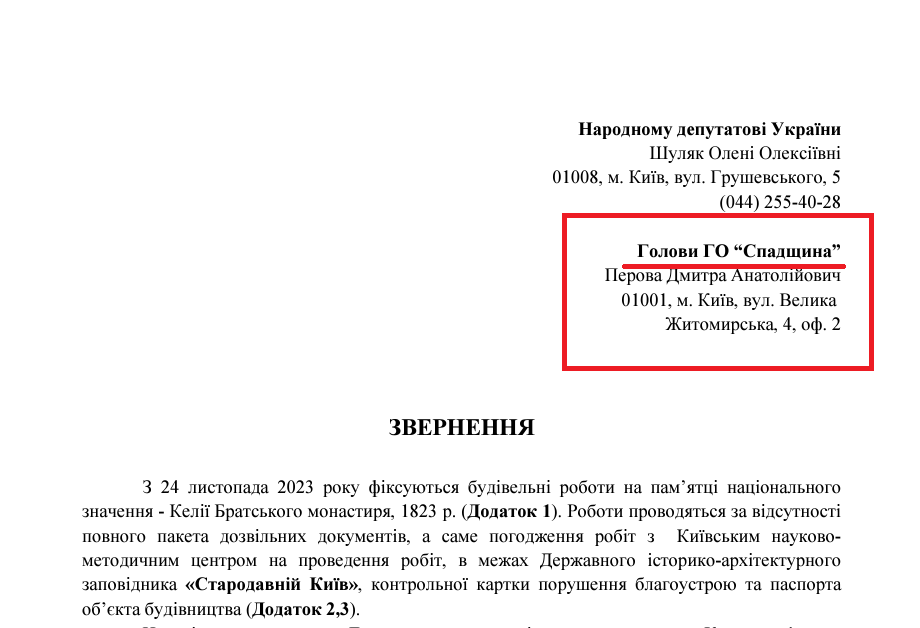
In mid-December, Shuliak received a letter from Perov. He signed it as the head of the NGO “Spadshchyna”
Excerpt from Perov’s letter, who identified himself as the head of the NGO “Spadshchyna”. The document is undated and has no number.
In his appeal, he requests the MP to submit a request for inspection. But in reality, the NGO “Spadshchyna” is registered in Poltava region, and it is led by Irina Trotsko.
Screenshot from the Youcontrol register: NGO “Spadshchyna” is headed by Irina Trotsko.
Perov has no affiliation with this organization. And the “Spadshchyna Kyiv,” which Perov currently heads, was registered more than a month after he wrote the appeal to Shuliak.
The civic initiative “Holka” reached out to Perov to clarify why he signed as the head of the NGO “Spadshchyna” when he has no connection to this organization. His response was as follows:
Why did Dmytro Perov sign as the head of the NGO “Spadshchyna”?
Dmytro Perov
Assistant to the deputy of the Kyiv City Council (Servant of the People)
We, along with friends, established the "Spadshchyna" initiative aimed at practical work on the preservation and protection of historical buildings. Issues with legal formalization were not acute, so we did not undergo any registration procedures, which, however, is not a violation of the law. According to Article 11 of the Human Rights Convention, everyone is guaranteed the right to free assembly and freedom of association. This, according to the practice of the ECHR, cannot be restricted by registration or any other formal procedure. For me, the main thing is what we do, not some formal conditions or requirements. Unfortunately, the name "Heritage" was already taken, so we added "Kyiv". But we did not register a "similar (by name - ed. note) public association". We decided to formalize the association because it is a requirement of most grantors.
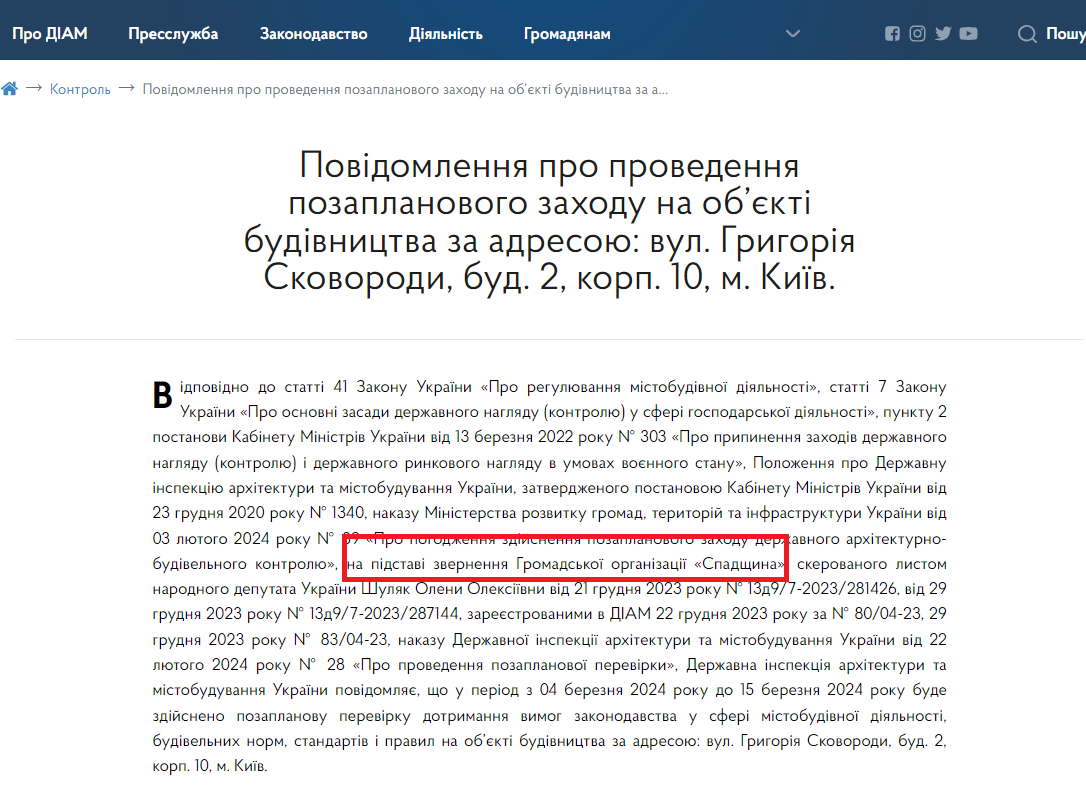
This is a very significant fact because, according to the “Urban Planning Regulation Act” (Article 41), inspections are appointed upon the application of individuals or legal entities, and Perov’s application is, de facto, anonymous.
Screenshot from the State Inspection website, indicating that they are conducting an inspection upon the request of the legal entity, NGO “Spadshchyna”, which did not request it.
Shulyak directs a parliamentary inquiry to the Ministry of Infrastructure and the State Inspection on December 21, requesting inspections with reference to “Spadshchyna”. Interestingly, on the same day, an event took place at Mohyla Academy, where experts were invited to discuss the restoration project of the cells. Also present at the event was People’s Deputy Anna Bondar (“Servant of the People”), who heads the working group developing the urban planning code – an alternative to Shulyak’s failed urban planning “reform” (5655).
Anna Kyrii, Deputy Head of the Architectural Chamber of the National Union of Architects, who attended the event, emphasizes:
What's remarkable about Shuliak's appeal?
Anna Kyrii
Deputy Chair of the Architectural Chamber of the National Union of Architects
It's strange that Ms. Shuliak's appeal appeared precisely when this event was happening. They openly showed all the documents there, and everything was fine with them. Somehow, there is not such enthusiasm from the State Architectural Inspection and the Ministry for checks on truly scandalous developments. Yet, for Mogylyanka, they staged a whole show with drones and a smear campaign in the media. Although they could have simply checked the documents. Mogylyanka put everything in the public domain. It's interesting to observe who among the authorities has always been at odds with Mogylyanka, whose student body was at the forefront of all Maidans. Under Yanukovych, it was the Minister of Education, the "regional" Tabachnyk, then the plagiarist Shkarlet. It seems someone has decided to join those ranks now. Fighting against the 400-year-old Mogylyanka is like shooting oneself in the foot. The Deputy Prime Minister and the head of the ruling party are acting in a very unprofessional manner in the situation with the cells. Well, Mogylyanka has always prevailed. It will be the same now. But where are the Shkarlets and Tabachnyks now?
The head of the Kyiv-Mohyla Academy, Serhiy Kvit, notes that everyone who has seen the documents understands that everything is fine at the Kyiv-Mohyla Academy.
What are the reasons behind such unusual attention from the authorities?
Serhiy Kvit
Rector of Kyiv-Mohyla Academy
In our opinion, those who advocated for the controversial urban planning "reform" 5655, which did not provide adequate protection for cultural heritage, decided to make a splash in the information field and show society that they supposedly care about this heritage after all. It is crucial to note one more detail: when the leader of the ruling party wrote her inquiry. Last year, on December 21. It was precisely on this day that we openly presented the documents at Kyiv-Mohyla Academy. Among the experts present were those working on an alternative to 5655 - the Urban Planning Code. A week before that, the Ministry of Regional Development failed to push through the decree-clone of the urban planning "reform" criticized by the European Parliament, the European Commission, and recently Chatham House. But no one will allow politicians to whitewash themselves at the expense of Mohyla's reputation.
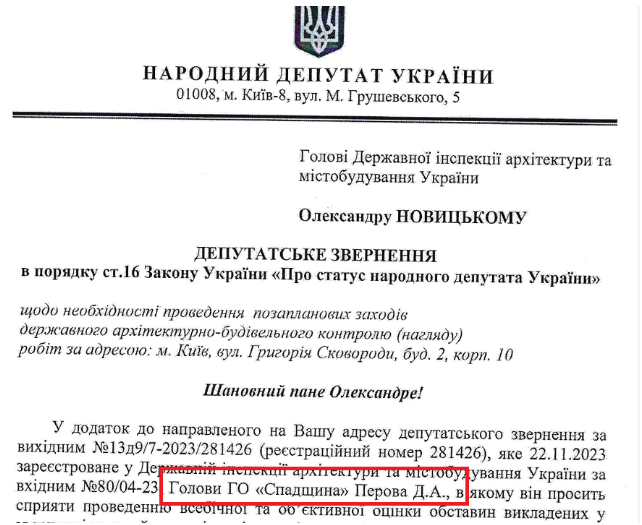
After this event, Shuliak sends another appeal to the State Inspection, again referring to Perov as the head of the public organization.
Screenshot of Deputy Shuliak’s appeal, where she refers to Perov as the head of the NGO “Spadshchyna”.
The parliamentary appeal has a separate status and cannot be considered as an appeal from an individual or legal entity, and therefore cannot be the basis for an inspection.
For the appointment of an unscheduled inspection, the appeal must be considered by a special commission at the State Inspection. The consideration must take place in the presence of the applicant. In case of the applicant’s repeated absence, their appeal should be left unconsidered (paragraph 7-1, Cabinet Resolution No. 553).
Perov twice failed to attend the commission meetings, so his appeal was officially left unconsidered. Moreover, even if Perov had attended the meeting, his application could not have been considered because he is not authorized to represent the NGO “Spadshchyna“.
Excerpt from the protocol on leaving without consideration the appeal of Dmytro Perov due to his absences.
The story should have ended there, as the State Inspection, by law, did not have the right to appoint an inspection.
But instead of sending Perov a response stating that his appeal had been left without consideration, on January 25th, the State Inspection sent a letter to the Ministry of Infrastructure requesting approval for an unscheduled inspection based on Perov’s appeal.
According to another Cabinet resolution (No. 303 of March 13, 2022), the Ministry of Infrastructure is supposed to control to ensure that there are no unjustified inspections and undue pressure on construction clients, especially during a state of war. However, instead of fulfilling its duties, the Deputy Prime Minister and head of the Ministry of Regional Development, Alexander Kubrakov, issues an order approving the conduct of an obviously illegal unscheduled inspection. It should be noted that the Ministry of Infrastructure further violates its own procedure for granting such approvals and does not publish the order on its website.
Next, the head of the State Inspection, Oleksandr Novytskyi, issues an order to appoint the inspection itself, citing the appeal of the NGO “Spadshchyna“, which was forwarded by Shulyak, and the order of the Ministry of Infrastructure to approve the inspection.
Upon learning of this, the Mohyla Academy at the end of February sends a letter to Kubrakov with a reasoned description of the violations of the law and a request to cancel the illegal approval. The same appeal was sent on March 1st to Novytskyi.
Since everyone was informed in advance, the Mohyla Academy exercised its right not to allow inspectors to conduct an illegal inspection. However, instead of correcting the violations, the inspection begins, already knowing the result in advance. Moreover, it is accompanied by an active information campaign.
Photo: Alexander Kubrakov’s Facebook
If the allegations were true, violations would have been identified during the issuance of the permit. However, the legality of the permit issuance is not being checked.
If construction inspection pertains to state architectural and construction control, then verification of the legality of officials’ actions during permit issuance falls under state architectural and construction supervision. This supervision is carried out by the State Inspectorate.
There is a separate procedure for appointing such verification, approved by the Cabinet of Ministers. This concerns verification of the legality of officials’ actions, so the requirements for its appointment are significantly simpler than for verification of the legality of economic entities’ actions.
If the State Inspectorate wishes to stop illegal construction, it has the legal right to appoint a verification in the framework of state architectural and construction supervision even without requests to conduct such verification.
The government, by its resolution, suspended planned and unscheduled control and supervision activities for the duration of the state of war. However, the mentioned procedure additionally provides for documentary and desk checks, not only planned and unscheduled ones.
Issuing an order for a desk or documentary verification is not required; they are carried out by checking the documents already available to the State Inspectorate. In case signs of violation of legislation are found, a certificate is drawn up, based on which within five working days from the date of its preparation, the head of the State Inspectorate makes a decision to conduct an unscheduled verification.
Moreover, in her appeal to Deputy Prime Minister Kubrakov and the head of the State Inspectorate Novytskyi, Olena Shuliak even separately requested verification of the legality of the decision to issue the permit.
Deputy appeal of O. Shuliak regarding the restoration of the Bratski Keliyi.
After the appeal of the head of the relevant committee of the Verkhovna Rada and the head of the pro-government party Shuliak, the verification of the legality of the permit issuance could have been carried out in January.
However, there is no information about the results of such verification. So we have two options.
The first one. The verification was conducted, but no violations were found – the permit was issued legally, and the works conducted by the Kyiv-Mohyla Academy at the Bratski Keliyi are restoration activities carried out in accordance with the issued permit. If violations had been found, the status of the permit in the Unified State Electronic Construction System would have changed to “Suspended” rather than remaining “Active.”
This means that the Ministry of Infrastructure and the State Inspectorate are aware of the legality of the restoration. Then the question arises, why create an information field that discredits the Mohyla Academy?
The second one. The verification of the legality of the permit issuance was not conducted.
In this case, the Ministry of Infrastructure and the State Inspectorate are not interested in the legality or illegality of the works at the Bratski Keliyi.
Sergiy Kvit explains:
Why are all these "coincidences" causing concern?
Sergiy Kvit
Rector of Kyiv-Mohyla Academy
The emergence of the self-proclaimed leader of the unregistered NGO "Heritage" coincided with the failure of an attempt to declare the perpetual lease and security contracts of the Kyiv-Mohyla Academy, including the Bratska cells, invalid. In February, we accidentally learned that the land around the cells and a number of other historical buildings of the Mohyla Academy had been seized by another organization. All these actions can only be described as systematic and raid-like. It is reminiscent of attempts in 2008 to take away the House of the Prior and the Bratska cells from the Mohyla Academy in order to open entertainment venues there. Mohyla Academy won the lawsuits. Perhaps at various stages, some government officials, politicians, or individuals who call themselves activists are involved. One of the goals of this raid-like process is to cause reputational damage to the Kyiv-Mohyla Academy by making a series of unfounded absurd accusations.
Top officials and politicians in this case not only violate the legislation of Ukraine but also our international obligations.
In 2006, Ukraine ratified the Convention on the Protection of the Architectural Heritage of Europe adopted by the Council of Europe in 1985. Article 11 of this Convention establishes that by giving due attention to the architectural and historical character of the heritage, each Party undertakes to promote:
the use of protected architectural heritage objects, taking into account the needs of modern life;
adaptation, where possible, of ancient buildings for new use.
Ukraine, before the Council of Europe, committed to promoting the adaptation of monuments similar to what Kyiv-Mohyla Academy is doing at the Bratska cells.
The draft law proposed by the leader of the "Servant of the People" party, Olena Shulyak (5655), was criticized by the media and civil organizations for over a year. The President emphasized that he did not sign this initiative because it was his own decision. At the end of 2023, the Cabinet of Ministers published a resolution that duplicates the provisions of the criticized draft law by the European Parliament and the European Commission.



 The appendix to the expertise lists the scope of work envisaged during the restoration with adaptation of the Bratski Cells.
 Photo: Bratski Cells, sketch by NAUKMA.

 Screenshot of the document stating that the state building regulations DBN V.3.2-1-2004 are invalid.