Ministry of Infrastructure VS Mohyla Academy: What’s Wrong with the Second Fine for the Restoration of the Brotherhood Chambers?

The Ministry of Infrastructure reported a new ‘victory.’ The State Inspectorate of Architecture and Urban Planning fined the Kyiv-Mohyla Academy 180,000 hryvnias for repeatedly preventing inspectors from accessing the Bratske Monastery cells, where restoration work is taking place. The previous fine amounted to over 90,000 hryvnias.
Illegal high-rise construction in the center of Kyiv or other violations in Ukraine do not concern the relevant ministry as much as the Bratske Monastery cells of Mohyla Academy. Using one of the leading universities in the country as an example, the head of the ministry and Vice Prime Minister Oleksandr Kubrakov, together with the leader of the ‘Servant of the People’ party, Olena Shuliak, decided to portray themselves as consistent fighters against chaotic construction and for the preservation of cultural heritage.
Initially, the Ministry announced the start of an inspection by the State Inspectorate, described the inspection in detail, posted a video from the inspector’s body camera about the refusal of access, flew a drone over the construction site, and ultimately triumphantly reported twice about imposing fines for preventing inspectors.

Construction work at the Bratske Monastery cells. Photo by Dmitry Perov on Facebook.
However, this inspection was conducted with legal violations. The Mohyla Academy did not want to be a silent victim and turned to court.
The civic initiative ‘Golka’ reviewed the documents to determine if the second inspection was lawful. Spoiler: the officials’ violations in appointing the first inspection were just a warm-up. This is despite the fact that the State Inspectorate is supposed to oversee the legality of construction and restoration.

The Academy was penalized for refusing to allow State Inspectorate inspectors to perform their duties. But were they assigned duties specifically related to inspecting the construction site?
During unscheduled inspections, only issues that prompted the inspection are supposed to be reviewed (as regulated by the corresponding procedure).
The State Inspectorate’s order states that the inspection is aimed at ensuring compliance with the requirements of a previous notice from March.

State Inspection Order No. 50 of 2014 Regarding the Second Unplanned Inspection of the Restoration of the Bratske Cells
The aforementioned directive required that by March 27, all officials of the State Inspection be granted access and provided with necessary documents for the conduct of the unplanned inspection. Furthermore, it mandated ensuring the presence of an authorized representative from the Academy.

State Inspection Directive, issued by NaUKMA on March 13, 2024, based on the results of the initial inspection.
Inspectors were not authorized to check anything other than the fact of admission to the construction site until March 27 for another unplanned inspection and the provision of documents to them.
Therefore, Mogilyanka theoretically could not have committed a violation for which it received a second fine because State Inspectors were not supposed to inspect the construction site itself.
And in any attempt to check anything other than the fact of compliance with the directive, the Academy may demand the termination of the inspection (Article 10 of the Law “On the Basic Principles of State Supervision (Control) in the Field of Economic Activity”).
The current inspection began three weeks after the deadline for compliance with the directive expired, so well before its start, State Inspectors knew that the requirements of the directive had not been met.
An inspection is simply the name of a control measure, and not in all cases does anything actually need to be inspected during its conduct. For example, if a violation of the project during construction is identified, a directive is issued requiring reconstruction. In such a case, to verify compliance with the directive, inspectors must inspect the construction site to ensure that the reconstruction has been carried out. And if unauthorized construction is taking place and a directive is issued requiring the necessary permit document to be obtained, its compliance or non-compliance can only be verified based on the data of the Unified State Electronic System in the field of construction, and you will not find an electronic document at the construction site.
Despite the fundamental difference in possible scenarios, urban planning legislation defines the same procedure for conducting state architectural and construction control in all situations, which necessarily includes an on-site inspection.
In this case, the State Inspection did not conduct an unplanned inspection at the Bratske Cells by March 27 and did not receive documents from the Academy. No inspections directly related to construction work allow this fact to be established, but it can be easily proven documentarily. However, due to the requirements of the law, the State Inspection still needs to conduct a separate unplanned inspection to legally establish the fact of non-compliance with the directive, during which it can, if necessary, draw up an inspection report and a protocol on violations.

So, the two chief building inspectors, Hanna Yaremenko and Lyudmila Avdyushenko, dispatched to verify compliance with the previously issued directive, had the right only to draw up a report stating that the directive had not been complied with. Then, depending on whether Mogilyanka was at fault or not, they could draw up a protocol on the violation, which is the non-compliance with the directive.
However, instead of fulfilling their duty, these two inspectors invented a violation that theoretically could not have occurred in this situation according to the legislation.
What’s crucial in this story is that actions beyond the scope of authority during unplanned inspections, when against legal requirements they are used as a pretext to check anything that comes to mind, are not only characteristic of ordinary inspectors of the State Inspection but also its leadership.
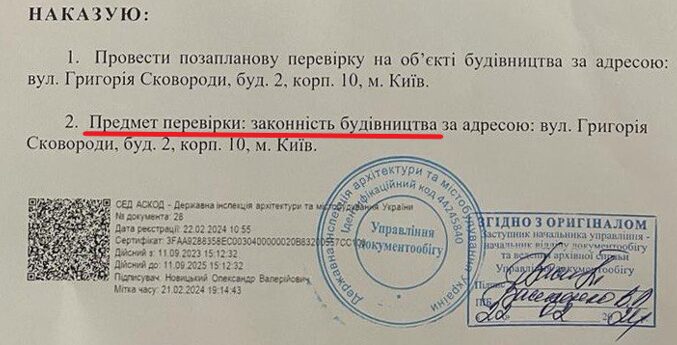
For example, the head of the State Inspection, Oleksandr Novytskyi, in his order appointing the first unplanned inspection of the Bratske Cells, designated “the legality of construction” as the subject. However, the State Inspection does not have the authority even during a planned inspection to oversee such a broad and abstract range of issues because its powers are limited to ensuring compliance with the legislation in the field of urban planning activities, building norms, and rules.
An order appointing an unplanned inspection upon the request of a natural or legal person alleging a violation of the legislation must contain an exclusive list of issues for inspection, which cannot in any case go beyond the scope of the request. And by violating the requirements of the legislation already in appointing the first inspection, Novytskyi de facto acknowledged the groundlessness of Mogilyanka’s public accusations of violations during restoration and directed his subordinates to find something to latch onto.

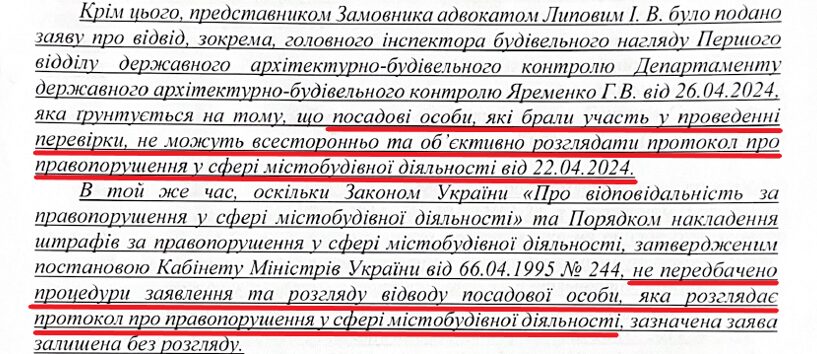
Resolution on Imposing a Fine on NaUKMA
Indeed, the legislation does not provide for the possibility of recusal of a public official in such situations, but there are provisions in the Law “On Prevention of Corruption” that explicitly prohibit making decisions in conditions of conflict of interest.
According to Cabinet of Ministers Resolution No. 244 of 1995, the protocol drawn up as a result of the inspection is the main evidence in a case of violation. When preparing the case for consideration, the official must ascertain whether the protocol and other materials of the case were drawn up correctly. And during the consideration of the case, this official is obliged to determine whether a violation in the field of urban planning was actually committed and whether the relevant urban planning subject is guilty of it.
Thus, in considering the case of imposing a fine, Hanna Yaremenko should have verified the legality of her own actions during the unplanned inspection, which constitutes a real conflict of interest. And according to Articles 28-30 of the Law “On Prevention of Corruption,” she should not have had the right to delegate the consideration of this case at all, and if the case mistakenly reached her, the head of the State Inspection was obliged to remove her from consideration and assign this task to another employee.
By the way, in the case of the first inspection of Mogilyanka, the situation was similar, but it was not Yaremenko who considered the case of imposing a fine in conditions of conflict of interest, but Avdyushenko, although they both conducted that inspection together.

Bratski Cells of Discord. Why is Mohylanka suing the State Inspectorate of Urban Planning and Architecture?
On April 3rd, Kyiv-Mohyla Academy filed a lawsuit with the Kyiv District Administrative Court to annul the order for an unscheduled inspection of restoration work by the State Inspectorate of Architecture and Urban Planning at the Bratski Cells. This initiative was reported by the head of Kyiv-Mohyla Academy, Serhiy Kvit, to the public initiative "Holka".
It’s worth mentioning that its current head, Oleksandr Novytskyi, at DIAM, previously transitioned from the National Agency for Prevention of Corruption, and just a few months ago, he participated in a competition for the position of head of this national agency, so he is well aware of all existing anti-corruption requirements.
And about the necessity of regulating conflicts of interest, he knows it well because recently in an interview, he mentioned that the State Inspection does not verify the legality of permits issued by itself (although it is required to do so by law) to avoid conflicts of interest. In the same interview, he also criticized local self-government bodies, where “one specialist is responsible for everything: making decisions and controlling them.”
But as the history with the restoration of the Bratske Cells shows, under Novytskyi’s leadership, the work at the State Inspection is organized with gross violations of anti-corruption legislation: officials first invent something during inspections, and then, when imposing fines, they themselves verify the legality of their own actions.

The directive issued by the State Inspection during the previous inspection has not been revoked by the court yet. And as mentioned earlier, the Academy did not comply with this directive. At first glance, it seems simple: the inspection was conducted to verify compliance with this directive, so all that’s left is to draw up a report on the violation, a protocol, and submit it for consideration for imposing a fine.
But there’s a catch: even if Mogilyanka wanted to, it couldn’t comply with this directive due to the actions of the State Inspection.
How can officials of the State Inspection be allowed access and provided with necessary documents for conducting an unplanned inspection if no unplanned inspection is being conducted?
If the State Inspection demands that an inspection be allowed on the construction site by March 27, it must start this inspection no later than this date. But after receiving the directive from Mogilyanka, no inspection to ensure compliance with urban planning legislation during the restoration with adaptation of the Bratske Cells was scheduled.
So it was impossible to find any violations by the Academy, for which even a small fine could be lawfully imposed, because the State Inspection cannot lawfully impose a fine for non-compliance with a directive, the execution of which is impossible due to the fault of the State Inspection itself.
What preceded actions of the State Inspection of Architecture and Urban Planning being disputed?

Sergiy Kvit
Head of Kyiv-Mohyla Academy
Before disputing the illegal actions of the State Inspection of Architecture and Urban Planning, we consulted with many of our partners. It was interesting to see the reaction of those working in the construction and restoration field. From them, we heard the same words: "State Inspection of Architecture and Urban Planning, has unlimited power, don't argue with these people, they will do whatever they want with you." And I always thought that in Ukraine, everyone should be equal before the law and no one should have unlimited power.

Yunakov emphasizes that there is a threat that as a result of such “reform,” the state will not only fail to address the problematic issues that existed before but may also lose such competence and the ability to effectively respond in situations when it is really important and necessary for society.
Specifically for “Glavkom”