
One in five communities is without a head. How can the stability of local government be ensured during the war and after the victory?

Today, almost every fifth community has no elected head. This data was provided to the public initiative “Holka” by the Association of Ukrainian Cities. The reasons for this are quite different. For example, the mayor of Boryspil went to serve in the Armed Forces, and the mayor of Obukhiv died in 2022.When the head elected by the community is absent, the secretary performs his duties. This is a deputy, who was elected by a majority vote of his fellow deputies in a secret ballot. However, there is a caveat here. While the mayor elected by the community can be removed by two-thirds of the votes cast removing the secretary requires only 50% plus one vote. If the deputies elected the secretary, they can also remove them.
Even in relatively peaceful times, until 2022, no one rushed to organize mayoral elections as required by law. For instance, when the mayor of Lutsk, Mykola Romaniuk, died in 2017, no one hastened to appeal to the Verkhovna Rada to initiate elections. The thing is that such elections require an appeal to the parliament from the very same council secretary who, in this case, has a conflict of interest.
Overall, in 2019, almost 200 communities were waiting for the election of mayors, and there is a reason for that. When there is no mayor, the “secretariats” emerge, which means that someone tries to dismiss one secretary to appoint the other, possibly resulting in an economic collapse. The position of the secretary is noteworthy since the community did not elect them as mayor. However, performing the functions of an acting mayor, they get access to control of the community’s resources while acting as the head of the council, and simultaneously the head of the executive committee.
The performance of a mayor is supposed to be controlled by the council. The situation with the secretary is different though. The council is headed by… the secretary. Therefore, there is an unlimited field for corruption and embezzlement for them in this situation.
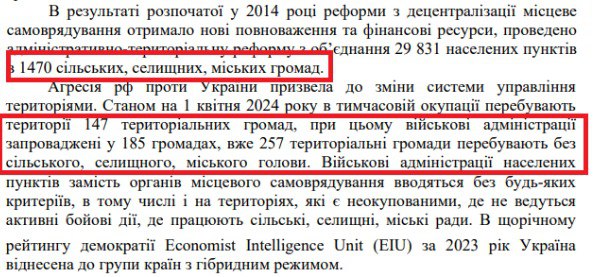
An excerpt from the “Concept of Restoring Local Self-Government” by the Association of Ukrainian Cities
During the war, another problem arises: there are no elections. However, it is possible to change the law so that communities are not held hostage by “secretariats” and coups d’état when the mayor is dismissed.
What needs to be done now and after the victory? “The Institute for Territorial Development” and the civic initiative Holka prepared an article for ZN.UA.

When the mayor is absent, the council secretary, albeit temporarily, actually holds two positions, which is prohibited by Article 50 of the Law on Local Self-Government in Ukraine. They receive one salary as a secretary. However, they also make power decisions as the speaker of the council (prepare meetings) and at the same time, they are the head of the executive body of the council, which is the chairman according to the Constitution of Ukraine.
It is as if the speaker of the parliament were also the head of the government, i.e., combining the legislative and executive branches of government.
Since the city has a budget, some deputy group often seeks access to it and puts its trust in its secretary. Such a kaleidoscope of “secretariats” threatens the functioning of municipal and social infrastructure. It also decreases trust in the authorities.
A head elected by the community has higher legitimacy than a secretary. The next local elections were due in 2025. During the war, however, the chances that the story of the “secretariats” will be reset to zero are quite slim, at least next year.
Parliamentarians can already change the law. The secretary must resign as a deputy when he or she starts acting as the head. In those communities where the 2020 elections were held under the party system, the list will move, and a new deputy will join the council.
In this case, the vote of no confidence should be the same as for the mayor, which is two-thirds of the votes. This way, the secretary will not be held hostage by the council and will not worry that they will be easily dismissed at the session.
These are the rules that can be introduced before the victory. Whereas after the victory, the system needs to be changed radically.

“The Secretariats” highlighted major problems of local self-government. First and foremost, it is the overlapping powers of the representative and executive branches of government, which dates back to Soviet times.
The executive committee, as well as the council, adopts discretionary regulations. That is when there are several ways to resolve an issue. Obviously, the executive committee has the advantage in this confrontation. Authoritarianism is inherent in the Constitution itself, which provides for only one way to form the executive branch and that is through direct election of the mayor. Although this form is widespread in both Europe and the United States and is called a “strong mayor,” in Ukraine it has become hypertrophied due to the constitutional provision that the mayor presides over a meeting of a council of which he or she is not a member. Besides, with the changes in legislation due to martial law, the mayor was given the right to ignore the council altogether while deciding on personnel issues, among other things.
The trend of increasing authoritarianism is also evident in military administrations. Whereas such liquidation of self-government in the combat zone is a necessary step, in communities far from the front line, in the eyes of the public, it has no logical explanation. After all, it would be possible to strengthen the security component on the territory by simply deploying a separate territorial unit of the district military administration. However, both the district and regional administrations would need to be provided with new functionality. Namely, supervision over the legitimacy of decisions of local self-government bodies and, most importantly, coordination of the activities of territorial executive authorities, primarily the police, the State Emergency Service, and the tax administration.
This is stipulated in the draft law “On Local State Administrations” (No. 4298), which the parliament has not yet approved.

Montesquieu’s principle of separation of powers into three branches should apply not only to the central but also to the local level.
Ideally, in local elections, the community would elect a mayor who would head the executive body and nominate his or her future deputies from the “bench” before the election. And the mayor would not have to chair sessions and vote with the deputies. This way, the deputies elected by the community would have to elect a council chairman (secretary) from among themselves, who could be removed by a simple majority of the deputies. The council, of course, should have the right to remove the mayor by a two-thirds vote, but in this case, the deputy mayor should perform their duties. Thus, no one will even think about organizing “coups” of power in the community, which are done to make the secretary become the acting mayor and gain control over the council and the executive committee at the same time.
Why should this system work?
Previously, the ruler, as the personification of the executive branch, existed only to ensure that the council’s decisions were discretionary, i.e. of a political nature. Even in times of war, the representative body always made sure that the dictator did not go beyond the law. Otherwise, in Rome, the Senate would declare him a tyrant, which meant losing immunity from reprisals by citizens and his guards.
What needs to be done in Ukraine to overcome the phase of authoritarianism that most civilized countries have been dealing with for centuries? The very phenomenon of local self-government breaks the state’s monopoly on power and therefore opens up prospects for reforming the public administration system, particularly at the state level.
In addition to the obvious and overdue amendments to the Constitution that would streamline local self-government following the requirements of the European Charter of Local Self-Government, care should be taken to clearly separate the powers of the representative and executive bodies of local self-government.
It should be stipulated that the executive body can issue only one-time acts. The council, on the other hand, can issue all regulatory and legal acts and acts of one-time effect, which primarily concern the disposal of community property. Of course, it is necessary to establish safeguards against the council’s inaction when, for example, it does not approve the regulations on structural subdivisions of the executive body or the regulations of the executive body. In this case, the executive body should use standard documents approved by the government.
Such a distinction between the types of authorities determines the limitations of the executive body in case the council is unable to fulfill its powers, which is the case in more than one and a half hundred communities today. In terms of the budget, the executive body should use the provisions of the Budget Code on the procedure for implementing the expenditure estimate in case the budget is not adopted. On other issues where the law provides for decision-making by the council, the government should define a clear algorithm for the executive body’s actions, because any decision that involves ambiguity is already vulnerable to corruption.
The Constitution stipulates that the head of the community heads the executive body of the council. The body is singular. Now it is a system of bodies. Formally, it is headed only by the already mentioned collegial body which is the executive committee. However, other subdivisions that have the status of a legal entity can adopt acts that affect third parties without the participation of the chairman and the executive committee. On the one hand, this makes management easier, especially when implementing the budget, as the head signs financial documents independently within the budget allocations.
On the other hand, problems arise in the case of court proceedings, especially if they involve charges from the budget that are not provided for in the budget allocations. The same litigation requires qualified legal support, which is usually not available in the structure of a sectoral unit. Again, decision-making aimed at third parties, i.e. what is called the exercise of power, is legitimized only concerning the head, who is elected by all residents of the community. Not the head of a subdivision that has been granted the status of a legal entity.
Therefore, it is logical to introduce the institution of a single legal entity – a municipality, a government (the legislator will decide), headed by a head. But the degree of autonomy of other structural units of this municipality should be determined by law and the decision of the council, based on the level of tasks and workload.
 The function of these persons is to supervise sectoral divisions and temporarily perform the duties of the head in his/her absence. Today, the legitimacy of the deputy chairmen is granted by the board, which appoints them to the aforementioned executive committee. This contradicts the principle of separation of powers and introduces a political factor into such appointments.
It would be logical if the deputies were appointed directly by the head, taking into account the requirement of their professionalism. It would also be logical to delegate the exercise of powers to one of the deputies if the head is unable to fulfill his or her powers due to, for example, a vote of no confidence by the board.
However, it is necessary to legitimize the deputies through an indirect election procedure similar to the US vice presidency. This is when, during the election of the head, the candidate for this position publishes a list of candidates whom they will appoint as deputies if they win. The head will remain a “strong mayor” because he or she has the right to veto council decisions and the exclusive right to submit both the budget and amendments to it to the council.
Of course, not all mayors will perceive the need to cooperate with the council, rather than view the deputies as “someone getting in their way” and impeding the implementation of their election program.
That is why there are calls for the return of the majority election system. It is easier to negotiate with individual deputies than with organized political groups. In this case, the mayor’s art would be to transform the political programs of the deputy factions into documented action plans that could be implemented, rather than to pay off a majoritarian deputy. Given that the council will not be able to influence the personnel policy in the executive body, this situation will look more promising than lobbying for the most corrupt and irresponsible election system, the majority system.
Determining the organizational powers of self-government bodies, in addition to the division and distribution of budgetary and sectoral powers, is part of the reform of local self-government, which is commonly called decentralization of power. Here, too, the Ukrainian elite still has a lot of work to do, as only the administrative-territorial and budget reforms have been partially implemented.
It is also necessary to deconcentrate the executive branch to make Ukraine look attractive, at least in terms of the territorial organization of public authorities in the process of joining the European community.
Special for Dzerkalo Tyzhnia.